The 12 Best Language Learning Apps for Adults in 2026

In the search for the best language learning apps for adults, the sheer number of options can be overwhelming. From gamified vocabulary builders to immersive conversation simulators, each app promises fluency but delivers a vastly different experience. Many learners start with popular choices like Duolingo only to discover their limitations when it comes to deep conversational practice or complex grammar. This guide is designed to cut through the marketing noise and provide a clear, user-centric roadmap to finding the tool that aligns perfectly with your specific learning style and goals.
This comprehensive resource moves beyond surface-level descriptions. We provide an in-depth analysis of the top applications available today, evaluating everything from their teaching methodology and standout features to their practical limitations. Whether you are a professional needing business-level proficiency, a traveler preparing for real-world interactions, or a hobbyist who loves the challenge of mastering new grammar, our breakdown will help you make an informed decision. For those who prefer a more structured approach or are living in the Netherlands, exploring options like structured Dutch language courses can be a valuable complement to app-based learning.
Inside this guide, you will find:
- A ranked list of the best apps with honest pros and cons.
- Detailed use-case recommendations to match apps with learner goals.
- A direct comparison of pricing, language availability, and core features.
- Screenshots and direct links to get you started immediately.
Our goal is to equip you with the insights needed to choose an app that not only teaches you a language but also keeps you engaged and motivated on your path to fluency. Let's find the right fit for you.
1. PolyChat
Best For: Unrestricted, gamified daily practice.
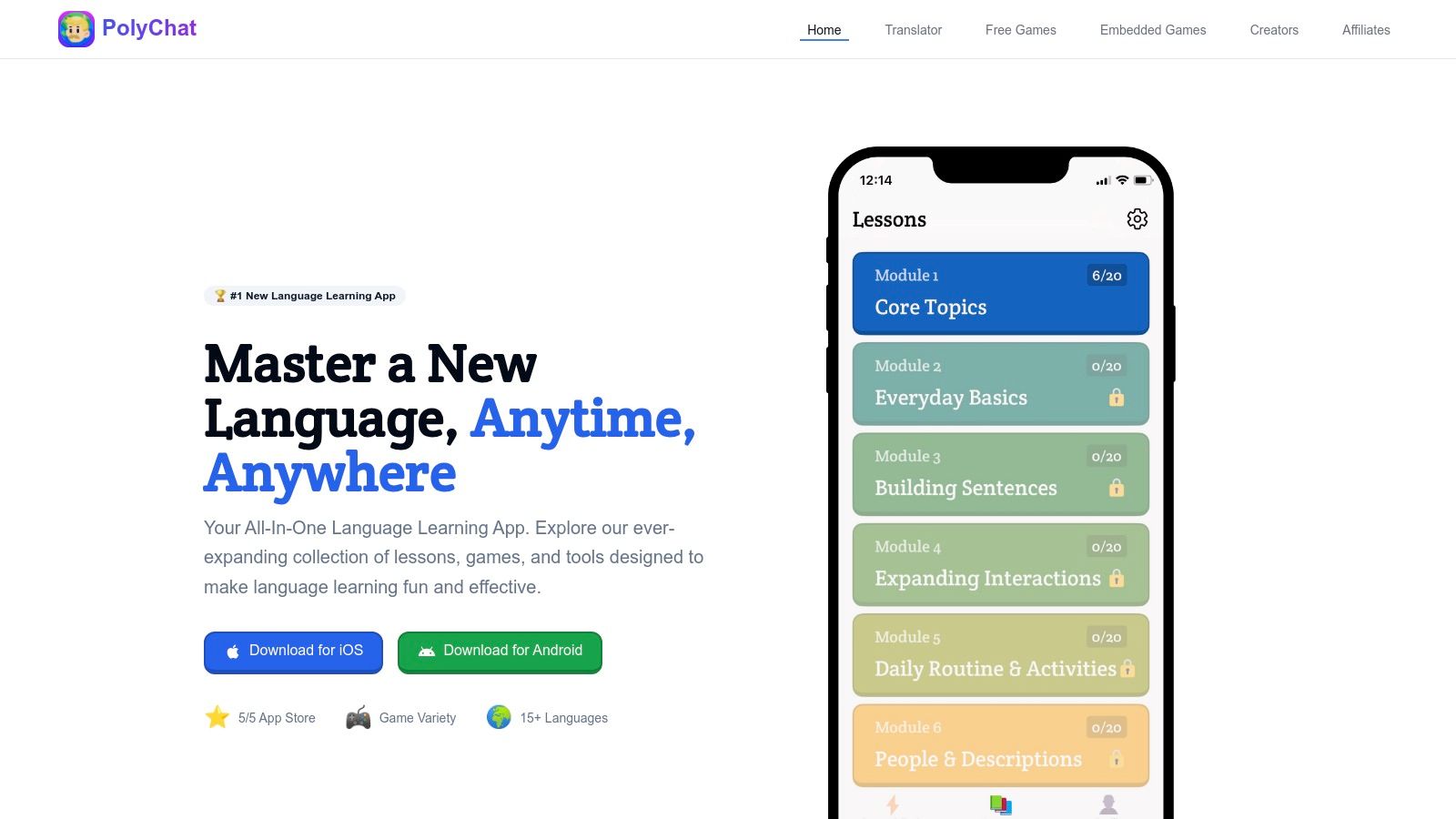
PolyChat distinguishes itself as a premier, all-in-one mobile app that masterfully blends gamification with effective study methodologies. It’s an ideal choice for adult learners who value consistency and want to practice without the frustrating limitations common in other apps. Its core philosophy revolves around unlimited access, meaning you can engage with lessons and exercises as much as you want each day without encountering energy caps or "hearts" systems. This makes it one of the best language learning apps for adults who prefer to learn in intensive bursts or simply want the freedom to dictate their own study schedule.
Why It Stands Out
What truly elevates PolyChat is its robust suite of practical, AI-powered tools integrated directly into the learning experience. The built-in translator is perfect for on-the-go moments, while the personal dictionary automatically populates with words you’ve learned, creating a customized review deck. However, its market-leading conjugation practice tool is a significant advantage, offering a dedicated space to master verb forms, a critical and often challenging aspect of language acquisition.
The app supports learning across 17 languages, including the unique ability to learn from a non-English base language (e.g., studying French from a Spanish interface). This cross-language support is invaluable for polyglots or non-native English speakers.
Key Features & Benefits
- Unlimited Daily Practice: No "hearts" or energy system means you can learn at your own pace without being forced to stop or pay.
- Comprehensive Toolset: Features a free translator, personal dictionary, and a superior conjugation trainer for targeted skill-building.
- Engaging Gamification: Utilizes timed vocabulary challenges, conversation games, and interactive translation exercises to maintain motivation.
- Cross-Language Learning: Supports learning a new language from a variety of starting languages, not just English.
| Feature Highlights | Practical Application |
|---|---|
| No "Hearts" System | Ideal for binge-learning sessions on a weekend or during a commute. |
| Conjugation Trainer | Perfect for intermediate learners struggling with verb tenses. |
| Built-in Translator | Useful for travelers needing quick translations in real-world situations. |
| Personal Dictionary | Creates an automatic, personalized flashcard system for efficient review. |
Pricing: The app is promoted as free, available on both iOS and Android. While the website does not detail specific in-app purchases or a premium tier, the core experience is fully accessible without mandatory costs.
Website: https://www.polychatapp.com
2. Apple App Store
For language learners within the Apple ecosystem, the App Store isn't just a marketplace; it's a centralized, secure hub for discovering, purchasing, and managing the best language learning apps for adults. Rather than being an app itself, it serves as a trusted gatekeeper and curator, simplifying the entire process from discovery to subscription management for iPhone, iPad, and Mac users.

The platform stands out for its robust editorial curation and strict security standards. Users can browse hand-picked collections like "The Best Language Apps," which often highlight tools for specific use cases like travel or business. Each app page provides transparent details, including user ratings, privacy labels, and in-app purchase pricing ranges. This trusted environment, combined with features like Family Sharing and easy refund processes, offers a level of convenience and security that third-party marketplaces often lack. For more details, explore this comprehensive language learning apps comparison on polychatapp.com.
Key Features and User Experience
- Curated Discovery: Apple's editorial team frequently publishes stories and lists that help users find high-quality, effective language apps tailored to their goals.
- Transparent Privacy: Clear "Privacy Nutrition Labels" on each app page show exactly how your data is being used, a critical factor for privacy-conscious learners.
- Simplified Management: All subscriptions and purchases are managed through your Apple ID, making it easy to track spending, cancel trials, and request refunds directly from your device settings.
Pros:
- A secure and centralized environment for downloads.
- Easy subscription and refund management.
- High-quality editorial curation helps discover new tools.
Cons:
- Exclusive to Apple devices (iOS, iPadOS, macOS).
- Final pricing or special offers are sometimes only visible inside the app itself.
Link: Apple App Store
3. Google Play
For Android users, Google Play is the definitive ecosystem for discovering and managing the best language learning apps for adults. As the official app store for the Android operating system, it offers a vast and diverse catalog, acting as a secure gateway for finding everything from mainstream platforms to niche learning tools. Its primary role is to simplify the user journey, from searching for an app to handling subscriptions with integrated Google billing.
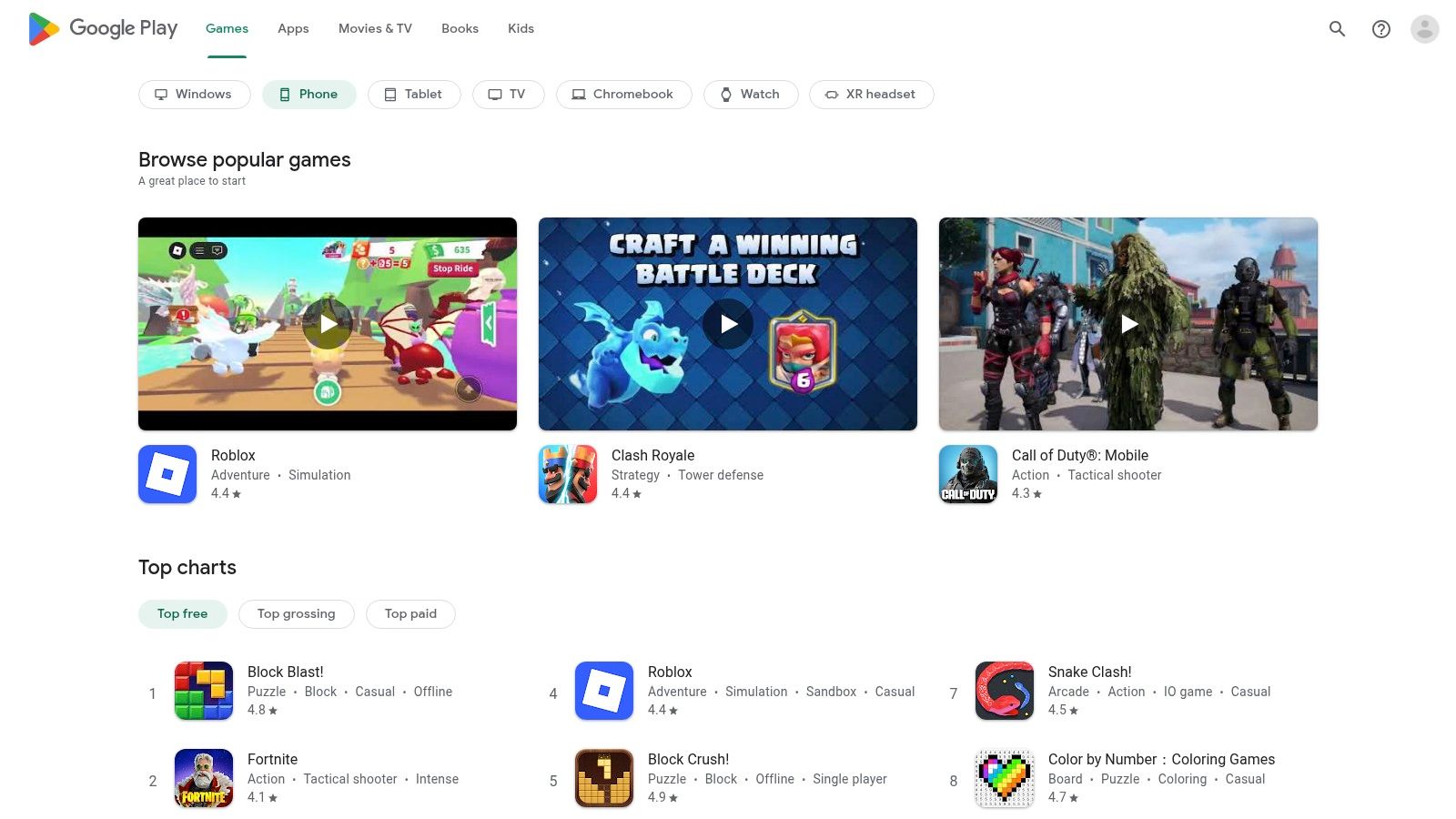
The platform's strength lies in its sheer volume and open nature, providing access to a wider array of apps than more curated stores. Users can leverage detailed app pages with ratings, user reviews, and device compatibility checks to make informed decisions. Features like the Family Library allow sharing of paid apps with family members, while Google Play Protect provides a layer of security by scanning apps for harmful behavior. This combination of choice and integrated management makes it an essential resource for any language learner on an Android device.
Key Features and User Experience
- Massive App Catalog: Offers an enormous selection of language learning apps, with category pages and top charts to help filter and find suitable options.
- Ratings and Compatibility Checks: User reviews and ratings provide real-world insights, while automated checks ensure an app will work correctly on your specific device.
- Integrated Billing and Management: Subscriptions are tied to your Google account, making it simple to manage payments, track trials, and cancel services directly through the Play Store.
- Family Library: Allows users to share eligible purchased apps and games with up to five family members, which can be a cost-effective way to access premium tools.
Pros:
- A massive selection of apps compatible with most Android phones and tablets.
- Easy and centralized subscription management via your Google Play account.
- User reviews provide valuable social proof and feedback.
Cons:
- The quality and security of apps can vary widely.
- Some apps use aggressive trial upsells that require careful attention.
Link: Google Play
4. Duolingo
As one of the most recognized names in digital education, Duolingo has solidified its place as a go-to starting point for millions. It offers a freemium, gamified approach that makes it one of the most accessible best language learning apps for adults looking to begin their journey. Its bite-sized lessons are designed for quick, daily practice on both web and mobile, making it easy to build a consistent learning habit.
The platform stands out for its powerful motivational mechanics, including streaks, leaderboards, and achievement badges that encourage users to return daily. While its core content is free with ads, Duolingo offers paid tiers like Super and Max that remove ads, unlock unlimited "hearts," and add AI-powered features for deeper practice. While some find its gamification overly simplistic for advanced learning, it serves as an excellent, low-commitment tool for building foundational vocabulary and grammar. For a deeper look at its alternatives, you can explore this analysis of apps better than Duolingo on polychatapp.com.
Key Features and User Experience
- Gamified Learning Path: Lessons are structured as a skill tree, where users complete drills covering reading, listening, and basic speaking to unlock new levels.
- Motivational Mechanics: Streaks, daily goals, and competitive leaderboards are central to the experience, driving user engagement and habit formation.
- Large Language Catalog: Duolingo supports learning for over 40 languages, offering one of the widest selections available in a single app.
- AI-Enhanced Practice: The premium Duolingo Max tier introduces AI features like "Explain My Answer" and role-playing conversations for more dynamic practice.
Pros:
- A robust free version makes language learning highly accessible.
- Strong motivational tools are effective for building daily habits.
- Quick, "snackable" lessons fit easily into a busy schedule.
Cons:
- Heavy gamification may not suit learners who prefer in-depth grammatical explanations.
- The free tier includes frequent ads and a restrictive "hearts" system.
- Pricing for paid tiers can vary significantly based on platform and region.
Link: Duolingo
5. Babbel
For learners who prefer a structured, curriculum-based approach over pure gamification, Babbel stands out as one of the best language learning apps for adults. Its methodology is built around practical, real-life conversations, with lessons designed by linguists to get you speaking confidently from day one. The platform focuses on building a solid foundation through lessons that are directly applicable to everyday situations like ordering food, asking for directions, or introducing yourself.

Babbel’s core strength lies in its bite-sized, 10-15 minute lessons that integrate vocabulary, grammar, and pronunciation in a cohesive way. The app uses a spaced repetition system to help you retain new words and phrases effectively. While the main subscription covers the self-study courses, Babbel also offers live, teacher-led classes for an additional cost, providing an opportunity to practice with native speakers and other learners. This blended learning model makes it a versatile choice for serious learners.
Key Features and User Experience
- Structured Learning Paths: Courses are aligned with the Common European Framework of Reference for Languages (CEFR), offering a clear progression from beginner to advanced levels.
- Conversation-Focused Lessons: Content is centered on practical dialogues you would encounter in real life, making learning immediately useful.
- Spaced Repetition Review: An integrated review manager prompts you to practice vocabulary at optimal intervals to strengthen memory retention.
- Offline Accessibility: Lessons can be downloaded in advance, allowing you to continue learning without an internet connection, perfect for commutes or travel.
Pros:
- Clear, adult-friendly structure suited to real-life use.
- High-quality, expert-designed lesson content.
- Frequent promotions and discounts are often available.
Cons:
- Live classes and some advanced features require an extra subscription.
- Pricing and available promotions can vary significantly by region and platform.
Link: Babbel
6. Rosetta Stone
A veteran in the language learning space, Rosetta Stone offers a deeply immersive and structured program that makes it one of the best language learning apps for adults seeking a polished, comprehensive curriculum. Its core philosophy revolves around dynamic immersion, teaching you to associate words with images and context rather than relying on direct translation. This method is designed to mimic natural language acquisition, making it an intuitive choice for beginners.
The platform stands out for its TruAccent speech recognition engine, which provides instant feedback on pronunciation by comparing your voice to that of native speakers. This emphasis on speaking from the very first lesson is ideal for learners who prioritize conversational fluency and accent reduction. With seamless syncing between its mobile app and desktop platform, Rosetta Stone provides a consistent and high-quality learning experience whether you're at home or on the go.
Key Features and User Experience
- TruAccent Speech Recognition: Get detailed, real-time feedback on your pronunciation to help you sound more like a native speaker.
- Structured Learning Paths: Follow a carefully designed curriculum that builds from basic vocabulary to complex conversational skills, with offline access to lessons.
- Dynamic Immersion Method: Learn intuitively through images, audio, and context without relying on your native language for translation.
- App and Desktop Sync: Start a lesson on your computer and seamlessly pick it up on your phone, ensuring a consistent experience across all devices.
Pros:
- Polished, consistent course experience for adult learners.
- Strong focus on accent and pronunciation from day one.
- Immersive method avoids translation, encouraging you to think in the new language.
Cons:
- Less explicit grammar explanation can be challenging for some learners.
- The uniform lesson style may feel repetitive over time.
Link: Rosetta Stone
7. Pimsleur
For learners who prioritize conversational skills and prefer an audio-based approach, Pimsleur is one of the best language learning apps for adults, especially those with busy, on-the-go lifestyles. Its methodology is built around 30-minute core audio lessons designed to be completed daily, fitting perfectly into a commute, workout, or household chores. The method focuses on teaching you to understand and speak a language from day one through a scientifically proven spaced repetition technique.

Pimsleur stands out by minimizing screen time and maximizing active recall and pronunciation practice. It prompts you to speak aloud, constructing sentences and responding to native speakers, which builds practical speaking confidence far more effectively than simple vocabulary memorization. With features like Car Mode and Amazon Alexa integration, it seamlessly integrates into a hands-free learning routine, making it exceptionally habit-forming for auditory learners. The "All Access" subscription is a great value for polyglots, offering its entire library of over 50 languages for a single monthly price.
Key Features and User Experience
- 30-Minute Audio Lessons: Core content is delivered through daily, hands-free audio sessions that build conversational skills incrementally.
- Graduated Interval Recall: A scientifically-backed method for moving vocabulary and structures from short-term to long-term memory.
- Car Mode & Smart Speaker Support: Designed for true on-the-go learning, allowing users to progress without looking at a screen.
- All Access Plan: A subscription option that grants access to the full catalog of languages, perfect for users interested in learning multiple languages.
Pros:
- Excellent for developing oral proficiency and a natural accent.
- Minimal screen time makes it ideal for commuters and busy schedules.
- The structured, daily lesson format is easy to maintain as a habit.
Cons:
- Less emphasis on reading, writing, and explicit grammar rules.
- Most effective when supplemented with other resources for visual learning.
Link: Pimsleur
8. Busuu
Busuu offers a comprehensive, curriculum-based approach that makes it one of the best language learning apps for adults seeking structure. It combines AI-powered lessons with a unique community feature where learners get feedback on their speaking and writing exercises from native speakers, bridging the gap between automated learning and real-world human interaction.
The platform stands out by aligning its courses with the Common European Framework of Reference (CEFR), offering official certificates from McGraw Hill upon completion of certain levels. This structured path, which includes dedicated grammar lessons and a smart review system, provides a clear sense of progression. While the free version is quite limited, the Premium plans unlock offline access, advanced grammar units, and the full suite of features, making it a powerful tool for serious learners.
Key Features and User Experience
- Community Corrections: Submit speaking or writing exercises and receive personalized feedback and corrections from a global community of native speakers.
- Structured Curriculum: Courses are designed around CEFR levels (A1 to B2), providing a clear and measurable learning path with official certificates available.
- Smart Review System: An AI-powered review tool helps you practice vocabulary and grammar concepts you’ve struggled with, ensuring long-term retention.
- Offline Mode: Premium subscribers can download lessons to continue learning without an internet connection, perfect for commutes or travel.
Pros:
- A balanced blend of structured lessons and practical community feedback.
- Official certificates provide tangible proof of your language proficiency.
- Strong focus on grammar alongside conversational practice.
Cons:
- The free tier is very restrictive, limiting access to core features.
- Pricing can vary significantly depending on the platform and region.
Link: Busuu
9. Memrise
Memrise distinguishes itself by focusing on practical vocabulary and phrase acquisition through a powerful combination of spaced repetition and authentic video content. Instead of animated characters, the platform uses thousands of short video clips of native speakers, allowing learners to hear and see how words are used in real-life contexts. This approach makes it one of the best language learning apps for adults who want to quickly build a functional vocabulary and attune their ear to natural pronunciation and intonation.
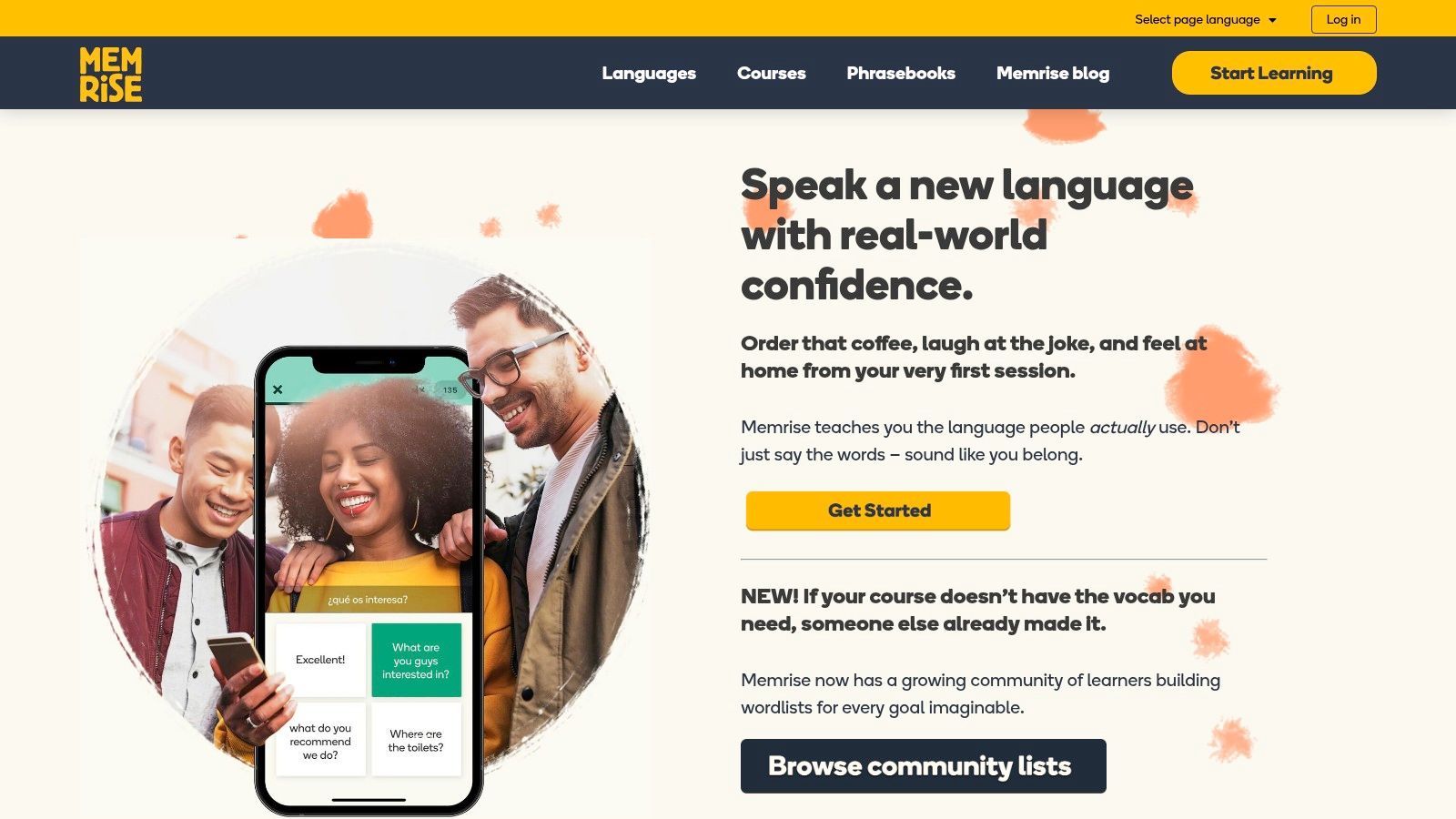
The platform is built around a smart, science-backed learning algorithm that determines the optimal time to review new words, ensuring they move from short-term to long-term memory efficiently. Progress is seamlessly synced across its web, iOS, and Android applications, letting you pick up wherever you left off. Its gamified elements make the learning process feel less like a chore and more like a game, which is a powerful motivator for consistent practice. You can explore how gamification in language learning on polychatapp.com enhances retention and engagement.
Key Features and User Experience
- Real-World Video Clips: Learn from thousands of videos of native speakers, providing authentic accent, context, and non-verbal cues for new vocabulary.
- Spaced-Repetition System: An intelligent algorithm schedules vocabulary reviews at optimal intervals to maximize long-term retention.
- AI Conversation Practice: The "MemBot" feature allows you to practice speaking skills in simulated, low-pressure conversations.
- Cross-Platform Syncing: Start a lesson on your computer and finish it on your phone with fully synchronized progress across devices.
Pros:
- Highly effective for rapid vocabulary and phrase acquisition.
- Engaging video content with native speakers improves listening skills.
- Strong gamified elements keep users motivated.
Cons:
- Less emphasis on in-depth grammar instruction.
- The quality and depth of user-generated courses can vary significantly.
Link: Memrise
10. Mondly
Mondly excels at immersing learners in practical, real-world scenarios through a visually engaging interface. It stands out by offering interactive chatbot conversations and advanced speech recognition, making it one of the best language learning apps for adults who want to build conversational confidence quickly. Rather than focusing heavily on grammar rules, its approach centers on learning phrases and vocabulary relevant to everyday situations.
The platform is particularly notable for its broad language support, allowing users to learn from their native language rather than defaulting to English. This flexibility, combined with its daily lessons, gamified point system, and innovative AR/VR features, provides a modern and motivating learning experience. Mondly offers a free tier with daily lessons, but a Premium subscription unlocks its full library of content, including specialized courses for business professionals.
Key Features and User Experience
- Chatbot Conversations: Practice real-life dialogues with an AI chatbot that provides instant feedback on your pronunciation and phrasing.
- Scenario-Based Learning: Lessons are built around practical topics like ordering food, navigating a city, or making introductions, helping you learn useful vocabulary from day one.
- Extensive Language Pairs: Learn a new language from any of the 41 languages offered, a feature that sets it apart from many competitors.
- Innovative Technology: Mondly incorporates augmented reality (AR) and virtual reality (VR) modules to create highly immersive and memorable learning environments.
Pros:
- Excellent for practicing pronunciation and conversational recall.
- Wide range of languages to learn from, not just English.
- Engaging, visual interface with gamified elements.
Cons:
- Offers less in-depth grammatical instruction for advanced learners.
- The free 7-day trial may auto-convert to a paid subscription if not canceled manually.
Link: Mondly
11. italki
For adults who believe that nothing replaces human interaction, italki is the definitive marketplace connecting learners with live tutors. It moves beyond automated apps to offer one-on-one lessons tailored entirely to your goals, making it one of the best language learning apps for adults seeking personalized instruction. Whether you need structured grammar lessons from a professional teacher or casual conversation practice with a community tutor, the platform's extensive filtering options let you find the perfect match based on price, availability, and specialty.
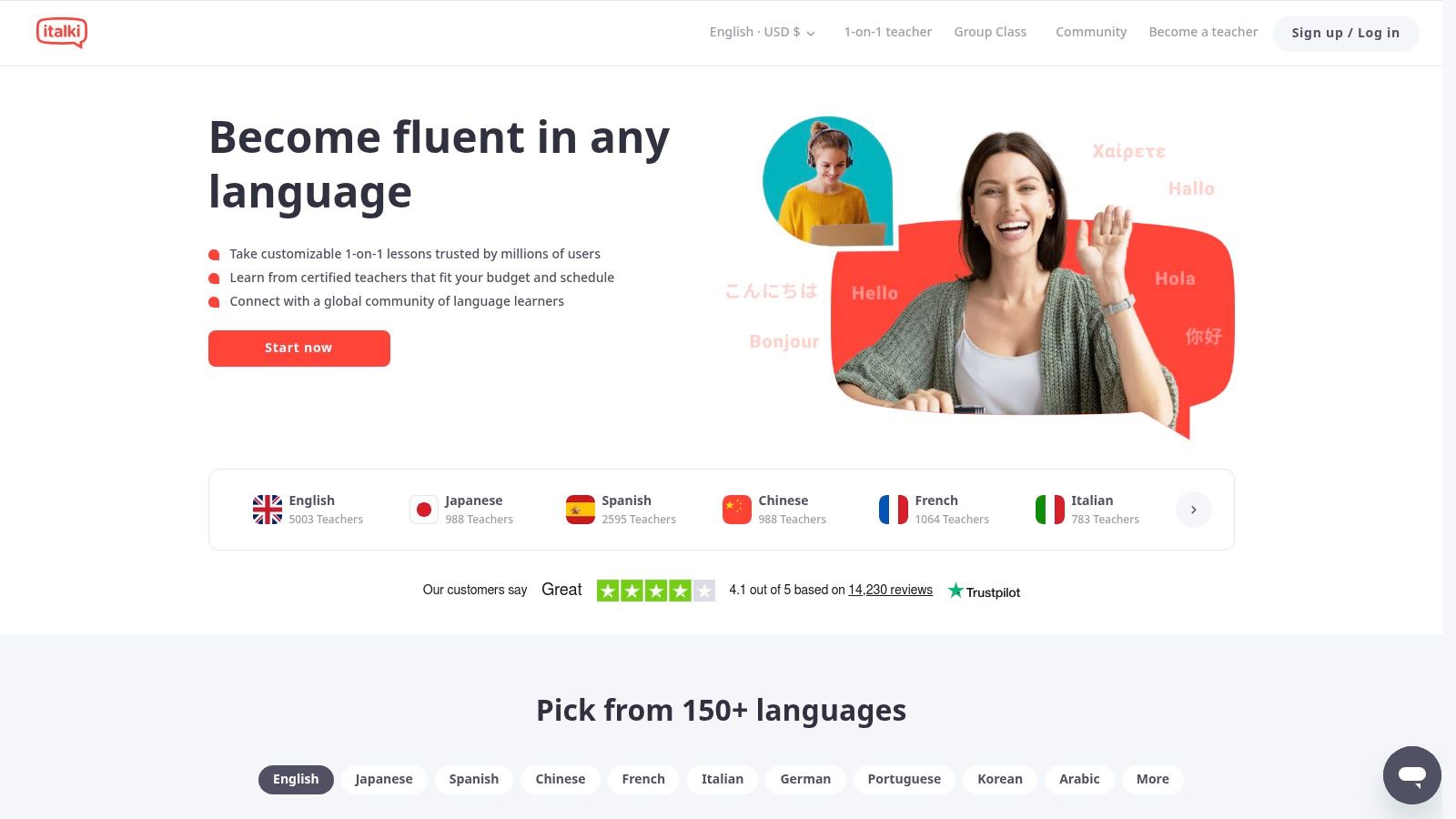
The pay-per-lesson model provides maximum flexibility, allowing you to book individual sessions without committing to a subscription. Most tutors offer discounted trial lessons, so you can test their teaching style before buying a package. Since lessons are live, ensuring clear communication is key; you can find helpful tips to improve your audio quality for online conversations to make every session effective. This direct, human-centric approach is ideal for overcoming speaking anxiety, preparing for exams, or diving deep into cultural nuances that apps often miss.
Key Features and User Experience
- Tutor Marketplace: Browse thousands of profiles for professional teachers and community tutors, with transparent reviews, ratings, and video introductions.
- Pay-Per-Lesson Flexibility: Avoid subscriptions by purchasing lesson credits and booking sessions individually or in packages, paying only for what you use.
- Customized Learning: Lessons are fully personalized to your needs, whether you're focusing on business vocabulary, exam preparation, or conversational fluency.
Pros:
- Fully personalized instruction tailored to individual learner goals.
- Transparent teacher reviews and flexible, affordable pricing.
- Direct practice with native speakers to build real-world confidence.
Cons:
- Quality and pricing vary significantly between individual tutors.
- Scheduling can be complicated across different time zones.
Link: italki
12. LingQ
For adults who learn best through immersion, LingQ transforms authentic web content into powerful, personalized lessons. Instead of following a rigid curriculum, this platform lets you import articles, YouTube videos, and podcasts, turning material you already find interesting into an interactive learning experience. It is particularly effective for intermediate and advanced learners aiming to transition from textbooks to real-world language comprehension, making it one of the best language learning apps for adults who favor an input-heavy approach.
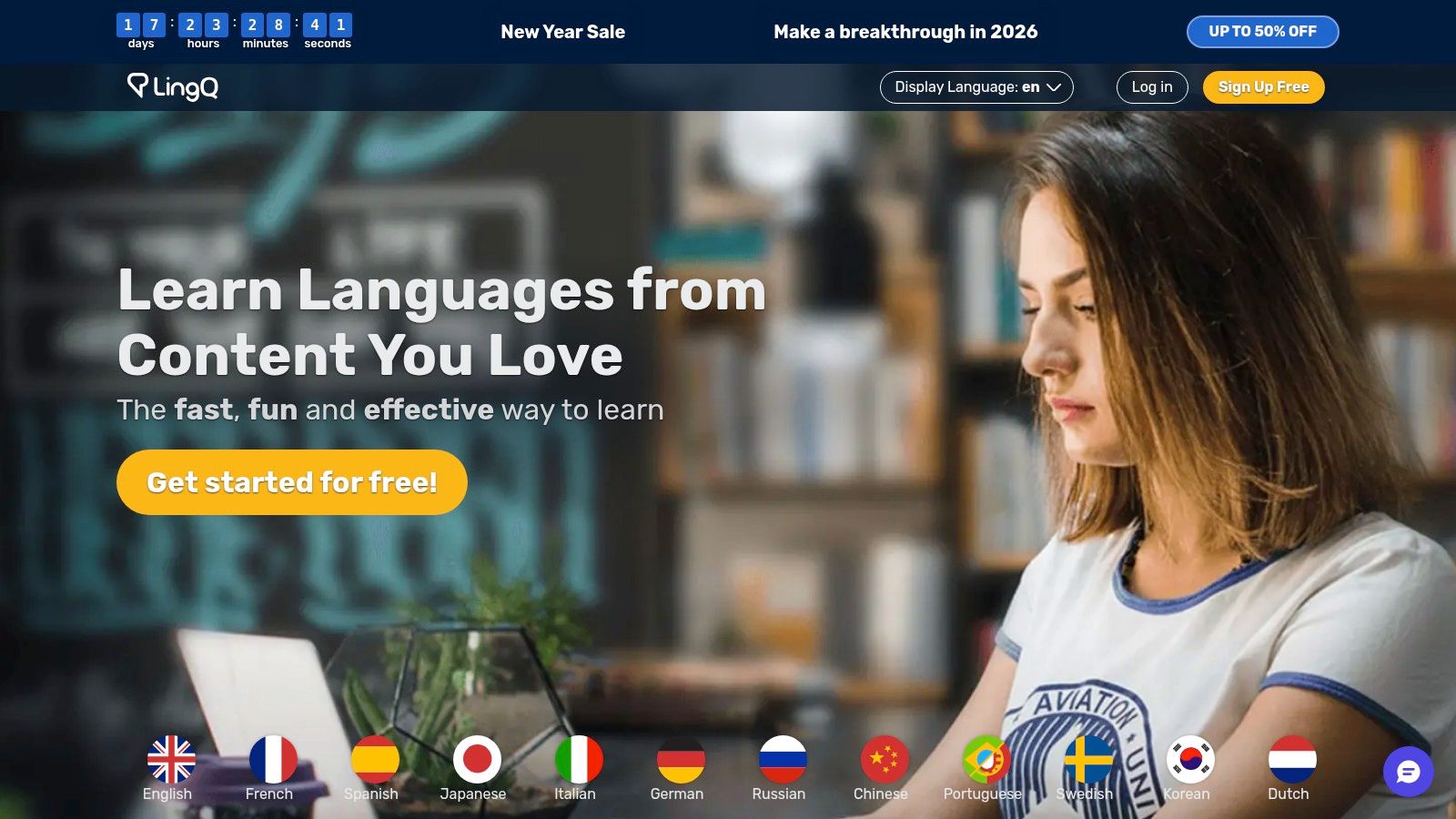
LingQ stands out by putting the learner in control of the content. As you read or listen, you can tap on any unfamiliar word to get an instant pop-up definition and save it as a "LingQ." These saved words form a personal vocabulary database that is reinforced through spaced repetition flashcards and review exercises. The platform syncs seamlessly between web and mobile, allowing you to build your vocabulary and listening skills from anywhere using content you genuinely enjoy.
Key Features and User Experience
- Content Importer: Import web articles, YouTube videos, and audio files to create custom, interactive lessons from authentic sources.
- Interactive Reader: Get instant translations for any word or phrase and build a personal vocabulary list by creating "LingQs" as you read.
- Integrated SRS: Automatically turns your saved LingQs into flashcards for review using a spaced repetition system to aid long-term retention.
- Extensive Library: Access a massive user-contributed library of lessons, including full audiobooks and interviews, organized by difficulty.
Pros:
- Excellent for building vocabulary through extensive reading and listening.
- Highly flexible, allowing you to learn from content you find engaging.
- Tracks known words, providing clear metrics on your vocabulary growth.
Cons:
- Less structured for absolute beginners who need foundational guidance.
- Grammar instruction is minimal compared to course-based apps.
- The user interface can feel complex and dated at first.
Link: LingQ
Top 12 Language-Learning Apps Comparison
| Product | Core features ✨ | Quality ★ | Value 💰 | Target 👥 | USP / Notes |
|---|---|---|---|---|---|
| PolyChat 🏆 | Gamified lessons, unlimited daily practice, AI tools, built-in translator, conjugation trainer | ★★★★★ | 💰 Free (in-app options unclear) | 👥 Beginners → Advanced; travelers, students, polyglots | 🏆 ✨ Unlimited plays, cross-language learning, personal dictionary |
| Apple App Store | Curated app lists, ratings, privacy labels, purchase management | ★★★★☆ | 💰 Free platform — app prices vary | 👥 iOS users seeking vetted apps | ✨ Editorial curation, secure billing & refunds |
| Google Play | Large app catalog, reviews, compatibility checks, Play billing | ★★★★☆ | 💰 Free platform — app prices vary | 👥 Android users wanting variety | ✨ Wide selection, Family Library & auto-updates |
| Duolingo | Bite-sized gamified drills, streaks, AI tiers | ★★★★☆ | 💰 Freemium → Super/Max subscriptions | 👥 Casual learners & beginners | ✨ Strong motivation mechanics, huge language list |
| Babbel | Short structured lessons, spaced review, speech recognition | ★★★★☆ | 💰 Subscription-based (paid tiers) | 👥 Adults seeking conversation skills | ✨ CEFR-aligned paths, offline downloads |
| Rosetta Stone | Immersive audio/visual lessons, TruAccent pronunciation | ★★★★☆ | 💰 Paid subscription / one-time options | 👥 Adults focused on speaking & accent | ✨ Polished course design, strong pronunciation tools |
| Pimsleur | Audio-first 30-min lessons, graduated recall, Car Mode | ★★★★☆ | 💰 Subscription or per-course pricing | 👥 Commuters & speaking-focused learners | ✨ Hands-free speaking practice, All Access plan |
| Busuu | Lessons + grammar, AI review, community corrections | ★★★★☆ | 💰 Freemium → Premium with certificates | 👥 Learners wanting feedback & structure | ✨ Native-speaker corrections, certificates |
| Memrise | Native-speaker videos, SRS vocab, AI conversation | ★★★★☆ | 💰 Freemium → Premium features | 👥 Vocabulary-focused learners | ✨ Real-speaker videos, fast vocab growth |
| Mondly | Scenario lessons, chatbots, speech feedback, AR/VR packs | ★★★★☆ | 💰 Freemium → Premium/subscriptions | 👥 Phrase/phrase recall learners | ✨ Language-from-language support, AR/VR extras |
| italki | Marketplace for 1:1 lessons, tutor filters, pay-per-lesson | ★★★★☆ | 💰 Pay‑per‑lesson (varies by tutor) | 👥 Learners needing personalized tutoring | ✨ Fully personalized instruction; trial lessons available |
| LingQ | Import content, pop-up definitions, spaced review, vocab | ★★★★☆ | 💰 Freemium → Subscription | 👥 Intermediate → Advanced, input-heavy learners | ✨ Immersion with authentic content and custom vocab lists |
Final Thoughts
Navigating the crowded digital landscape of language education can feel like a journey in itself. The sheer volume of options, each promising fluency, can lead to decision paralysis. However, as we've explored, the key isn't finding a single "perfect" app, but rather identifying the right tool-or combination of tools-that aligns with your unique learning style, goals, and lifestyle. The search for the best language learning apps for adults is ultimately a personal one, guided by self-awareness and a clear understanding of what you want to achieve.
Our deep dive has shown that the most effective learning strategies often involve a multi-app approach. You might find that the structured, grammar-focused lessons of Babbel provide a solid foundation, while the real-world conversational practice on italki builds the confidence you need to actually speak. Similarly, Memrise's user-generated courses can be a powerful supplement for niche vocabulary, and Pimsleur’s audio-based method is perfect for transforming your daily commute into productive learning time.
Key Takeaways for Your Language Journey
To distill our findings into actionable advice, remember these core principles as you move forward:
- Define Your "Why": Your motivation is your most powerful asset. Are you learning for travel, career advancement, or cognitive enrichment? Your answer will steer you toward apps that prioritize conversational skills (like Busuu or italki) versus those that excel at comprehensive grammar and vocabulary (like Babbel or LingQ).
- Embrace a Hybrid Approach: Don't limit yourself to one platform. The modern polyglot's toolkit often includes a primary app for structured lessons, a secondary one for vocabulary drills, and a third for conversational practice. This "stacking" method covers all your bases and keeps the learning process fresh and engaging.
- Prioritize Consistency Over Intensity: The most successful language learners build a sustainable habit. Choosing an app with features that encourage daily practice, whether through gamification like Duolingo or bite-sized lessons like Mondly, is crucial. A consistent 15 minutes every day will yield far better results than a sporadic two-hour cram session.
- Don't Underestimate Real-World Practice: Digital tools are accelerators, not replacements for human interaction. The ultimate goal is communication. Platforms like italki and Busuu's community features are vital because they bridge the gap between passive knowledge and active, real-time application.
Making Your Final Decision
Before committing to a subscription, take full advantage of free trials. Spend a week with your top two or three contenders. Assess not just the content, but the user experience. Does the interface feel intuitive or clunky? Do the exercises inspire you to keep going or do they feel like a chore? This hands-on evaluation is the most reliable way to find an app that you'll stick with for the long haul.
Ultimately, the best language learning app for an adult learner is the one that seamlessly integrates into your life and keeps you motivated day after day. It respects your intelligence, adapts to your schedule, and provides a clear, rewarding path toward fluency. Your linguistic adventure is just beginning, and with the right digital companion, you are well-equipped to unlock a new world of communication, culture, and connection.
Ready to put theory into practice with a tool designed for real-world conversation? PolyChat leverages advanced AI to provide you with a judgment-free space to practice speaking, build confidence, and master practical dialogues. Start your journey from learning to actually using a language by visiting PolyChat today.

Jean-Baptiste Bolh
Co-Founder
Applied AI