The 12 Best Vocabulary Building Apps for Language Mastery in 2026

Expanding your vocabulary is more than just memorizing definitions; it’s about unlocking new ways to think, communicate, and connect. A richer lexicon empowers you in professional settings, deepens your understanding of complex subjects, and makes learning a new language an achievable goal. To truly 'Unlock a Wider World, One Word at a Time' through vocabulary, exploring broader language and culture resources can provide rich context and deeper understanding.
But let's be honest: flipping through dense dictionaries or physical flashcards can feel like a chore. That's where technology steps in. The best vocabulary building apps transform a tedious task into an engaging, gamified, and highly effective daily habit. These tools use proven methods like spaced repetition and active recall to make new words stick, whether you're learning your first language or your fifth.
This guide is designed to help you cut through the noise and find the perfect app for your specific goals. Whether you're a student prepping for the GRE, a professional aiming to communicate with more precision, or a language enthusiast tired of the limitations in mainstream apps, the right tool is on this list. We’ll break down the top contenders, analyzing their core features, ideal user profiles, and practical use cases. Each entry includes screenshots and direct links, so you can easily find and try the app that best fits your learning style and helps you accelerate your journey.
Ready to Learn a Language?
Try PolyChat's engaging language lessons, interactive learning games and put your new vocabulary to the test!
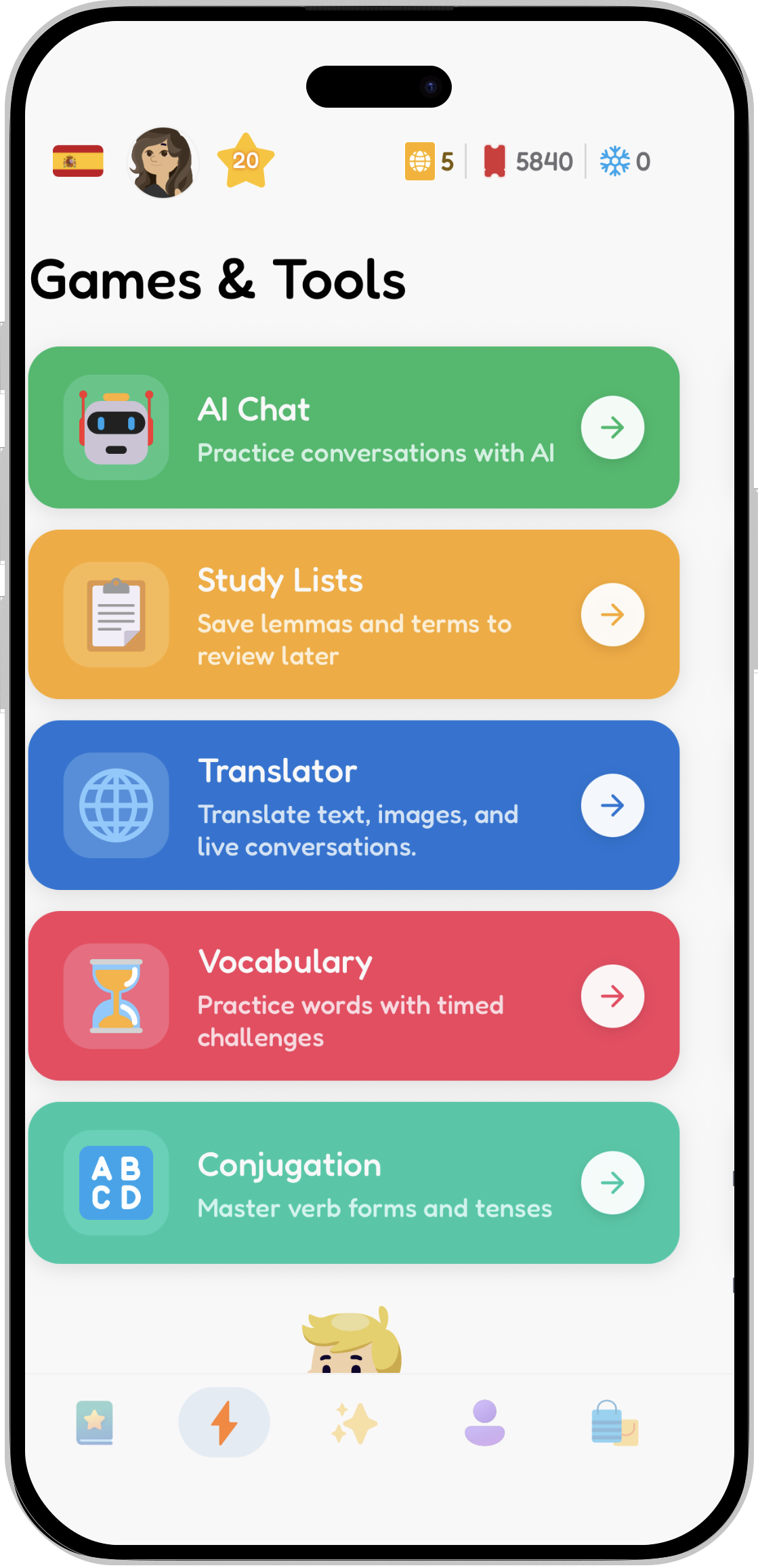
Games & Tools
Tools that every language learner needs at all stages of their learning journey.
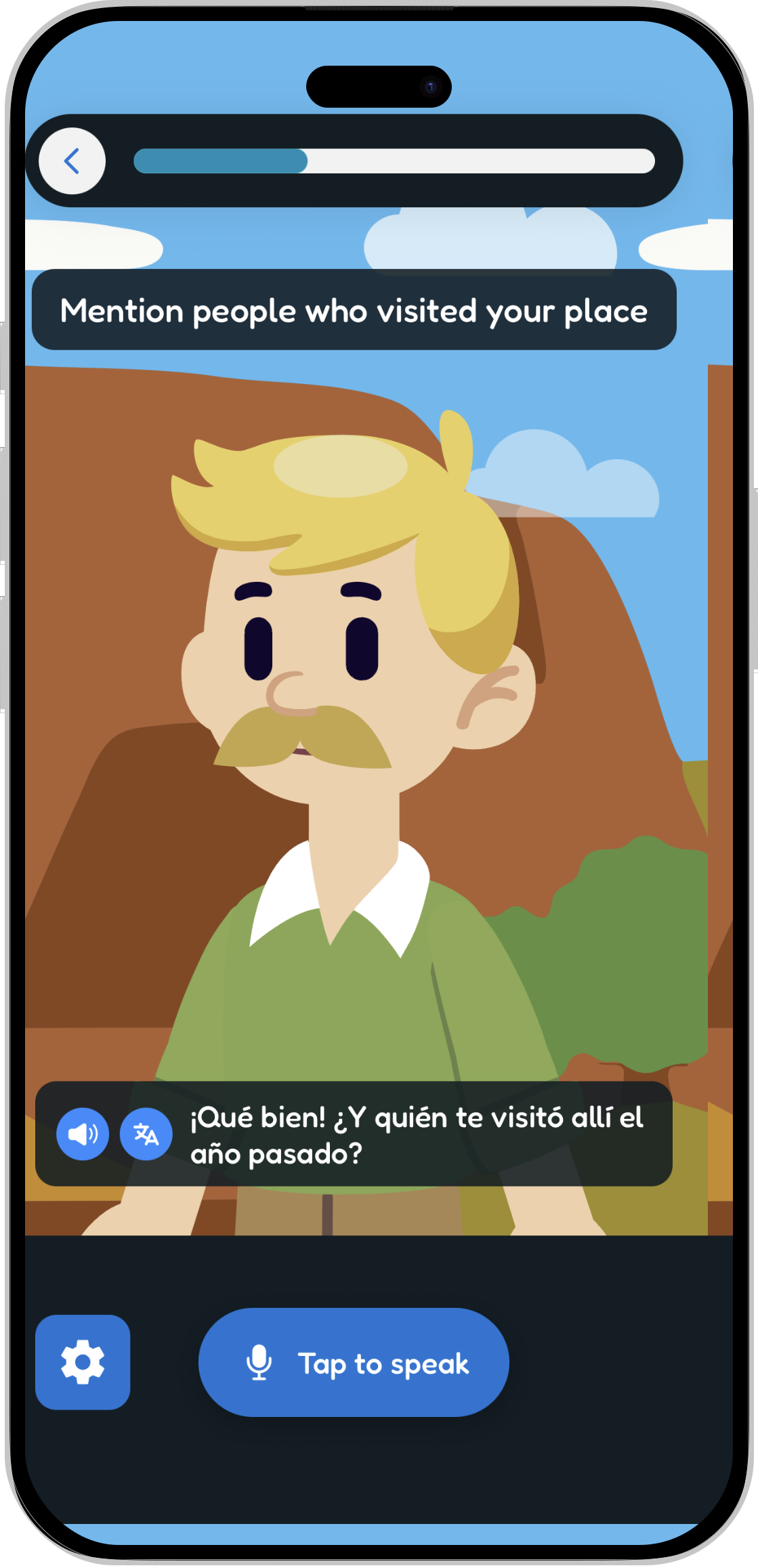
AI Chat Tutor
Practice real conversations with an AI tutor that helps you speak with confidence.
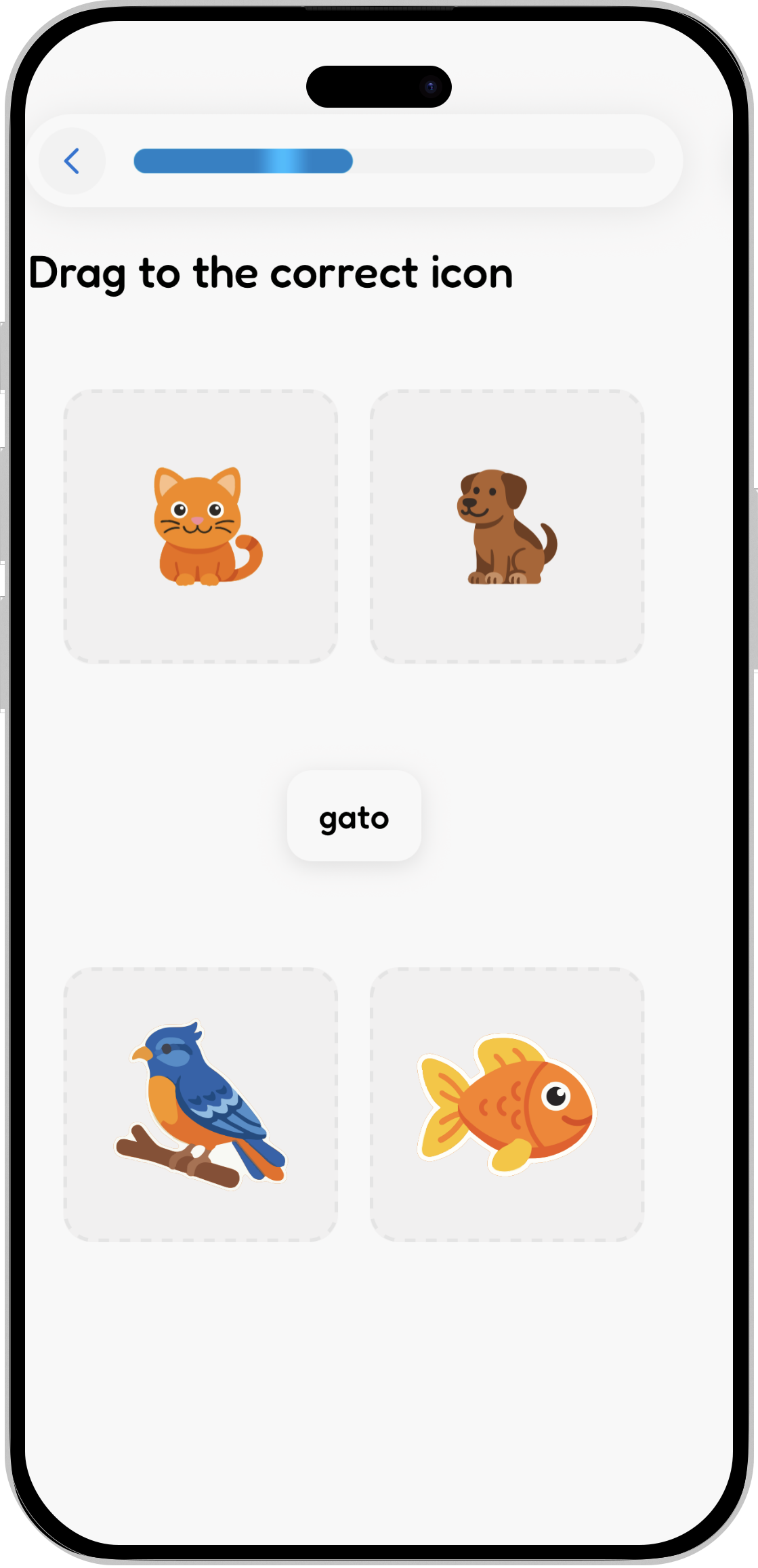
Interactive Games
A variety of games to help you learn and remember new words and phrases.


1. PolyChat
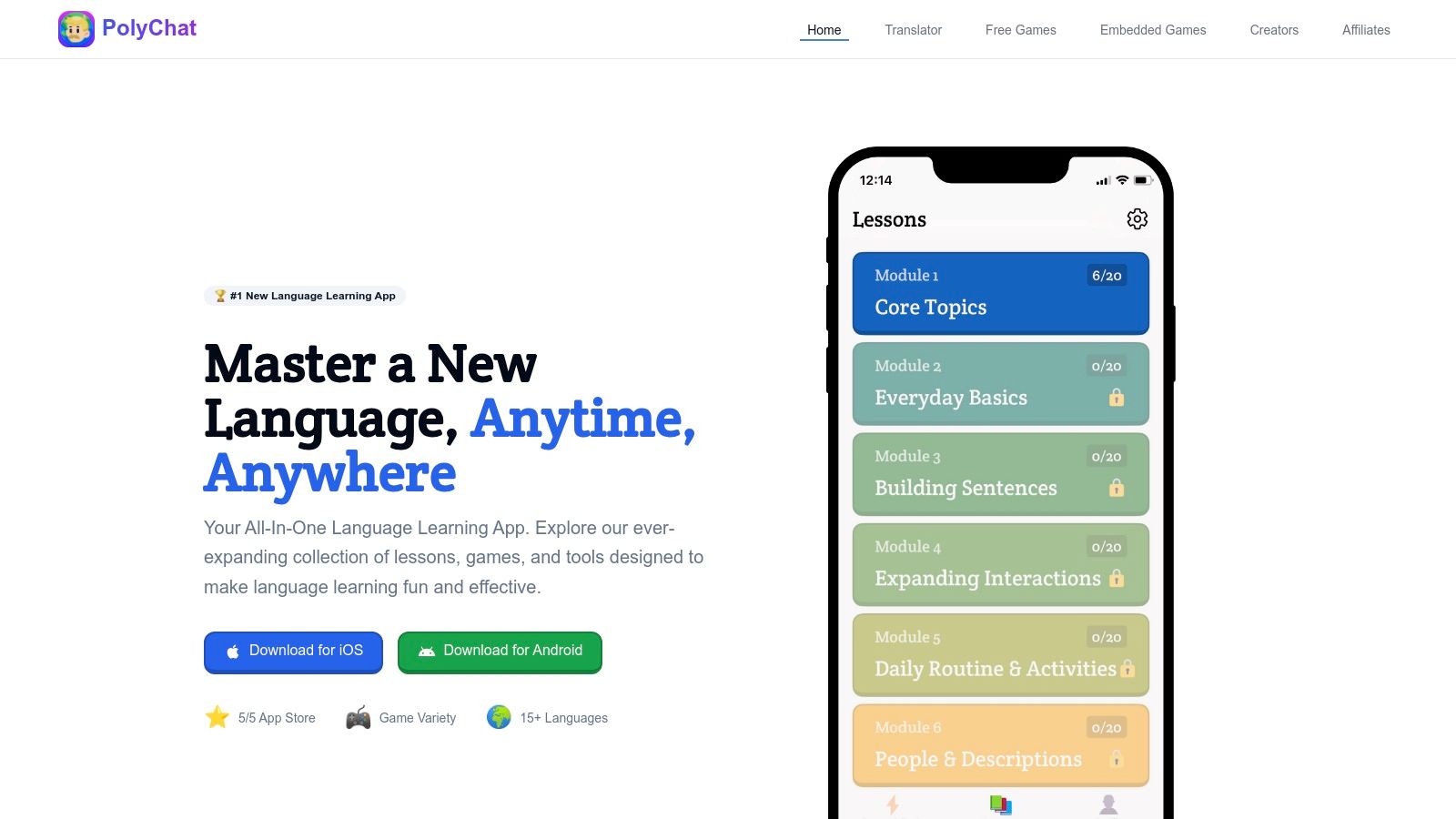
PolyChat earns its top spot as one of the best vocabulary building apps by delivering a comprehensive, all-in-one learning experience that masterfully blends proven educational methods with engaging game mechanics. It stands out by removing the restrictive "hearts" or energy systems common in other apps, offering learners unlimited daily practice. This core feature allows for deep, uninterrupted study sessions tailored to your own pace.
The platform is built around a structured learning path that guides users from beginner to advanced levels. Its strength lies in a diverse suite of activities, including timed vocabulary challenges and interactive conversation games that make daily practice both fast and effective.
Core Features & Standout Advantages
PolyChat’s feature set is robust and thoughtfully designed to accelerate vocabulary acquisition and retention. It offers more than just rote memorization, focusing instead on practical application and context.
- Unlimited Practice: The "no hearts, no limits" policy is a game-changer. Users can engage in as many lessons, drills, and games as they wish, making it ideal for intensive study or simply fitting in extra practice whenever time allows.
- Specialized Conjugation Tool: PolyChat bills its conjugation practice tool as the market's best, and for good reason. It provides focused drills that are critical for moving beyond basic vocabulary and constructing grammatically correct sentences.
- Flexible Language Pairing: A unique benefit is the ability to learn any of its 17 supported languages from any other. For instance, a native Italian speaker can learn Spanish directly, a feature often missing in mainstream apps. This makes it a powerful tool for polyglots.
- Integrated Learning Tools: The app includes a personal dictionary that grows as you learn, a built-in translator for real-world use, and hundreds of bite-sized lessons that fit easily into a busy schedule.
Ideal User & Practical Application
PolyChat is particularly effective for self-directed learners who are frustrated by the limitations of other gamified apps and want the freedom to study extensively. For a traveler preparing for a trip, the unlimited practice and on-device translator are invaluable. A student can use the conjugation tool to supplement formal coursework, while a professional can quickly build conversational skills for a new international assignment. As PolyChat explains in its own roundup of the best language learning apps, combining different learning styles is key to success.
Pros and Cons
| Pros | Cons |
|---|---|
| No daily limits on lessons or games | Pricing transparency is limited; "free" is advertised, but details on potential premium tiers are not clearly outlined. |
| Advanced conjugation drills accelerate grammatical proficiency | Content depth for advanced or specialized topics may vary by language and require supplemental resources. |
| Learn any supported language from any other language | |
| Broad language coverage, including less common options | |
| Strong social proof with high user ratings and positive testimonials |
Website: https://www.polychatapp.com
2. Apple App Store
For anyone with an iPhone or iPad, the Apple App Store is the primary gateway to finding the best vocabulary building apps. It’s not an app itself, but a vast, curated marketplace where you can discover, compare, and download a wide array of language tools. Its rigorous review process ensures a high standard of quality and security for the applications it hosts.
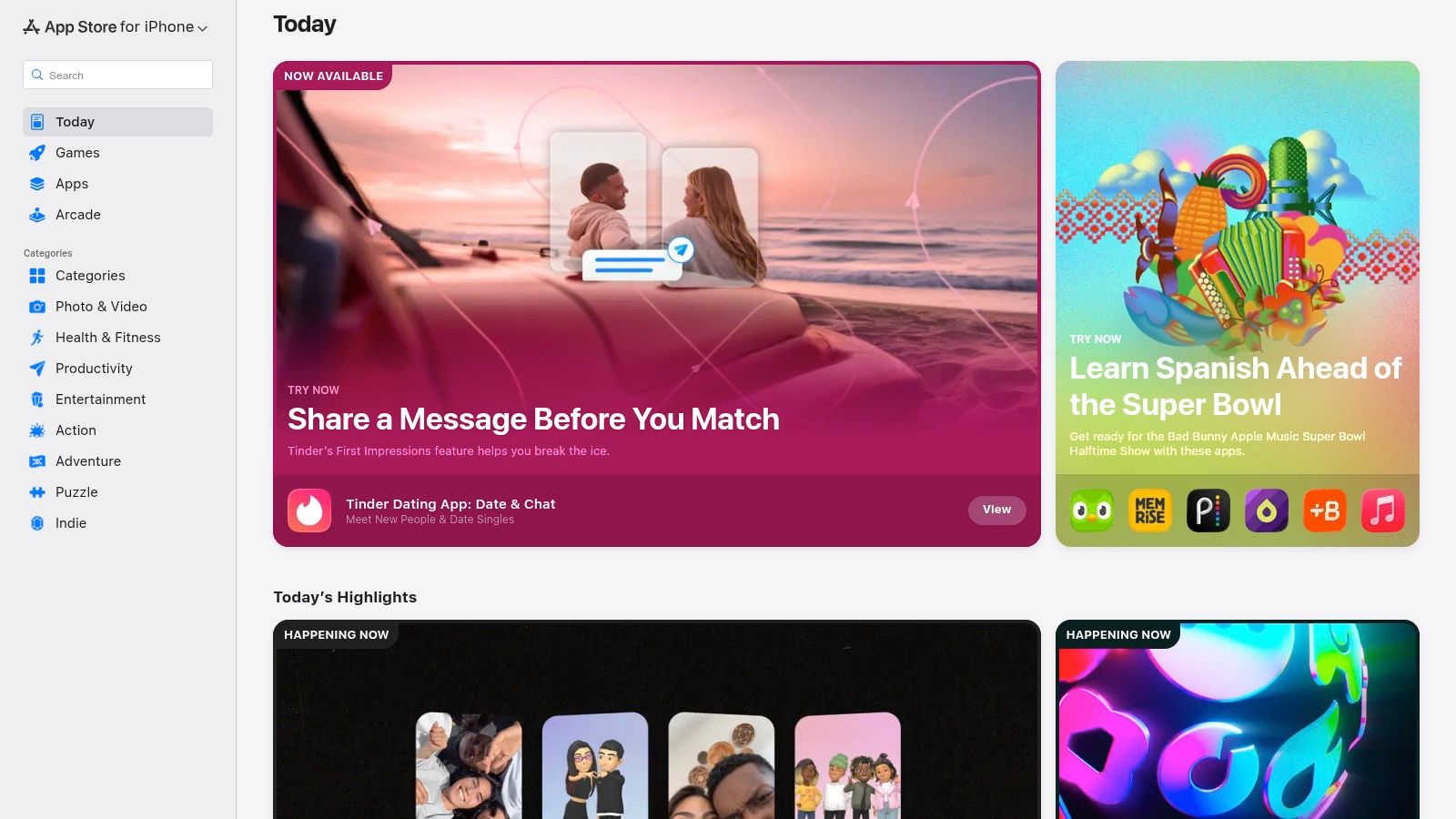
The platform centralizes user ratings, editorial reviews, and detailed in-app purchase information, making it easier to gauge an app's value before downloading. Managing subscriptions is incredibly straightforward through your Apple ID, eliminating the hassle of tracking payments across different developer websites. This streamlined ecosystem also extends to other useful tools; for instance, if you prioritize security while learning online, you can also find the best VPN solutions available for Apple devices right in the store.
Key Features & User Experience
The App Store's main strength lies in its user-centric design and trusted ecosystem. Navigation is intuitive, with powerful search functions and curated lists like "Apps We Love" that often highlight exceptional educational tools.
- Curated Discovery: Apple's editorial team frequently features high-quality apps, helping users discover effective new vocabulary builders.
- Unified Management: Subscriptions and purchases are tied to your Apple ID, providing a single point of control for payments and cancellations.
- Family Sharing: Many paid apps and subscriptions can be shared with up to five other family members, offering excellent value.
Website: apps.apple.com/us
Pros:
- Trusted, secure payment and simple subscription management.
- US-localized pricing and common free trials.
- Vetted catalog with user reviews to guide choices.
Cons:
- App prices and IAP options can sometimes differ from web pricing.
- Some apps list multiple, confusing price points.
3. Google Play Store
For the millions of Android users worldwide, the Google Play Store is the definitive source for discovering the best vocabulary building apps. Much like its Apple counterpart, it serves as a massive digital marketplace, but with a characteristically open ecosystem. It offers an enormous catalog of vocabulary trainers, exam-prep tools, flashcard systems, and full-scale language courses tailored for the Android platform.
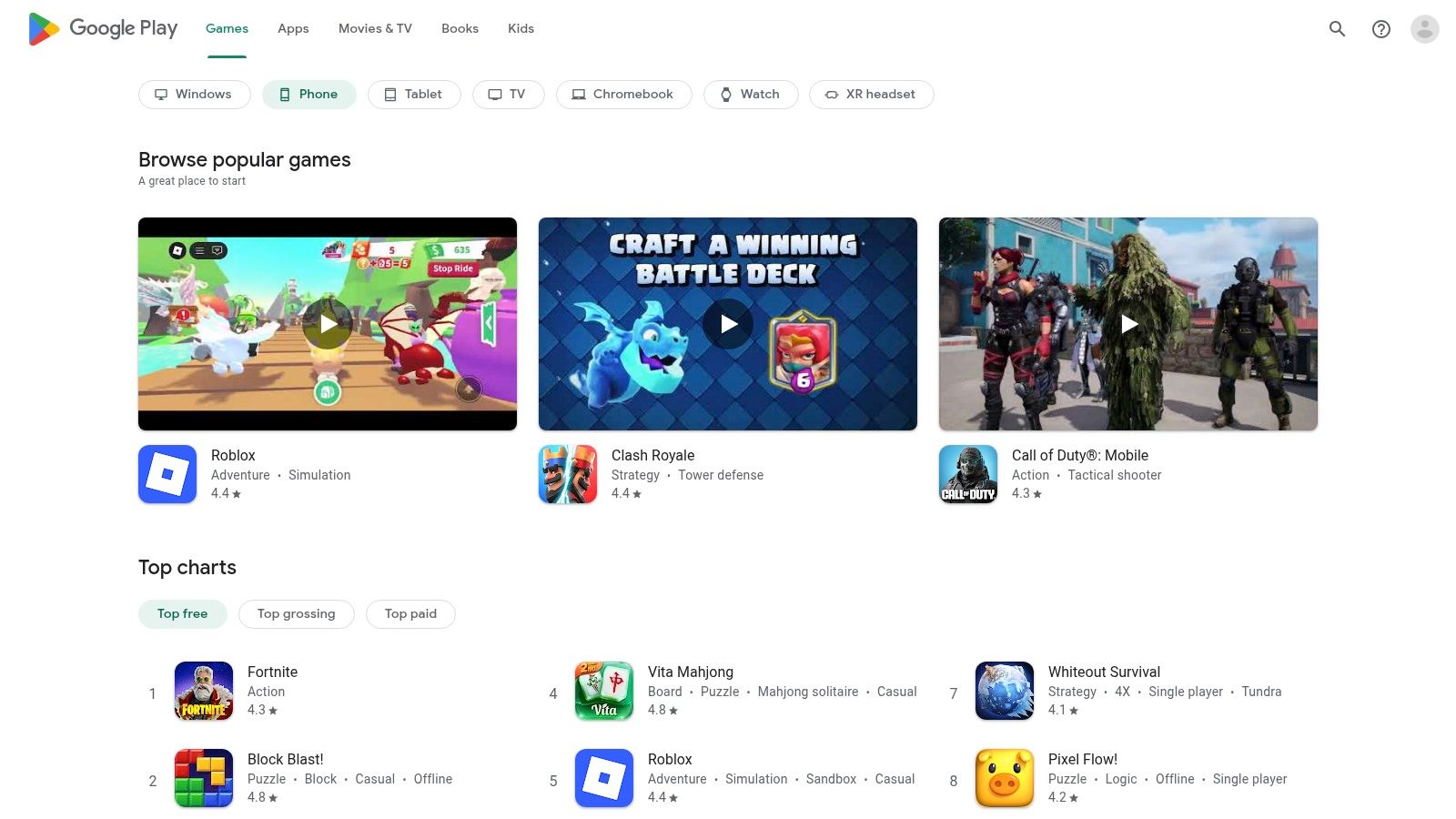
The platform is known for its user-friendly interface, frequent deals, and transparent app metadata. Before installing, users can easily review ratings, download counts, and specific in-app purchase ranges, which helps in making informed decisions. Features like the Family Library allow sharing of purchased apps with family members, while easy installation across multiple linked Android devices ensures your learning tools are always at hand.
Key Features & User Experience
The Play Store's strength is its sheer volume and accessibility, providing a solution for nearly every niche and learning style. Its search and discovery tools, including top charts and curated collections, simplify the process of finding effective vocabulary apps.
- Transparent App Data: Each app page clearly lists user ratings, the total number of installs, and a full range of potential in-app purchase costs.
- Family Library: Eligible paid apps can be shared with your designated Google family group, making it cost-effective for households.
- Easy Installation: Apps can be installed directly from the web to any of your registered Android devices with a single click.
Website: play.google.com/store
Pros:
- Vast selection with frequent sales and promotional offers.
- Transparent app data and permission requirements are shown upfront.
- Simple installation and management across all your Android devices.
Cons:
- Quality can vary significantly, especially among smaller publishers; always check recent reviews.
- Some apps may have inconsistent performance or features across different Android devices.
4. Vocabulary.com
Vocabulary.com is a powerhouse platform dedicated entirely to mastering English vocabulary. It masterfully combines an adaptive learning game with an extensive, human-written dictionary, making it one of the best vocabulary building apps for students, professionals, and anyone serious about deepening their word knowledge for academic or professional purposes. The platform’s core is its adaptive trainer, which personalizes learning to focus on words you struggle with.
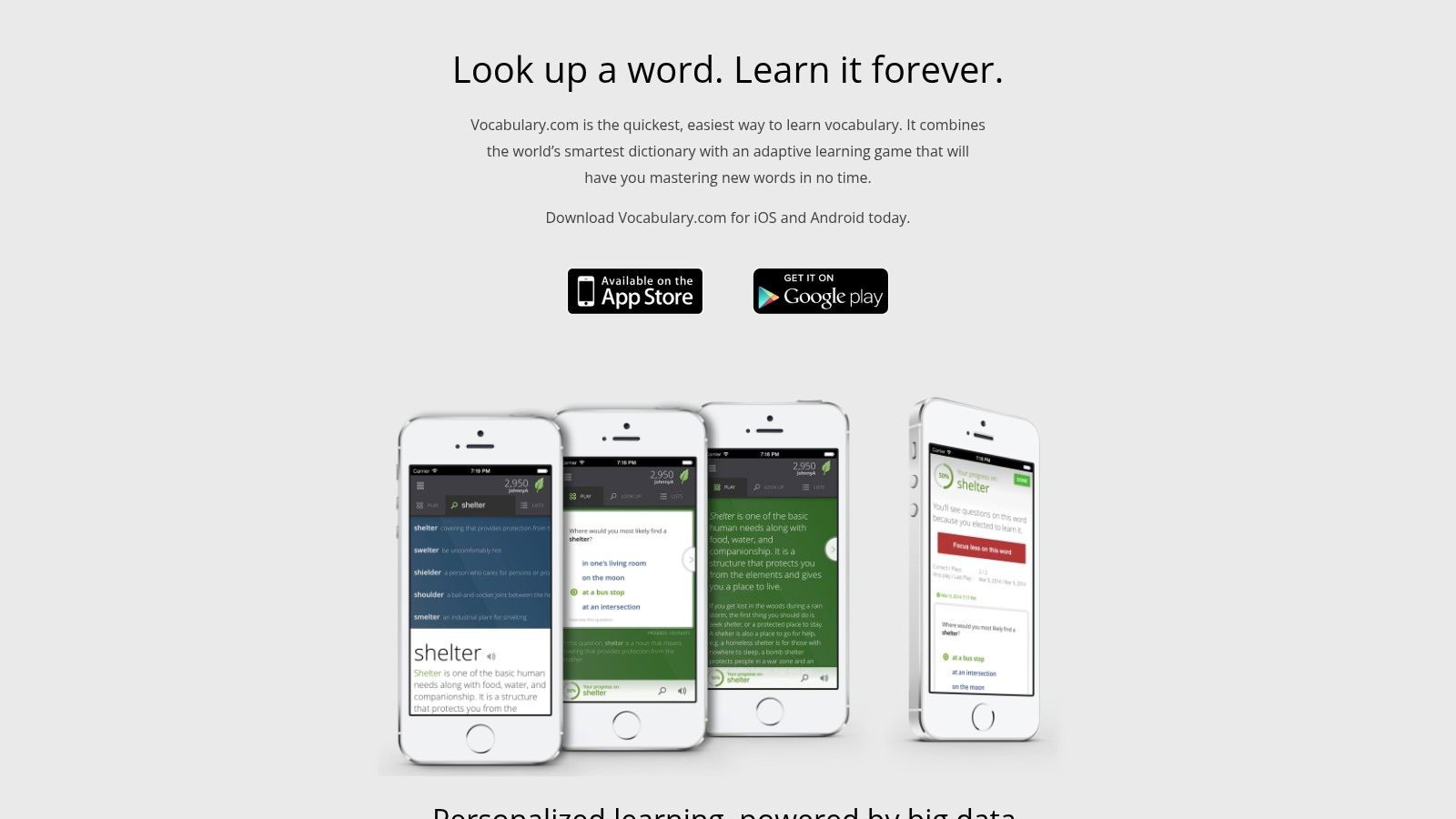
The platform stands out by gamifying the learning process through points, badges, and leaderboards, which fosters a sense of competition and motivation. Unlike apps that teach multiple languages, Vocabulary.com commits to providing unparalleled depth in English, with a massive library of pre-made lists for standardized tests like the SAT, GRE, and TOEFL, as well as lists based on classic literature.
Key Features & User Experience
The integration of learning activities directly with a comprehensive dictionary is Vocabulary.com's greatest strength. When you get a question wrong, the platform provides clear, friendly explanations and real-world examples to build true understanding, not just rote memorization.
- Adaptive VocabTrainer: The system intelligently assesses your knowledge and presents you with the right words at the right time to maximize retention.
- Human-Written Dictionary: Every definition is crafted to be understandable and engaging, with thousands of example sentences.
- Extensive List Library: Users can access a huge collection of vocabulary lists created by the community and educators or create their own.
- Gamified Learning: Earning points and competing on leaderboards makes the often tedious task of vocabulary building addictive and fun.
Website: www.vocabulary.com/app/
Pros:
- Exceptional focus on English vocabulary depth and context.
- Adaptive technology makes learning efficient and personalized.
- Gamification and community features boost motivation.
Cons:
- The free tier now limits the number of daily questions.
- Full access to the trainer and unlimited practice requires a subscription.
5. Magoosh GRE Vocabulary Builder
For students and professionals gearing up for standardized tests like the GRE, GMAT, or SAT, Magoosh GRE Vocabulary Builder is a laser-focused tool. Unlike general-purpose apps, it’s designed by expert test-prep instructors to teach the high-frequency, high-value words that consistently appear on these exams. Its no-frills approach prioritizes efficiency, making it one of the best vocabulary building apps for targeted academic and professional advancement.
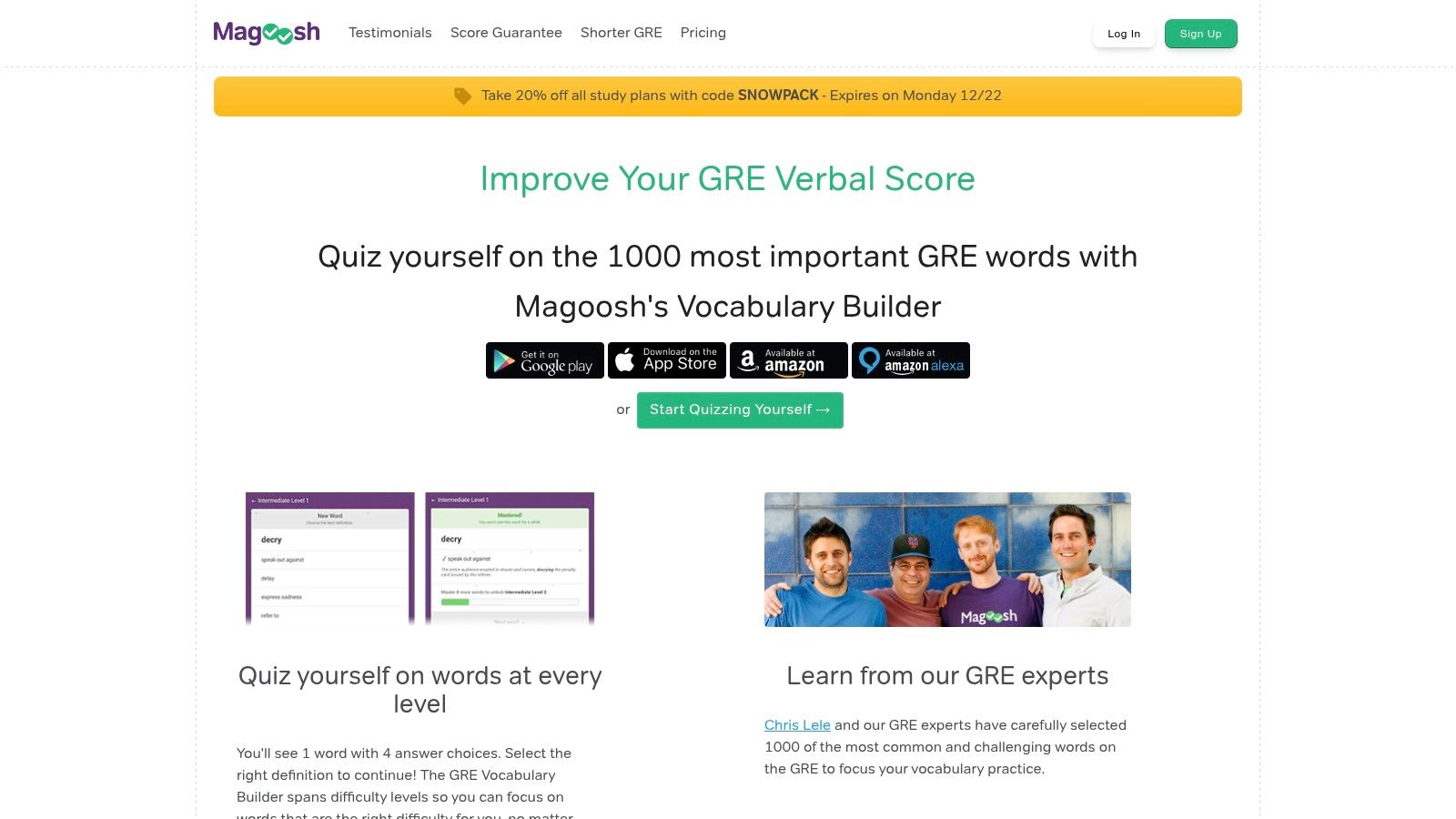
The platform is built around a curated list of approximately 1,000 essential words. Its strength lies in its simplicity: users engage in quick, multiple-choice drills to master definitions and usage, with a system that tracks progress and brings back difficult words for review. This minimalist design ensures that every minute spent on the app directly contributes to improving test scores, without the distractions of complex gamification or broad, conversational vocabulary.
Key Features & User Experience
Magoosh excels by stripping away non-essential features to deliver a powerful, streamlined learning experience. The interface is clean and intuitive, enabling users to jump into a quick practice session whenever they have a spare moment, even offline.
- Expert-Curated Word Lists: Focuses on 1,000 of the most critical words for standardized tests, selected by Magoosh experts.
- Multiple Difficulty Levels: Words are sorted into common, basic, and advanced tiers, allowing users to progress systematically.
- Progress Tracking: The app intelligently tracks your performance, helping you focus your efforts on words you find most challenging.
Website: gre.magoosh.com/vocabulary-builder
Pros:
- The core vocabulary builder is completely free to use.
- Highly credible, exam-focused content from a trusted prep company.
- Simple, fast, and effective for on-the-go learning.
Cons:
- Very narrow scope; not suitable for general or conversational vocabulary building.
- Lacks rich context or diverse sentence examples for real-world usage.
6. Elevate
Elevate approaches vocabulary building as one component of a broader cognitive enhancement program. Rather than being a single-purpose language tool, it's a premium brain-training app that integrates vocabulary exercises into a suite of games designed to improve communication, reading, and memory. Its polished, short sessions are designed to create a daily habit of mental workouts.
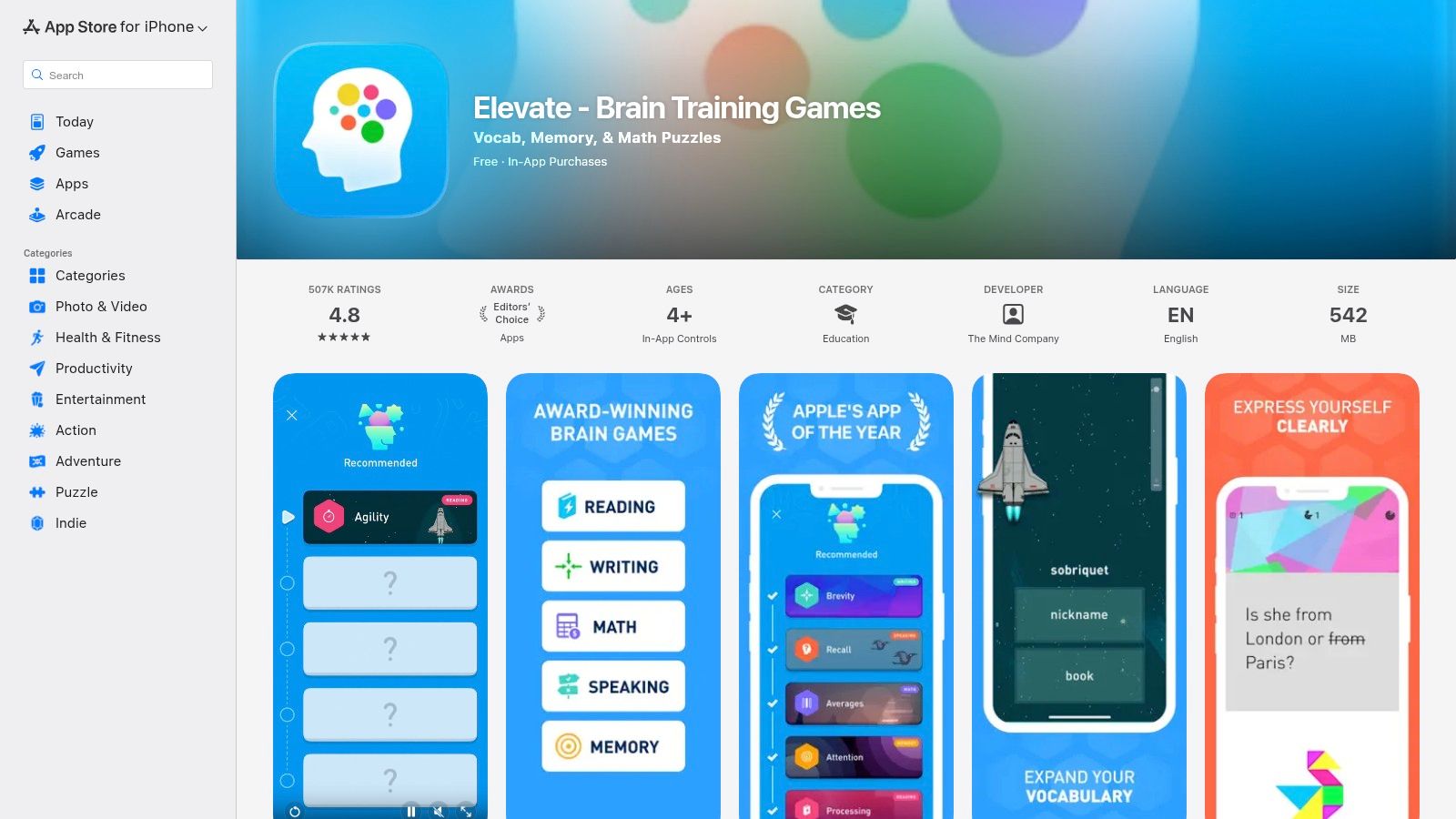
The app delivers personalized daily workouts based on your performance, ensuring the difficulty level remains challenging but not overwhelming. By bundling vocabulary games with tasks focusing on writing, speed, and reading comprehension, Elevate provides a holistic approach to improving your command of English. This method benefits users who want to see vocabulary gains in the context of overall communication skills, which is a core principle behind the power of gamification in language learning.
Key Features & User Experience
Elevate’s strength is its premium, game-based design that feels both productive and entertaining. The user experience is smooth and motivating, with clear progress tracking and streaks to encourage consistency.
- Holistic Skill Building: Features over 40 games that target vocabulary, reading, writing, and cognitive speed.
- Personalized Workouts: Delivers daily training plans that adapt to your skill level to keep you challenged.
- Habit-Forming Design: Sessions are short and engaging, making it easy to incorporate into a daily routine.
Website: apps.apple.com/us/app/elevate-brain-training-games/id875063456
Pros:
- High-quality design and a wide variety of game types.
- Effective habit-forming features and personalized difficulty.
- Improves vocabulary alongside other critical communication skills.
Cons:
- Full access and the best features require a premium subscription.
- Less specialized than dedicated vocabulary trainers.
7. WordUp
WordUp is an AI-powered English vocabulary app designed to help you learn the most useful words first. It creates a personalized learning path based on your existing knowledge and goals, moving beyond simple flashcards by providing rich, real-world context for every word. This approach makes it one of the best vocabulary building apps for learners who need to see words in action to truly understand them.
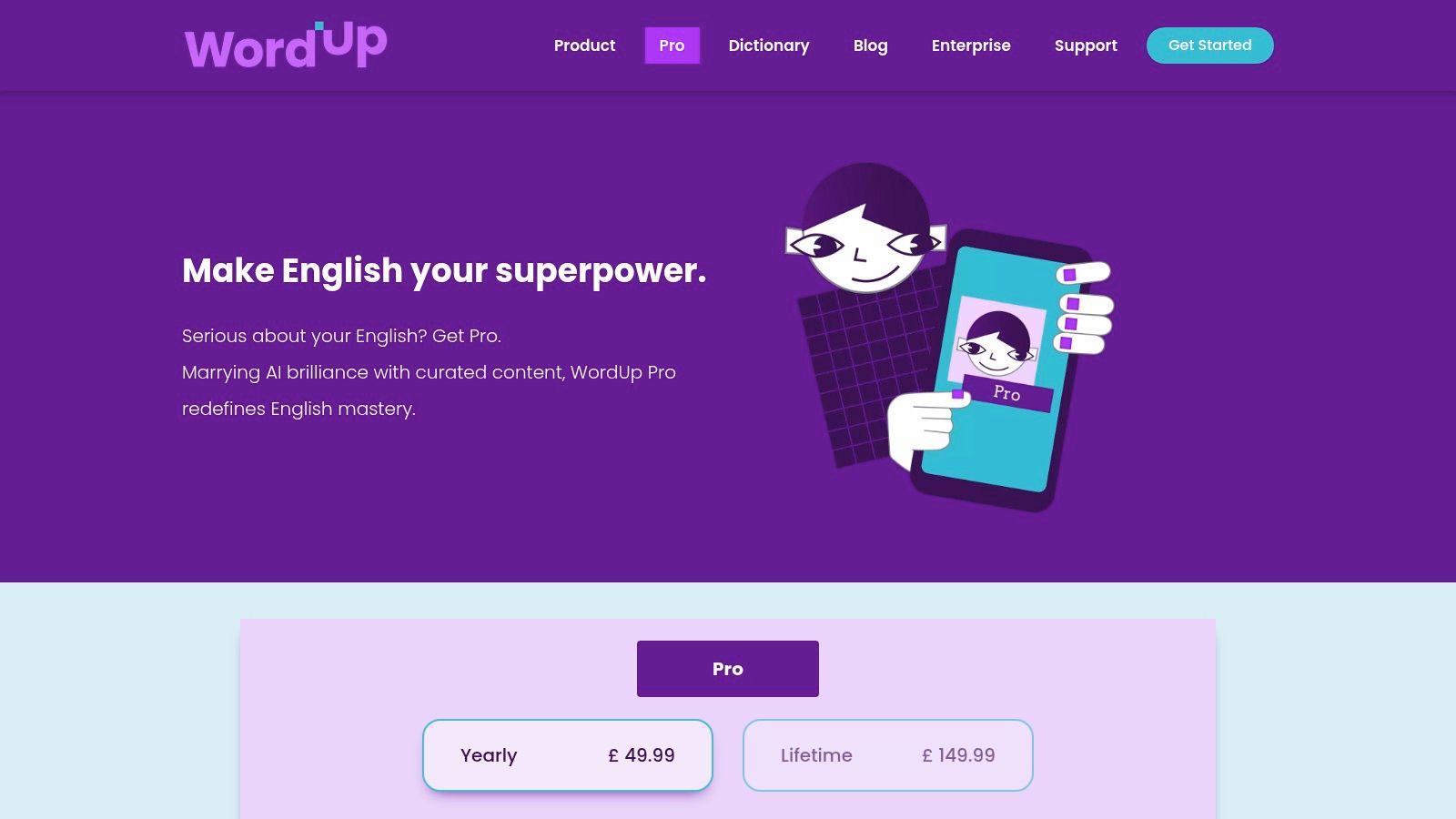
The platform’s core is its "Knowledge Map," which visually represents the 25,000 most useful English words, prioritized by frequency and utility. As you learn, the map fills in, giving you a clear sense of progress. It uses an AI tutor and clips from movies, news, and celebrity talks to demonstrate how words are used naturally, making the learning process more engaging and memorable than traditional methods.
Key Features & User Experience
WordUp excels at contextual learning, ensuring you understand a word’s meaning, nuance, and usage. The interface is modern and motivating, with challenges and daily reviews to keep you on track.
- AI-Driven Knowledge Map: Identifies your vocabulary gaps and prioritizes the most important words for you to learn next.
- Context-Rich Examples: Provides definitions, visuals, and thousands of video clips from real-world sources for deep understanding.
- Comprehensive Content: Covers idioms, phrasal verbs, and includes curated lists for exams like IELTS and TOEFL.
- Cross-Platform Sync: Offers a Chrome extension and offline mode, allowing you to learn anytime, anywhere.
Website: www.wordupapp.co/our-plans
Pros:
- Real-world context via videos makes usage memorable.
- Engaging challenges and good coverage for exam lists (IELTS/TOEFL).
- Personalized learning path focuses on high-utility words.
Cons:
- Most advanced and useful features are behind a Pro subscription.
- Pricing and tier options can vary significantly by currency and platform.
8. Memrise
Memrise distinguishes itself by combining spaced repetition with a vast library of video clips featuring native speakers. This approach grounds vocabulary learning in real-world context, helping users connect words to authentic accents, expressions, and situations. It’s an ideal platform for learners who want to move beyond robotic audio and build practical, conversational fluency.
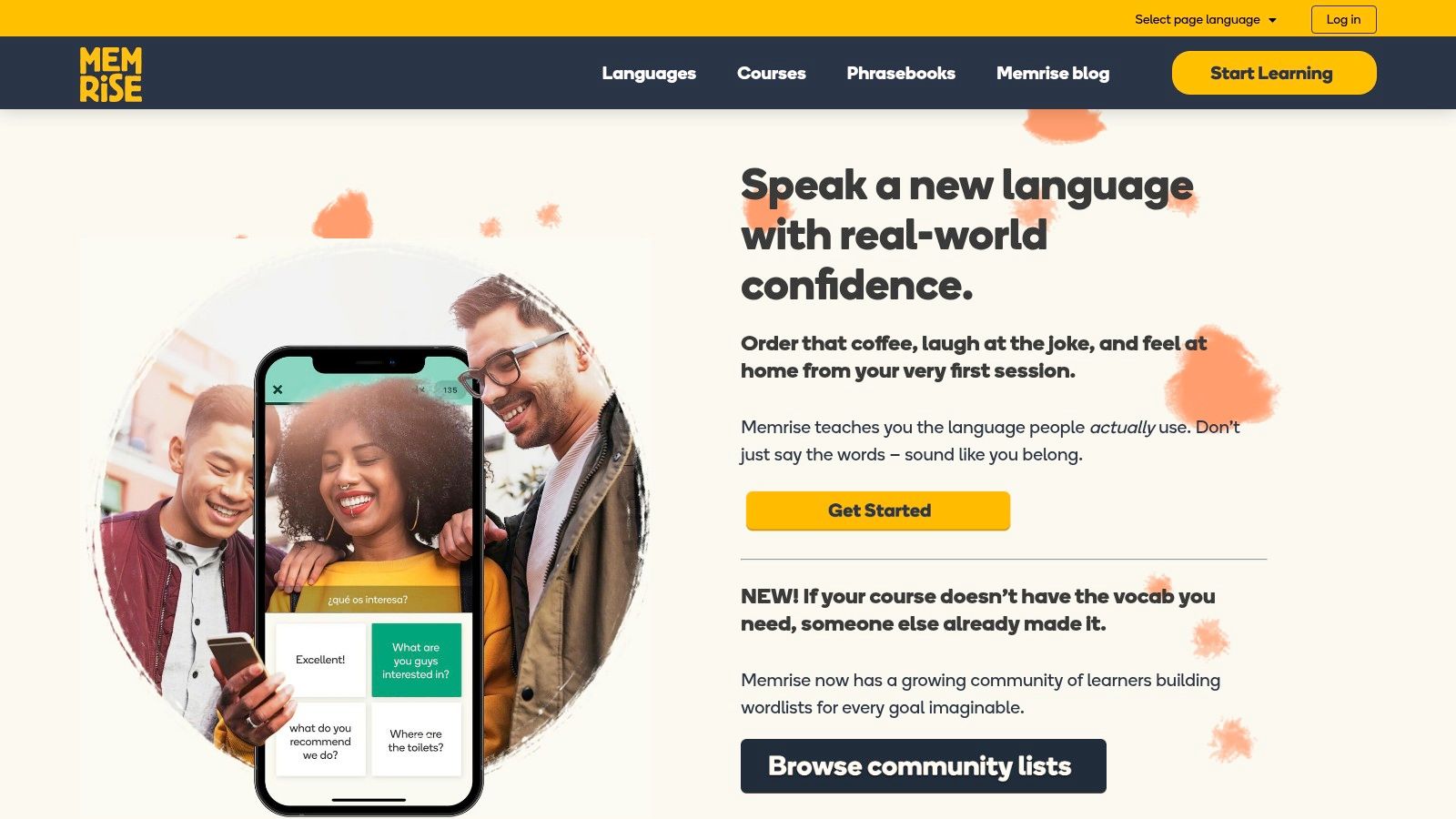
The platform is built around short, engaging sessions that make it easy to maintain a consistent learning habit. While its core strength is its official, curated courses, it historically hosted a large amount of community-generated content, though much of this was migrated to a separate platform in 2024. The app syncs seamlessly between web and mobile, with paid tiers offering offline access for learning on the go.
Key Features & User Experience
Memrise excels at making vocabulary acquisition feel natural and immersive through its multimedia-rich interface. The user experience is designed for quick, effective daily practice that builds long-term retention.
- Video-Based Learning: Short video clips of native speakers help you master pronunciation and understand words in authentic, real-life contexts.
- Spaced Repetition System: An intelligent algorithm determines when you should review words and phrases to move them into your long-term memory.
- Cross-Platform Sync: Your progress is saved and synced across the web platform and mobile apps for a seamless experience.
Website: https://www.memrise.com
Pros:
- Easy to fit short daily sessions into a routine.
- Broad language coverage and strong contextual materials.
- Video-rich content with native speakers enhances learning.
Cons:
- Exact prices vary by region and platform.
- Some community-created content was moved off the main app in 2024.
9. Anki
Anki is a powerful, open-source flashcard program that uses a spaced repetition system (SRS) to help users commit information to long-term memory. Unlike many gamified apps, Anki provides a highly customizable and scientific approach to learning, making it one of the best vocabulary building apps for serious, dedicated learners who prioritize efficiency and retention over entertainment.
The platform’s strength is its algorithm, which schedules reviews at increasing intervals as you prove you know a word. This method is exceptionally effective for building a large and durable vocabulary. Anki is free on desktop and Android, with a paid official iOS app that supports its ongoing development. Users can create their own multimedia-rich decks or download thousands of high-quality, pre-made decks shared by the community.
Key Features & User Experience
Anki’s interface is utilitarian rather than flashy, focusing entirely on function. While this presents a steeper learning curve, it grants users complete control over their study sessions, from the card layout to the review schedule.
- Spaced Repetition System (SRS): Its core feature is a sophisticated algorithm that optimizes when you review each flashcard for maximum long-term retention.
- Full Customization: Users can create cards with images, audio, and custom fields, and download add-ons to extend functionality.
- Cross-Platform Sync: Decks are synchronized via the free AnkiWeb service, allowing seamless study sessions across desktop and mobile devices.
Website: https://ankiweb.net
Pros:
- Extremely effective for systematic, long-term vocab building.
- You own your data and can use shared community decks.
- Highly customizable and free on most platforms.
Cons:
- Steeper learning curve compared with gamified apps.
- Fewer built-in game elements or onboarding for casual users.
10. Quizlet
Quizlet is a titan in the world of digital flashcards, evolving into a comprehensive study platform that’s incredibly effective for building vocabulary. It leverages a massive, community-driven library of study sets, allowing users to find pre-made flashcard decks for almost any subject, language, or exam. This crowdsourced model means you can quickly start learning specific vocabulary lists, from academic terms to conversational phrases, without creating them from scratch.
The platform goes beyond simple flashcards by offering various study modes, including multiple-choice tests, spelling drills, and matching games. This variety keeps learning engaging and helps reinforce memory from different angles. While the free version is robust, a Quizlet Plus subscription unlocks advanced features like offline access, ad-free studying, and more sophisticated learning paths powered by spaced repetition.
Key Features & User Experience
Quizlet’s strength lies in its versatility and vast content library, making it one of the best vocabulary building apps for structured learning and exam prep. The interface is clean, making it easy to create, find, and share study sets.
- Diverse Study Modes: Engage with material through Learn, Test, Match, and Gravity modes to reinforce knowledge in different ways.
- Massive User-Generated Library: Access millions of study sets created by other users and publishers, covering virtually any topic.
- Cross-Platform Sync: Seamlessly switch between the web platform and mobile apps, keeping your study progress in sync.
Website: quizlet.com
Pros:
- Extensive library of pre-made study sets for almost any subject.
- Simple, intuitive interface for creating and sharing your own flashcards.
- Multiple engaging study and game modes to aid memorization.
Cons:
- Key features like offline access and advanced study modes require a paid subscription.
- The quality of user-created sets can be inconsistent.
11. Duolingo
Duolingo is a globally recognized, gamified language learning app that provides extensive vocabulary exposure through its well-known, bite-sized lessons. It uses spaced repetition and streak mechanics to encourage consistent daily practice, making it a low-friction option for learners to build vocabulary in a structured, contextual way. It's particularly useful for establishing a daily learning habit for dozens of languages, including English for ESL learners.
The platform integrates vocabulary acquisition into broader language skills like grammar and sentence structure, rather than focusing solely on flashcards. This approach helps users understand words in context from the very beginning. While it provides a fantastic starting point for many, some advanced learners may eventually seek out more specialized tools or explore other apps to complement their Duolingo studies for deeper, more focused vocabulary training.
Key Features & User Experience
Duolingo's primary strength is its engaging and motivating user experience, which transforms language learning into a game. The learning path is linear and clear, guiding users from basic phrases to more complex sentences with adaptive difficulty.
- Gamified Learning: Uses points, streaks, and leaderboards to motivate users to return daily and complete lessons.
- Contextual Vocabulary: Words are introduced and reviewed within full sentences and interactive exercises.
- Bite-sized Lessons: Each lesson is designed to be completed in just a few minutes, fitting easily into a busy schedule.
Website: www.duolingo.com
Pros:
- Extremely easy to start and maintain a daily learning habit.
- Extensive content available for a wide variety of languages.
- Free, ad-supported version is highly functional.
Cons:
- Not a specialized vocabulary-only trainer; vocabulary is part of a broader curriculum.
- Pricing for the premium "Super Duolingo" can vary by platform and region.
12. Merriam-Webster
For learners focused on mastering the nuances of English, Merriam-Webster is an indispensable tool. More than just a dictionary, its app and website serve as an authoritative resource for understanding word origins, precise definitions, and correct usage. It is one of the best vocabulary building apps for those who want to build a deep, contextual understanding of words rather than just memorizing flashcards.
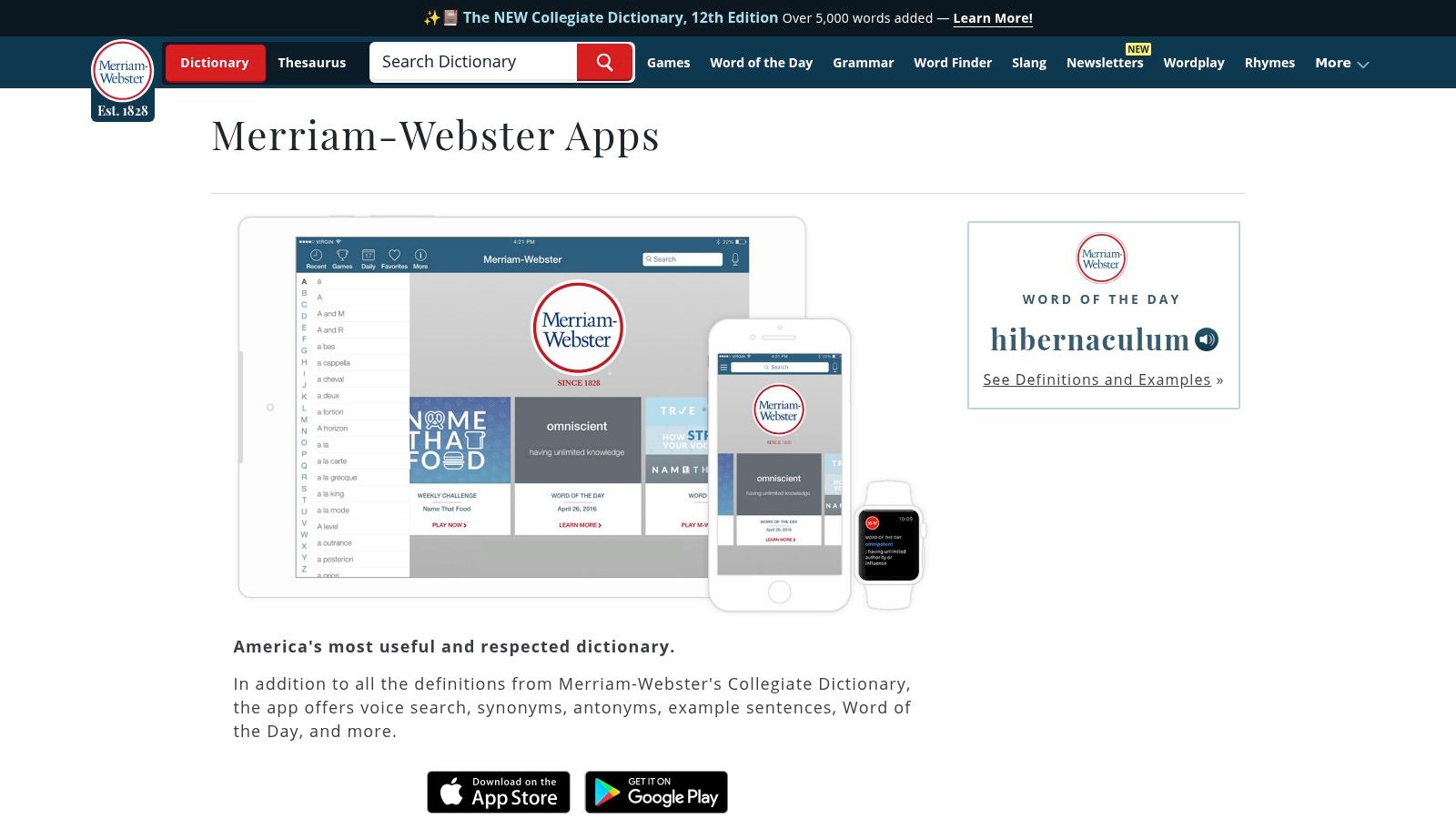
The platform shines with its "Word of the Day" feature, which introduces new vocabulary daily through engaging and memorable content. This, combined with integrated thesaurus entries and example sentences, helps users see how words function in the real world. While the free version is robust, a premium subscription removes ads and unlocks additional reference materials for an even richer learning experience.
Key Features & User Experience
Merriam-Webster’s strength is its authority and depth. The user interface is clean and academic, prioritizing clear information delivery over gamification, making it a serious companion for dedicated learners and writers.
- Authoritative Content: Provides trusted definitions, synonyms, antonyms, and etymologies.
- Daily Learning Tools: Features like "Word of the Day" and vocabulary quizzes offer consistent, light-touch practice.
- Offline Access: The app allows for offline access to the dictionary and thesaurus, perfect for learning on the go.
Website: https://www.merriam-webster.com/apps
Pros:
- Authoritative definitions and usage notes from a trusted dictionary.
- Excellent for learners building depth, nuance, and precise usage.
- Free version is highly functional for core dictionary needs.
Cons:
- Not a full structured course or intensive trainer; best when paired with dedicated practice apps.
- Premium features require payment to remove ads and access reference bundles.
Top 12 Vocabulary Apps — Comparison
| Product | ✨ Core features | ★ Quality / UX | 💰 Price & value | 👥 Target audience | 🏆 Standout / USP |
|---|---|---|---|---|---|
| 🏆 PolyChat | ✨ Unlimited daily lessons & games; timed vocab; best conjugation tool; built‑in translator | ★ 5★ (high engagement); gamified + structured path | 💰 Free app (premium tiers unclear) | 👥 Self‑learners, students, educators, travelers, polyglots | 🏆 Unlimited gamified practice + top conjugation & multilingual pairing |
| Apple App Store | ✨ Curated catalog; editorial picks; clear IAP listings | ★ Trusted vetting; strong review system | 💰 Varies by app; easy secure purchases | 👥 iOS users seeking vetted apps | ✨ Centralized iOS marketplace & subscription management |
| Google Play Store | ✨ Broad catalog; top‑charts; app metadata & permissions | ★ Wide selection; frequent deals | 💰 Varies by app; regional pricing & offers | 👥 Android users wanting variety & deals | ✨ Large Android hub with transparent app data |
| Vocabulary.com | ✨ Adaptive VocabTrainer; human‑written dictionary; leaderboards | ★ Deep English focus; effective retention | 💰 Free limited; full trainer paid | 👥 Students & professionals (English) | ✨ Depth in English vocab + adaptive algorithm |
| Magoosh GRE Vocabulary Builder | ✨ 1,000 curated test words; quick multiple‑choice drills | ★ Credible exam‑prep quality | 💰 Core free; related paid resources | 👥 GRE/SAT/GMAT test‑takers | ✨ Exam‑focused high‑value vocabulary drills |
| Elevate | ✨ 40+ games (vocab, reading, speed); personalized workouts | ★ Polished UX; habit‑forming sessions | 💰 Subscription for full access | 👥 Learners wanting brain‑training & habits | ✨ High‑quality design & varied game types |
| WordUp | ✨ AI tutor + Knowledge Map; video examples & idioms | ★ Engaging, context‑rich learning | 💰 Pro tier for advanced features | 👥 ESL learners; exam prep (IELTS/TOEFL) | ✨ Real‑world videos + AI‑personalized lists |
| Memrise | ✨ Spaced repetition; short videos; multimedia practice | ★ Strong multimedia UX; contextual phrases | 💰 Subscription (Monthly/Annual/Lifetime) | 👥 Casual learners wanting real‑life context | ✨ Video‑rich, contextual phrase learning |
| Anki | ✨ Proven SRS (SM2/FSRS); full deck control; multimedia | ★ Extremely effective; steeper learning curve | 💰 Free desktop/web; paid iOS app | 👥 Serious learners & advanced students | ✨ Most powerful SRS for durable retention |
| Quizlet | ✨ Flashcards, Learn mode, games; huge set library | ★ Widely used; simple clean UI | 💰 Free w/ ads; Plus subscription | 👥 Students, teachers, classroom use | ✨ Massive user‑created library & sharing |
| Duolingo | ✨ Bite‑sized lessons; spaced review; adaptive difficulty | ★ Very accessible; strong habit mechanics | 💰 Free w/ ads; Super (paid) removes ads | 👥 Beginners & casual language learners | ✨ Low‑friction daily habit builder |
| Merriam‑Webster | ✨ Full dictionary + thesaurus; Word of the Day; quizzes | ★ Authoritative reference; clear usage notes | 💰 Free w/ ads; ad‑free premium | 👥 Learners needing nuance & precise usage | ✨ Trusted definitions & example sentences |
Choosing Your Perfect Vocabulary Partner
The journey to a broader, more powerful vocabulary is deeply personal, and as we've explored, the digital landscape offers a tool for every type of learner. The quest for the "best vocabulary building apps" doesn't lead to a single answer, but rather to the app that best aligns with your unique learning style, goals, and daily routine. Your perfect tool is the one that transforms a daily chore into an engaging habit.
We've seen the sheer diversity available. For the dedicated academic or polyglot who demands absolute control, Anki provides a powerful, no-frills Spaced Repetition System (SRS) that is unmatched in its customizability. For students facing standardized tests like the GRE, Magoosh offers a laser-focused, expertly curated word list designed for maximum impact on exam day. Meanwhile, apps like Elevate and Vocabulary.com take a broader approach, weaving vocabulary enhancement into a larger framework of cognitive training and gamified learning to make the process feel less like studying and more like playing.
Aligning Your Choice with Your Goals
Selecting the right app requires a moment of self-reflection. Ask yourself what you truly want to achieve.
- For Native Language Mastery: If your goal is to enrich your English vocabulary for professional or academic reasons, platforms like Vocabulary.com, Merriam-Webster, and WordUp offer deep dives into etymology, nuanced usage, and contextual learning. They are built to add precision and flair to your existing linguistic foundation.
- For New Language Acquisition: When learning a new language from scratch, your needs shift. You require not just words, but context, pronunciation, and grammatical structure. This is where apps like Memrise, with its use of video and mnemonics, and Duolingo, with its structured, game-like lessons, have traditionally found their audience.
- For Unrestricted, Ambitious Learning: For the serious language learner, traveler, or polyglot who feels constrained by the limitations of mainstream apps, the choice becomes clearer. The frustration of energy systems, limited language pairings, and a lack of depth in grammar can stifle progress. This is the specific challenge that a modern tool like PolyChat is designed to solve.
The Deciding Factors: Consistency and Motivation
Ultimately, the most feature-rich app is useless if you don't open it. The critical factor in your success will be consistency. The best app for you is the one that seamlessly integrates into your life and keeps you motivated to return day after day.
Consider a trial period for your top two or three choices from this list. Pay attention to how each app makes you feel. Does the interface feel intuitive or clunky? Does the gamification energize you or feel like a gimmick? Does the learning method resonate with how your brain best retains information? Answering these questions through hands-on experience is the most effective way to find your ideal vocabulary partner. Whether you need a rigorous exam-prep tool, a customizable flashcard system, or a versatile, all-in-one language learning companion, your perfect match is out there.
Ready to break free from learning limits and experience a vocabulary app built for ambitious language learners? Discover how PolyChat's unique features, like unlimited practice, an advanced conjugation tool, and the ability to learn any language from any other language, can accelerate your journey. Start your multilingual adventure with PolyChat today!

Jean-Baptiste Bolh
Co-Founder
Applied AI