Conjugation Practice App: How to Choose and Use One

You can hold a conversation in your target language, understand the general meaning of a podcast, and still freeze when a sentence demands the right verb form quickly. That gap usually isn't caused by a lack of intelligence or effort. It comes from practicing conjugation as a visual table instead of as a decision you must make while communicating.
A good conjugation practice app should help you move from recognition to production, then connect verb forms with vocabulary, sentence context, listening, and speaking. Standalone drill apps have a place, especially when you need concentrated repetition. But drills work best as one part of a broader workflow, not as the entire definition of progress.
Ready to Learn a Language?
Try PolyChat's engaging language lessons, interactive learning games and put your new vocabulary to the test!
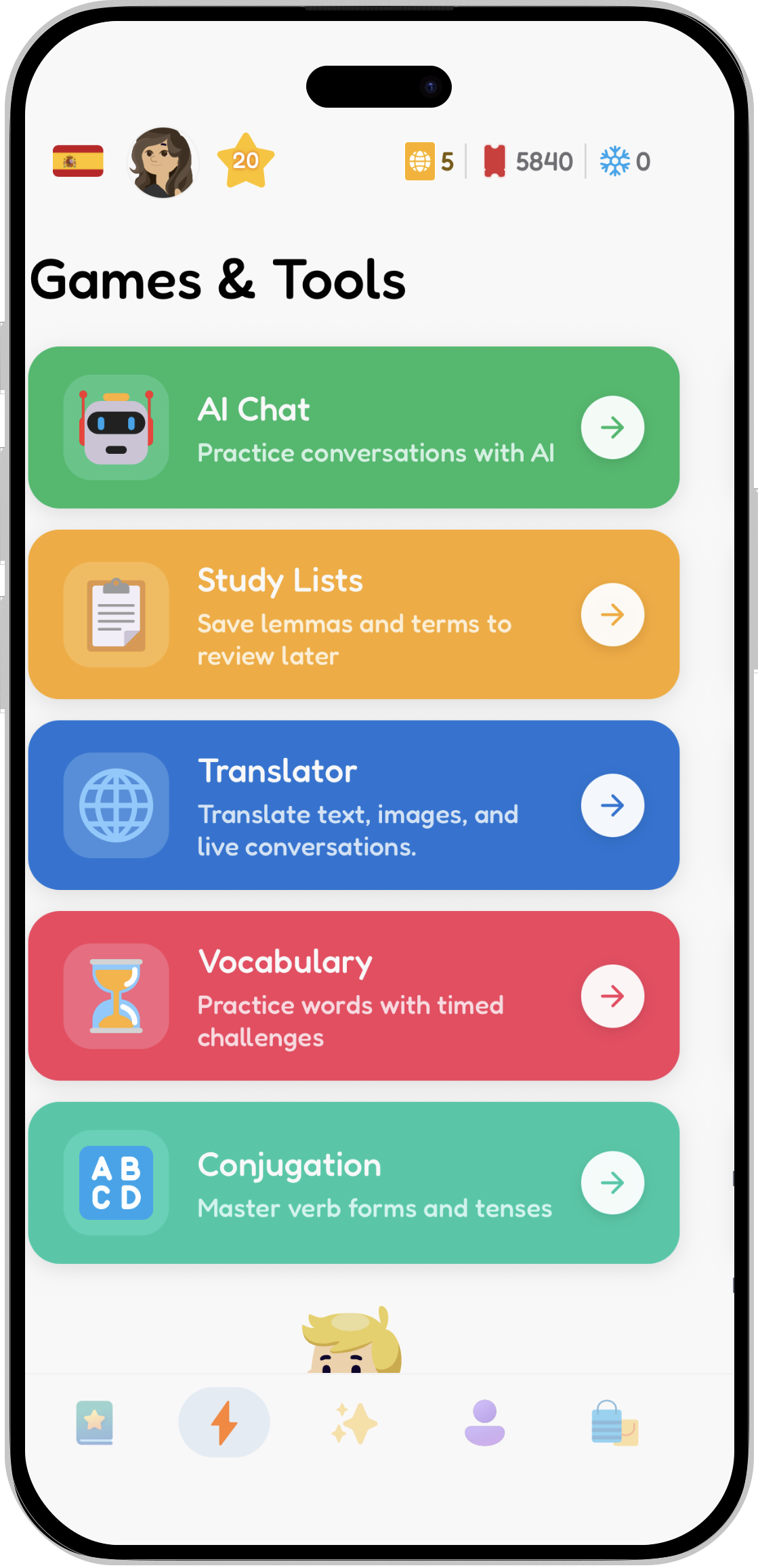
Games & Tools
Tools that every language learner needs at all stages of their learning journey.
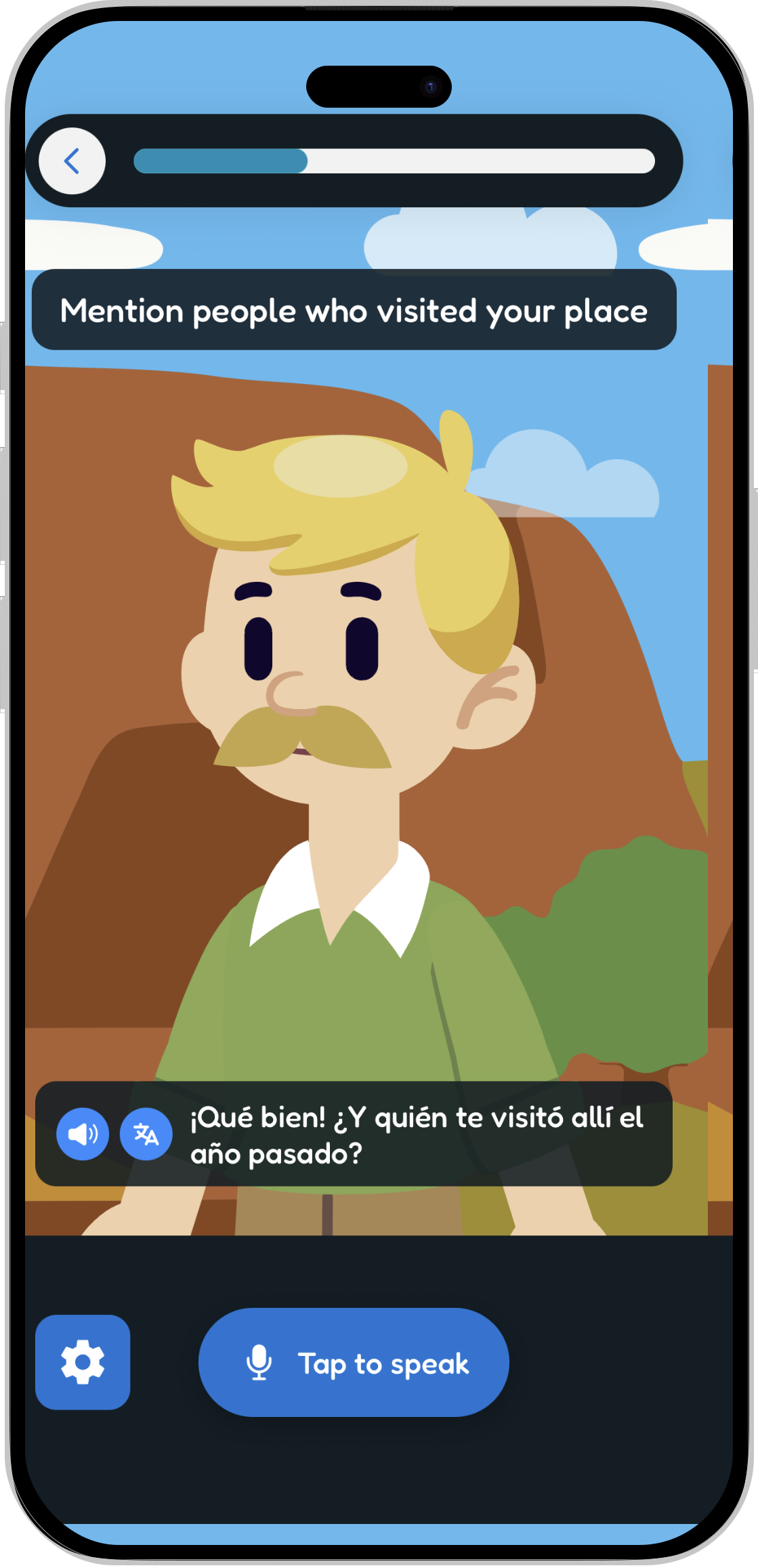
AI Chat Tutor
Practice real conversations with an AI tutor that helps you speak with confidence.
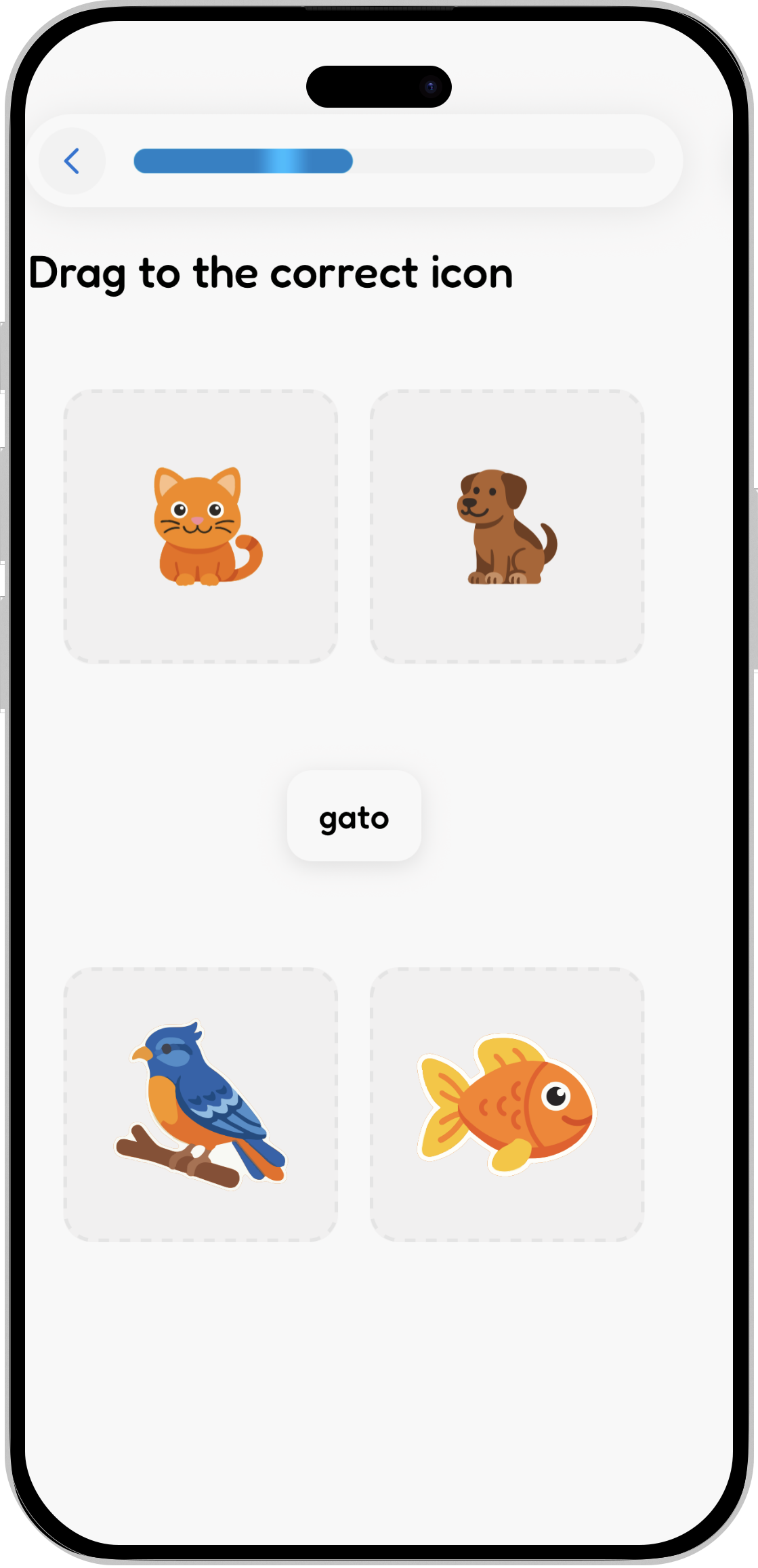
Interactive Games
A variety of games to help you learn and remember new words and phrases.


Why Most Learners Struggle with Conjugation
Maria is an intermediate Spanish learner. She can talk about travel, explain where she stayed, and describe what she did last weekend. Then someone asks what she would have brought if the weather had changed, and she stalls. The vocabulary is familiar, but the verb form doesn't arrive quickly enough.
Her problem isn't unusual. Many learners memorize charts for a test, recognize the correct answer on a flashcard, and assume the form is ready for conversation. It isn't. Speaking requires the brain to identify the subject, interpret the time frame, select the tense or mood, retrieve the verb stem, and produce the ending while the conversation continues.

Four habits that create the freeze
- Passive recognition: Multiple-choice exercises let you identify the correct form without creating it. Recognition feels comfortable, but typing or saying the answer demands a stronger memory pathway.
- Single-tense drilling: Repeating one tense makes the exercise predictable. Real conversation isn't predictable, so learners also need controlled mixing of persons, time markers, and tense contrasts.
- Form-first thinking: Conjugation isn't the final product. It serves meaning. The form must help you say who did something, when it happened, what might happen, or what you want someone to do.
- Avoiding irregular verbs: High-frequency irregulars often resist a single pattern. Delaying them leaves a learner unable to express basic ideas smoothly, even after mastering regular endings.
Conjugation behaves like a motor skill layered on top of vocabulary. You need to retrieve a form actively, connect it to a subject and time frame, and use it inside a sentence that means something. A useful paper-based supplement is to try the Kuraplan verb sheet, particularly when you want to write out difficult patterns before bringing them into app practice.
Practical rule: If an exercise lets you succeed without producing the form, it belongs in the warm-up, not at the center of your routine.
Features That Actually Matter in a Conjugation Practice App
Most app stores make conjugation tools look interchangeable. They aren't. Judge them by whether they force the kind of retrieval you need outside the app, then assess how well they fit your larger study routine.
Tier one, the non-negotiables
A serious tool should include active input, ideally typed answers or another production task before revealing the solution. Multiple choice has value for quick discrimination, but it shouldn't carry the full workload. The app should also mix tenses and grammatical persons instead of serving predictable blocks that allow you to answer by pattern alone.
Audio matters because a form you can write may still feel unfamiliar when spoken. Look for clear pronunciation and a way to hear the answer after attempting it. Irregular verb coverage is equally important, especially for learners beyond the earliest beginner stage.
Spaced repetition should reintroduce difficult forms after effortful forgetting, not bury you under endless random questions. Research on trainable spacing models found that spacing can produce a medium-to-large effect on second-language outcomes, while longer delays support delayed retention better than cramming for some learners. The spacing research supports adjustable review timing rather than one rigid schedule.
| Feature | Standalone Drill App | Full Learning Platform | Integrated Tool (e.g., Polychat) |
|---|---|---|---|
| Active recall | Usually strong | Varies by activity | Strong when production exercises are included |
| Mixed tenses | Often configurable | Depends on the learning path | Useful when drills connect to progression |
| Audio | May be focused on forms | Usually tied to lessons and dialogue | More valuable when paired with listening |
| Irregular verbs | Often a major strength | May appear gradually | Works best when selected by level and need |
| Spaced review | Common, sometimes narrow | Often distributed across skills | More useful when review connects with broader practice |
Tier two, the workflow fit
Progress analytics should show which forms you miss, not merely award a general score. Custom verb lists help you align practice with a textbook, course, exam, or professional need. Offline access matters if your routine includes commuting or travel.
The decisive question is integration. Standalone apps usually win on repetition density and focused control. Full learning systems usually win on context, because vocabulary, sentences, translation, and conversation surround the verb form. Independent app coverage shows that many conjugation tools still center on random verb, tense, and pronoun prompts, typed answers, and score breakdowns, while the wider market is moving toward integrated learning experiences. This app listing illustrates the narrow drill format common in the category.
Choose the standalone option when one stubborn form is blocking you. Choose an integrated tool when your real problem is transferring accurate forms into sentences and conversations.
Setting Up Your App the Right Way
Most learners download an app, tap through the onboarding screens, and start practicing whatever verb set appears first. That creates activity, but not necessarily progress. Set the tool up around your actual communication goal before you complete the first session.
Start with the outcome
Choose one primary objective: conversational fluency, exam preparation, reading comprehension, travel, or workplace communication. A conversation goal requires high-frequency verbs and spoken retrieval. An exam goal may require broader coverage and precise written production. Reading may place more weight on recognition, but you should still produce difficult forms if you want them available later.
Next, select a deliberately limited starting set of regular and irregular verbs. Don't begin with the full library. A focused set makes mistakes visible and gives each form enough repeated contact to become familiar.
Configure difficulty for production
Turn on mixed-tense practice early enough that you can't rely on the session's title to guess the answer. Disable hints and multiple choice once you've understood the basic pattern. Your first attempt should require you to produce the form, then compare your answer with the correction.
Set new forms to return quickly, then allow successful forms to spread out. The exact controls vary between apps, so use the most flexible schedule available rather than accepting a fixed default without inspection.
Protect the habit
Connect the app to one daily calendar reminder and silence competing study notifications. A short, repeatable session beats an ambitious routine that collapses after a few days.
Use this setup sequence:
- Select the target language. Match the app language to the language you need to use.
- Define your proficiency level. Start below your ego if the forms aren't automatic.
- Choose verb categories. Include regular patterns, common irregulars, and the tenses your goal demands.
- Set a daily reminder. Put practice next to an existing habit, such as coffee or a commute.

This setup takes only a few minutes, but it determines whether the app becomes a routine or an abandoned subscription. Don't let onboarding choose your curriculum for you.
A Real Daily Practice Session Walkthrough
Use a session that alternates form retrieval and contextual decision-making. The following routine uses Polychat's conjugation tool as a model, but you can reproduce the same sequence in another app if it offers comparable exercises.
Block one, warm up with controlled mixing
Spend five minutes on a tense-mix warm-up in French. Select eight verbs and rotate through présent, imparfait, and passé composé. The purpose isn't to master every distinction immediately. It wakes up yesterday's forms and prevents you from treating one tense as the automatic answer.
Read the prompt, produce the form before checking the correction, and say the completed sentence aloud. If the app provides audio, listen after your attempt, not before it.
Block two, let context choose the form
Use seven minutes for a fill-in-the-blank passage. The missing form should depend on clues such as a time expression, a subject pronoun, or the relationship between two actions.
Don't treat this as a spelling exercise. Ask yourself three questions before answering: Who is acting? When does the action happen? Is the writer describing a completed event, a background condition, or a current routine?

Block three, rebuild the sentence
Spend five minutes on a reordering exercise. Assemble words into complete sentences, paying attention to pronoun and verb agreement. This step adds word order and sentence structure, so the conjugated form isn't floating alone on a screen.
If you're studying Portuguese, a related reference on Portuguese verb conjugation can help you connect individual forms with broader grammar patterns.
Block four, rate honestly
Use the final three minutes for self-rating. Mark every form below 4 out of 5 for the next review queue. Rate the retrieval you produced, not the answer that looked obvious after the correction appeared.
This routine works because it moves from controlled recall to contextual selection, then to sentence construction. It also ends with a clear handoff to the next session instead of leaving errors buried in a score.
Using Spaced Repetition Without Burning Out
Spaced repetition fails when learners confuse frequent exposure with effective retrieval. You don't need every card every day. You need difficult forms to return while they're still recoverable, then gradually move successful forms farther apart.
A practical starting rhythm is 1 day, 3 days, 7 days, and 14 days. Use it as a working curve, not a law. A new irregular form that repeatedly disappears should return sooner. A regular pattern you produce without hesitation can wait longer.

Make production the gate
Don't reveal the answer before you attempt it. Type the form or say it aloud, then inspect the correction. If you recognize the answer but couldn't produce it, rate the card as difficult. That distinction matters more than a reassuring green checkmark.
Use four ratings consistently:
- Again: You couldn't retrieve the form or produced the wrong person or tense.
- Hard: You recovered it slowly, with uncertainty or a small error.
- Good: You produced it correctly with ordinary effort.
- Easy: The form arrived immediately and felt stable in context.
Learners often select Easy because the answer looks familiar after the reveal. Resist that shortcut. For a broader explanation of how spacing supports study habits, boost memory retention with Kohru offers useful context.
Control the review load
Burnout shows up when sessions become longer without a corresponding improvement in retrieval. When that happens, stop adding new verbs, shorten the queue, and focus on the forms that keep failing. A daily review cap of 20 cards is a sensible ceiling for a sustainable routine, especially when each card requires genuine production.
You can also separate new learning from maintenance. Introduce a small number of new forms, then spend the rest of the session retrieving older ones. The spaced repetition language learning guide provides another framework for thinking about review timing across a wider language routine.
Beyond Drills Where Conjugation Fits in Real Fluency
Grinding conjugation cards alone won't produce fluent output. It can make forms more accurate, but fluent communication also requires vocabulary, sentence planning, listening comprehension, and the ability to retrieve language while another person is waiting for your answer.
Think of conjugation as one gear in a larger mechanism. Vocabulary supplies the content, conversation adds pressure, and translation exposes gaps that isolated prompts can hide. After a focused drill, you should use the same tense and verbs in meaningful language.
Make three integration moves
First, pair each new tense with sentences taken from material you consume, such as a news item, podcast transcript, or short story. Notice what time expressions and sentence structures trigger the form.
Second, reserve a weekly speaking session for newly practiced verbs. Ask a partner or tutor to keep the topic narrow and correct the target verb forms rather than interrupting every mistake. This keeps feedback usable instead of overwhelming.
Third, translate a short passage in both directions. Forward translation tests whether you can choose the target-language form. Reverse translation tests whether you can recover the original meaning without leaning on recognition.
Resources such as ready-to-use fluency activities can supply practical tasks when your app sessions start feeling detached from communication. For a wider study framework, see the best way to learn a language.
| Practice Mode | Conjugation Accuracy | Spoken Output Speed | Retention After 2 Weeks |
|---|---|---|---|
| Isolated drills only | Often improves for practiced forms | May remain slow under pressure | Vulnerable when context changes |
| Mixed-mode practice | Builds accuracy across varied cues | More likely to transfer into answers | Strengthened by retrieval in different settings |
Treat focused drilling as a tool with diminishing returns. Once your attention drops or the same errors repeat without improvement, switch modes. A short speaking task or translation passage may strengthen the form more than another batch of nearly identical prompts.
Your Conjugation Practice Plan Starting Today
Start with a decision, not a download. Write down your current level, target language, and the verb range you need. A beginner may need a focused core set, an intermediate learner may need a broader group of high-frequency regular and irregular verbs, and an advanced learner may need full verb tables, mood contrasts, and professional vocabulary.
Use this plan as your operating checklist:
- Define the target. Choose the proficiency goal and the verb set that supports it. Don't study every tense because the app includes it.
- Match the tool to the job. Pick a standalone drill app when you need dense form repetition. Choose an integrated option such as Polychat's conjugation tool when you also want reading, speaking, translation, progression, and reinforcement in the same environment.
- Set the difficulty. Make typed or spoken production the default, mix the relevant tenses, and activate spaced reviews beginning with a practical sequence such as 1, 3, and 7 days.
- Run the session workflow. Start with a short mixed review, move into fill-in-the-blank context, then use sentence production and a final self-rating pass. Multiple choice can support recognition, but it shouldn't replace output.
- Record the evidence. Log your accuracy and confidence after every session. Revisit any tense that falls below 80 percent accuracy, but treat the threshold as a diagnostic rather than a verdict.
- Add real language each week. Pair app work with listening, translation, or a speaking task that forces you to use the newly practiced forms.
Follow the sequence for 30 days before judging the app. Evaluate which features you used, which errors persisted, and whether the forms appeared more readily in real sentences. A tool earns its place by improving your workflow, not by offering the largest verb library.
The strongest routine is simple: retrieve, check, contextualize, space, and use. If a conjugation practice app supports those actions without making you depend on hints or passive recognition, it can become a valuable part of your language system.
Polychat combines conjugation challenges with vocabulary, translation, conversation activities, lessons, and progress tracking, so you can practice verb forms and then use them in broader language tasks. Visit Polychat to build a structured routine around the forms you need to produce.

Jean-Baptiste Bolh
Co-Founder
Applied AI