Custom Vocabulary Language App Guide

You save a useful phrase from a podcast, add a work-related term after a meeting, and note a restaurant expression before a trip. Later, the words sit neatly inside your language app, yet a conversation begins and your mind goes blank. You recognize the vocabulary when you see it, but you can't retrieve it quickly enough to speak.
That frustration doesn't mean you have a poor memory. It usually means your practice has stopped at recognition instead of moving toward active recall and real communication. A custom vocabulary language app can close that gap, but only if it does more than store words. It should help you capture meaningful language, revisit it at useful intervals, and produce it in sentences that resemble your daily life.
Ready to Learn a Language?
Try PolyChat's engaging language lessons, interactive learning games and put your new vocabulary to the test!
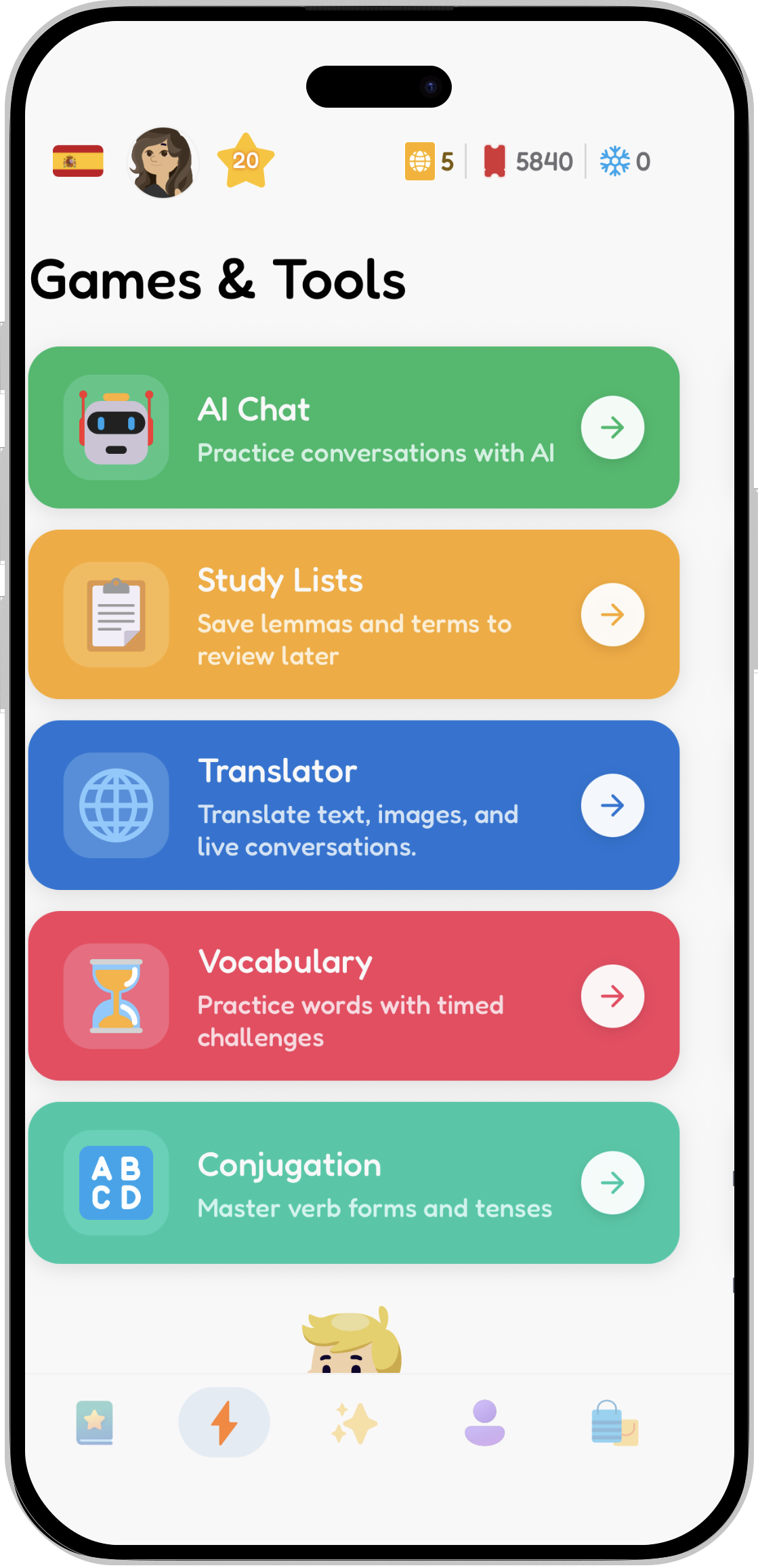
Games & Tools
Tools that every language learner needs at all stages of their learning journey.
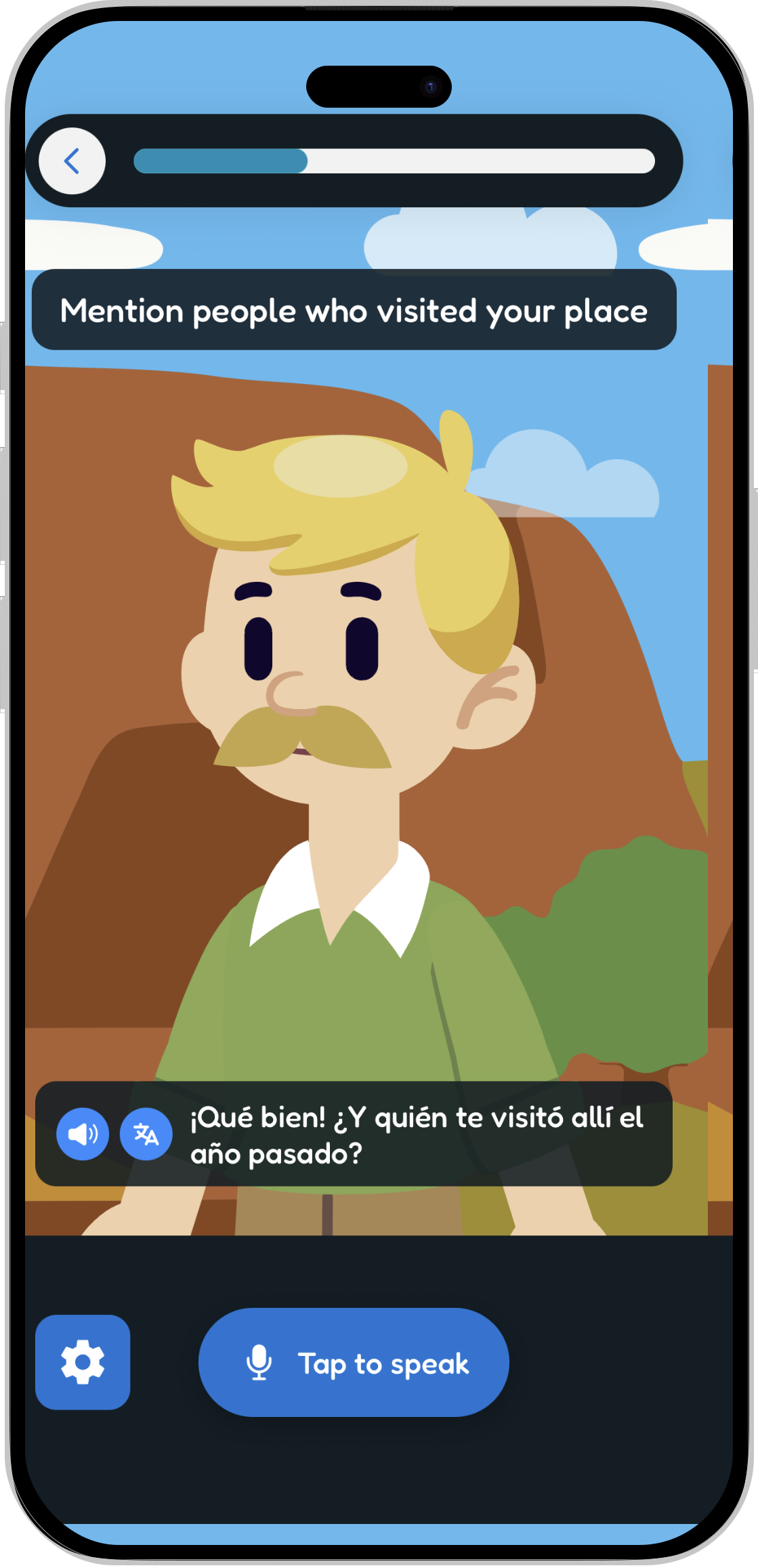
AI Chat Tutor
Practice real conversations with an AI tutor that helps you speak with confidence.
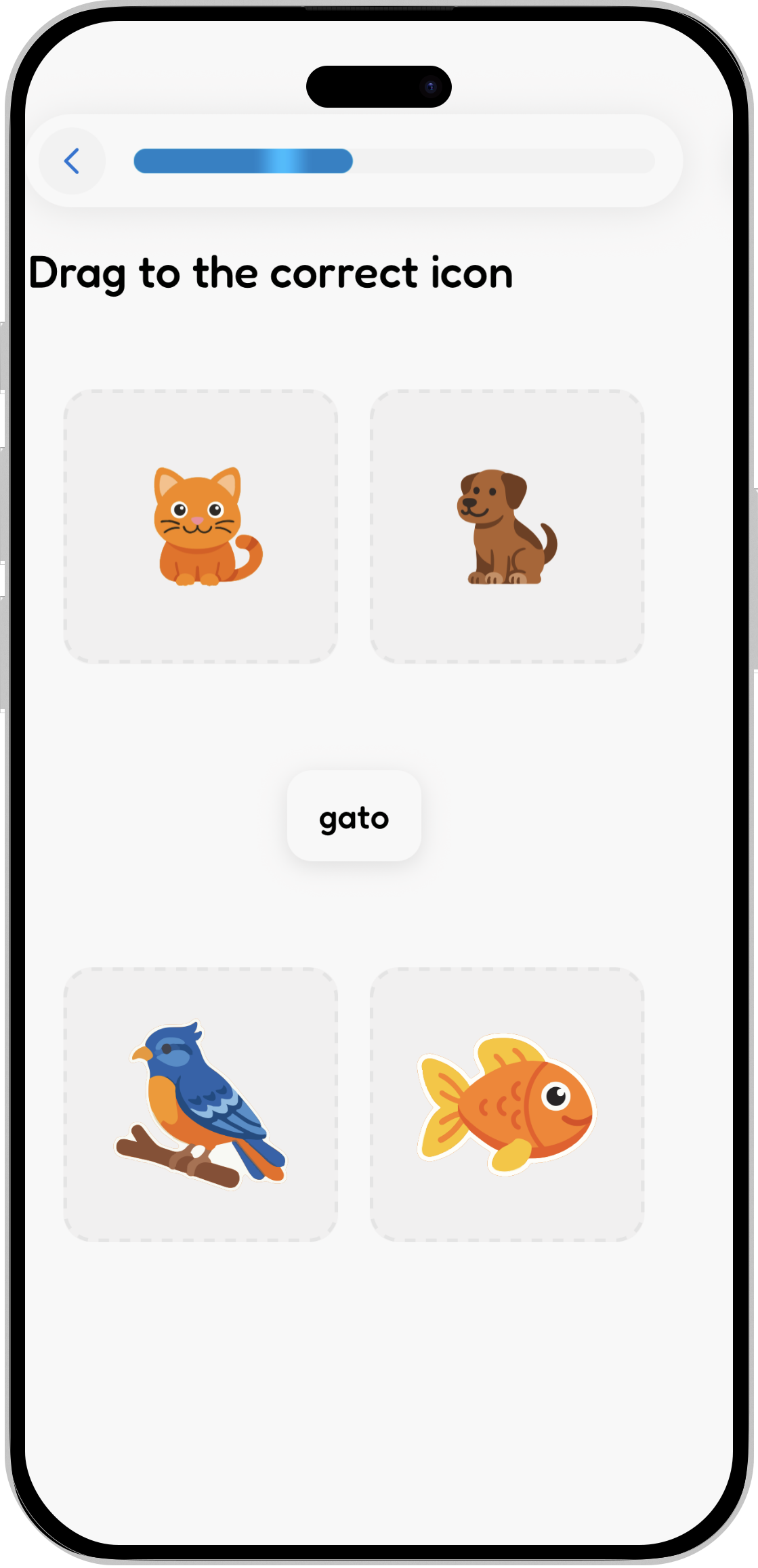
Interactive Games
A variety of games to help you learn and remember new words and phrases.


Why Standard Word Lists Fail Modern Learners
A standard word list often treats vocabulary as a collection of isolated translations. You might study “appointment,” “schedule,” and “available,” recognize each answer on a flashcard, and still struggle to say, “Are you available to reschedule our appointment?” during a real exchange. The problem isn't necessarily that you haven't seen the words enough. You haven't practiced assembling them under conversational pressure.
Passive recognition happens when a word looks familiar on a screen. Active recall happens when you must produce the word from a meaning, situation, image, or prompt. Speaking depends far more on the second ability. A list can show you what you know, while a conversation reveals what you can access.
A dictionary built around your life
A custom vocabulary language app works differently from a fixed course. It acts as a dynamic personal dictionary that grows from your interests, work, travel plans, reading, and conversations. Instead of waiting for a textbook to introduce the vocabulary of your industry or next destination, you can save the exact phrase you need.
For example, a learner preparing for a conference might collect “follow up,” “project timeline,” and “to clarify the requirements.” A traveler could save expressions for asking whether a train stops at a particular station, requesting a table, or explaining a dietary restriction. Each entry carries a reason for existing, which gives the learner a stronger mental connection than an arbitrary list can provide.
Personal relevance keeps practice alive
Personal vocabulary also improves the emotional side of learning. Words connected to a real email, favorite television series, upcoming trip, or family conversation feel useful now, not merely possible someday. That relevance gives you a natural reason to return to the app.
Practical rule: Save language because you expect to use it, not because it happens to be easy to collect.
The broader microlearning ecosystem can help you compare tools built around short, repeatable study sessions. This guide to best microlearning platforms for 2026 offers useful context when you're evaluating how a vocabulary app fits into a busy routine. The strongest option for your needs won't just offer more words. It will connect your personal words to repeated retrieval and spoken use.
The Learning Science Behind Personalized Memory
Building a personal list creates relevance, but relevance alone doesn't guarantee retention. Memory strengthens when learners repeatedly retrieve information, receive useful feedback, and encounter the material across changing intervals and contexts.
Spaced repetition is central to this process. Instead of reviewing a word repeatedly in one sitting, you return to it after time has passed. Controlled studies and reviews report better delayed recall from distributed review than from massed practice, including language-learning experiments that found higher retention after delays ranging from one to five weeks. Some designs reported recall near 86% at an optimal one-day spacing, compared with about 62% at a ten-day spacing for the same vocabulary set, as described in this review of spacing effects in verbal learning.

Why effort helps memory
A review that feels slightly difficult can be more valuable than one that feels effortless. When you try to retrieve a word before seeing the answer, your brain has to reconstruct the connection between meaning, sound, spelling, and use. That effort makes the next retrieval more accessible, especially when the app adjusts the interval according to your performance.
A word you miss shouldn't disappear from your list. It should return sooner, perhaps in a simpler prompt first and then in a more demanding sentence. A word you recall comfortably can rest longer. This is why an adaptive schedule is more useful than a fixed daily rotation.
Feedback completes the cycle
Retrieval practice works best when the learner discovers whether the answer was accurate. Experimental work on third-language vocabulary learning found that retrieval practice with feedback outperformed repeated studying, with a stronger advantage when feedback followed each attempt. A productive vocabulary session therefore looks like this:
- Retrieve: Translate a prompt, complete a sentence, or produce a phrase.
- Check: See the correct word, pronunciation, grammar, or collocation.
- Repair: Notice the specific mistake and try again.
- Return: Meet the item later through a spaced review.
This combination matters because vocabulary isn't only a meaning-to-word connection. You also need the word form, sound pattern, grammatical behavior, and natural neighbors that make the expression usable.
For a deeper explanation of scheduling and review design, explore spaced repetition for language learning. The practical principle is simple: a personal list becomes powerful when the app turns saved items into varied retrieval events.
How to Build and Organize Your Custom Dictionary
A custom dictionary can become useful very quickly, or it can become a crowded storage box. The difference comes from what you save and the information you attach to each entry.

Capture language in the wild
Start with language you meet in a meaningful setting. While watching a film, save a phrase that a character repeats in a situation you understand. While reading an article, capture a useful expression rather than every unfamiliar word. After a conversation, record the phrase you wanted but couldn't produce.
Add enough surrounding context to preserve the original meaning. “Run” can describe movement, operating a business, or a malfunctioning machine. A complete phrase makes the intended sense easier to recover later.
Tag entries by purpose
Alphabetical order helps you find a word, but it doesn't help you decide when to use it. Add tags such as:
- Travel: transport, accommodation, directions, food.
- Work: meetings, negotiation, presentations, follow-up.
- Study: academic verbs, essay language, exam topics.
- Personal: hobbies, family, entertainment, daily routines.
You can also mark an item as receptive, speaking-ready, difficult, or needing pronunciation work. These labels give your review sessions a clear purpose.
Define, connect, and review
Each entry should contain a translation or explanation, an example sentence, audio when available, and a short grammatical note. Add related forms when they matter. A verb may need its common preposition, a noun may have a typical adjective partner, and an expression may be more natural as a complete phrase than as separate words.
Educators looking for richer vocabulary categories can use the Intonetic tier 2 word guide as a reference for selecting useful, broadly transferable language. The important step is to connect every new item to something you already know. Link opposites, related verbs, common phrases, and word families so your dictionary becomes a network instead of a pile.
A manageable workflow looks like this:
- Capture a word or phrase with its original sentence.
- Tag it by topic, situation, and difficulty.
- Define it in plain language and add your own sentence.
- Link it to related expressions or grammatical forms.
- Review it through a recall prompt, not just rereading.
This approach complements the broader principles in the best way to learn vocabulary. Your goal isn't to save everything. Your goal is to create a small, searchable collection of language you can imagine saying.
Real-World Applications for Every Type of Learner
The value of a custom list depends on the situation it serves. A traveler, a project manager, and a student may use the same app, but their vocabulary should lead to different practice.
Travel vocabulary needs fast access
A traveler should organize language around moments of friction. Useful groups include checking in, asking for directions, ordering food, handling payment, and solving a problem. Save complete requests such as “Could you show me where this platform is?” rather than isolated terms like “platform” or “show.”
Practice by changing the details. If the original sentence refers to a hotel, adapt it to a train station or café. This preserves the communicative pattern while preparing you for variation.
Professional lists need precision and flexibility
Workplace vocabulary often includes familiar words used in specialized ways. A professional might save “let's revisit the timeline,” “the figures are preliminary,” or “could you clarify the next steps?” Each phrase carries a social purpose as well as a literal meaning.
Create separate tags for meetings, presentations, email, negotiation, and informal workplace conversation. Then practice switching register. A formal request and a friendly request may communicate the same idea, but they won't sound interchangeable.
Academic learners need language for thinking
Students preparing for advanced study should collect verbs and phrases that support explanation, comparison, evaluation, and argument. Instead of memorizing “significant” alone, save frames such as “a significant difference between the two approaches” or “the evidence doesn't support that conclusion.”
A useful test is whether you can use an item to express your own opinion. If you can recognize a phrase but can't build a sentence around it, keep it in active review. If you can use it naturally in several topics, move it toward maintenance review and give more attention to newer gaps.
Personalization also helps learners follow motivation. A student interested in environmental policy will remember academic language more readily when examples relate to climate, transport, or energy. A professional working in design will benefit from examples tied to clients, prototypes, and feedback. The app should reflect the conversations you expect to have, not an abstract idea of a language learner.
Turning Saved Words into Active Speaking Skills
Saving a word can feel like progress because the list gets longer. But a growing list may hide a serious weakness: you know what the word means, yet you haven't trained yourself to produce it.

Productive collocation knowledge is particularly difficult. You may know the translation of “decision,” but still hesitate between “make a decision,” “take a decision,” and other combinations depending on the language. Research summarized in a 2026 meta-analysis found that mobile apps generally support vocabulary learning and delayed retention, while productive collocation knowledge remains harder and benefits from richer contextualized practice. A 2024 quasi-experiment also reported short-term gains from a mobile vocabulary app but no significant long-term memory difference compared with paper wordlists, showing why custom lists alone aren't enough. These findings are discussed in the meta-analysis on mobile-assisted vocabulary learning.
Make the prompt demand production
A strong practice sequence moves from support to independence:
- Recognition: Choose the correct meaning from several options.
- Guided recall: Complete a sentence with the missing word.
- Translation: Express a message from your first language in the target language.
- Transformation: Change the tense, person, number, or level of formality.
- Conversation: Use the phrase in a reply to a realistic question.
Conjugation drills matter because a vocabulary item isn't ready for conversation if you only know it in one frozen form. Translation games can force you to select the right word quickly, while timed challenges add pressure that resembles an actual exchange.
Practice phrases, not just entries
Suppose you save the verb “to postpone.” Don't stop at its dictionary meaning. Practice “We need to postpone the meeting,” “Could we postpone it until Friday?” and “The launch was postponed because of a technical issue.” These examples teach grammar, collocation, and communicative intent together.
Short interactive sessions work well because they give you repeated chances to attempt, receive correction, and try again without turning practice into a long study block. Polychat offers custom word and phrase lists, custom vocabulary and conjugation practice, interactive translation activities, timed challenges, progress tracking, and unlimited games and lessons without a hearts or energy system. Use those features to move each saved item from recognition toward flexible production, rather than treating the personal dictionary as an archive.
A voice-based exchange can add another layer by making you retrieve language aloud. The following video shows how spoken interaction can fit into app-based practice.
Choosing the Right App for Unlimited Practice
The right custom vocabulary language app should support ambition instead of interrupting it. Some mainstream products use hearts, energy, or mistake limits that stop a learner after several errors. Those systems may encourage caution, but language learning requires experimentation, correction, and repeated attempts.
Compare the practice model
| App type | What it often emphasizes | What to check |
|---|---|---|
| Mainstream apps | A guided path with short activities | Whether mistakes restrict further practice |
| Specialized vocabulary apps | Personal lists and focused review | Whether saved words appear in sentences and speaking tasks |
| Broader practice platforms | Vocabulary, grammar, games, and conversation | Whether personalization remains available as your goals change |
A useful app should let you practice one language from another when that matches your background. It should include progress tracking so you can see which vocabulary is emerging, developing, or secure. A free translator can also help during travel or daily life, especially when you need to understand something immediately and save it for later study.
Check language and feature coverage
Language availability matters more than a long feature list. Learners may need common options such as Spanish, French, German, or Italian, while others may be looking for Catalan, Albanian, or another less frequently supported language. Check whether the app offers the actual combination you need, including the possibility of learning a foreign language through a language you already know.
Gamification should serve learning rather than replace it. Look for timed vocabulary challenges that require retrieval, translation games that test meaning in both directions, and conjugation practice that expands a word into usable forms. The most useful progress indicator is connected to behaviors you want to improve, such as accurate recall, sentence completion, and spoken production.
For a broader look at how artificial intelligence can support personalization, compare the design principles in AI language learning apps. A platform can be playful and still demand serious recall. It can also be structured without forcing every learner into the same sequence.

Before choosing, test whether the app answers three practical questions: Can I save the language I need? Will it make me produce that language in varied contexts? Can I continue practicing after mistakes instead of waiting for access to return?
Your Daily Workflow for Lasting Fluency
A sustainable routine has three parts: encounter useful language, store it with context, and retrieve it aloud. You don't need every session to feel intense. You need a repeatable system that keeps your personal dictionary connected to real communication.
Start with a short piece of native content, such as a video, article, conversation, or message. Save only the words and phrases that are relevant to your current life. Add a sentence, tag the situation, and note any pronunciation or grammar issue that could affect use.
Then complete a focused review:
- Recall first: Try to answer before revealing the solution.
- Speak next: Say the word or phrase in a complete sentence.
- Change the context: Use a different subject, tense, or situation.
- Record the gap: Mark items that still feel slow or uncertain.
- Use one item naturally: Include it in a message, conversation, journal entry, or voice practice.
At the end of a study cycle, prune entries that no longer matter and promote reliable items into lighter maintenance review. Keep difficult vocabulary visible, but don't confuse repeated exposure with mastery. A word becomes speaking-ready when you can retrieve it without the original flashcard and adapt it to a new message.
Your app should fit your habits, not force your life into a rigid template. Build a personal dictionary around the conversations you want, use active recall to make those words accessible, and let spaced review keep them available over time.
Polychat combines custom study lists for words and phrases with vocabulary quizzes, conjugation practice, translation games, timed challenges, progress tracking, and a free translator for on-the-go use. Visit Polychat to turn the words you save into repeated, structured practice that moves them closer to everyday speaking.

Jean-Baptiste Bolh
Co-Founder
Applied AI