A Practical Guide to English Lessons for Spanish Speakers

Learning English when you come from a Spanish-speaking background is a unique journey. You've got some serious advantages, but you'll also run into some very specific challenges. This guide skips the generic advice and gets right to a focused roadmap, showing you how to use what you already know to your advantage.
Our goal is to give you a clear and efficient path from basic understanding to confident, conversational fluency.
Ready to Learn a Language?
Try PolyChat's engaging language lessons, interactive learning games and put your new vocabulary to the test!
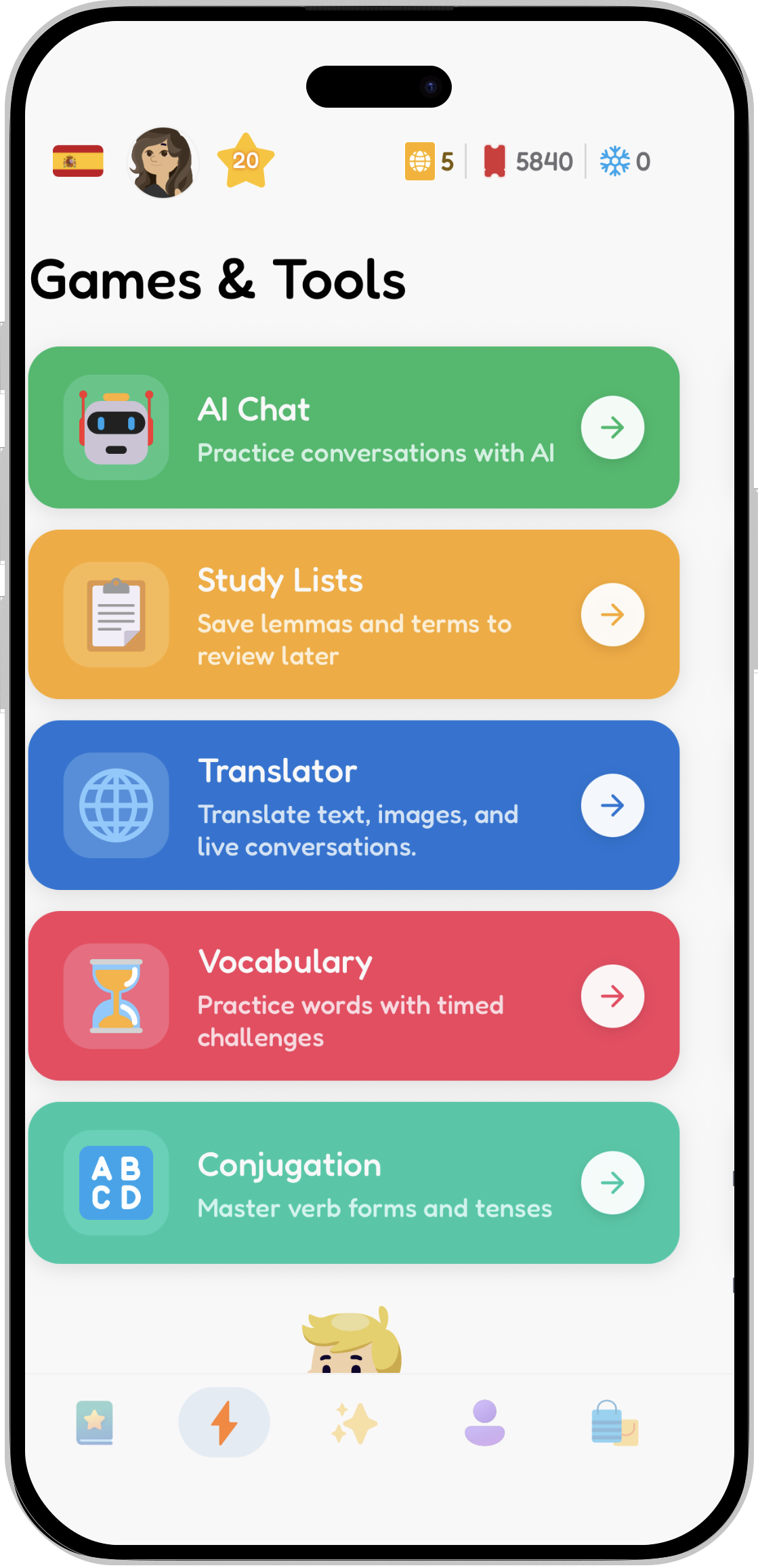
Games & Tools
Tools that every language learner needs at all stages of their learning journey.
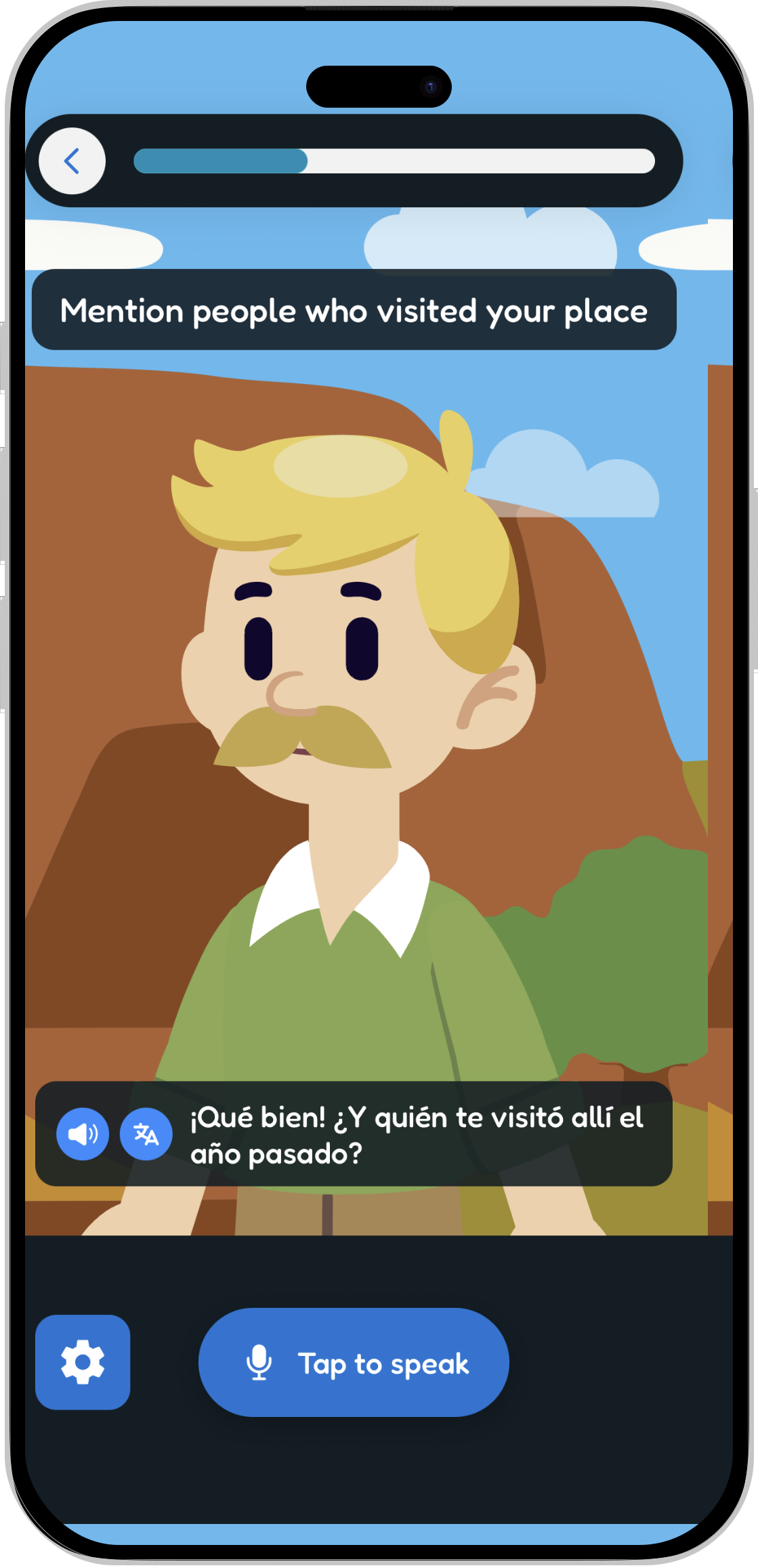
AI Chat Tutor
Practice real conversations with an AI tutor that helps you speak with confidence.
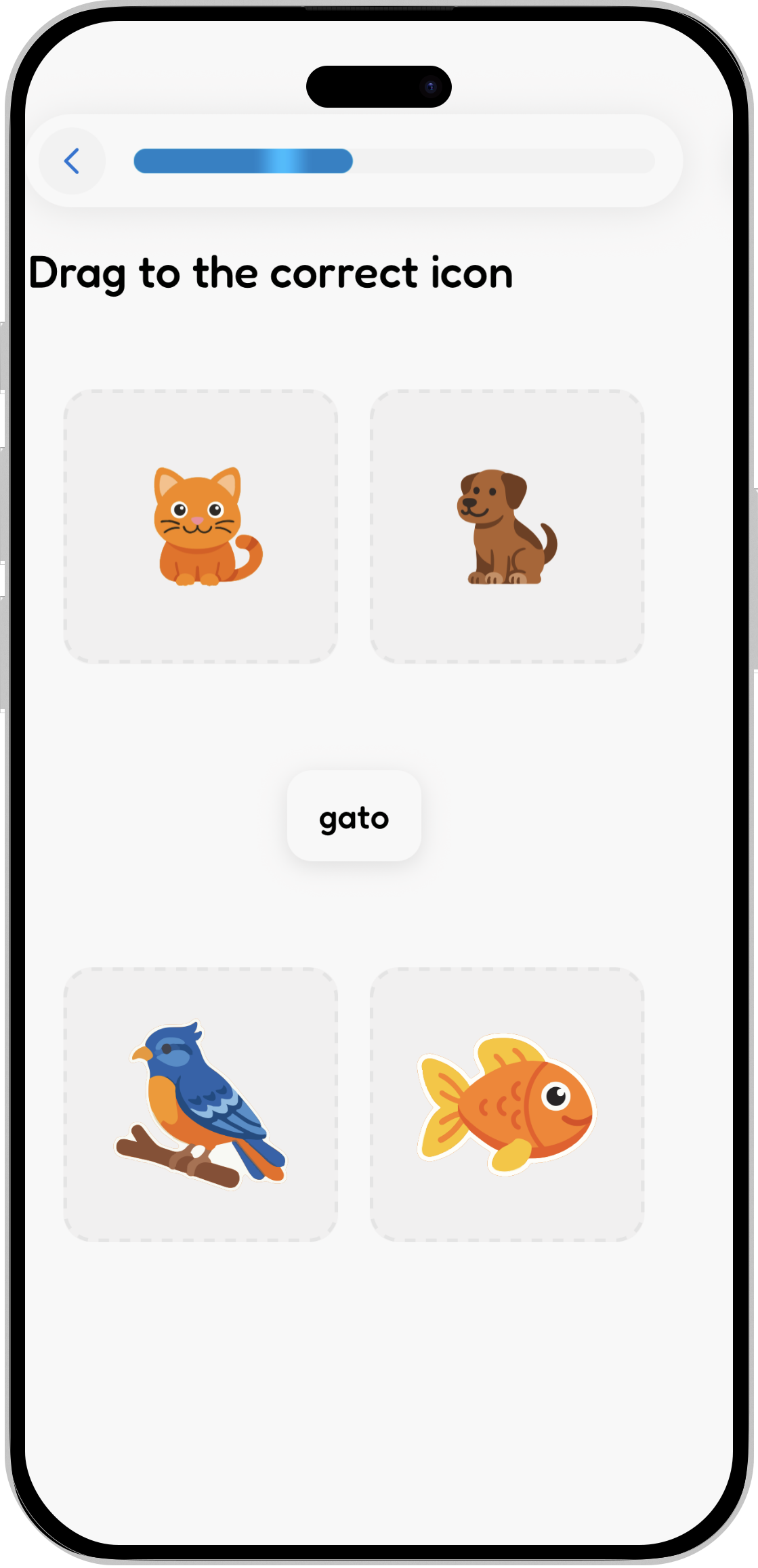
Interactive Games
A variety of games to help you learn and remember new words and phrases.


Your Realistic Path to English Fluency
Getting started with English is exciting, and as a Spanish speaker, you’re not starting from zero. Far from it. Thanks to a shared Latin history, you’ll instantly recognize thousands of words, known as cognates. But real fluency means going beyond vocabulary—it's about tackling the core differences in pronunciation, grammar, and the rhythm of how sentences are built.
This guide is built specifically for you. We’ll dive into the common hurdles Spanish speakers face, like mastering those tricky English vowel sounds that don’t exist in Spanish or figuring out why English sentences can sometimes feel like they’re put together backward. It’s all broken down into practical, manageable stages designed to build your confidence step by step.
Building a Strong Foundation
The secret to success isn't cramming; it's consistency. A focused 30 minutes of practice every day will do more for you than a frantic multi-hour session once a week. It’s all about building a solid routine with the right tools. To get the most out of your study time from day one, it’s worth exploring some powerful learning strategies for students to really optimize your approach.
The key isn't just what you learn, but how you learn it. Active practice—like speaking out loud to yourself or writing a quick journal entry in English—cements the knowledge in your brain far better than just passively reading or listening.
Using Modern Tools to Your Advantage
Today’s technology is a game-changer for language learning. There are incredible apps that can help you build vocabulary, nail down tricky grammar rules, and even connect you with native speakers to practice conversation. When you weave these tools into your daily routine, learning starts to feel less like a chore and more like a habit.
If you’re looking for the right fit, our guide on the best language learning apps can help you find a platform that clicks with your personal style.
Here’s a quick look at what you’ll find in this guide:
- Targeted Pronunciation Drills: Specific exercises for English sounds that trip up Spanish speakers.
- Clear Grammar Contrasts: Simple side-by-side comparisons that finally make English sentence structure make sense.
- Vocabulary Pitfall Alerts: How to spot and avoid those tricky "false friends" (words that look similar but have totally different meanings).
- Actionable Practice Activities: Real-world tasks you can do right away to put what you've learned into practice.
Nailing English Pronunciation When You Speak Spanish
Let’s be honest: for most Spanish speakers, pronunciation is the first real roadblock you hit. It makes perfect sense. Your mouth is a finely-tuned instrument for Spanish, with its five pure, crisp vowel sounds. Suddenly, English throws a dozen or so nuanced vowels at you, and it feels like trying to play a completely new instrument.
This isn't about memorizing rules. It's about physical training. You’re literally teaching your tongue, lips, and jaw a new kind of gymnastics. We're going to break down the most common challenges and give you a physical roadmap to making these new sounds.
Conquering Those Tricky Vowel Sounds
The biggest and most frequent mix-up? The short 'i' (ship, live, it) versus the long 'ee' (sheep, leave, eat). In Spanish, you really only have one 'i' sound, and it’s much closer to the English 'ee'. This tiny difference can lead to some pretty awkward mistakes.
- The 'ee' Sound (like in sheep): To nail this, think "smile." Your mouth should be wide, and your tongue should feel high and forward. It's a tense sound. A good trick is to say "queso" and just hold that "e" sound—you're already very close.
- The short 'i' Sound (like in ship): This is the one that takes practice. It’s a relaxed sound. Your jaw drops just a little, and your lips are neutral, not smiling. The sound feels like it comes from the middle of your mouth, not the front. It's the sound in words like this, is, and big.
Here’s a great way to feel the difference physically: say "cheap chip" out loud, very slowly. For "cheap," you’ll feel your mouth muscles tense and go wide. For "chip," feel your jaw and lips instantly relax. That physical shift is the whole secret.
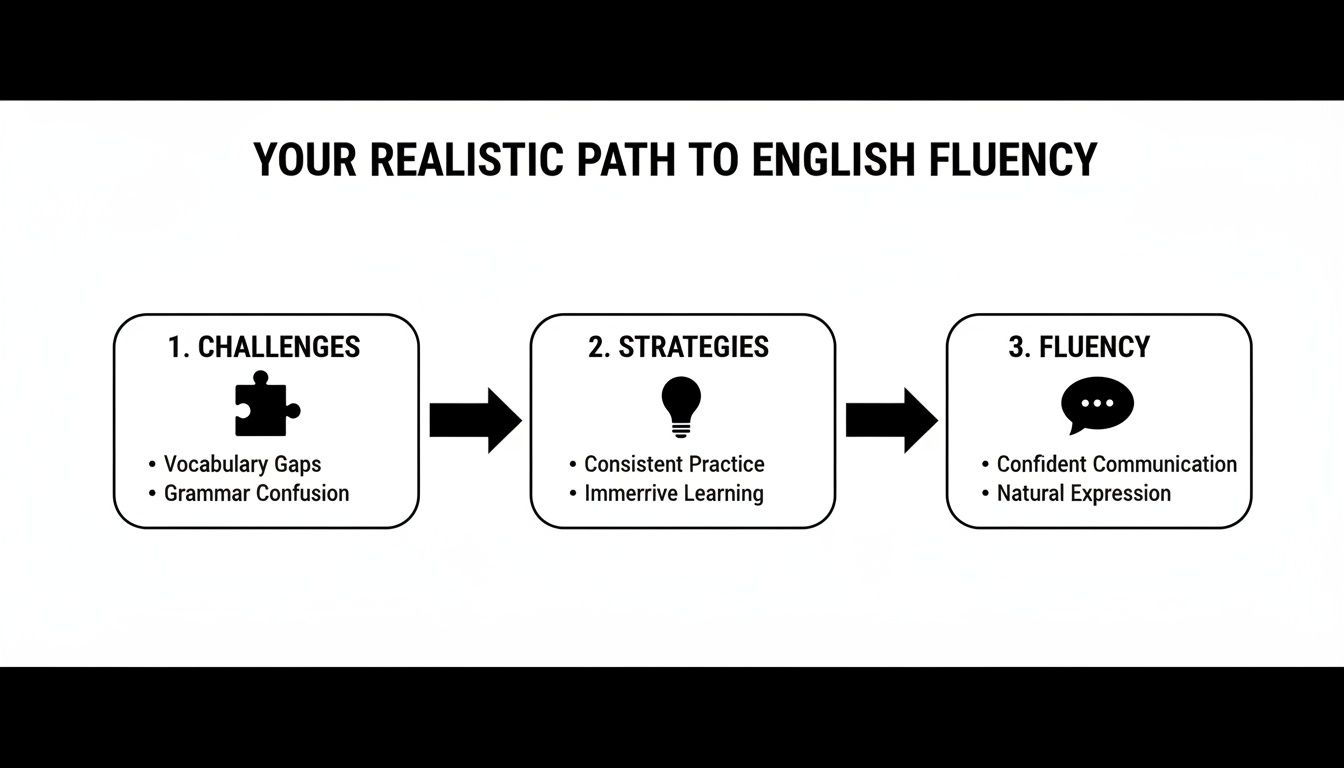
The path to fluency is all about identifying these specific hurdles and using targeted strategies to overcome them, which ultimately leads to confident communication.
Tackling Troublesome Consonants
It’s not just the vowels. A few English consonants can also feel pretty alien. Let’s focus on the two biggest culprits: the infamous 'th' sound and those clunky consonant clusters at the start of words.
The Elusive 'th' Sounds
English has two 'th' sounds that simply don't exist in most Spanish dialects, which is why many speakers default to a 'd' or 't' sound. The key is tongue placement. You have to get comfortable putting your tongue between your teeth.
- Voiceless 'th' (think, three, path): Gently place the tip of your tongue between your top and bottom teeth and just blow air. There should be zero vibration in your throat. It's pure air.
- Voiced 'th' (this, that, the): The tongue position is identical, but now you hum. Make a sound with your vocal cords. You should feel a distinct buzzing or vibration in your throat.
Try this sentence out loud, nice and slow: "I think that this is the one." Feel your tongue moving in and out for each 'th' sound. It feels weird at first, but it gets easier.
Dropping the Extra 'e' Before 's' Clusters
Words starting with an 's' followed by another consonant (stop, street, Spain) are a classic giveaway. Since Spanish words don't begin with this structure, it’s a natural reflex to add an 'e' sound for support—"estop," "estreet."
To break this habit, isolate the 's'. Start by making a long, hissing sound like a snake: sssssssss. Then, without pausing or adding a vowel, slam right into the next consonant.
- Practice: sssss-top.
- Practice: sssss-treet.
- Practice: sssss-peak.
Focusing on these nitty-gritty pronunciation details is becoming a cornerstone of modern English lessons for Spanish speakers. And the motivation is clearly there. A Pew Research Center analysis found that a record 33.2 million Hispanics in the U.S. spoke English proficiently back in 2013, a number that's only grown since.
To help you practice, here’s a quick-reference table for the sounds we’ve discussed and a few others that often cause trouble.
Common Pronunciation Hurdles and Practical Solutions
This table breaks down some of the toughest English sounds for Spanish speakers and gives you concrete, physical instructions on how to produce them correctly.
| English Sound / Word | Common Spanish Speaker Error | How to Correct It (Mouth Position) | Practice Sentence |
|---|---|---|---|
| Short 'i' (ship, it) | Sounds like "ee" (sheep, eat) | Relax your jaw and lips. The sound is short and comes from the middle of your mouth. | This is a big ship. |
| 'th' (think, the) | Sounds like 'd' or 't' | Place the tip of your tongue between your teeth and blow air (think) or hum (the). | I think this is the best. |
| 'j' (jump, job) | Sounds like 'y' (yump, yob) | Start with a 'd' sound, then push air through. It’s a hard, sharp sound. | John has a new job. |
| 'h' (hello, have) | Silent 'h' (like in Spanish) | Exhale a puff of air from your throat, like you're fogging up a mirror. | How have you been? |
| 'r' (run, red) | Tapped or rolled 'r' (like in Spanish) | Pull the middle of your tongue back and up. Your tongue tip should not touch anything. | Really rare red rocks. |
Spending just a few minutes each day on these specific sounds works wonders. Record yourself on your phone, listen to native speakers on YouTube, and don't be afraid to exaggerate the movements at first. This targeted practice retrains your muscle memory, making your English clearer and giving you a massive confidence boost in every single conversation.
Navigating Critical Grammar Differences
Grammar is where the logic of a language lives. For many Spanish speakers, English grammar can feel completely backward—like a house where the doors and windows are all in the wrong places.
What feels natural in Spanish, like dropping the subject of a sentence, can make you sound strange or even be misunderstood in English. This is a massive hurdle, but here's the secret: once you understand why the differences exist, they become much easier to master.
It’s not about memorizing endless rules. It’s about building a new intuition for how English sentences click together. The good news? Once you nail a few core concepts, the chaos starts to disappear. Let's break down the biggest pain points one by one.
The Ever-Present Subject Pronoun
Let's start with the first and most important habit you need to build: always include the subject pronoun (I, you, he, she, it, we, they). In Spanish, your verb endings are so specific that the subject is obvious. "Voy al mercado" is perfectly clear without saying "Yo."
English verbs don't change nearly as much. For instance, "go" is the same for "I," "you," "we," and "they." Take away the pronoun, and the sentence completely falls apart.
-
Spanish: Voy al mercado. (The subject "Yo" is clearly understood)
-
English: I go to the market. (Go to the market is a command, not a statement)
-
Spanish: ¿Quieres café? (The subject "Tú" is clearly understood)
-
English: Do you want coffee? (Do want coffee? is just plain wrong)
The takeaway is simple but powerful: every complete English sentence needs a subject. Making this a non-negotiable habit is one of the fastest ways to make your English sound natural.
The demand for lessons that clarify these fundamentals is huge. With roughly 1.5 billion people learning English and 519 million native Spanish speakers, the need for this kind of focused instruction has never been greater. The global language learning market, valued at $70.69 billion in 2022, is projected to hit $187.69 billion by 2028, and a huge part of that growth comes from digital tools built for specific language pairs like this one. You can read more about these global language trends and the importance of Spanish for a deeper dive.
Understanding the Role of Auxiliary Verbs
Okay, let's talk about do, does, and did. These "helper" verbs are probably the most confusing concept for Spanish speakers. Why? Because they simply don't exist in Spanish for making questions or negative statements.
In Spanish, you make a sentence negative by just adding "no" before the verb (No hablo inglés). To ask a question, you just change your tone (¿Hablas inglés?). English, however, requires an extra piece.
Forming Questions and Negatives
Think of do/does/did as a special tool that carries the "question" or "negative" signal for most verbs.
Negatives:
- You don't say: "I no speak English."
- You say: "I do not (don't) speak English."
- She doesn't say: "She no live here."
- She says: "She does not (doesn't) live here."
Questions:
- You don't ask: "Speak you English?"
- You ask: "Do you speak English?"
- You don't ask: "Lived she here?"
- You ask: "Did she live here?"
This structure applies to almost all verbs except "to be" (am, is, are) and modal verbs like can, should, and will. Getting the hang of this is a game-changer.
Adjective and Noun Order
Here's another one that requires retraining your brain. In Spanish, adjectives usually come after the noun they describe—un coche rojo. It adds a bit of descriptive flair.
In English, the rule is strict: the adjective almost always comes before the noun. This isn't just a style choice; it's a fundamental law of the language.
Let's look at the difference:
| Spanish Structure | Direct (Incorrect) Translation | Correct English Structure |
|---|---|---|
| El perro grande | The dog big | The big dog |
| Una casa bonita | A house beautiful | A beautiful house |
| La chica inteligente | The girl intelligent | The intelligent girl |
Nailing this word order is a huge step toward fluency. A great way to practice is to just describe things around you, forcing yourself to put the adjective first: "a blue pen," "a hot coffee," "a heavy book."
Cracking the Code on Prepositions
Finally, we get to prepositions—those tiny words like in, on, and at that cause so much frustration. Spanish uses prepositions like en very broadly, but English is maddeningly specific and all about context.
Here’s a quick-and-dirty guide for time and place:
-
AT is for specific, precise points.
- Time: at 3 PM, at midnight, at the moment
- Place: at the bus stop, at the corner, at 123 Main Street
-
ON is for surfaces or general days/dates.
- Time: on Tuesday, on my birthday, on October 31st
- Place: on the desk, on the wall, on the floor
-
IN is for enclosed spaces or larger periods of time.
- Time: in July, in 2025, in the morning, in the 80s
- Place: in the car, in Mexico, in the box
Mastering these differences takes time and conscious effort. By zeroing in on these four areas—subject pronouns, helper verbs, adjective order, and prepositions—you’re tackling the most common mistakes head-on and building a solid foundation for speaking English with clarity and confidence.
Avoiding Common Vocabulary Traps and False Friends
Your Spanish vocabulary is a massive head start on your English journey, but be careful—it can also lay some clever traps. I’m talking about "false friends," or falsos amigos—those words that look so familiar but mean something completely different. Getting these right is a huge step in making your English sound natural.
It’s not just about memorizing lists. It’s about building an instinct for context so you can navigate the subtle (and sometimes not-so-subtle) differences between the two languages. Let's dive into the most common pitfalls.

Recognizing Deceptive Cognates
The most famous false friend is probably actually vs. actualmente. They look almost identical, but their meanings couldn't be more different. This single pair shows you the core problem: false friends feel so familiar that you use them with confidence, only to realize you’ve said something you didn’t mean.
- Actually means "in reality" or "in fact" (en realidad).
- Example: "He looks young, but he's actually over 40."
- The Spanish word actualmente means "currently" or "nowadays" in English.
- Example: "Currently, I am working from home."
This goes way beyond single words and can lead to some seriously awkward conversations. Imagine telling an English-speaking colleague, "I'm embarrassed," when you mean you're pregnant (embarazada). It’s a classic mistake that shows exactly why mastering false friends is so crucial.
The real goal isn't just to avoid mistakes. It’s about building the confidence to choose the right word without a second thought. Think of it as fine-tuning your linguistic GPS.
Top 15 False Friends Every Spanish Speaker Should Know
Here’s a quick-reference table of some of the trickiest false friends out there. Instead of just trying to memorize the list, a much better approach is to create your own sentence for each one. This locks the correct meaning into your memory by putting it into a real context.
| English Word | What It Actually Means | Misleading Spanish Cognate | Correct Spanish Translation |
|---|---|---|---|
| Actually | In reality, in fact | Actualmente (Currently) | En realidad / De hecho |
| Embarrassed | Ashamed, self-conscious | Embarazada (Pregnant) | Avergonzado/a |
| Library | A place to borrow books | Librería (Bookstore) | Biblioteca |
| Carpet | Soft floor covering | Carpeta (Folder/File) | Alfombra / Moqueta |
| Exit | A way out | Éxito (Success) | Salida |
| Sensible | Practical, reasonable | Sensible (Sensitive) | Sensato / Razonable |
| Fabric | Cloth, material | Fábrica (Factory) | Tela / Tejido |
| Rope | Thick cord for tying | Ropa (Clothes) | Cuerda / Soga |
| Attend | To go to an event | Atender (To help/assist) | Asistir a |
| Argument | A disagreement, a fight | Argumento (Plot/Reasoning) | Discusión / Pelea |
| Assist | To help | Asistir (To attend) | Ayudar |
| Realize | To become aware of something | Realizar (To carry out/make) | Darse cuenta |
| Success | Achievement of a goal | Suceso (Event/Incident) | Éxito |
| Pretend | To feign, to act like | Pretender (To intend/try) | Fingir / Simular |
| Introduce | To present someone | Introducir (To insert/put in) | Presentar a alguien |
Keep this table handy. Catching yourself before you use one of these incorrectly is a huge win and will make your English much clearer.
Tackling Phrasal Verbs
Okay, let's talk about another vocabulary hurdle: phrasal verbs. These little combinations like run into, get over, and look forward to can be tricky because they often have no direct, one-word translation in Spanish. You have to learn them as a complete chunk of meaning.
The secret? Learn them in context. Don't just memorize "get over = superar." Instead, learn it inside a real scenario: "It took him a long time to get over the flu." This approach connects the phrase to a situation, which makes it infinitely easier to remember and use correctly.
Here are a few essential ones to get you started:
- Look up: To search for information. ("If you don't know the word, look it up in the dictionary.")
- Turn down: To refuse or reject an offer. ("She had to turn down the job offer.")
- Come up with: To think of an idea or plan. ("He came up with a great idea for the project.")
- Run out of: To use all of something and have none left. ("We've run out of milk.")
Learning phrasal verbs is a bit like learning a new set of informal expressions. And if you really want to dive deep into conversational English, understanding some common English slang words is another fantastic way to make your speech sound more authentic and fluent.
Creating a Sustainable Learning Routine
Fluency isn’t built in a weekend. It doesn't come from a few marathon study sessions you cram in when you feel motivated. Real, lasting fluency comes from small, consistent actions that slowly become second nature.
The trick is to build a learning routine that actually fits into your life, not one that forces you to blow up your entire schedule. You want to weave English practice into your daily habits so seamlessly that it stops feeling like a chore and starts feeling automatic.
Designing Your Beginner’s Daily Habit Loop
When you're just starting out, the mission is simple: build a core vocabulary and get comfortable with basic sentence structures. The best way to do that is with tiny, manageable daily habits.
Forget about blocking out two hours on a Saturday. Instead, aim for just 15-20 minutes of focused practice every single day. That consistency is far more powerful for building the neural pathways you need to retain a new language.
Here are a few simple habits to get you started:
- Label Your World: Grab some sticky notes and label common things around your house. La mesa becomes the table, and la silla is now the chair. You'll see these words constantly, reinforcing them without even trying.
- Narrate Your Life: As you make your morning coffee, say the simple sentences out loud in English: "I am making coffee. I am adding milk." This creates a direct link between the action and the English words, helping you bypass that clunky mental translation step.
- Use “Dead Time” for Flashcards: Got five minutes while waiting for the bus or during a commercial break? That’s perfect for a quick flashcard session on your phone. Focus on the most common verbs and nouns to start.
These small actions create what's known as a "habit loop." The cue (like making coffee) triggers the routine (narrating in English), which gives you a small reward (a little jolt of progress). That’s how learning becomes automatic.
Your first goal isn't to make huge leaps. It's to lay a foundation of consistency. Every small interaction with English builds momentum for what comes next.
Evolving to an Intermediate Immersion Strategy
Once you've got a decent vocabulary and can string together a few simple sentences, your routine needs to change. The focus shifts from memorizing words to actually using the language through immersion.
At this stage, you start integrating English into things you already do for fun. English becomes less of a subject you "study" and more of a tool you use to access interesting content.
Here’s how to level up your routine:
- Switch Up Your Entertainment: Re-watch a favorite TV show or movie, but this time, switch the audio to English and turn on English subtitles. You already know the plot, so you can focus completely on the language.
- Curate an English Social Feed: Follow English-speaking influencers, creators, or news outlets on your social media. Suddenly, your daily scroll becomes a bite-sized lesson in modern slang and everyday phrases.
- Start a Five-Minute Journal: Right before bed, write just three sentences in English about your day. It can be super simple: "Today was a busy day. I had a good lunch. I am tired now." This is a low-pressure way to build writing confidence.
To get a better handle on spoken English, consider using video transcription services to analyze podcasts or YouTube videos. Reading along as you listen is a fantastic way to connect spoken sounds to their written forms, which is a huge help for those tricky pronunciation spots.
Advancing Your Routine for Nuance and Fluency
For advanced learners, the game changes again. The goal is no longer just to communicate but to do so with nuance, confidence, and flair. Your routine should now actively push you out of your comfort zone and into more complex, spontaneous situations.
You need to seek out challenges that force you to think on your feet in English. This is where you master things like cultural context, humor, and the art of a good debate.
Advanced Strategies for Your Daily Practice:
- Jump into Debates: Find online forums or language exchange partners to discuss complex topics. Force yourself to form and defend your opinions entirely in English.
- Consume Native-Level Content: Ditch the learner materials. Start listening to podcasts, watching documentaries, and reading articles made for native English speakers on subjects you genuinely find interesting.
- Think in English: This is a big one. Consciously switch your internal monologue to English for a set period of time each day. Start with 10 minutes and work your way up.
The demand for high-level English skills among Spanish speakers is massive and growing. The global English learning market is projected to reach $69.62 billion by 2029, largely driven by digital platforms creating specialized English lessons for Spanish speakers that tackle specific grammar and phonetic hurdles.
To keep your motivation high at this stage, you have to keep it interesting. Adding game-like elements to your practice can make even the most complex grammar feel less like a grind. Check out our guide on gamification in language learning for some fresh ideas. A routine that works is one that grows with you, always providing just the right amount of challenge to keep you moving toward fluency.
Common Questions I Hear from Spanish Speakers
As you get deeper into your English journey, a few questions always seem to pop up. These aren't just textbook problems; they're the real-world hurdles that nearly every Spanish speaker I've worked with has to clear.
Getting straight answers to these can save you a ton of frustration. Let’s tackle four of the most common ones right now.
What’s the Absolute Fastest Way for a Spanish Speaker to Learn English?
Look, there's no magic pill. But the fastest route is always through consistent, active use. Listening passively is good, but actually speaking is what builds real fluency. You need to find ways to immerse yourself daily, even if it’s just for a few minutes.
Here are a few things that actually work:
- Go English-only on your devices: Switch the language on your phone, computer, and social media. This is a game-changer because it forces you to learn and use practical, everyday words you’d otherwise never look up.
- Start speaking from day one: Seriously. Don't wait until you "feel ready." Find a language exchange partner online and just start talking. A messy 30-minute chat every day is way more powerful than cramming for hours once a week.
- Watch and listen to things you actually like: Binge that Netflix series you already love, but this time in English. Find a podcast about football or video games. When it feels like entertainment instead of work, you’ll stick with it.
Should I Learn American or British English?
Honestly, this decision should come down to your own goals. When you're just starting out, the differences are pretty small, but it’s a good idea to pick a lane and stay in it for the sake of consistency.
Just ask yourself: Where will I be using English the most? If you're planning to work with companies in the US, travel to the Americas, or just consume a lot of American media, then focus on American English. If your plans involve Europe or other places with strong historical ties to the UK, then British English might serve you better.
But here’s the most important part: native speakers of both can understand each other perfectly. The core grammar and vocabulary are the same. Don't let this choice freeze you up. Just pick the one that makes the most sense for your life and move on.
How Do I Stop Translating in My Head?
This is a huge milestone: thinking directly in English. It's a skill you have to build intentionally by creating a direct link between a concept and its English word, completely skipping the Spanish middleman.
A super effective trick is to start narrating your daily life in your head, using simple sentences. As you get dressed, think, "I'm putting on my shirt. Now I am grabbing my keys." It feels silly at first, but it works.
Another habit you need to build is using an English-to-English dictionary (like Merriam-Webster or the Oxford Learner's Dictionaries) instead of a bilingual one. This forces your brain to stay in "English mode," connecting new words to English words you already know. It’s a slow burn, but this inner monologue habit is the fastest way to stop translating and start thinking.
Are Language Apps Enough to Become Fluent?
Apps are fantastic for what they do best: building your vocabulary foundation and getting you into a daily learning habit. They make drilling words and basic grammar feel like a game, which is perfect when you're starting out.
But let's be real—they are not enough to make you fluent on their own.
Fluency is messy. It's born from unpredictable, real-world conversations. You absolutely must get practice that apps can't give you. This means talking to native speakers, trying to understand different accents in movies, and learning to navigate the awkward pauses and interruptions of a real chat.
Think of apps as your training wheels. They're essential for getting your balance, but you have to take them off to really learn how to ride.
Ready to stop translating and start thinking in English? PolyChat offers a fun, gamified approach to build your core vocabulary and grammar skills without limits. Our app provides endless practice with interactive conversation games and conjugation tools to help you build a solid foundation for fluency. Download PolyChat today at https://www.polychatapp.com and start your journey.

Jean-Baptiste Bolh
Co-Founder
Applied AI