Learn a Language from Any Language How to Start Smart

You've opened a beginner course in your strongest language, but the explanations feel less clear than the target language itself. Or perhaps you live in Germany, study in English, and want to learn Italian without routing every sentence through your native language. Polyglots, expats, international students, and multilingual families face this problem constantly: the “obvious” base language isn't always the most useful one.
You can learn a language from any language when you choose the right bridge, control interference, and make every translation serve a learning purpose. The method isn't about collecting apps or forcing yourself to abandon your native language. It's about selecting the language that gives you the clearest explanations, the best resources, and the most useful mental connections.
UNESCO reports that 40% of people globally lack access to education in the language they speak and understand fluently, and that this share reaches 90% in some low- and middle-income countries. More than a quarter of a billion learners are affected, which makes flexible multilingual learning an access issue, not a niche preference. (UNESCO's report on multilingual education)
Ready to Learn a Language?
Try PolyChat's engaging language lessons, interactive learning games and put your new vocabulary to the test!
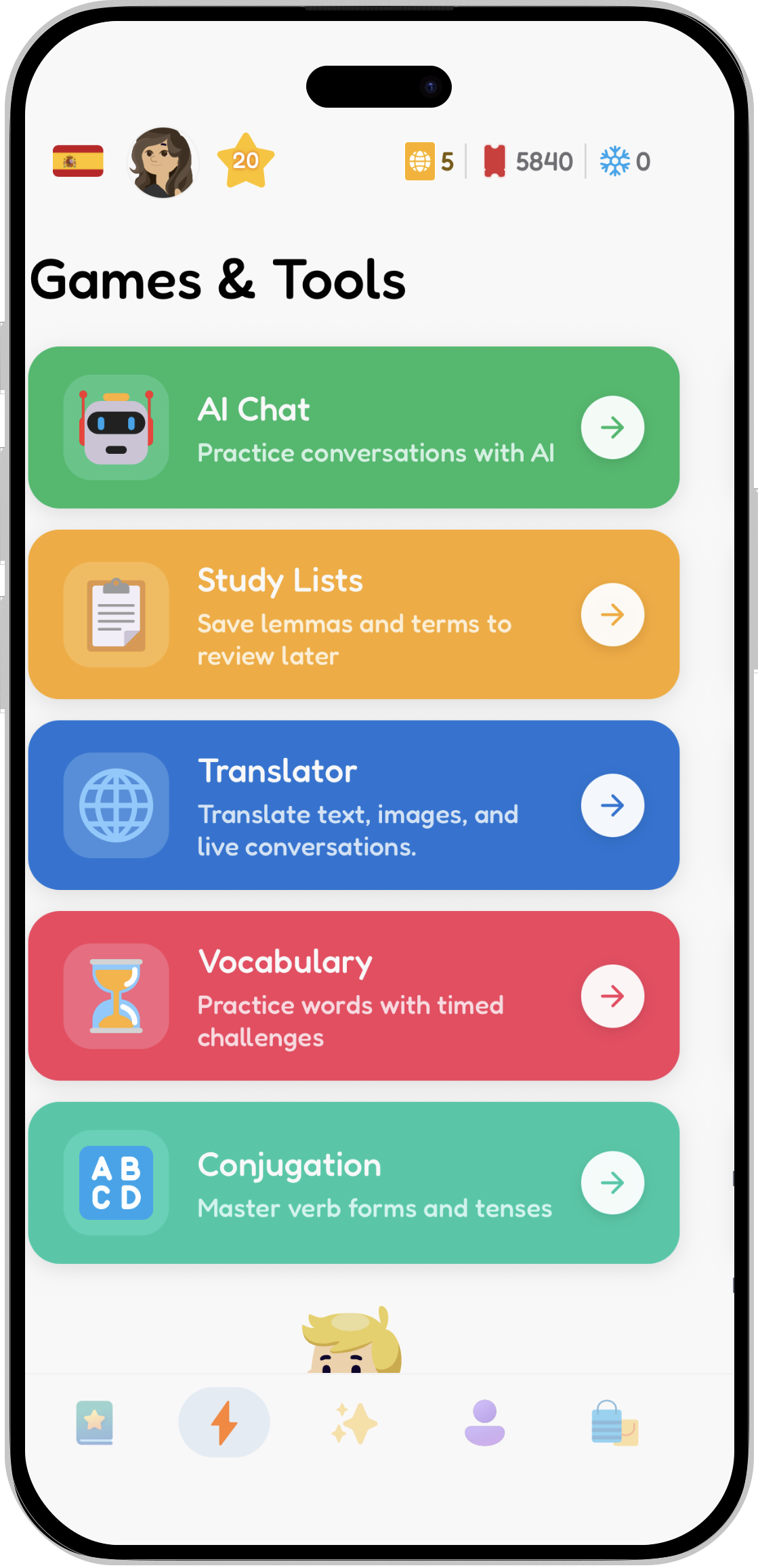
Games & Tools
Tools that every language learner needs at all stages of their learning journey.
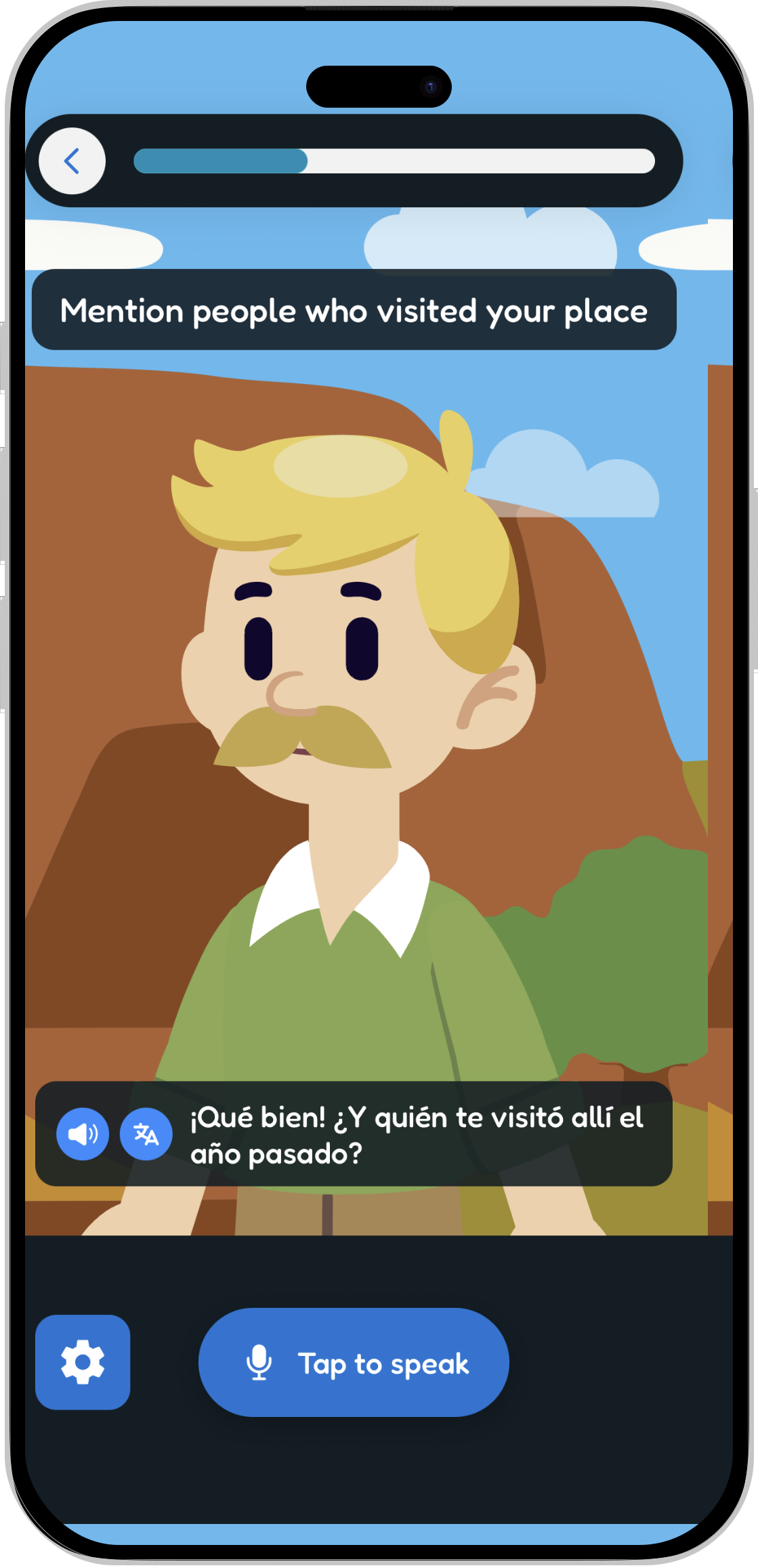
AI Chat Tutor
Practice real conversations with an AI tutor that helps you speak with confidence.
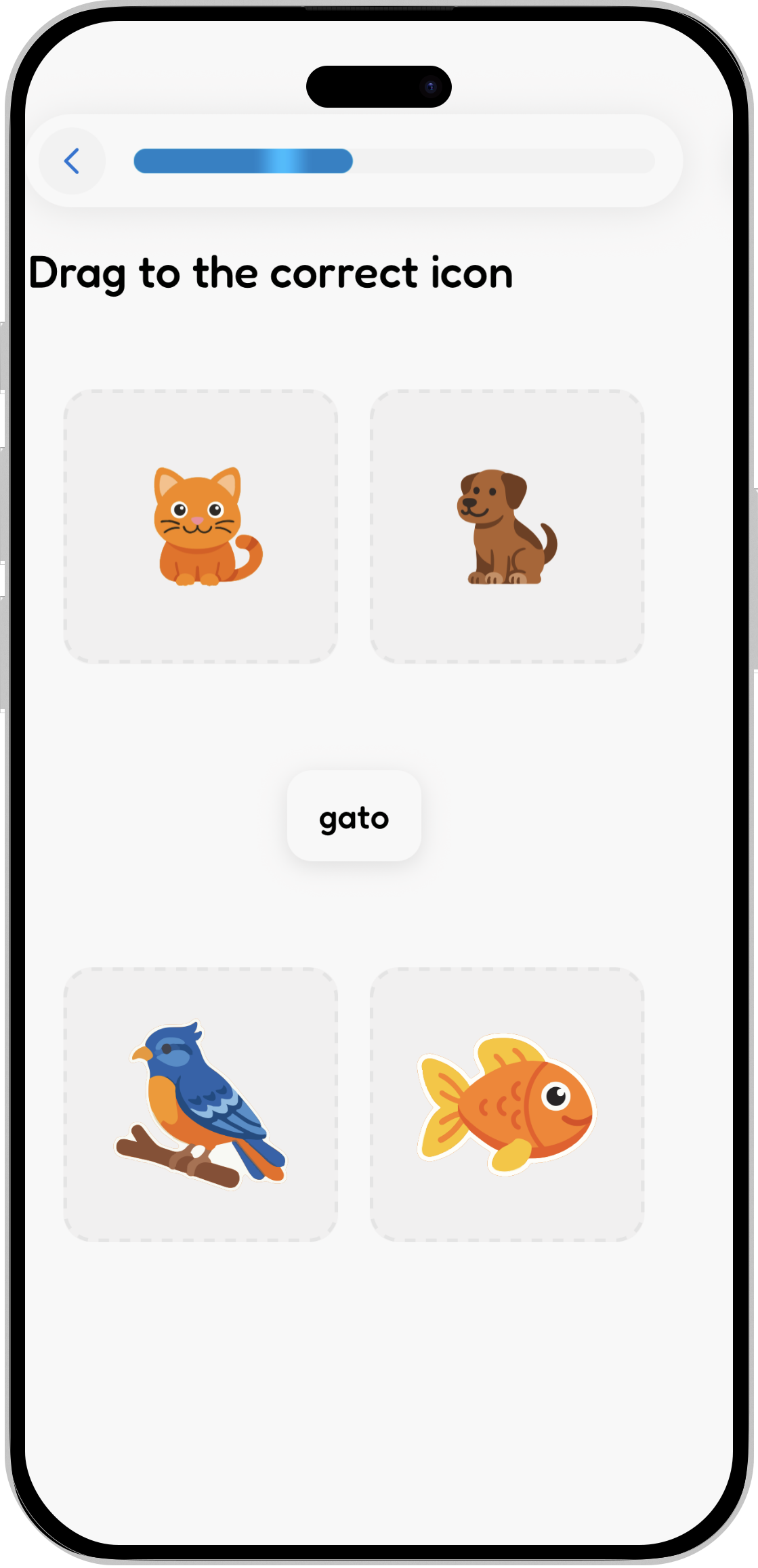
Interactive Games
A variety of games to help you learn and remember new words and phrases.


Why Learning From Any Language Changes Everything
A Spanish-speaking student may learn English through university materials, then use English to learn Dutch. An English-speaking expat may understand French explanations more easily than unfamiliar grammar terminology in their native language. Someone who speaks Russian and Belarusian may find Polish structures more transparent through one of those related languages than through English.
The advantage comes from reduced distance. Your strongest learning language might share vocabulary, sentence patterns, writing conventions, or cultural context with the target language. It might also have better textbooks, teachers, dictionaries, and conversation partners available for that language pair.

The bridge language is a tool, not an identity test
A pivot language can speed up access to good explanations, but it can also introduce mistakes. Similar words may be false friends. A grammar rule that works in your bridge language may not transfer to the target language. If you understand the bridge language only weakly, you'll spend your study time decoding explanations instead of learning the target.
Use this simple test before committing:
- Comprehension: Can you follow grammar explanations without translating every sentence?
- Resource quality: Can you find a structured course, reliable dictionary, and useful example sentences?
- Transfer value: Does the bridge language offer genuine similarities, or are you choosing it only because it's available?
- Emotional ease: Do you feel comfortable making mistakes through this language?
Translation technology makes more combinations possible, but it doesn't remove the need for judgment. Reviews of machine translation in language education identify a gap in practical guidance about the right educational scenarios and warn that unstructured use can encourage superficial learning or avoidance of the target language. (Research on machine translation literacy in language learning)
The sustainable approach is deliberately modest. Choose one target language, one primary bridge, and a small set of dependable tools. Protect your energy before enthusiasm turns into overload. A practical guide to Rooy Development's burnout prevention can help if you're balancing several languages or ambitious study plans.
Choose Your Starting Point and Map Your Goals
Start with the outcome, not the app. “Learn Japanese” is too broad to guide daily decisions. “Handle restaurant orders, read signs, and ask for directions on a trip” tells you what vocabulary, listening practice, and speaking tasks deserve attention.

Use a five-part decision process
-
Define your reason. Travel, work, family, school, reading, and exams require different priorities. A traveler needs phrases and listening cues, while a professional may need formal writing and role-specific vocabulary.
-
Assess your base language. Compare your native language with every language you know well. Pick the one in which you can understand explanations naturally and notice useful similarities. A related language can help with vocabulary and grammar, but only if you can recognize where the similarities end.
-
Set a visible milestone. Choose an outcome you can demonstrate, such as introducing yourself, writing a short message, following a simple dialogue, or completing a work-related exchange. A milestone should describe an ability, not a vague feeling of fluency.
-
Audit the tools. Search for a dictionary, pronunciation reference, grammar course, and example-rich content in your selected bridge language. If a target language is well supported from English but poorly supported from your strongest other language, English may still be the practical choice.
-
Reserve study blocks. Put short sessions on your calendar and decide what each session does. A plan that separates vocabulary, listening, speaking, and review is easier to maintain than an undefined promise to “study more.”
When your native language is still the better choice
Use your native language when the target language has unfamiliar concepts, when the bridge language causes confusion, or when you need precise explanations. Beginners often benefit from clarity more than cleverness. You can switch later once basic structures are familiar.
Use another foreign language when it gives you better access to the target language or when you want to develop both languages through the same material. Research on multilingual machine translation in language learning indicates that benefits depend on context and may be stronger for learners with existing proficiency, while learner and teacher attitudes can differ across language pairs. (Research on multilingual translation and language learning)
Write your decision down: “I'll study Portuguese from Spanish because I understand Spanish grammar comfortably and the comparison helps me notice shared patterns. I'll use English only when a concept needs clarification.” That sentence prevents constant switching.
Build Your Core Vocabulary and Grammar Foundation
Your first task isn't memorizing isolated translations. It's building a small working system that lets you recognize patterns, form sentences, and retrieve useful language under pressure.
Start with a high-frequency list of roughly 800 words, but treat that figure as a working target rather than a promise of fluency. Organize words around actions and situations: eating, moving, asking, describing, agreeing, refusing, paying, and repairing misunderstandings. A word becomes useful when you can place it in a sentence.

Build from phrases instead of word piles
Create a three-column personal dictionary:
| Target language | Bridge-language meaning | Your example |
|---|---|---|
| Target word or phrase | Short, natural explanation | Sentence connected to your life |
Add gender, plural forms, irregular changes, or pronunciation notes when they matter. If you're learning German through English, record the article with the noun. If you're learning Spanish through French, mark a word that looks familiar but behaves differently.
False friends deserve their own warning list. Write the misleading pair, its actual meaning, and one sentence for each language. This turns a likely error into a deliberate memory cue.
Grammar should produce language
Choose a compact set of structures:
- Statements: present, past, and future patterns.
- Questions: word order, question words, and polite requests.
- Negation: how to say no, not, never, and nothing.
- People and actions: pronouns, common verb changes, and agreement.
- Connections: because, but, so, if, and when.
Study each pattern through several example sentences. Then change one element at a time. Replace the subject, tense, object, or location. This forces you to understand the structure instead of copying a memorized line.
Spaced retrieval matters here. A 2022 meta-analysis of 48 experiments involving 3,411 participants found a medium-to-large effect of spacing on second-language learning, with delayed retention showing the key advantage over immediate performance. (The 2022 meta-analysis of spaced learning) For additional vocabulary organization ideas, use this guide to the best way to learn vocabulary.
Don't translate every word forever. At first, the bridge language gives you access. As your target-language examples accumulate, let definitions, pictures, context, and target-language explanations take over.
Create a Daily Practice Routine That Actually Sticks
A reliable routine has a low entry cost and a clear job for every minute. You don't need every activity every day, but you do need regular contact with the target language and repeated opportunities to retrieve what you've studied.
Try this compact cycle:
- Listening: Play a short dialogue and identify the situation, speakers, and familiar phrases.
- Speaking: Retell the dialogue, answer a question, or describe your day without reading.
- Reading: Study the transcript, underline recurring structures, and check only essential words.
- Writing: Produce a short message using the same pattern with your own details.
- Review: Retrieve older vocabulary before adding new material.
If you have only a brief window, begin with retrieval rather than rereading. Hide the translation, recall the target phrase, say it aloud, and then check. Recognition feels easy because the answer is visible. Retrieval exposes what you can use.
Give each level a different workload
Beginners need controlled material, clear audio, and sentence frames. Intermediate learners should increase the amount of unscripted listening and use short conversations to expose gaps. Advanced learners benefit from topic-specific vocabulary, correction of recurring errors, and sustained interaction.
A spaced system should become less repetitive over time. A nine-year foreign-language word-pair study found that longer relearning intervals improved long-term retention, and that 13 sessions spaced at 56-day intervals produced retention comparable to 26 sessions spaced at 14-day intervals. (The long-horizon vocabulary study) The lesson is practical: review before forgetting, then allow the interval to grow when recall becomes reliable.
Use a progress log that records abilities rather than time alone. Note whether you understood a dialogue, completed a role-play, wrote a message without a translator, or recovered from a missed word. For ideas on making routines stick, this review of habit-building apps offers a useful comparison of habit support.
A short session that you repeat beats an elaborate plan you avoid. For guided practice on retrieval schedules, see this resource on spaced repetition for language learning.
Use the video below as a model for adding focused listening or speaking practice to your routine.
Use Translators and AI Tools Without Sabotaging Progress
A translator can answer a question in seconds. It can also hide the exact difficulty you need to practice. The difference lies in whether you use the tool to investigate language or to avoid producing it.
| Situation | Productive use | Risky use |
|---|---|---|
| You meet an unknown phrase | Check meaning, pronunciation, and example sentences | Copy the translation and move on |
| You write a message | Draft it first, then compare and inspect corrections | Generate the whole message without reading it |
| You're unsure about grammar | Ask for a contrast between two forms | Accept the first explanation without testing examples |
| You need conversation practice | Speak, retrieve, and request targeted feedback | Let the tool translate every response immediately |
A practical machine translation protocol
First, attempt the sentence yourself. Second, compare your version with the output. Third, identify the difference: word choice, tense, agreement, word order, politeness, or idiom. Finally, save a corrected example and produce a new sentence that follows the same pattern.
When the output seems surprising, check it against a second resource. A bilingual dictionary, learner grammar reference, or native-speaker correction can reveal ambiguity. Pay special attention to short words, pronouns, prepositions, articles, and polite forms. These small elements often carry more grammatical information than the main vocabulary.
AI can explain a rule at your level, generate a controlled dialogue, quiz you from your personal dictionary, or correct a short paragraph. Ask it to show alternatives and explain why one fits your context. Don't ask it to do the learning task while you watch.
For audiovisual practice, understanding how tools work can help you evaluate options, including resources that find the best video dubbing AI. Keep the same standard: inspect the output, compare it with the original, and use the difference as material.
Polychat's AI language learning tools fit this active model when you use conversation and translation activities for retrieval rather than passive copying. The technology is useful, but your attention remains the deciding factor.
Put It All Together With Polychat and Keep Momentum
The system is straightforward: choose a target outcome, select the clearest bridge language, build phrases and grammar patterns, retrieve them on a growing schedule, and use translation or AI only when it creates a learning opportunity.
A platform such as Polychat combines lessons, vocabulary activities, conversation and translation games, conjugation practice, a personal dictionary, progress tracking, and a free translator. It supports learning across 15+ languages, including Spanish, French, German, Italian, Portuguese, Dutch, Swedish, Danish, Norwegian, Romanian, Polish, Czech, Croatian, Catalan, Albanian, English, and Vietnamese. Learners can use one foreign language as the starting point for another, which makes it relevant to multilingual study plans.
Keep your next action concrete:
- Write your target outcome in one sentence.
- Choose the language you'll use for explanations.
- Create your first phrase set around a real situation.
- Schedule a short retrieval session for tomorrow.
- Test yourself without translation before checking your answer.
Language learning becomes more manageable when every tool has a defined role. Your native language can clarify, your bridge language can connect, and your target language must increasingly carry the work.
Use Polychat to practice lessons, vocabulary, conjugation, conversation, and translation from the language that works best for you. Start with one target, complete a focused session today, and let consistent retrieval turn your multilingual route into usable communication.

Jean-Baptiste Bolh
Co-Founder
Applied AI