How to Learn Portuguese Fast A Realistic Action Plan


Learning Portuguese fast is less about talent than sequence. Pick one variant, build a short daily loop around vocabulary, listening, speaking, and review, and start using the language before you feel ready. That combination creates momentum much faster than collecting grammar notes and waiting for the “right time” to talk.
Your Blueprint for Rapid Portuguese Fluency
If your goal is speed, keep the plan simple: choose Brazilian or European Portuguese, study every day across four skills, speak from day one, and follow a 30- or 90-day progression instead of random lessons. The fastest learners do not do everything at once; they repeat a small set of useful actions until those actions become automatic.
For most beginners, that means this daily sequence: learn a small batch of high-frequency words, listen to beginner audio with text support, say those words out loud in short sentences, and review them with spaced repetition. I prioritized this order because it gets you to your first real interaction sooner than textbook-first study, which often leaves beginners able to explain grammar but unable to answer a simple question.
A realistic target is not “fluency in a month.” It is much more practical to aim for introductions, greetings, travel basics, and short personal conversations in your first few weeks, then expand into past and future talk over the next two months. One reason this works is that early progress in Portuguese can be surprisingly visible: the learning estimates collected by 17 Minute Languages suggest about 4.9 hours for a basic 300-word vocabulary and 9.8 hours for an A1-level 600-word base, even though real outcomes vary by learner.
Portuguese is also worth the effort because it opens a large language world. It is spoken by roughly 260 to 267 million people across Brazil, Portugal, parts of Africa, and major diaspora communities, as outlined in Babbel’s overview. That scale matters: you are not studying for a narrow niche, but for travel, media, relationships, and work across multiple countries.
What to Do in Week 1
In your first seven days, ignore advanced grammar and build a usable starter kit. Learn greetings, introductions, numbers, yes/no questions, courtesy phrases, and 25 to 40 high-frequency words. Pair that with 5 to 10 minutes of beginner audio daily and one tiny speaking task, such as introducing yourself, ordering coffee, or saying where you live.
First, Figure Out Your "Why"
Before you even touch a verb conjugation, you need to get crystal clear on your core motivation. Why are you doing this? Is it to backpack through Brazil, connect with your family’s heritage, or land a better job? Your "why" is the fuel that will keep you going when you hit an inevitable roadblock.
For instance, if your goal is a three-week trip to Lisbon, you’ll want to zero in on travel phrases, ordering food, and asking for directions. If it’s for a business meeting in São Paulo, you’ll be prioritizing formal vocabulary and professional etiquette. A clear goal dictates your entire strategy.
A huge piece of learning quickly is actually making things stick. It’s worth looking into some neuroscience strategies to retain what you read to make sure your study time isn't wasted.
The Four Pillars of Rapid Portuguese Learning
The four pillars still matter, but they work best as a sequence, not just a concept list: first get daily exposure, then do focused practice, then use tools that reduce friction, then review what would otherwise fade. In my experience, beginners waste the most time when they try to “immerse” without a system and end up hearing lots of Portuguese without retaining much of it.
Four Pillars of Rapid Portuguese Learning
| Pillar | Core Principle | Key Action |
|---|---|---|
| Active Immersion | Surround yourself with the language in your daily life. | Change your phone's language, listen to Brazilian music, and watch shows with Portuguese subtitles. |
| Focused Practice | Concentrate on high-impact activities that build practical skills. | Use interactive apps for daily vocabulary drills and practice speaking out loud, even to yourself. |
| Smart Technology | Use modern tools to structure your learning and make it efficient. | Leverage apps like PolyChat for gamified lessons, conjugation trainers, and progress tracking. |
| Consistent Review | Regularly revisit what you've learned to move it into long-term memory. | Dedicate 10-15 minutes daily to review past vocabulary and grammar concepts using spaced repetition. |
How I Picked This Fast-Track Portuguese Plan
This plan was built around five criteria: speed to first conversation, beginner-friendliness, speaking payoff, daily time cost, and whether the method works without formal classes. If a tactic helped a new learner say useful things in the first week, it stayed. If it demanded lots of setup, expensive tutoring, or long grammar study before output, it moved down the list.
That means this guide favors short daily practice, guided dialogues, shadowing, transcript-based listening, and spaced review. It de-prioritizes grammar-first courses, resource-heavy immersion setups, and passive content binges that feel productive but do not reliably improve recall or speech. I am not anti-textbook; I just think textbooks are too slow when the goal is early conversation.
A method also had to work for someone learning alone. Plenty of people never join a class, and that is not a deal-breaker if the study loop is tight and repeatable. PolyChat, audio with transcripts, and one speaking outlet are enough to build momentum without waiting for a perfect schedule or teacher.
Building a High-Impact Daily Learning Routine
A good beginner routine should remove decisions, not create more of them. Instead of telling yourself to “study Portuguese later,” use a fixed split across vocabulary, listening, speaking, and review. That way, even a short session covers the skills that move you forward.
Pick the Version You Can Actually Sustain
15-Minute Minimum Plan
Use this on busy days to protect momentum.
- Vocabulary, 5 min: Review 8 to 12 words or phrases.
- Listening, 4 min: Play one short beginner clip with subtitles or transcript.
- Speaking, 3 min: Repeat key lines out loud and answer one simple prompt about yourself.
- Review, 3 min: Re-test yesterday’s words and one grammar pattern.
30-Minute Standard Plan
This is the best default for most beginners.
- Vocabulary, 10 min: Learn 10 to 15 high-frequency words in a theme such as greetings, food, or directions.
- Listening, 8 min: Use one short dialogue and replay it until you can catch the main idea.
- Speaking, 7 min: Read the dialogue aloud, then personalize it with your own details.
- Review, 5 min: Recycle old words and one verb pattern.
60-Minute Accelerated Plan
Use this if you want faster gains and can stay consistent.
- Vocabulary, 15 min: Add 15 to 20 useful words and short chunks, not isolated nouns only.
- Listening, 15 min: Work with transcript-supported audio and do a second pass without reading.
- Speaking, 15 min: Shadow audio, answer prompts, or do a guided chat.
- Review, 15 min: Spaced repetition, corrections, and one focused grammar drill.
Days 1–7: Simple Weekly Progression
Here is a same-day starter plan you can follow without designing your own curriculum:
- Day 1: Greetings, introducing yourself, yes/no, please/thank you.
- Day 2: Numbers, time, and basic question words.
- Day 3: Family, where you are from, where you live.
- Day 4: Food and drink; practice ordering.
- Day 5: Directions, transport, and location phrases.
- Day 6: Daily routine verbs in the present tense.
- Day 7: Review everything; record a 60-second self-introduction.
Weeks 2–4 Focus Table
| Week | Main Focus | What To Practice Daily |
|---|---|---|
| Week 2 | Build survival conversation | Introductions, common verbs, short answers, one listening clip repeated twice |
| Week 3 | Expand usable sentence patterns | Likes/dislikes, routines, simple questions, one guided dialogue aloud |
| Week 4 | Increase comprehension and spontaneity | Slow native audio, mini conversations, review weak vocabulary, one short speaking recording |
Tailoring Your Routine to Your Lifestyle
Look, your daily routine as a traveling professional won't look the same as a university student's. That’s the whole point. The beauty of this micro-learning approach is its flexibility. You plug the blocks into real life rather than waiting for ideal study conditions.
For example, a busy parent might use their train commute for vocabulary drills with an app, while a student might use the walk between classes to listen to a Portuguese podcast. I have found that the best routine is usually the least glamorous one: short sessions that happen every day beat a beautifully planned schedule you only follow twice a week.
This screenshot from PolyChat shows how a well-designed app can give you a variety of short, fun activities that are perfect for these kinds of micro-sessions.
Notice the different game modes like "Vocabulary Flashcards" and "Conjugation Practice." These are built for quick, high-impact learning bursts that fit perfectly into a packed schedule.
Leveraging Smart Tools for Maximum Efficiency
To make these short sessions as potent as possible, you need the right tools. A great language app acts like a personal trainer in your pocket, guiding your practice and keeping you from getting discouraged. When you're choosing a tool, make sure it supports this high-intensity, spaced-out learning style.
Look for tools that offer:
- Gamified Vocabulary Drills: These turn memorization into a fun challenge, so it feels less like a chore.
- Interactive Conversation Practice: Simulating real dialogues helps you build speaking confidence without the pressure of talking to a real person right away.
- Targeted Conjugation Trainers: Let’s be real, mastering verbs is a huge part of Portuguese.
- Unlimited Practice: An app like PolyChat lets you practice as much as you want, whenever you want, which is essential for a high-frequency method.
Mastering Core Speaking and Listening Skills
If your only goal is speed, the skill hierarchy is pretty clear: shadowing first, guided dialogues second, tutor or exchange sessions third, and active listening with transcripts throughout. Those four methods produce faster speaking gains than silent reading alone because they force retrieval, pronunciation, and real-time comprehension.
Beginners often assume they need more grammar before they can talk. I think the opposite is usually true. You need enough grammar to avoid chaos, but the bigger bottleneck is getting your mouth and ears used to the language while the stakes are still low.
Portuguese has also become easier to practice consistently because the learner ecosystem is bigger than it used to be. In Duolingo’s 2023 report, 23% of Portuguese learners said connection with people was their main reason for studying and 18% cited travel, while 72% of new Portuguese learners were under 30, according to the 2023 Duolingo language report. More learners usually means more communities, more beginner content, and more chances to speak.
Start Speaking Before You Feel Ready
You do not need to wait until you can “form full sentences naturally.” Start with controlled speaking:
- read one short dialogue aloud
- replace one detail with your own information
- answer one question without looking
- record a 30-second response and replay it
That is enough to begin. A beginner can say: “My name is…,” “I live in…,” “I like…,” and “I’m learning Portuguese.” Real speaking begins there, not after months of preparation.
A 10-Minute Shadowing Routine
Here is a compact routine that works well for early pronunciation and rhythm:
- Minute 1–2: Listen to a 20–30 second clip twice.
- Minute 3–4: Read the transcript and underline unfamiliar words.
- Minute 5–7: Play the clip line by line and repeat immediately after the speaker.
- Minute 8–9: Shadow the full clip without stopping.
- Minute 10: Record yourself once and compare rhythm, stress, and vowel sounds.
This is one of the fastest drills because it trains listening and speaking at the same time. For more structured output practice, we also have a guide on how to improve your speaking skills effectively.
Guided Dialogues and Real Conversation Practice
Once you can repeat short lines, move to guided dialogues. These are better than open-ended conversation at first because they reduce panic and increase repetition. Practice predictable scenes: greeting someone, ordering, introducing yourself, asking where something is, or talking about your day.
After that, add one live session each week with a tutor or exchange partner. Even 20 minutes matters. If you freeze, keep a tiny rescue list nearby: greetings, fillers, common verbs, and two questions you know how to ask.
And putting these skills to the test is critical. Imagine the confidence boost from successfully navigating local restaurants in Faro and ordering your entire meal without a hitch.
Use Beginner Audio the Right Way
Beginner audio works best with support, not as background noise. Start with slow material, use subtitles or a transcript on the first pass, then remove support on the second or third pass. Your goal is not total comprehension; it is to catch more on each repeat.
Here is a simple 3-step listening drill:
- First listen: catch the topic only.
- Second listen with transcript or subtitles: mark 3 to 5 useful phrases.
- Third listen without reading: repeat key lines and summarize what you understood.
This repeat-listen cycle is much more effective than hopping between random clips. If you want to remember the phrases you collect, there’s more from Zemith on how spaced repetition helps move them into long-term memory.
Is Portuguese Easy for English Speakers?
It is not effortless, but it is manageable. Portuguese shares a lot of international vocabulary with English through Latin roots, and early survival conversation comes together fairly quickly if you focus on high-frequency phrases. The hardest parts for many English speakers are pronunciation, listening speed, and verb forms, which is exactly why day-one speaking and transcript-based listening matter so much.
Nail Your Pronunciation From The Start
Let's be real: pronunciation can be a major hurdle, especially with the differences between Brazilian and European Portuguese. But focusing on just a few key sounds early on will pay off massively.
Deciding between Brazilian and European Portuguese is one of the first big choices you'll make. The sounds can be surprisingly different, and knowing which is which will save you a ton of confusion.
Brazilian vs. European Portuguese Pronunciation Quick Guide
Here's a quick cheat sheet to some of the most noticeable differences that will help you tune your ear.
| Sound / Letter Combination | Brazilian Portuguese Sound | European Portuguese Sound | Example Word |
|---|---|---|---|
| "te" / "ti" | Sounds like "chee" (as in "cheese") | Sounds like a hard "t" (as in "tea") | Leite (milk) |
| "de" / "di" | Sounds like "jee" (as in "jeep") | Sounds like a hard "d" (as in "deep") | Cidade (city) |
| Final "s" | Sounds like an "s" | Sounds like "sh" (as in "shoe") | Português |
| Vowel Sounds | Generally open and melodic | Often more closed, with some unstressed vowels "swallowed" | Excelente |
My advice? Pick one to focus on at the beginning to avoid getting mixed up. But make sure you expose your ears to both. Just having this awareness will dramatically improve your comprehension and how well native speakers understand you.
Cracking the Code on Portuguese Grammar
Grammar gets a bad rap. Many learners see it as the boring, tedious part of learning a language, full of complicated charts and frustrating rules. But that's the wrong way to look at it.
Grammar isn't just a set of rules—it's the blueprint that holds Portuguese together. Once you get a feel for the underlying patterns, you can stop just repeating phrases and start creating your own sentences.
The trick is to apply the 80/20 principle. We're going to focus on the 20% of grammar concepts that give you 80% of what you need to speak. That means strategically ignoring the obscure stuff for now.
Mastering the Most Important Verbs
If you focus on one thing in the beginning, make it verbs. Specifically, you have to conquer the two forms of "to be": ser and estar. This is a classic hurdle for English speakers, but you absolutely can't skip it if you want to sound natural.
Here's the simple breakdown:
- Ser is for permanent states or essential qualities. It's about what something is. For example, Eu sou professor (I am a teacher) or Ela é alta (She is tall).
- Estar is for temporary states and conditions. It’s about how something is right now. For instance, Eu estou cansado (I am tired) or O café está quente (The coffee is hot).
Internalizing this difference is a huge leap. Don't just memorize rules. Instead, try making simple sentences about your own life. Eu sou americano. Eu estou em casa. Personal connections make these concepts click way faster.
Don’t just read about ser and estar—live it for a day. Narrate what you're doing and seeing out loud. "Eu estou na cozinha. O café está quente." This kind of active practice is what builds that intuitive feel you're after.
Once you have a handle on ser and estar, the next step is to look at high-frequency verb endings. Instead of trying to swallow massive conjugation charts whole, just master the patterns for regular -ar, -er, and -ir verbs in the present tense. You’ll be shocked by how many verbs follow these simple, predictable rules.
Look for Patterns, Not Rules
The fastest way to get Portuguese sentence structure is to stop translating word-for-word from English. It just doesn't work. Portuguese has a more flexible word order, and things often feel a bit "backward" at first.
For example, adjectives almost always come after the noun they describe. You say um carro vermelho ("a car red"), not the other way around.
At some point, you'll also have to decide between Brazilian and European Portuguese. While they're grammatically very similar, the numbers often make the decision for you. Out of a global Lusophone population of 266.6 million, Brazil accounts for a whopping 216.4 million speakers, completely dwarfing Portugal's 10.53 million. It's no wonder so many learners start with the Brazilian variant. You can learn more about the differences to see which is right for you.
The key is to expose yourself to massive amounts of the language by listening to podcasts and reading simple stuff. Your brain is a pattern-recognition machine. It will start to internalize the correct flow without you having to consciously think about rules every time you open your mouth.
Gamify Your Grammar Practice
The secret to making grammar stick is consistent, targeted practice that doesn't feel like a chore. Smart tools can help. Forget boring worksheets.
Modern apps can turn this process into a game. A tool like PolyChat’s conjugation trainer , for example, lets you do rapid-fire drills that build muscle memory for different verb forms. Turning a tough task into a timed challenge engages your brain in a totally different way and makes learning stick.
The goal is to get from a place where you're consciously recalling a rule to instinctively knowing what sounds right. When you combine a pattern-based approach with fun, game-like practice, grammar stops being an obstacle and starts becoming your biggest asset on the road to fluency.
Your Accelerated 90-Day Learning Roadmap
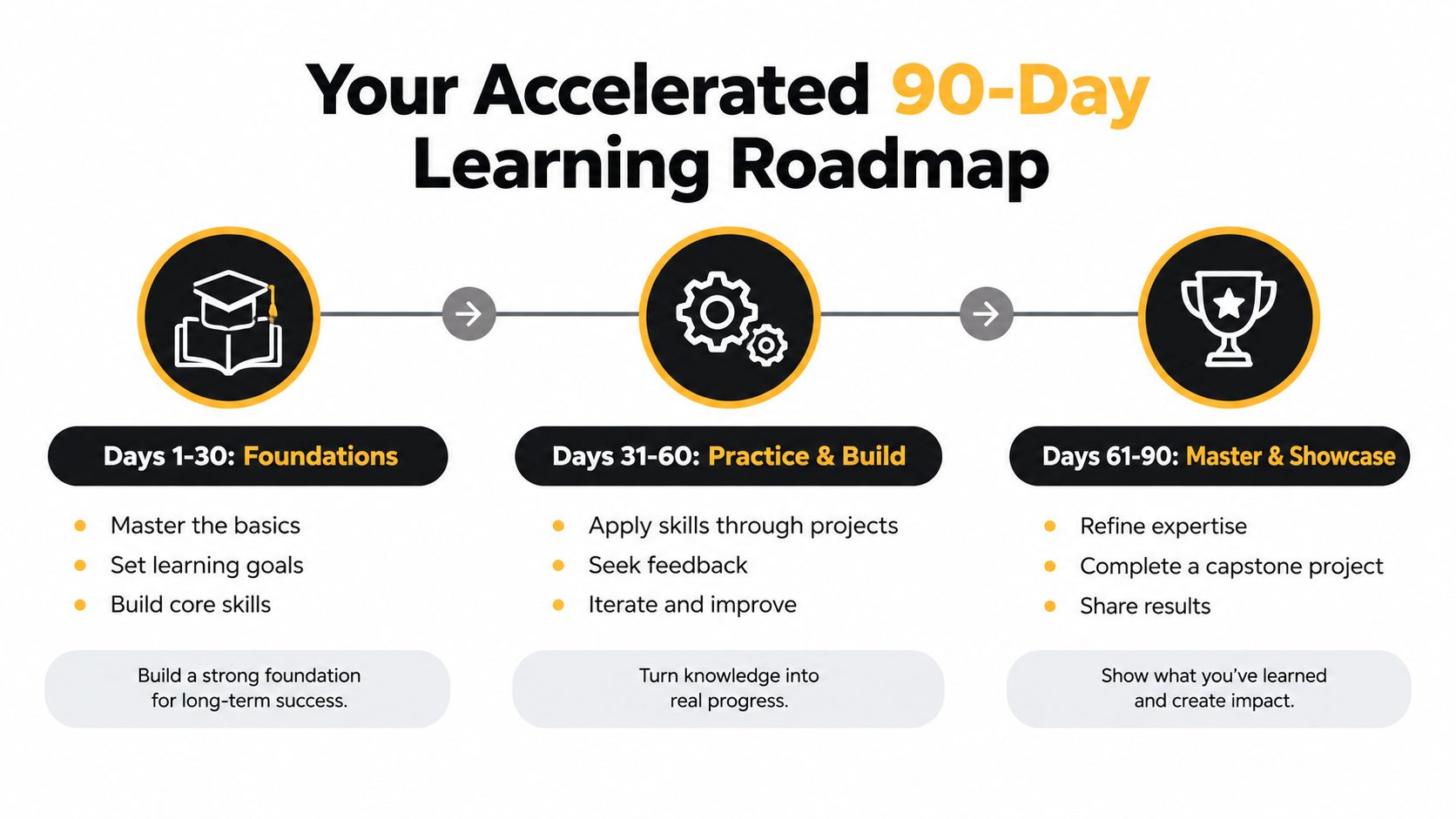
Having a solid routine is one thing, but a real roadmap is what turns daily habits into long-term success. We shift gears from practicing every day to following a concrete, milestone-driven plan for your first three months.
An accelerated path isn’t about skipping the hard parts. It’s about doing the right things in the right order to build momentum fast.
This 90-day framework is designed to take you from zero to a confident, conversational speaker. Each phase has a clear focus, specific tasks, and measurable goals. Think of it less like a rigid schedule and more like a strategic guide to channel your energy where it counts the most.
As you can see, each 30-day block builds directly on the last, making sure you develop a well-rounded skill set without getting overwhelmed.
Month 1: The Foundation (Days 1-30)
Your first 30 days are all about laying a solid foundation. The main goal here is to get comfortable with the absolute essentials so you can start stringing together simple sentences right away. Forget complex grammar for now; the focus is on high-impact vocabulary and present-tense verbs.
Your daily checklist should look something like this:
- Master Greetings and Introductions: Learn how to say hello, goodbye, ask how someone is, and introduce yourself. Practice these out loud, maybe with an AI conversation partner.
- Build Core Vocabulary: Concentrate on the 100 most common words. You’d be surprised how much of everyday conversation these cover. Use flashcard games on an app to keep it from feeling like a chore.
- Nail Present Tense Verbs: Get a handle on the regular -ar, -er, and -ir verb endings. Drill them daily until you don't even have to think about them.
By the end of this month, you should be able to introduce yourself and have a super basic, three-minute conversation about who you are and where you're from. We're building functional skills, not just memorizing word lists.
Month 2: The Expansion (Days 31-60)
Okay, you've got the basics down. Now it’s time to expand your conversational range. This month, you'll break free from the present moment by learning to talk about the past and the future. Your listening skills are also about to get a serious workout.
Here are the key tasks for this phase:
- Past and Future Tenses: Focus on the simple past (preterite) and simple future tenses for the most important verbs. This is what unlocks your ability to tell stories and make plans.
- Active Listening Practice: Start tuning into slow-paced podcasts or news reports made for Portuguese learners. Your goal isn't 100% comprehension; it's just to get the main idea.
- Start Asking Questions: Move beyond just making statements. Master common question words like onde (where), quando (when), and porquê (why).
Your end-of-month milestone? Describe what you did last weekend (past) and talk about your plans for the next one (future). This is a huge leap toward having real, dynamic conversations.
Month 3: The Confidence (Days 61-90)
The final month is all about cementing your skills and building the confidence to use them in the wild. You’ll focus on navigating everyday situations, understanding native-speed audio, and starting to share your own opinions on simple topics. Everything comes together now.
A structured lesson plan is key to keeping you from feeling lost. It ensures you’re always working on the next logical skill without having to guess. This kind of self-directed learning is effective, see how to learn a language on your own for more on these strategies.
At this stage, you should be aiming for a 10-15 minute conversation where you can handle a few unexpected questions and express basic preferences. By day 90, you won't be fluent, nobody is. But you will have the confidence and the practical ability to manage a wide range of real-world interactions in Portuguese.
Supercharge Your Progress with Smart Tools
A solid routine is a great start, but the right tools are what really separate stalled progress from rapid fluency. Think of it as building a learning ecosystem—a digital bubble that surrounds you with Portuguese, making daily practice feel less like a chore and more like a reflex.
Your first step is to anchor your routine with a strong core learning app. Something like PolyChat gives you a structured path, fun drills to keep you engaged, and excellent conjugation tools essential for getting grammar down. It offers unlimited practice sessions, so you're never blocked by an annoying energy system when you're in the zone.
Create a Total Immersion Environment
With your core app in place, the next move is to layer in tools that turn dead time into learning opportunities. This is the secret to learning Portuguese fast.
- Switch your phone's language setting to Portuguese. It sounds simple, but you'll be amazed at how much practical vocabulary you absorb just by navigating your daily apps.
- Find a real person to talk to. Hop on a language exchange app like Tandem to find native speakers. Even 15 minutes of clunky, real-world conversation a day is pure gold.
- Turn on a Brazilian or Portuguese show on Netflix. Start with Portuguese subtitles on, and you’ll start connecting the written word to the spoken sounds naturally.
- Curate your social media feed. Follow a few Portuguese-speaking creators, news outlets, or meme accounts. It’s a low-effort way to get daily, bite-sized exposure to slang and casual language.
The goal is to blur the lines between "study time" and "leisure time." When your digital life and your dedicated learning are both happening in Portuguese, your brain adapts much faster.
Your Top Questions, Answered
Brazilian or European Portuguese: Which One Should I Learn?
Choose the version that matches where you plan to travel, live, work, or talk most. For many beginners, Brazilian Portuguese is the easier practical starting point because there are more learning materials, more media options, and a larger speaker base. If your focus is Portugal, though, start there and stay consistent.
How Long Does It Really Take to Get Conversational?
With daily focused practice, many beginners can reach basic conversation in about three to six months. That usually means introducing yourself, handling simple travel situations, asking questions, and talking about daily life. The pace depends less on total months and more on whether you speak and review consistently.
What's the Single Biggest Mistake I Need to Avoid?
The biggest mistake is staying passive for too long. Watching videos and tapping flashcards can help, but they do not replace saying words aloud, answering prompts, and listening actively. If you are not producing Portuguese regularly, progress usually feels slower than it should.
Frequently Asked Questions
Is Portuguese an easy language to learn?
For English speakers, Portuguese is usually considered manageable rather than easy. You can make fast early progress with greetings, basic sentence patterns, and high-frequency vocabulary, but pronunciation and listening speed take steady practice. Most beginners improve much faster once they stop waiting for perfection and start speaking daily.
What are 5 greetings in Portuguese?
A useful starter set is olá (hello), bom dia (good morning), boa tarde (good afternoon), boa noite (good evening/night), and tchau (bye). Practice them out loud with natural rhythm instead of memorizing them. If you only learn five phrases today, these are a good place to start.
How do I say “sorry, I don't speak Portuguese”?
A simple version is Desculpe, eu não falo português. In Brazil, many learners also hear Desculpa in informal situations, while Desculpe sounds more polite or neutral. Keep this phrase ready for travel, then follow it with Você fala inglês? if needed.
What is “I love you” in Portugal?
The phrase is Eu amo-te in European Portuguese. In Brazilian Portuguese, learners more often hear Eu te amo. Both mean “I love you,” but the word order reflects the regional standard.
Can I learn Portuguese without classes?
Yes, if your plan includes speaking, listening, review, and some feedback. A class can help, but it is not required for early conversational progress. Many learners do well with a core app, transcript-supported audio, and one regular speaking outlet.
Should I learn grammar first or phrases first?
Start with useful phrases and basic sentence patterns, then add grammar as support. That gives you something to say immediately while still building a correct foundation. I would only go grammar-first if your main goal were academic reading rather than conversation.
How much should I study each day?
Thirty minutes a day is enough to make real progress if the time is focused. Fifteen minutes can maintain momentum, and 60 minutes can accelerate speaking and listening gains. The best daily amount is the one you can repeat for months without burning out.
Do I need to choose between Brazilian and European Portuguese right away?
Yes, at least for your main study track. Choosing one variant early keeps your pronunciation, vocabulary, and listening input consistent. You can still expose yourself to the other version later without confusion.
Ready to stop just thinking about it and start speaking? PolyChat gives you a clear path and all the practice you could ever need to build real confidence, fast. Ditch the guesswork and start your fluency journey today. Try PolyChat for free.
Practice Portuguese False Friends with Quickshot
Test your knowledge of Portuguese false friends with this interactive game!
Embed this game on your siteFree for teachers, schools and bloggersGet code
Paste this where you want the game. It includes a credit link back to this article.
<iframe src="https://www.polychatapp.com/widget/quickshot-game?data=N4IgLiBcIKIHYHMA2BLAzgCwARgPZYEkwBDVYuLANVwGNiAjLARQFcUAvLAWiwDFS0AUz4AnFILgATNFhiSUYFLjgBCEABoQIqAG1QAdyggAcihoBrOMQC2gjSFy6QAZVwAHEeTi5b9gMK4CN6+mgCC1maOmsY+dgC6mjRGrh5esSAAvuoGRjCeQtqajpA6IACq9GLEdPYA4j7WxPYASsQIxOzsTZoAssSKJCAJIEnQ9daNmdkghtAAKvhuSMQAnvbFpc6kJCJ2mrVKdLv2AArEIjRRIABCNvQocChDiUYHtOd2WTnQzjQSwgAKB5YYhYay4ABu4gAlOsnH4JN0XH8rPZeCgkNZ7K4RB4JJIJGB4i8fiiml8ZrlrPRzvkhJI4SUQAQ4DQHoNNARqecOl08NjcLskMt-MRJCxBsNRszuZ5Ov1HBTZjcRCxMIzNpc3EjnNrOrgRZo-MQ3IJhU9NAARQlPKXJPXsA3k6bKgDqghQIgZRScMDQAEc2GgFFdrah2Eo0FcyuCWIUQGczSK7dA-YH0CGpt8QK6UASNSAADIsRBXQvnBBXY2m83YsCeSRNFNFiuKl1GV2C8yYdwAelqPIQewcTjKADMx2YlPYAPITqeoo2EkRl4gQwWOZtzyds1FKowzmh4NxqgsnA3r04XwTHXq4e6oU4sJBuTckhMXxVxDJAA" title="Language game" style="width: 440px; height: 520px; border: none; display: block;"></iframe>
<p style="font-size: 12px; margin: 4px 0 0;">Free language games by <a href="https://www.polychatapp.com/blog/how-to-learn-portuguese-fast">PolyChat</a></p>

Jean-Baptiste Bolh
Co-Founder
Applied AI