How to Improve Speaking Skills: Practical Exercises for Confidence
Ever feel like the words are stuck in your head? It's a classic language learner problem. You can ace a grammar test, understand a movie, and read an article, but when it's time to actually speak, everything just freezes.
The goal here isn't just about knowing a language; it's about using it. We're going to bridge that gap between passive knowledge and active, confident conversation with a plan that focuses on daily, targeted practice.
Ready to Learn a Language?
Try PolyChat's engaging language lessons, interactive learning games and put your new vocabulary to the test!
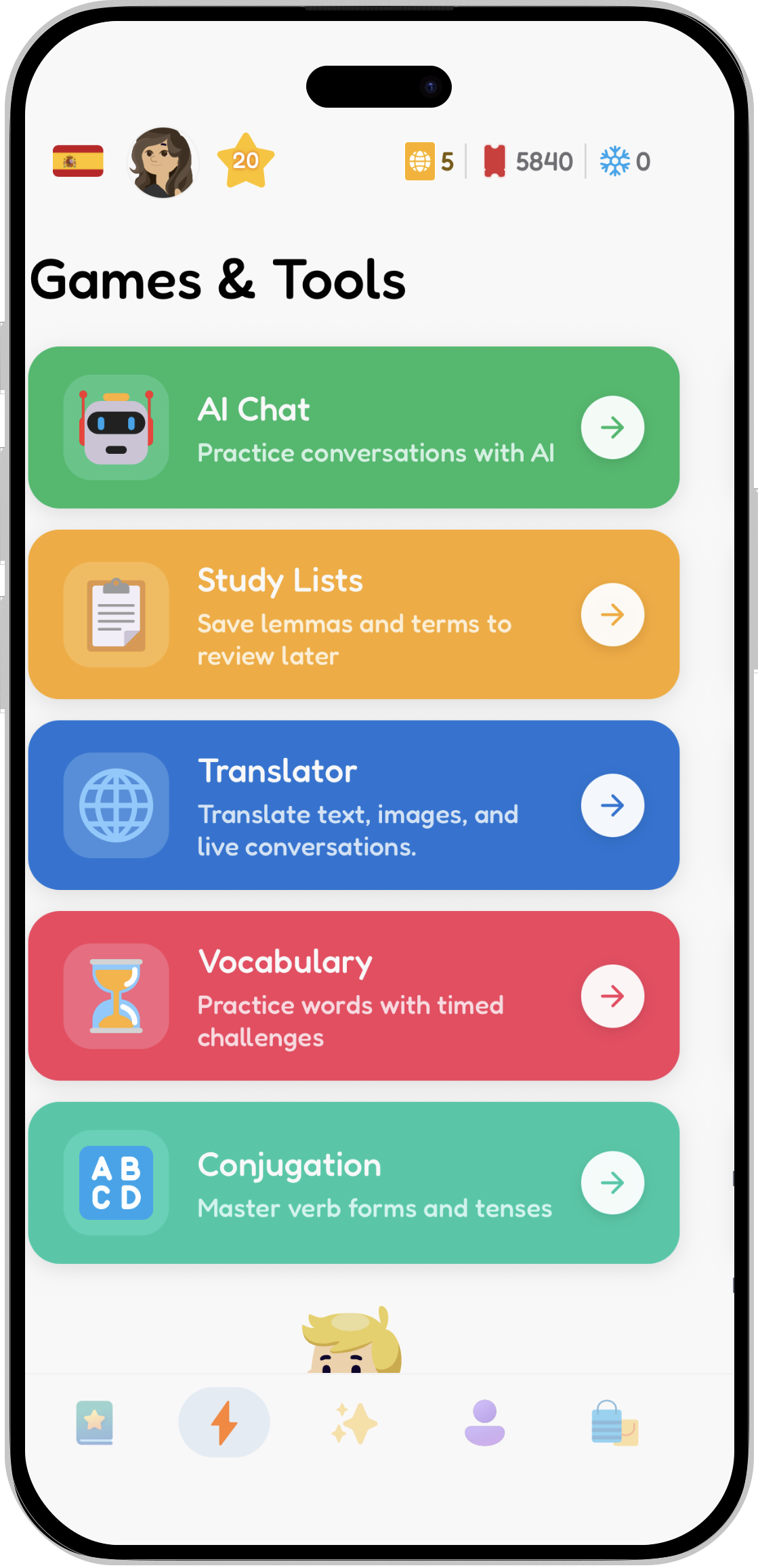
Games & Tools
Tools that every language learner needs at all stages of their learning journey.
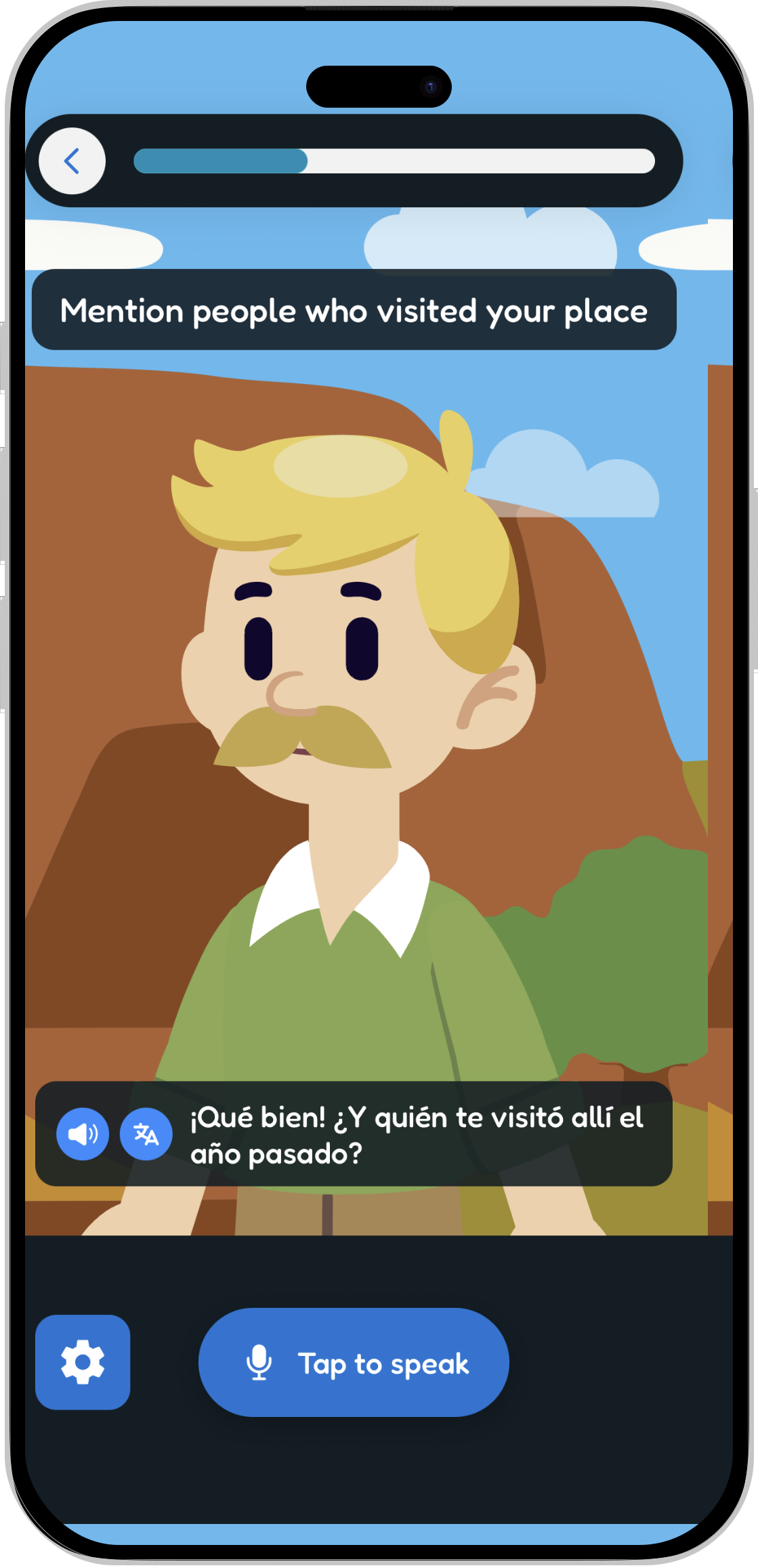
AI Chat Tutor
Practice real conversations with an AI tutor that helps you speak with confidence.
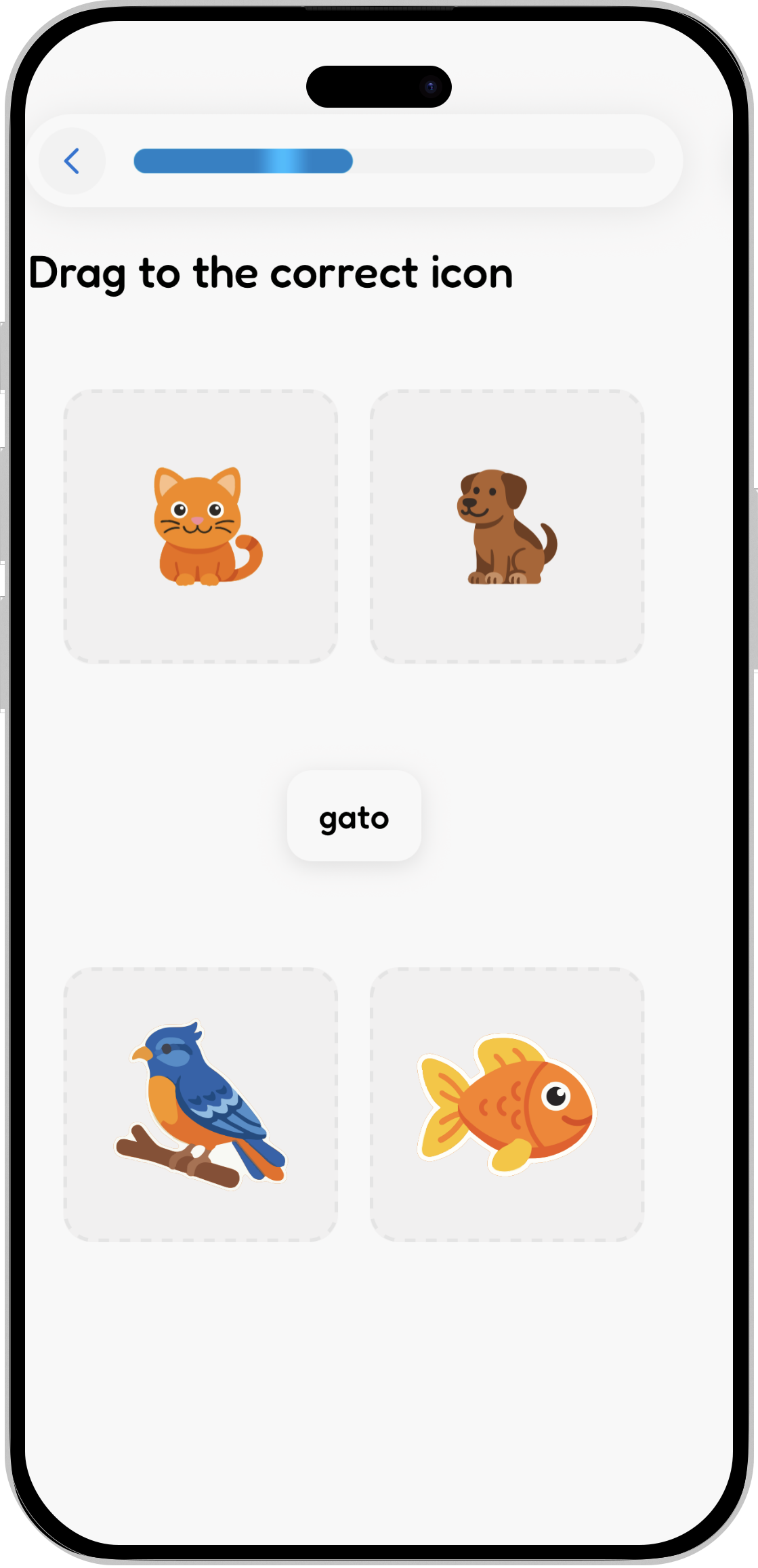
Interactive Games
A variety of games to help you learn and remember new words and phrases.


Your Journey to Confident Speaking Starts Now

This guide is your roadmap. We're ditching abstract theory for practical strategies you can start using the second you finish reading.
Let’s get one thing straight: the goal is communication, not perfection. Think of speaking as a muscle. You wouldn't expect to lift a heavy weight without training, and speaking is no different. It takes consistent effort and the right exercises to build strength and confidence.
Pinpointing Your Starting Line
Before you can build a solid routine, you need to know exactly where you stand right now. A quick, honest self-assessment is the best way to figure out your strengths and, more importantly, the areas that need a little more love.
This isn't about judging yourself. It's about being smart with your time and energy so you can focus on what will make the biggest impact.
To get a clear picture, let's look at the core components of speaking. Use the checklist below to do a quick diagnostic.
Speaking Skills Self-Assessment Checklist
Take a moment to rate yourself honestly on a scale of 1 (Needs a lot of work) to 5 (Feeling confident). This will give you a baseline to track your progress against.
| Skill Area | Description | Your Rating (1-5) |
|---|---|---|
| Pronunciation | How clearly can you produce the individual sounds and rhythm of the language? | |
| Fluency | Can you speak smoothly, without long or unnatural pauses to search for words? | |
| Vocabulary | How quickly can you recall the right words to express your thoughts? | |
| Grammar Accuracy | Do you use correct sentence structures and conjugations when speaking? | |
| Confidence | How comfortable do you feel speaking, even when you know you might make mistakes? |
Once you've filled this out, you have a personalized map of where to begin. Maybe your pronunciation is solid but you're constantly pausing, or perhaps you feel confident but keep using the wrong verb tenses. Now you know what to work on.
The journey from knowing a language to speaking it fluently is bridged by consistent practice. For a deeper look at this process, check out our guide on how to become fluent in a language.
And don't forget, strong speaking skills are a massive asset in the professional world, too. If you want to dive deeper into the career benefits, this resource on improving verbal communication skills offers some fantastic insights and drills.
Building Your Daily Speaking Practice Routine
Real progress in speaking doesn't happen in marathon, multi-hour study sessions. I’ve seen it time and time again: the people who get fluent are the ones who show up every single day, even if it's just for a little while. A sustainable daily habit is way more powerful than cramming once a week.
Forget trying to magically find an extra hour you don't have. The trick is to create high-impact, 15-minute micro-habits. This approach builds the "muscle memory" you need to recall words and phrases without thinking, which is exactly what you need when you're in a real conversation.
Start with Solo Speaking Techniques
Before you even worry about talking to other people, you can build a killer foundation all on your own. Speaking by yourself is a brilliant, low-pressure way to get comfortable with the language and build that initial confidence. You don't need a partner to start improving right now.
One of the most effective solo exercises is shadowing. Find a short audio clip of a native speaker and simply repeat what they say, as they're saying it. Your goal is to match their pronunciation, rhythm, and intonation perfectly.
Shadowing isn’t really about understanding every word. It's about mimicking the music of the language. This exercise literally trains your mouth to form new sounds and helps you internalize the natural flow of speech.
Another fantastic solo habit is the daily monologue. Just take three to five minutes every day to talk out loud about something simple. Record yourself on your phone—it's an incredible way to hear your own progress and spot the little things you want to work on.
Simple Prompts for Your Daily Monologue
The goal here is consistency, not complexity. Pick a dead-simple topic and just start talking. Overthinking is the enemy.
Here are a few easy prompts to get the words flowing:
- Describe your breakfast: What did you eat? How did you make it? Was it good?
- Plan your day aloud: Walk through your schedule. What do you need to get done? What are you looking forward to?
- Explain a hobby: Talk about one of your favorite activities as if you were telling a friend about it for the first time.
- Summarize a show or book: Briefly recap the plot of something you just watched or read.
This simple act forces your brain to produce the language, which solidifies vocabulary and grammar much faster than just reading. It's a direct and powerful way how to improve speaking skills with zero pressure.
Make Your Practice Engaging and Fun
Let's be honest: if your daily routine feels like a chore, you won't stick with it. The real secret to long-term progress is making your practice something you actually enjoy.
Gamification is a game-changer for this. When learning feels like a game, you're naturally more motivated to come back day after day. You can find out more about the psychology behind gamification in language learning and how it works on our blog.
The key is variety. One day you might do a shadowing exercise, the next you could jump into a speaking game on PolyChat, and the day after that you could record a quick monologue. Keep it fresh.
A Sample 15-Minute Daily Routine:
- Minutes 1-5: Warm-up with shadowing. Grab a clip from a podcast or a scene from a TV show and repeat after the speaker.
- Minutes 6-10: Play a targeted speaking game. Use an app to practice specific vocabulary sets or sentence patterns out loud.
- Minutes 11-15: Record a 3-minute monologue. Pick a prompt, speak freely, and save it. You'll thank yourself later when you listen back and hear the improvement.
This structured-but-flexible routine ensures you’re building well-rounded skills. By committing to just 15 minutes a day, you build a powerful habit that will dramatically speed up your journey to speaking fluently and confidently.
Mastering the Art of Real Conversation

Daily solo practice builds your foundation, but let's be honest—nothing gets you fluent faster than talking to real people. This is where all your hard work pays off, turning textbook knowledge into genuine communication. The goal isn't perfection; it’s connection.
Moving from talking to yourself to talking with someone else can feel like a huge leap. It's intimidating, but it’s the single most important one you’ll take. Live conversation forces you to think on your feet, decode different accents, and reply spontaneously—skills you simply can't develop on your own.
Finding Your Conversation Partners
So, where do you find people to talk to? Thankfully, it’s easier than ever to connect with native speakers and other learners. The trick is to find an environment that feels comfortable and actually helps you improve.
Here are a few of my go-to methods for finding practice partners:
- Language Exchange Apps: Platforms like Tandem or HelloTalk are fantastic. They connect you with native speakers who want to learn your language, creating a natural give-and-take where you both get to practice.
- Online Tutors: If you want a more structured approach, services like Preply or italki are worth every penny. You can book time with a professional tutor who can guide you, answer specific questions, and focus entirely on your goals.
- Local Meetups: Don't forget to look offline! Check sites like Meetup.com for language exchange groups in your city. There's something special about face-to-face conversation that you just can't replicate online.
There's solid data to back this up. A 2025 analysis found that learners who had at least two 30-60 minute live conversation lessons per week improved their speaking scores 25–40% faster than those who only used solo-practice apps. Live interaction is a game-changer.
Structuring Your Practice Sessions
Once you’ve found a partner, don't just "wing it." Just saying "let's chat" often leads to awkward silences. A little bit of structure can make your practice time way more productive.
For a 30-minute session with a language exchange partner, try a simple 15/15 split. Spend the first 15 minutes speaking only in their native language, then switch to yours for the next 15. This ensures both of you get focused practice.
When working with a tutor, be direct about what you need. Instead of just having a generic chat, give them specific scenarios to work on.
Example Tutor Prompts:
- "Can we spend 10 minutes role-playing how to order food in a restaurant?"
- "I want to get better at storytelling. Can I tell you about my last trip while you ask me questions?"
- "Let's have a simple debate. Topic: Does pineapple belong on pizza?"
This approach gives you a clear goal for the session and helps you practice the exact vocabulary you need for real-world situations. To really level up, it helps to think about the bigger picture, including practical ways to improve workplace communication if that's one of your goals.
Navigating the Awkward Moments
We’ve all been there. Your mind goes completely blank. You can’t find the right word, or you have no idea what your partner just said. The key is to see these moments not as failures, but as learning opportunities.
Memorize a few "survival phrases" to get you through the rough patches without panicking.
| Situation | Phrases to Use |
|---|---|
| You don't understand a word | "Sorry, what does [word] mean?" or "Could you explain that word?" |
| You need them to speak slower | "Could you please speak a bit more slowly?" |
| You can't find the right word | "How do you say...?" or "I'm looking for the word that means..." |
| You need a moment to think | Use natural filler words in the target language (e.g., "Umm," "Well," "Let me see..."). |
Using these phrases does more than just save you from an awkward pause. It keeps the conversation alive and signals to your partner that you’re actively trying to learn. Every time you have to ask for help, you're building a stronger foundation. Mistakes aren't just okay; they're the engine of your progress.
Using Feedback and Error Correction for Growth
Practicing every day is great for building muscle memory, but here's the catch: practicing the wrong way just reinforces bad habits. If you really want to get better, you have to learn how to actively seek out, understand, and actually use feedback.
Think of it like this: if you're exploring a new city, you can either wander around hoping you find your way, or you can use a map. Feedback is your map to fluency.
Making mistakes isn't a sign of failure—it's proof you're actually trying. The trick is to turn those slip-ups into powerful learning moments. This means shifting your mindset from fearing errors to seeing them as valuable clues that show you exactly where to focus next.
How to Ask for Feedback That Actually Helps
Not all feedback is created equal. I'm sure you've been there—you ask a language partner to "correct my mistakes," and they either pick apart every tiny error, killing the conversation, or they say nothing at all because they're trying to be polite. Neither is very helpful.
You need to be specific. Being direct and guiding your partner helps them give you the kind of advice you can actually use, without ruining the natural flow of the chat.
Try using these phrases with your tutor or exchange partner:
- For big-picture feedback: "Could we just talk for 10 minutes, and then maybe at the end, you could point out one or two major things I got wrong?"
- For specific grammar: "I'm really trying to get my past tense verbs right. Could you listen out for those and let me know how I do?"
- For sounding more natural: "How would a native speaker say this? Does my phrasing sound a little weird?"
This targeted approach gives you focused, manageable advice you can work on in your very next session.
The Power of an Error Log
Hearing a correction once is rarely enough to fix a mistake you've been making for ages. To truly stamp out those recurring errors, you need to track them. This is where a simple but incredibly powerful tool called an error log comes in.
It can be a physical notebook or just a simple document on your computer.
Every time a partner corrects you or you catch a mistake in a recording of yourself, write it down. I like to make a few columns: the mistake I made, the correct version, and a quick note on why it was wrong.
An error log transforms random corrections into your own personalized curriculum. It helps you spot patterns—like always mixing up two verb conjugations—so you can create targeted exercises to finally fix them for good.
This simple habit ensures that every conversation, good or bad, makes you a more accurate speaker over time.
Why Immediate Feedback Is a Game-Changer
When you get feedback plays a huge role in how effective it is. While getting a summary at the end of a session has its place, corrections made closer to the moment you make a mistake can seriously speed up your learning.
Recent studies back this up. Global language-learning reports for 2024–2025 synthesized research showing that learners who received at least 1–2 corrective interventions per minute of speaking practice did way better than those who only got occasional feedback. In fact, learners with this kind of systematic guidance saw their oral fluency and accuracy jump by 30–50% in just 12–16 weeks. You can discover more insights about these language learning trends and statistics.
Now, this doesn't mean your tutor should be interrupting every other word. It's about finding a balance, like getting quick, in-the-moment corrections for critical errors while saving minor slip-ups for the end. This is where technology can be a huge help. The world of AI in language learning is making it easier than ever to get instant, personalized feedback without the pressure of having a live person listening.
Creating Your Own Immersion Environment at Home
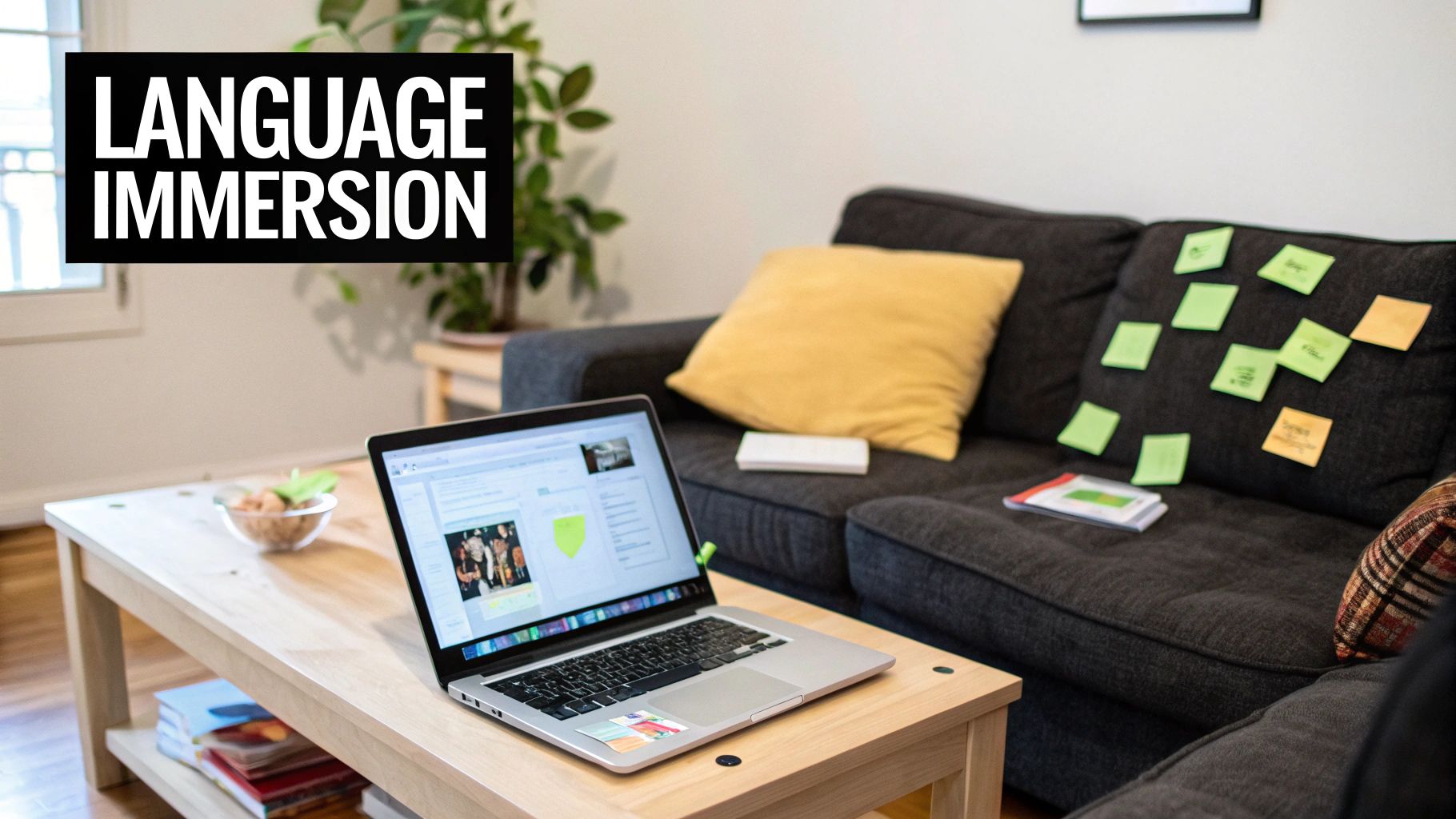
You don’t need a plane ticket to immerse yourself in a new language. With a little creativity, you can build a rich, stimulating environment right in your own home that will dramatically speed up your progress. The whole idea is to surround yourself with your target language so completely that hearing it, reading it, and thinking in it becomes a daily reflex.
This is about way more than just watching a foreign film now and then. Real at-home immersion means weaving the language into the fabric of your everyday life. You're turning passive exposure into active engagement, which helps you absorb the natural rhythm, modern slang, and cultural quirks that textbooks almost always miss.
And the results speak for themselves. Global language surveys show a massive gap in learning speed based on exposure. Learners in immersive situations—we're talking 4+ hours per day—often hit functional fluency in just 6–12 months. Compare that to those studying for only 1–5 hours per week, who can take 2–4 years to get to the same level. The data is pretty clear, as you can see if you read the full research on language learning statistics.
Transform Your Digital World
Think about it: your phone is probably the first thing you see in the morning and the last thing you see at night. This makes it the single most powerful tool for immersion. Switching your device's language is a game-changer. Suddenly, everyday tasks like checking the weather or setting an alarm become tiny learning moments.
This simple tweak forces you to learn practical, high-frequency vocabulary without even trying. Sure, it might feel a little weird at first, but you'll adapt surprisingly fast. Your muscle memory for navigating your phone will help you figure out new words through sheer context.
Don't stop at your phone's system settings. Change the language on your most-used apps and social media accounts. This instantly turns mindless scrolling into a productive activity, exposing you to the casual, authentic language real people use every day.
Curate Your Entertainment and Hobbies
The secret to making immersion stick is to blend the language into stuff you already love doing. Instead of carving out "study time," you're just upgrading your hobbies. This strategy makes practice feel less like a chore and more like fun.
Here are a few simple swaps to get you started:
- Music Lover? Ditch your usual playlist and create a new one with popular artists who sing in your target language. Actually listen to the lyrics, look them up, and try singing along. It’s a killer way to improve your pronunciation and rhythm.
- Movie Buff? Watch films and shows in their original language. Start with subtitles in your native tongue, then bravely switch to target-language subtitles. Eventually, try turning them off completely.
- Avid Gamer? Change the language settings on your favorite video game. You’ll be shocked at how much vocabulary you pick up from quests, items, and instructions.
- Passionate Cook? Pull up a cooking tutorial on YouTube created by a native speaker. Following a recipe is a fantastic, hands-on way to learn verbs and food-related words.
When you link language practice to your personal interests, you create a powerful and motivating learning loop that feeds itself.
Key Takeaway: The goal of at-home immersion isn’t to understand every single word. It’s to get comfortable with the sounds, cadence, and flow of the language, letting your brain build comprehension skills naturally over time.
Make Your Physical Space a Learning Tool
Your immersion shouldn't stop at your screens. Bring the language into your physical environment to keep it top of mind all day long. Simple visual cues are a low-effort way to reinforce vocabulary constantly.
One of the oldest tricks in the book is still one of the best: sticky notes. Slap a label on your mirror, your coffee maker, your desk—everything. Every time you see the word, you strengthen the mental link between the object and its new name. It's a dead-simple but incredibly effective technique for anyone learning how to improve speaking skills by building a solid vocabulary foundation.
Got Questions About Speaking? We've Got Answers.
Even with a great strategy, the road to speaking fluently is almost never a straight line. Hitting a plateau or feeling stuck is totally normal. It happens to everyone. Let's break down some of the most common hurdles learners run into and give you some real, practical ways to get over them.
This isn't about finding one magic bullet. It’s about understanding the process so you can tweak your approach and figure out what clicks for you.
"So, How Long Until I'm Fluent?"
Ah, the million-dollar question. The honest answer? There's no single timeline. It's less like a sprint with a finish line and more like learning an instrument—it depends entirely on how much you practice and where you're starting from.
A few things really influence your pace: your current level, how much time you can realistically dedicate each week, and how similar your target language is to your native tongue. Someone practicing for an hour every single day is, of course, going to move faster than someone squeezing in two hours on a Sunday.
- Immersive study (think several hours a day) can get you to a conversational level in as little as 6-12 months.
- Consistent, non-immersive study (a few solid hours per week) will likely take 2-4 years or more to reach that same point.
My advice? Ditch the deadline. Chasing a date on the calendar is the fastest way to burn out. Instead, focus on celebrating the small wins. Did you just have a five-minute chat without panicking and switching back to English? That's a massive victory. Consistent, daily effort will always beat intense, sporadic cramming.
The real goal here is sustainable progress, not speed.
"I'm Too Shy to Speak. What Can I Do?"
Speaking anxiety is real, and it’s probably the single biggest roadblock for most language learners. That fear of sounding stupid or making a mistake can be paralyzing. The secret is to start small and build a low-pressure environment for yourself.
Don't throw yourself into a high-stakes debate with a native speaker on day one. Just start by talking to yourself. I know it feels weird, but it's an incredibly powerful trick.
A Few Ways to Ease Into It:
- Narrate Your Life: Seriously. While you're making coffee, describe what you're doing. Out loud. "I am pouring the water. Now I am adding the coffee." This gets the words flowing without any audience pressure.
- Record Yourself: Grab your phone and record a one-minute voice memo on any simple topic. "Today, I am going to the store." Nobody ever has to hear it. The simple act of producing the language is what builds the muscle.
- Find a Patient Partner: When you're ready to talk to a real person, find a tutor or language exchange partner and just be honest. Saying, "Hey, I'm a little nervous about speaking, so thanks for being patient with me!" can change the entire dynamic. Most people are incredibly supportive and have been in your shoes.
It’s all about gradual exposure, not diving into the deep end. Every tiny success builds the confidence for the next, bigger step.
"Should I Focus on Perfect Grammar or Just Talking?"
In the beginning? Prioritize fluency over accuracy, hands down. Think of a conversation as a river. If you stop to analyze every single drop of water (or every grammar mistake), the river stops flowing.
Getting your message across—even imperfectly—and building that conversational rhythm is way more important early on. If you're constantly pausing to self-correct, you'll sound robotic, lose your train of thought, and just end up frustrating yourself. The goal is communication, and grammar is just one of the tools, not the entire point.
But that doesn't mean you should ignore grammar forever. The key is a balanced approach that changes as you grow.
| Stage | Primary Focus | Why It Works |
|---|---|---|
| Beginner | Fluency & Confidence | You’re building the habit of speaking and proving to yourself that you can communicate. That's a huge motivator. |
| Intermediate | Balanced Approach | Now you can start tidying things up. Maybe you ask a tutor to focus on just one error (like verb tenses) per session. |
| Advanced | Accuracy & Nuance | Here's where you polish. You'll focus on fine-tuning your grammar to sound more sophisticated and natural. |
Let the words flow first. You can always go back and polish the grammar later.
"How Do I Stop Translating in My Head All the Time?"
This is the classic sign of an intermediate learner. Your brain is so used to its native "operating system" that it tries to run every new word through a translation filter. The key is to train your brain to think directly in the new language.
The most powerful way to do this is to learn in "chunks" instead of single, isolated words. A chunk is just a group of words that naturally belong together.
For instance, don't learn "how," then "are," then "you." Learn the entire block "How are you?" as one single unit of meaning. Your brain doesn't have to translate; it just pulls the whole phrase.
Here are a few ways to build this habit:
- Learn Full Phrases: When you encounter a new word, don't just write it down. Put it in a common sentence you might actually use.
- Label Your World: Grab some sticky notes and label things around your house. This creates a direct link between the physical object (a chair) and the new word (la silla), completely bypassing English.
- Narrate Your Actions: Just like we talked about for overcoming shyness, saying "I am opening the door" or "I am drinking water" in your target language forges direct thought patterns.
The more you force your brain to work without the crutch of translation, the faster it builds the new pathways you need. This is a crucial step if you want to learn how to improve speaking skills and sound truly natural.
Ready to put these strategies into action with a tool that makes practice fun and effective? PolyChat offers a suite of gamified exercises, from conversation practice to vocabulary and conjugation drills, all designed to build your confidence and fluency. Start your journey today at https://www.polychatapp.com.

Jean-Baptiste Bolh
Co-Founder
Applied AI