How to Learn a Language on Your Own a Practical Guide

To really learn a language on your own, you just need a straightforward game plan. It boils down to setting clear goals, building a daily habit you can actually stick to, and picking the right tools to get you there. This approach lets you mix structured learning with real-world practice, so you can hit your fluency goals on your own time.
Why Independent Language Learning Is More Effective Than Ever
Gone are the days when mastering a new language meant locking yourself into a rigid classroom schedule with dusty, expensive textbooks. Today, learning on your own isn't just a backup plan—it's become the go-to method for millions of people all over the world. This massive shift is all thanks to the flexibility and instant access that modern tech gives us.
The pillars of successful self-study haven't changed: you still need clear goals, consistent practice, and the right resources. But how we use them has been completely flipped on its head. You're no longer just passively receiving information; you're the director of your own learning journey.
The Power of Self-Directed Learning
The real magic of learning on your own is the freedom. You get to customize every single study session based on your interests, your energy level that day, and whatever specific goal you're chasing. This isn't just convenient—it’s incredibly effective.
Research backs this up. The move toward app-based learning has exploded over the past decade. A recent review of 43 different studies confirmed that self-directed mobile learning helps people progress at their own speed and supports long-term language growth. Learners using apps didn't just passively memorize vocabulary; they actually improved their ability to communicate, marking a huge shift from old-school classroom models to a more personal, self-managed approach. You can read more about these research findings to see how technology is empowering learners everywhere.
The most successful independent learners don’t just study; they build a system. They integrate the language into their lives, turning everyday moments into opportunities for growth.
This is exactly where a tool like PolyChat makes all the difference. By offering unlimited, gamified lessons without frustrating limits like hearts or energy systems, it gives you complete control. You can dive in and practice whenever you want, for as long as you want, reinforcing the very habits that make self-study so powerful. Check out our guide on AI language learning to see how this works in practice.
Taking Control of Your Progress
Going it alone also means you can focus on the skills that matter most to you. For instance, you can discover how to reduce your accent without expensive coaching using self-directed strategies that fit your schedule. This modern approach is more than just a trend—it's a proven and highly effective path to mastering a new language on your own terms.
Laying the Groundwork for Lasting Success
Jumping straight into memorizing vocabulary lists is like trying to build a house without a blueprint. Before you even open a textbook or download an app, you need a solid foundation. This starts with defining your "why"—that deep, personal reason that’ll keep you going when the initial excitement wears off.
Simply saying, "I want to learn Spanish," is a wish, not a plan. Motivation is the engine, sure, but clear goals are the steering wheel. Without them, you'll burn through your enthusiasm and end up stalled on the side of the road.
Define Your Powerful Why
Your "why" is your core motivator. It’s the emotional anchor you’ll come back to on days when you feel stuck or uninspired. And trust me, those days will happen. Your reason has to be more meaningful than a vague interest.
Maybe you want to connect with your grandparents in their native tongue. Perhaps you’re planning a trip to rural Japan and want to experience the culture beyond the tourist traps. Or maybe you see a clear path to advancing your career by communicating with international colleagues.
Whatever your reason, write it down. Put it on a sticky note on your monitor. This isn't just a feel-good exercise; it’s a strategic tool. When you hit a plateau, reminding yourself why you started is often the push you need to keep going.
From Vague Ideas to Actionable Goals
Once you've nailed down your "why," it's time to build a roadmap. The best way I've found to do this is by using the SMART framework. This classic method turns fuzzy ambitions into concrete, actionable steps.
Make sure your goals are:
- Specific: What exactly do you want to achieve?
- Measurable: How will you track your progress?
- Achievable: Is this realistic with your current time and resources?
- Relevant: Does this goal actually help you achieve your "why"?
- Time-bound: When will you achieve this by?
It's one thing to talk about it, but another to see it in action. Here’s how you can turn those common language wishes into powerful goals.
Crafting Your Language Learning Goals From Vague to Actionable
| Vague Goal | SMART Goal Example |
|---|---|
| "I want to learn French." | "I will complete all beginner lessons in PolyChat and learn 300 core vocabulary words within three months to prepare for my trip to Paris." |
| "I want to get better at speaking." | "I will use PolyChat's conversation games for 15 minutes a day, four times a week, to be able to hold a simple 5-minute conversation about my hobbies in six months." |
| "I should learn some grammar." | "I will master the present and past tense conjugations for the 20 most common verbs using PolyChat's conjugation trainer by the end of next month." |
See the difference? This simple shift moves you from a passive dreamer to an active learner. A SMART goal gives you a clear target and a way to know if you're hitting it.
Choose a Core Learning Tool
With your goals in place, the final piece of your foundation is picking a primary resource to guide you. It’s tempting to download a dozen different apps, but that usually leads to scattered, inconsistent learning. Instead, pick one comprehensive tool to serve as the backbone of your studies.
A platform like PolyChat provides a structured path, ensuring you cover all the necessary ground without trying to piece together a curriculum from random YouTube videos and blogs. This gives you a reliable framework to build on. For an even broader look at structuring your studies, a solid beginner's roadmap to fluency can be a huge help in organizing those first crucial steps.
The right tool provides the "what" and "how," freeing you up to focus on your "when" and "why." Research backs this up, too. Successful self-studiers almost always combine clear goals with consistent use of a structured resource. One case study on an independent Korean learner found that her structured goal-setting was the key factor in reaching functional proficiency on her own. Setting goals sharpens your ability to know what you know and adjust your study habits, which directly boosts your learning outcomes. If you're interested in the science behind it, you can explore the research on self-directed learning strategies to see just how powerful this connection is.
Building a Consistent Daily Learning Habit
Forget finding a magical eight-hour window to study. The real secret to learning a language on your own is much simpler: weaving small, consistent actions into the fabric of your everyday life. Consistency always beats cramming—it’s the slow, steady drip that eventually fills the bucket.
When you make language learning a daily habit, it stops feeling like a chore. It becomes a natural part of your routine, just like brushing your teeth. This is how you make real, lasting progress, even when life feels completely chaotic.
Weave Language Learning into Your Daily Routine
The easiest way to build a new habit is to attach it to an existing one. This clever trick is called habit stacking. Instead of trying to carve out new time from a busy schedule, you just piggyback your language practice onto something you already do without thinking.
Think about the non-negotiable parts of your day. Do you always brew coffee in the morning? Is your commute a solid 15 minutes on the train? Do you walk your dog every evening? These are your golden opportunities.
Here’s what that looks like in the real world:
- While your coffee brews: Knock out a quick vocabulary game in PolyChat.
- During your commute: Listen to a short podcast or an audio lesson in your target language.
- While you’re at the gym: Pop in your headphones and play audio of common phrases.
- As you wait in line at the grocery store: Flip through flashcards or review your personal dictionary.
This entire process—from finding your motivation to building these daily habits—is a journey. It starts with a solid foundation.
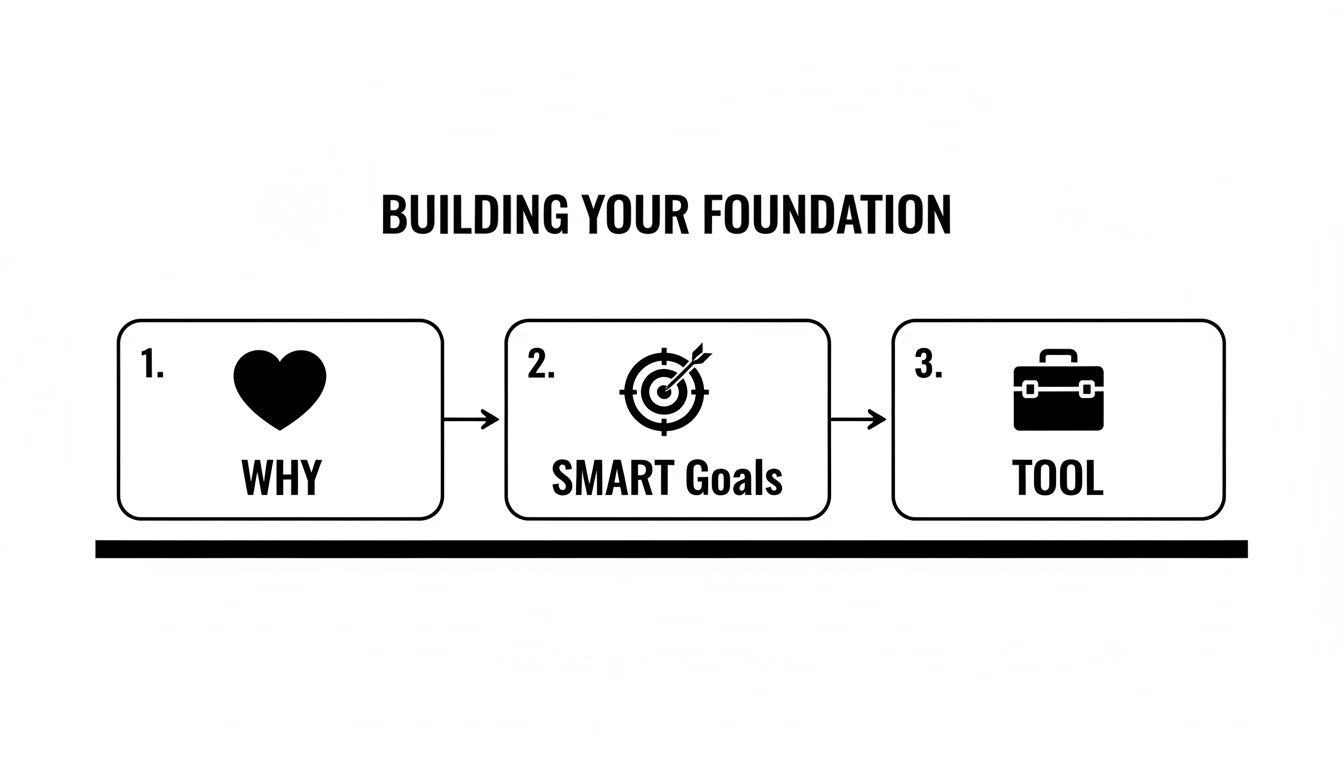
Starting with your 'Why,' setting clear goals, and choosing the right tool is the structure that makes these daily habits actually stick.
Create a Flexible Study Schedule
Let’s be honest: a rigid, hour-by-hour schedule is doomed to fail the first time life throws you a curveball. A better approach is to create a flexible menu of learning activities you can pick from, depending on how much time and energy you have.
The goal isn't perfection; it's consistency. Some days you might have an hour for a deep dive into grammar. Other days, you might only have five minutes to spare. And that’s totally fine.
A five-minute session is infinitely better than a zero-minute session. It keeps the momentum going and reinforces the habit, which is the most important part of learning a language on your own.
This is where an app like PolyChat really shines. It's built for these in-between moments. The quick, bite-sized games and lack of daily limits mean you can turn idle time—waiting for a meeting to start, standing in line—into productive practice. You don't need to block off a huge chunk of your calendar to make progress.
Sample Schedules for Different Lifestyles
So, how could this work for you? These aren't strict rules, just templates you can steal and adapt for your own life.
For the Busy Professional (15-30 Minutes a Day)
- Morning (5 mins): Play PolyChat’s vocabulary games while the coffee brews.
- Commute (10 mins): Listen to a beginner-level podcast or audio lesson.
- Lunch Break (10 mins): Go through one short, structured lesson.
- Evening (5 mins): Do a quick review of your personal dictionary before bed.
For the Dedicated Student (60+ Minutes a Day)
- Morning (20 mins): Tackle a grammar lesson and do some conjugation drills.
- Afternoon (25 mins): Dive into authentic content, like a YouTube video or news article.
- Evening (15 mins): Practice speaking with PolyChat’s conversation games.
See how both schedules break learning into manageable pieces? This method, known as distributed practice, is scientifically proven to be way more effective for long-term memory than trying to cram everything at once. It gives your brain the time it needs to actually process and store what you’ve learned.
Ultimately, the best schedule is the one you can stick with. Start small, aim for "every day" instead of "for hours," and let your progress build on itself. Make language learning a non-negotiable part of your daily rhythm, and you'll make success feel inevitable.
Mastering the Four Core Language Skills
True fluency isn't about memorizing a dictionary. It's about being able to actually use the language in the real world, and that boils down to four distinct skills: listening, speaking, reading, and writing.
When you're teaching yourself, it's incredibly easy to fall into a comfortable pattern—maybe you spend all your time reading articles but never dare to speak a word. From day one, you need a balanced approach. Think of the four skills like the legs of a table. If one is too short, the whole thing gets wobbly.
Developing Your Listening Comprehension
For most self-learners, listening is the toughest nut to crack. Real-world conversations are fast, filled with slang, and don't come with subtitles. The trick is to shift from just hearing the language to active listening, where you're hunting for meaning.
Start with materials that are just a tiny bit beyond your comfort zone. Good starting points include:
- Podcasts for learners: They often speak slower and break down tricky concepts.
- Kids' shows or cartoons: The language is simple and comes with tons of visual context.
- Music: Listen to a song a few times, then pull up the lyrics. You'll be surprised what you can pick up.
Don't aim for 100% understanding at first. Just try to grab the main idea, a few keywords, and get a feel for the rhythm of the language. As you get better, you can graduate to news reports, movies, and native podcasts.
A great little habit is to summarize what you just heard. After a podcast episode, say the main points out loud in one or two sentences. This turns passive listening into a powerful active learning moment.
Finding Your Voice Through Speaking Practice
The fear of speaking is real, but you don't need a conversation partner to get started. In fact, your first partner should be yourself. This is a game-changer when you're learning a language on your own.
Self-talk is your secret weapon. Just narrate what you're doing as you go about your day. "I am making coffee." "Now I'm opening my laptop." It feels a bit silly at first, but it trains your brain to form sentences and recall words without pressure.
Another easy trick? Use your phone's voice recorder. Read a short paragraph out loud, record it, and listen back. Then, find a native speaker reading the same text online and compare. You'll instantly hear the little pronunciation quirks you can fix. For more ideas, we've put together a full guide on how to improve your speaking skills.
Building Vocabulary Through Reading
Reading is hands-down one of the best ways to build a massive vocabulary naturally. Unlike drilling flashcards, reading shows you how words actually live and breathe in sentences, surrounded by context.
The key is to pick level-appropriate materials. If you’re stopping to look up every other word, you'll burn out fast. Start with graded readers, short stories for learners, or even news articles on topics you already know well.
When you find a new word, don't just write down the translation. Jot down the whole sentence you found it in. This context is gold—it helps you remember the meaning and see how it's properly used. This is also how you start to absorb grammar patterns without even trying.
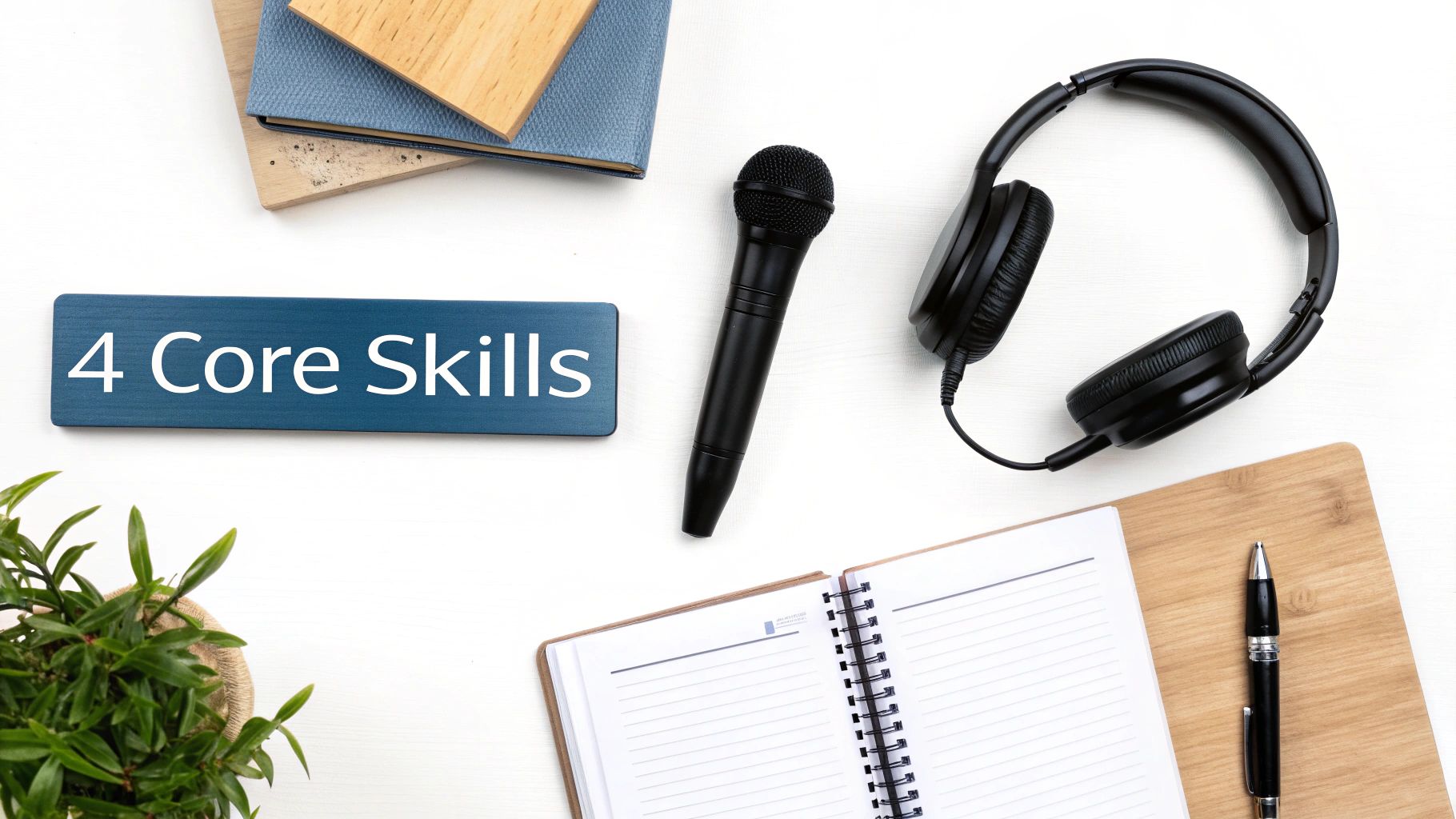
A good setup, like the one above, blends tech with traditional tools to hit all four skills. That's exactly what an effective self-study environment should look like.
Solidifying Knowledge Through Writing
Writing is where everything comes together. It’s the ultimate test of what you really know because it forces you to actively recall vocabulary, wrestle with grammar rules, and organize your thoughts.
Start small and simple. A daily journal is perfect for this. Just write a couple of sentences each day about what you did, how you feel, or your plans for tomorrow. The goal isn't perfection; it's production.
This is where an app like PolyChat can help connect the dots between all four skills:
- Listening: You're constantly hearing new words in lessons and conversation games.
- Speaking: The interactive dialogues challenge you to form your own spoken responses.
- Reading: Every lesson and exercise exposes you to new vocabulary in context.
- Writing: Translation games force you to type out full sentences, reinforcing spelling and structure.
Once you feel more confident, try finding a language exchange partner online. You can agree to swap short paragraphs and correct each other's mistakes. It's a fantastic way to spot errors you'd otherwise miss and push your skills to the next level.
Picking the Right Tools for Your Language Toolkit
When you’re learning a language on your own, the tools you choose can either make the journey exciting or incredibly frustrating. Think of it this way: your toolkit is your teacher, curriculum, and practice partner all rolled into one. The sheer number of apps out there can feel paralyzing, but building a powerful setup is actually simpler than it seems.
It's tempting to download a dozen different apps, each promising the secret to fluency. But juggling multiple platforms usually just leads to scattered, inconsistent practice. A much better strategy is to pick one all-in-one platform as the heart of your studies and then supplement it with real-world media.
Your All-in-One Learning Hub
Your main app is the engine that drives your daily learning habit. It needs to give you a clear, structured path from the absolute basics to more advanced concepts. This makes sure you're not just memorizing random words, but actually building your skills in a logical way.
When you're looking at different apps, here's what really matters for long-term success:
- Structured Lessons: You want a logical progression where each lesson builds on the last, mixing grammar and vocabulary in a way that makes sense.
- Comprehensive Practice: It needs tools that let you actively practice all four core skills—especially speaking and listening.
- Progress Tracking: Seeing how far you’ve come is a massive motivator when you're studying alone.
The biggest mistake I see learners make is choosing tools that penalize them for being consistent. Apps with frustrating mechanics like heart systems or daily energy limits literally punish you for wanting to practice more. That’s the exact opposite of what you need to succeed.
This is where a platform like PolyChat becomes your best bet. Because of its unlimited access, you can do as many lessons and play as many games as you want, whenever you're motivated. That freedom is everything for turning a spark of motivation into real, measurable progress.
To find the perfect fit, check out our guide on the best language learning apps for adults.
Rounding Out Your Toolkit with Authentic Media
Once you have your core app sorted, it’s time to dive into the language as it’s actually used by native speakers. This is how you close the gap between textbook knowledge and real-world conversation.
Start small by weaving authentic media into your daily routine:
- Music: Create a playlist of songs in your target language.
- Podcasts: Find shows made for learners or just listen to podcasts on topics you already love.
- YouTube: Watch vloggers, tutorials, or short documentaries.
- News: Try reading simple headlines or short articles to see the language in a more formal setting.
Let's be clear: self-study apps aren't some niche thing anymore; they are how most people learn a language independently. The global online language learning market is expected to explode from US$19.39 billion in 2025 to US$52.64 billion by 2033.
And self-learning apps? They’re projected to make up about 58% of that spending. Why? Because learners want 24/7 access and a personalized path, not a one-size-fits-all classroom.
By combining a powerful app with authentic content, you’re creating the exact kind of well-rounded toolkit that sets you up for success. You can learn more about the online language learning market to see just how big this trend is becoming.
Your Top Questions About Learning a Language Solo
Even the most perfect plan runs into real-world questions. It's just part of the process when you're learning a language on your own. Let's tackle some of the most common hurdles you'll face and give you practical ways to clear them.
How Long Does It Really Take to Become Fluent?
First off, "fluency" isn't a finish line you cross. It's more of a sliding scale. How quickly you move along that scale comes down to the language you chose, how much time you put in each day, and how you're actually studying.
The Foreign Service Institute (FSI) gives us a good baseline. They estimate it takes a native English speaker around 600-750 classroom hours to get good at a language like Spanish. That number skyrockets to over 2200 hours for something like Mandarin.
But as a self-learner, your secret weapon is consistency, not cramming. A focused 30-60 minutes a day—using a structured tool like PolyChat and mixing in real-world stuff like music or podcasts—can get you to a comfortable conversational level in about 6-12 months.
Forget about "fluency." Focus on real, tangible wins. Your goal isn't to master the entire language by next week; it's to order a coffee this month. It's understanding a short podcast by the end of the quarter. Celebrate those small victories—they’re what keep you going.
What's the Best Way to Practice Speaking Without a Partner?
This is the classic solo learner's dilemma, but it's totally solvable. You don't need a native speaker sitting across from you to start building the muscle memory for speaking.
Here are a few techniques that actually work:
- Shadowing: Find a short audio clip of a native speaker and just mimic them. Copy their rhythm, their intonation, their pronunciation. It’s an incredible workout for your mouth and ears.
- Talk to yourself: Seriously. Narrate what you're doing. "I am making tea." "Now I am looking for the sugar." It feels a bit strange at first, but it forces your brain to actively build sentences on the fly.
- Use the right tech: This is where tools like PolyChat’s interactive conversation games shine. They drop you into simulated dialogues in a completely safe space, letting you practice forming responses without the anxiety of a live conversation.
- Record a voice memo: Grab your phone, read a paragraph out loud, and play it back. You'll catch pronunciation quirks you'd otherwise completely miss.
Once you build a bit of confidence with these methods, you can jump onto language exchange platforms to find a real partner and put your skills to the test.
How Do I Stay Motivated When I Hit a Plateau?
First, let's get one thing straight: plateaus are completely normal. Everyone hits them. They don't mean you've stopped learning—they just mean your progress isn't as loud and obvious as it was in the beginning. When you feel stuck, it's time to adjust your strategy, not give up.
Start by going back to your "why." Remember that core reason you started this whole thing? Reconnect with that. It's the fuel for your motivation.
Next, shake things up. If you've been grinding grammar drills for weeks, your brain is probably bored. Put the textbook away and spend a few days just watching movies or listening to music in the language. Immersing yourself in something enjoyable can reignite that spark.
Finally, find a new way to measure how far you've come. It’s easy to forget the progress you’ve already made. PolyChat's progress tracking and personal dictionary give you a concrete look at every single word and phrase you've mastered. Seeing those numbers go up is a powerful visual reminder that you are, in fact, still moving forward.
Can I Actually Learn Grammar From an App?
Yes, you absolutely can—but only if the app teaches grammar the way your brain actually learns it. The old-school method of just memorizing abstract rules from a chart is painful and, frankly, doesn't work very well.
The best apps bake grammar into the context of real communication. You learn the concepts as you need them, through hands-on use.
For instance, PolyChat’s lessons introduce concepts clearly, but the real magic is in the practice. You’ll find things like the platform's best-in-market conjugation trainer, which helps you internalize verb patterns by actively using them, not just staring at them. The translation and conversation games show you exactly how those grammar rules function in the wild. This approach makes grammar feel natural and useful, not like some academic chore. You learn the rules by doing, which is the only way they truly stick.
Ready to take control of your language journey with a tool built for ambitious self-learners? With PolyChat, you get unlimited lessons, fun, gamified practice, and a clear path forward—without any frustrating limits holding you back. Start learning for free today on polychatapp.com.

Jean-Baptiste Bolh
Co-Founder
Applied AI