Imperfect Or Preterite A Guide to Spanish Past Tenses
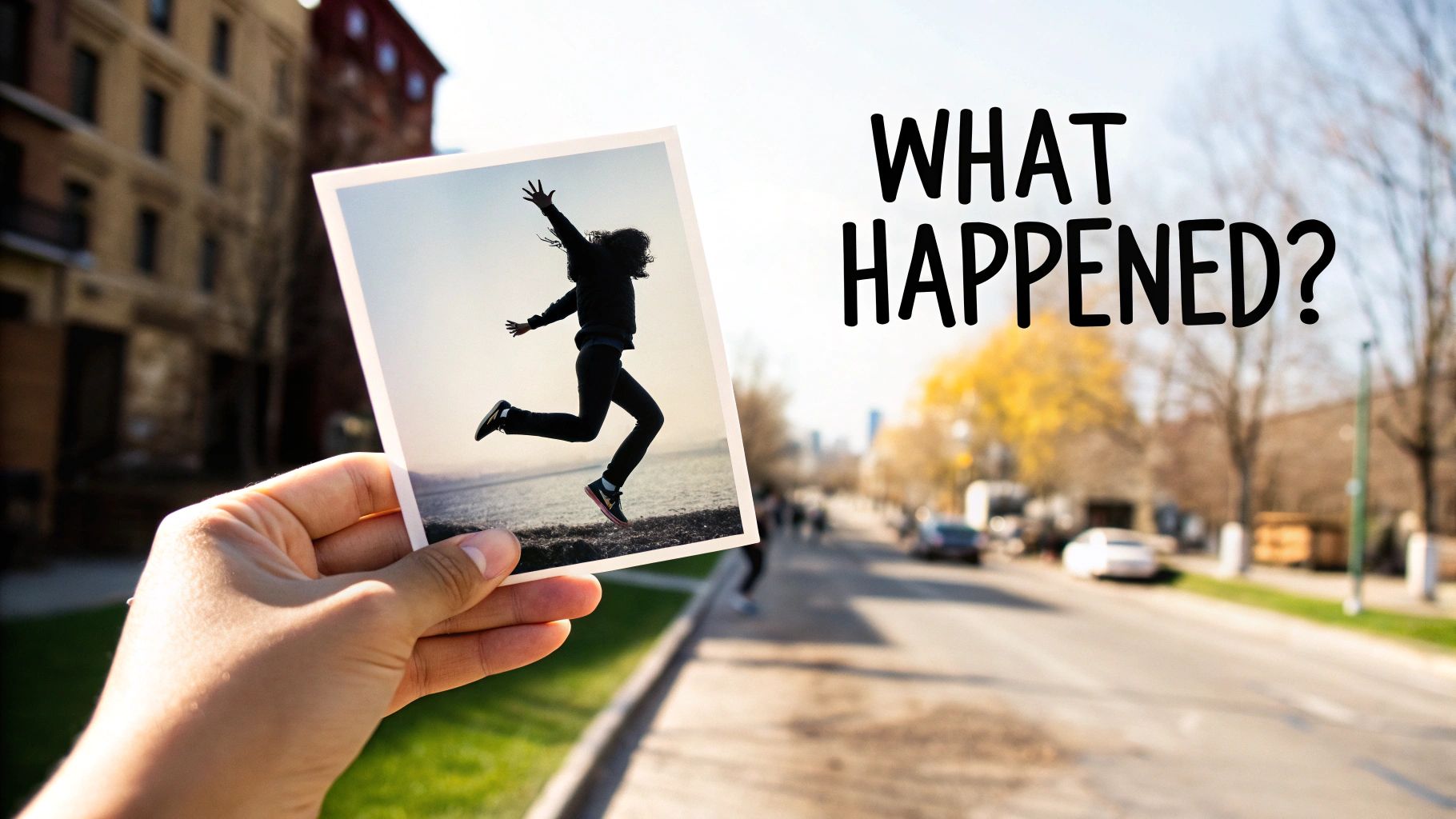
At its heart, the difference boils down to this: The preterite is a snapshot, capturing a single, completed past action with a clear beginning and end. The imperfect is more like a movie scene—it describes ongoing actions, sets the background, and details habitual routines without a defined endpoint.
The Core Difference Between Preterite And Imperfect
Choosing between the preterite and imperfect is one of the biggest hurdles for Spanish learners. Getting it right is the key to telling a compelling story about the past. Think of it as the difference between answering "What happened?" versus "What was happening?" One moves the plot forward, while the other paints the picture.
This isn't just a fussy grammar rule; it fundamentally changes the meaning and flow of your sentences. Using the wrong tense can make a story feel clunky and disjointed, like a list of disconnected facts instead of a rich, detailed memory. It's a massive challenge for language learners—in fact, analytics suggest that 40-50% of intermediate students get stuck on this exact concept. This struggle has helped fuel the growth of the language learning app industry, now valued at US$6.34 billion in 2024, as people search for better ways to master these tricky concepts.
Preterite vs Imperfect At a Glance
To make the choice a bit clearer, let's break down their core functions side-by-side. This table really highlights the conceptual divide between the two. Think of this as the framework you need before diving into the specific conjugations and rules. For a refresher on the fundamentals that underpin these tenses, our guide on https://www.polychatapp.com/blog/basic-spanish-grammar is a great place to start.
| Aspect | Preterite (Pretérito) | Imperfect (Imperfecto) |
|---|---|---|
| Primary Function | Narrates specific, completed actions. | Describes ongoing situations or backgrounds. |
| Timeline View | A specific point or a contained block of time. | An ongoing, undefined period in the past. |
| Core Question | What happened? | What was happening? What was it like? |
| Typical Use | Single events, sequential actions, interruptions. | Descriptions, habits, age, time, emotions. |
| Analogy | A photograph (snapshot). | A movie scene (background). |
The simplest way to decide is to ask yourself: Is this the main event, or is it just the setting where the event took place? The preterite tells you the action; the imperfect gives you the context.
Once you internalize this core difference, you're building a powerful foundation. The preterite pushes the story forward with completed actions, while the imperfect pauses to add color, detail, and atmosphere. Mastering both gives you control over the narrative, transforming your Spanish from simple statements into truly vivid storytelling.
When you're telling a story in Spanish, the preterite is your workhorse. Think of it as the tense that drives the plot forward, ticking off one completed action after another. If an event has a clear start and a definite end, you're almost certainly in preterite territory in the great imperfect or preterite debate.
It's the tense that answers the question, "So, what happened?" It gives you the main events, the key moments. Getting a feel for the preterite is absolutely essential for clear storytelling, which is why it's such a focus for language learners everywhere. It's a huge reason the global language learning app market was valued at USD 4.21 billion in 2023 and is projected to hit USD 16.2 billion by 2033.
In North America, which makes up 38% of that market, 48% of learners aged 18-24 are using apps to drill tricky concepts just like this one. If you want to see how these tools work, platforms like PolyChat are built specifically for this kind of practice.
Key Preterite Use Cases
To really master the preterite, you need to know when it's the star of the show. It’s not just for any old past action; it’s for things that are done, dusted, and finished.
Here are the three most common times you'll reach for the preterite:
-
Single, Completed Events: For an action that happened once and is now over. It's a snapshot in time.
- Ayer, compré un libro nuevo. (Yesterday, I bought a new book.)
- Ella terminó el proyecto la semana pasada. (She finished the project last week.)
-
Sequential Actions: When you're listing a series of events that happened one right after the other, like a chain reaction.
- Me desperté, me duché y salí para el trabajo. (I woke up, I showered, and I left for work.)
- El chef cortó las verduras, las cocinó y las sirvió. (The chef cut the vegetables, cooked them, and served them.)
-
Interrupting Actions: When something suddenly happens and interrupts an ongoing scene (which is usually being described with the imperfect tense).
- Yo leía cuando el teléfono sonó. (I was reading when the phone rang.)
Quick Conjugation Refresher
For regular verbs, the preterite is pretty straightforward. You just chop off the infinitive ending (-ar, -er, -ir) and stick on the correct preterite ending.
Regular Preterite Endings
| Pronoun | -ar Verbs (hablar) | -er / -ir Verbs (comer/vivir) |
|---|---|---|
| yo | -é (hablé) | -í (comí / viví) |
| tú | -aste (hablaste) | -iste (comiste / viviste) |
| él/ella/usted | -ó (habló) | -ió (comió / vivió) |
| nosotros/as | -amos (hablamos) | -imos (comimos / vivimos) |
| vosotros/as | -asteis (hablasteis) | -isteis (comisteis / vivisteis) |
| ellos/ellas/ustedes | -aron (hablaron) | -ieron (comieron / vivieron) |
Key Insight: Those little accent marks on the
yoandél/ella/ustedforms are not just for decoration. They're critical. Forgetting them completely changes the meaning and tense. For example, hablo means "I speak" (present tense), but habló means "he/she spoke" (preterite).
Of course, Spanish wouldn't be Spanish without a healthy dose of irregular verbs. Some of the most common ones you'll use every day, like ser (to be) and ir (to go), actually share the exact same set of conjugations. You'll learn them in no time.
- Ser / Ir: fui, fuiste, fue, fuimos, fuisteis, fueron
- Dar (to give): di, diste, dio, dimos, disteis, dieron
- Ver (to see): vi, viste, vio, vimos, visteis, vieron
Another trick is to keep an eye out for "signal words." These are words that basically scream "use the preterite!" because they lock an action into a specific, finished timeframe. If you see words like ayer (yesterday), anoche (last night), el año pasado (last year), de repente (suddenly), or una vez (one time), you can be pretty confident the preterite is the right call.
If the preterite is the engine that drives a story's plot forward, the imperfect is its heart and soul. Think of the preterite as answering, "What happened?"—it’s the sequence of main events. The imperfect, on the other hand, answers, "What was the scene like?" and "What used to happen?"
The imperfect is all about setting the scene. It gives you the rich, descriptive context that makes a story feel real and lets you paint a picture with your words. It doesn't care about specific start or end points; its job is to describe ongoing situations, conditions, and routines from the past. Getting this right is the key to finally conquering the imperfect or preterite decision.
This very distinction is what makes these two tenses such a classic headache for Spanish learners. It's a massive learning hurdle, and the demand for better ways to practice has sent the language app market soaring. The market hit USD 18.2 billion in 2023 and is expected to reach a staggering USD 48.7 billion by 2032. A huge 56.8% of this revenue stream comes from self-learning apps like PolyChat, which use gamified exercises to help people finally master tricky concepts like the imperfect tense. You can find more interesting facts about the growth of language learning apps if you're curious.
Core Functions of The Imperfect Tense
The easiest way to know when to grab the imperfect is to think about its two main jobs: describing and repeating. It's the master of setting a scene and talking about how things used to be.
Here’s what it does best:
-
Describing Past Conditions and Scenery: Use the imperfect to describe people, places, things, and the general vibe of a past scene. This is your go-to for weather, time of day, and physical or emotional states.
- Era una noche oscura y llovía. (It was a dark night and it was raining.)
- La casa era grande y tenía ventanas enormes. (The house was big and had enormous windows.)
-
Expressing Habitual or Repeated Actions: This is the classic "used to" or "would" scenario. If something happened over and over again in the past without a specific number of times mentioned, you need the imperfect.
- Cuando éramos niños, jugábamos en el parque todos los días. (When we were kids, we used to play in the park every day.)
- Mi abuela siempre me cocinaba galletas. (My grandmother always used to cook me cookies.)
-
Stating Age and Telling Time in the Past: When you're giving background information like someone's age or what time it was, always use the imperfect.
- Eran las tres de la tarde. (It was three in the afternoon.)
- Yo tenía diez años cuando mi familia se mudó. (I was ten years old when my family moved.)
A Simple Conjugation Guide
Here's some good news: the imperfect is one of the easiest tenses to conjugate in Spanish. The endings are consistent, and there are only three irregular verbs in the entire tense. Seriously, just three.
Regular Imperfect Endings
| Pronoun | -ar Verbs (hablar) | -er / -ir Verbs (beber/vivir) |
|---|---|---|
| yo | -aba (hablaba) | -ía (bebía / vivía) |
| tú | -abas (hablabas) | -ías (bebías / vivías) |
| él/ella/usted | -aba (hablaba) | -ía (bebía / vivía) |
| nosotros/as | -ábamos (hablábamos) | -íamos (bebíamos / vivíamos) |
| vosotros/as | -abais (hablabais) | -íais (bebíais / vivíais) |
| ellos/ellas/ustedes | -aban (hablaban) | -ían (bebían / vivían) |
Just watch out for that accent mark on the nosotros form for -ar verbs and on all the endings for -er/-ir verbs. The only three irregulars you need to memorize are ser (to be), ir (to go), and ver (to see).
Crucial Tip: Just like the preterite, the imperfect has its own signal words. When you see words like siempre (always), a menudo (often), todos los días (every day), and mientras (while), your brain should immediately think "imperfect." These words scream "ongoing or habitual action."
How The Preterite And Imperfect Work Together
Getting a handle on the preterite and imperfect tenses individually is a great start. But the real magic happens when you learn how to weave them together. They aren't rivals; think of them as partners in telling a good story.
The imperfect is your paintbrush. It sets the scene, describing the background and what was going on. The preterite is your spotlight, highlighting the key actions that push the narrative forward.
The Interrupted Action Framework
The clearest example of this partnership is what we call an interrupted action. It’s a classic storytelling tool. You use the imperfect to describe a continuous action—what was happening—and then you use the preterite to introduce a specific event that cut in. This is how you create layered, engaging stories instead of just rattling off a list of things that happened.
Think of it like a movie scene. The imperfect is the background music, setting the mood. The preterite is the sudden sound effect—a phone ringing, a dish shattering—that grabs your attention.
Here's how it plays out:
- Imperfect (Ongoing Action): Yo leía un libro en el sofá. (I was reading a book on the sofa.)
- Preterite (Interrupting Action): De repente, el perro ladró. (Suddenly, the dog barked.)
Put them together, and you get the full picture: Yo leía un libro en el sofá cuando de repente el perro ladró. (I was reading a book on the sofa when suddenly the dog barked.) The imperfect (leía) was the background activity, and the preterite (ladró) was the specific event that happened in the middle of it. This interplay is the key to mastering the imperfect or preterite choice.
The core principle is simple: The imperfect describes the background context ("what was going on"), while the preterite narrates the foreground action ("what happened").
Visualizing The Story Timeline
If you're a visual learner, picture a timeline. The imperfect is a long, continuous line stretching across it. It represents an ongoing state or action where the beginning and end aren't the point. The preterite, on the other hand, is a single, sharp dot on that line—a specific, completed event.
Let's look at another example:
- Sentence: Mientras caminábamos por el parque, empezó a llover. (While we were walking through the park, it started to rain.)
- Imperfect Action: caminábamos (we were walking) - This is the long, continuous line. It was the background scene.
- Preterite Action: empezó (it started) - This is the specific dot on the timeline. It’s the event that interrupted the peaceful walk.
This handy decision tree can help you visualize when a situation calls for the imperfect.
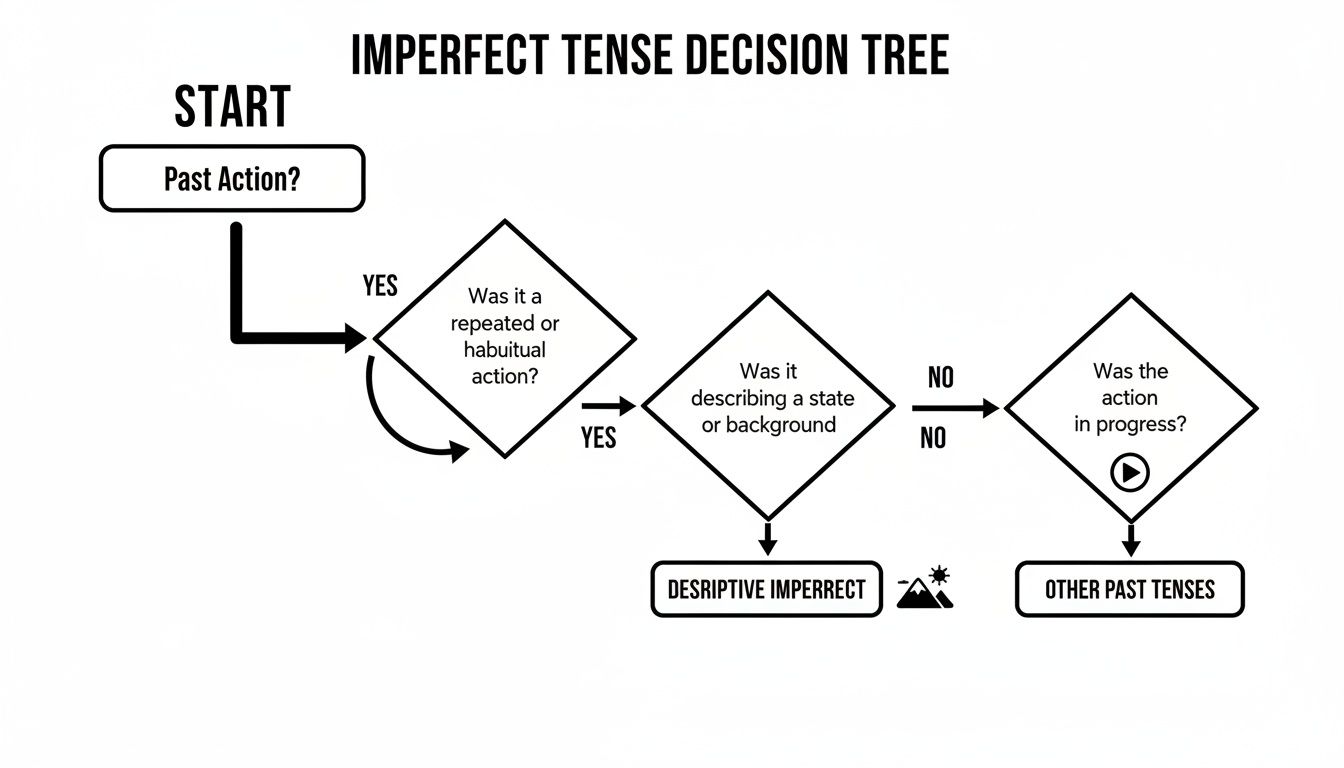
As you can see, if the past action was habitual, ongoing, or just setting the scene, the imperfect is your go-to for painting that background picture.
Signal Words: A Clear Guide
Just as some words point you toward one tense or the other, certain words are natural bridges for combining them. Cuando (when) is the most common connector for interrupted actions. Mientras (while) is perfect for describing two things happening at the same time.
Spotting these signal words is a huge shortcut. Committing some of them to memory will give you a big advantage when you have to make a split-second decision in a real conversation.
Here is a quick reference guide to some of the most common trigger words for each tense.
Signal Word Cheat Sheet
| Preterite Signal Words | Imperfect Signal Words |
|---|---|
| ayer (yesterday) | siempre (always) |
| anoche (last night) | a menudo (often) |
| el año pasado (last year) | todos los días (every day) |
| de repente (suddenly) | mientras (while) |
| una vez (one time) | cada semana/mes/año (every week/month/year) |
| en ese momento (at that moment) | generalmente (generally) |
| desde el primer momento (from the first moment) | con frecuencia (frequently) |
Once you get comfortable recognizing these signals and understanding the interrupted action framework, you'll be able to combine the preterite and imperfect to tell stories with real nuance. This is what separates learners who just state facts from those who can truly narrate like a native speaker.
Verbs That Change Meaning In The Past Tense
Choosing between the imperfect and preterite can feel like a simple grammar rule, but for a handful of common verbs, your choice completely changes the word's meaning. This is where Spanish gets really interesting, moving beyond just timelines and into the subtle art of context.
Getting these verbs right is a huge step toward sounding more like a native speaker. It shows you don't just understand what happened, but also the nuance behind the action.
The Querer Shift: Wanting vs. Trying
The verb querer (to want) is a classic example of this meaning shift. In the imperfect, it simply describes a state of mind—what someone desired. But in the preterite, it morphs into a specific action or even an outcome.
- Imperfect: Ella quería ver la película. (She wanted to see the movie.)
- This tells us about her ongoing desire. Maybe she saw it, maybe she didn't; all we know is what she was feeling.
- Preterite: Ella quiso ver la película. (She tried to see the movie.)
- This implies she actually made an attempt. She took action to see it, whether she succeeded or not.
The negative form is even clearer. No quería means someone just didn't want to do something, while no quise means they actively refused.
Key Takeaway: With querer, the imperfect describes a feeling (wanted to), while the preterite describes an action (tried to or refused to).
The Saber Shift: Knowing vs. Discovering
In the same way, saber (to know) highlights the difference between already having knowledge and the moment you acquire it. The imperfect describes a continuous state of awareness, but the preterite pinpoints the exact moment of discovery.
- Imperfect: Yo no sabía la verdad. (I didn't know the truth.)
- This describes my ongoing state of ignorance in the past.
- Preterite: Anoche, yo supe la verdad. (Last night, I found out the truth.)
- This marks the specific moment I learned the information. It’s an event.
Think of sabía as "I was aware of" and supe as "I discovered" or "I found out." One is a background state, the other is a key plot point.
Comparing Other Meaning-Changing Verbs
Several other common verbs follow this same pattern, shifting from describing a background state to narrating a specific event. For a deeper look at verbs like querer and saber, check out this guide to regular and irregular -er verbs in Spanish.
Here’s a quick rundown of more verbs that pull this magic trick.
| Verb | Preterite Meaning (Event) | Imperfect Meaning (State) |
|---|---|---|
| Conocer | met (for the first time) | knew (was acquainted with) |
| Poder | succeeded (managed to) | was able (had the ability) |
| No Poder | failed (couldn't and didn't) | was not able (lacked ability) |
| Tener | got, received | had, possessed |
Understanding these differences is what takes your Spanish to the next level. Instead of just stating facts, you can add a crucial layer of context. You didn't just know your friend, you remember the day you met them (la conocí vs. la conocía). It's all in the details.
Of course. Here is the rewritten section, crafted to sound completely human-written and natural, following all your provided instructions.
Practical Scenarios and Common Mistakes
Alright, the theory is one thing, but using the imperfect or preterite in a real conversation is where the rubber meets the road. This is where you really start to master it. Let's step away from the grammar charts and see how these tenses actually work in the wild, focusing on the classic mistakes that trip up most English speakers.

Analyzing A Simple Narrative
Think about how you’d tell a friend about your morning. You might say something like: “It was a beautiful day. The sun was shining, I was feeling great, and then suddenly, my boss called with an urgent task.” Let’s break that down into Spanish and see why certain tenses get picked.
- Hacía un día hermoso. (It was a beautiful day.) – Here, we're setting the scene. That’s a classic job for the imperfect.
- El sol brillaba y yo me sentía genial. (The sun was shining and I was feeling great.) – Again, imperfect. These are ongoing background details and internal feelings, not specific actions.
- De repente, mi jefe me llamó... (Suddenly, my boss called me...) – Boom. This is the preterite. It’s the specific, interrupting action that pushed the story forward.
This structure is really the heart of Spanish storytelling. The imperfect paints the background, and the preterite drops in the key plot points.
Overusing The Preterite For Descriptions
One of the most common giveaways of an English speaker is using the preterite for absolutely everything in the past. It feels more direct, a lot like our simple past tense, but it creates a story that sounds like a flat, boring list of events with no atmosphere.
Check out this all-too-common mistake:
- Incorrect: El hotel fue grande y estuvo cerca de la playa.
- Correct: El hotel era grande y estaba cerca de la playa.
The second sentence nails it by using the imperfect (era, estaba) to describe the hotel's general characteristics and its location—these are background facts, not actions. Using the preterite makes it sound like the hotel was suddenly big for just a moment, which is just weird.
A great rule of thumb: If you're describing what something was like or how someone was feeling, your first instinct should almost always be the imperfect. Save the preterite for what happened.
Misusing The Imperfect For Completed Actions
The flip side of the coin is using the imperfect for a single, finished event. This can make your story really confusing because it makes a one-and-done action sound like it was ongoing or something you used to do repeatedly.
For instance, if you say:
- Incorrect: Ayer, yo compraba un coche nuevo.
- Correct: Ayer, yo compré un coche nuevo.
The word ayer (yesterday) signals a very specific, completed timeframe. Using the imperfect (compraba) makes it sound like you were in the middle of buying the car all day long, or that you had a habit of buying a new car every yesterday. The preterite (compré) correctly signals that you bought the car, and the action is finished.
Common Questions About Preterite And Imperfect
Even after you think you've got the rules down, a few tricky questions always seem to pop up when choosing between imperfect and preterite. Let's tackle the most common points of confusion head-on to give you quick, clear answers.
Is There A Simple Trick To Always Know Which To Use?
While there’s no single "trick" that's 100% foolproof, the best mental shortcut I've found is the "snapshot vs. movie" analogy.
Ask yourself: is this action a single, completed snapshot in the past? Like a photo capturing one moment? If yes, you almost certainly need the preterite.
Or, is it part of the background scenery, an ongoing description, or a continuous action playing out over time? That’s your movie scene. For that, you’ll want the imperfect. This simple question will steer you right in the vast majority of situations.
Which Tense Is More Common In Spoken Spanish?
Honestly, they're both absolutely essential, and how often you hear them depends entirely on what's being said. When someone is telling a story or sharing a memory, you'll hear a constant mix—the imperfect sets the scene, and the preterite moves the plot forward with key events.
In quick, factual exchanges about the past, like "What did you do yesterday?", the preterite often shows up more. A fluent speaker bounces between them effortlessly, so mastering both is non-negotiable. If you need to brush up on the basics, reviewing something like how to conjugate present tense -ar verbs can help reinforce those foundational patterns.
What Is The Biggest Mistake Learners Make?
By far, the most common error is overusing the preterite for everything that happened in the past. This is especially true for English speakers, who are used to a single simple past tense ("I walked," "she ate"). The preterite feels like the most direct translation, so it becomes a crutch.
The problem? Using only the preterite makes your stories sound like a flat, robotic list of events. You lose all the context, description, and feeling that the imperfect provides.
If you're looking for new ways to get a handle on these tenses, modern tools can offer great supplemental practice. You can see how new tech is helping people learn in resources like this guide on AI Chatbots for Language Learning.
A classic mistake is saying "Hizo sol y yo estuve feliz" (Preterite). It just sounds clunky and unnatural. The correct version, "Hacía sol y yo estaba feliz" (Imperfect), properly describes the ongoing conditions—the sun was shining, and I was feeling happy.
Ready to stop guessing and start mastering Spanish verbs? PolyChat offers the market's best conjugation practice tool with unlimited, gamified challenges to build your confidence. Download the app and conquer Spanish grammar today at https://www.polychatapp.com.

Jean-Baptiste Bolh
Co-Founder
Applied AI