A Practical Guide to Mastering ER Verbs in Spanish
If you're just getting your feet wet with Spanish, you'll quickly notice that verbs tend to fall into one of three big families: those ending in -ar, -er, and -ir. Getting a handle on the -er verbs is a game-changer. It’s like being handed a key that unlocks a massive chunk of the language.
Think about it. So many of our daily actions belong to this group: eating (comer), drinking (beber), reading (leer), and understanding (comprender). The best part? They’re incredibly consistent. Once you nail the basic pattern for regular -er verbs, you can apply that same formula to hundreds of others. It’s a powerful shortcut to building real sentences right away.
Ready to Learn Spanish?
Try PolyChat's engaging language lessons, interactive learning games and put your Spanish vocabulary to the test!
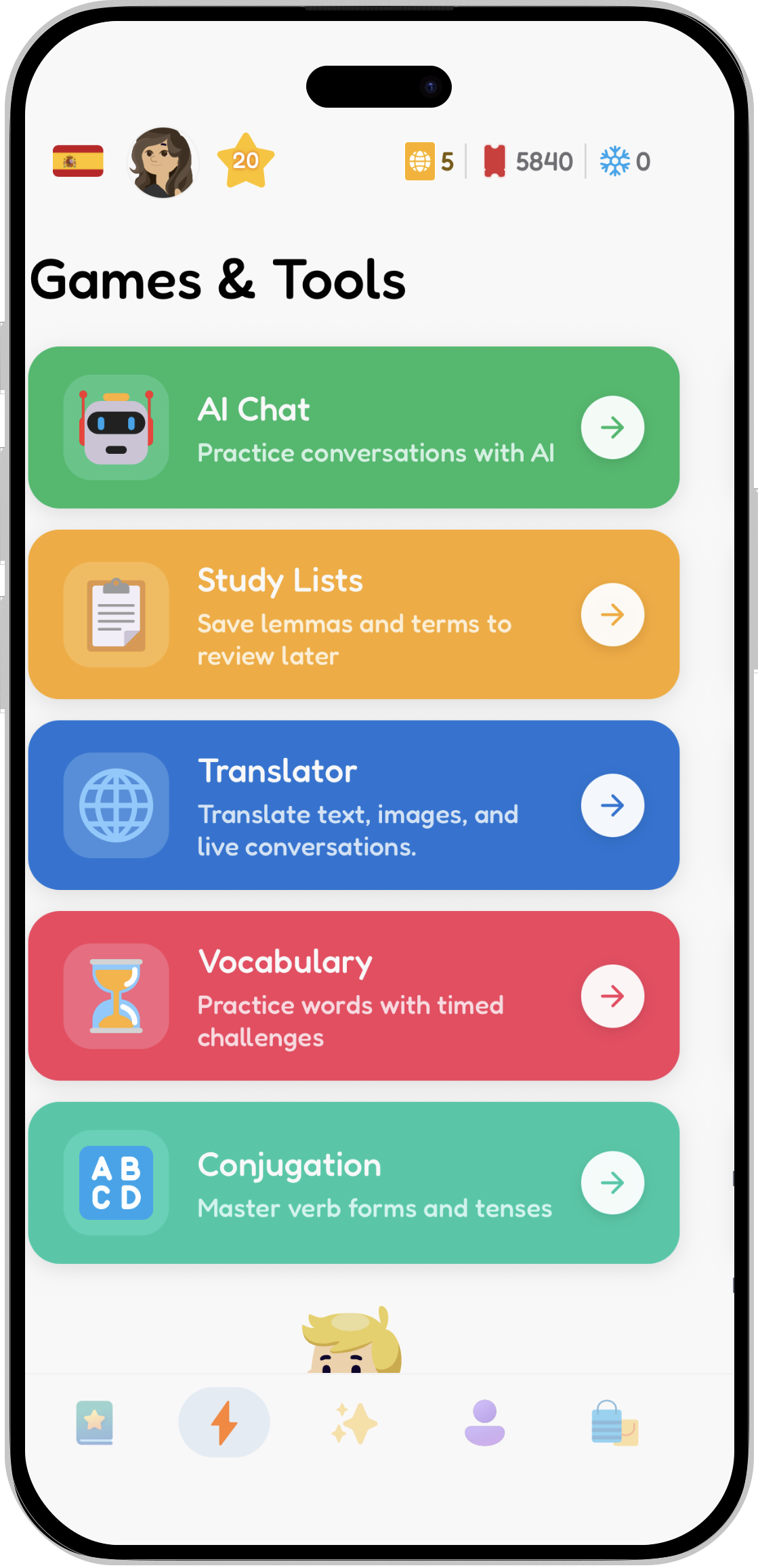
Games & Tools
Tools that every language learner needs at all stages of their learning journey.
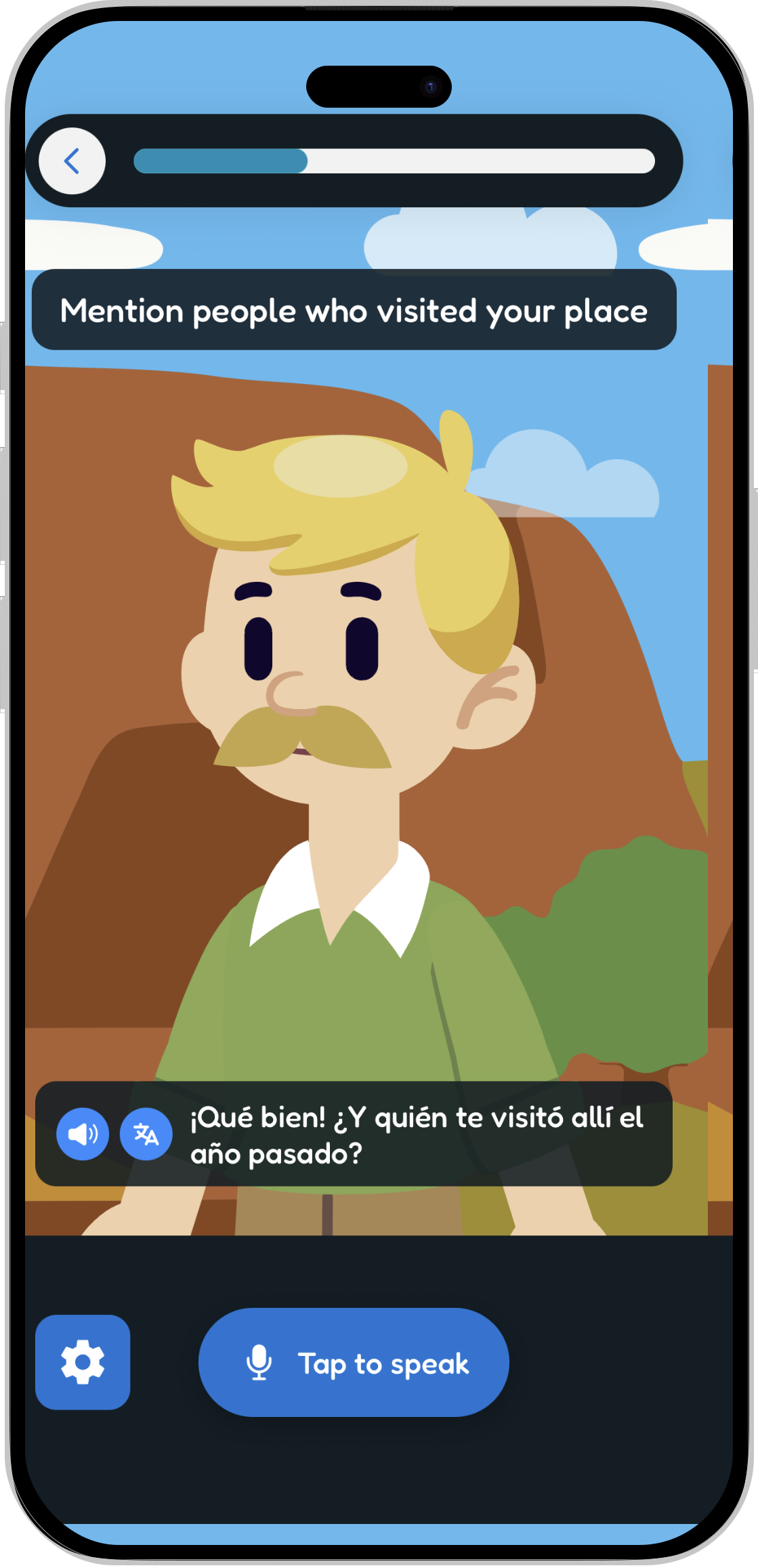
AI Chat Tutor
Practice real conversations with an AI tutor that helps you speak with confidence.
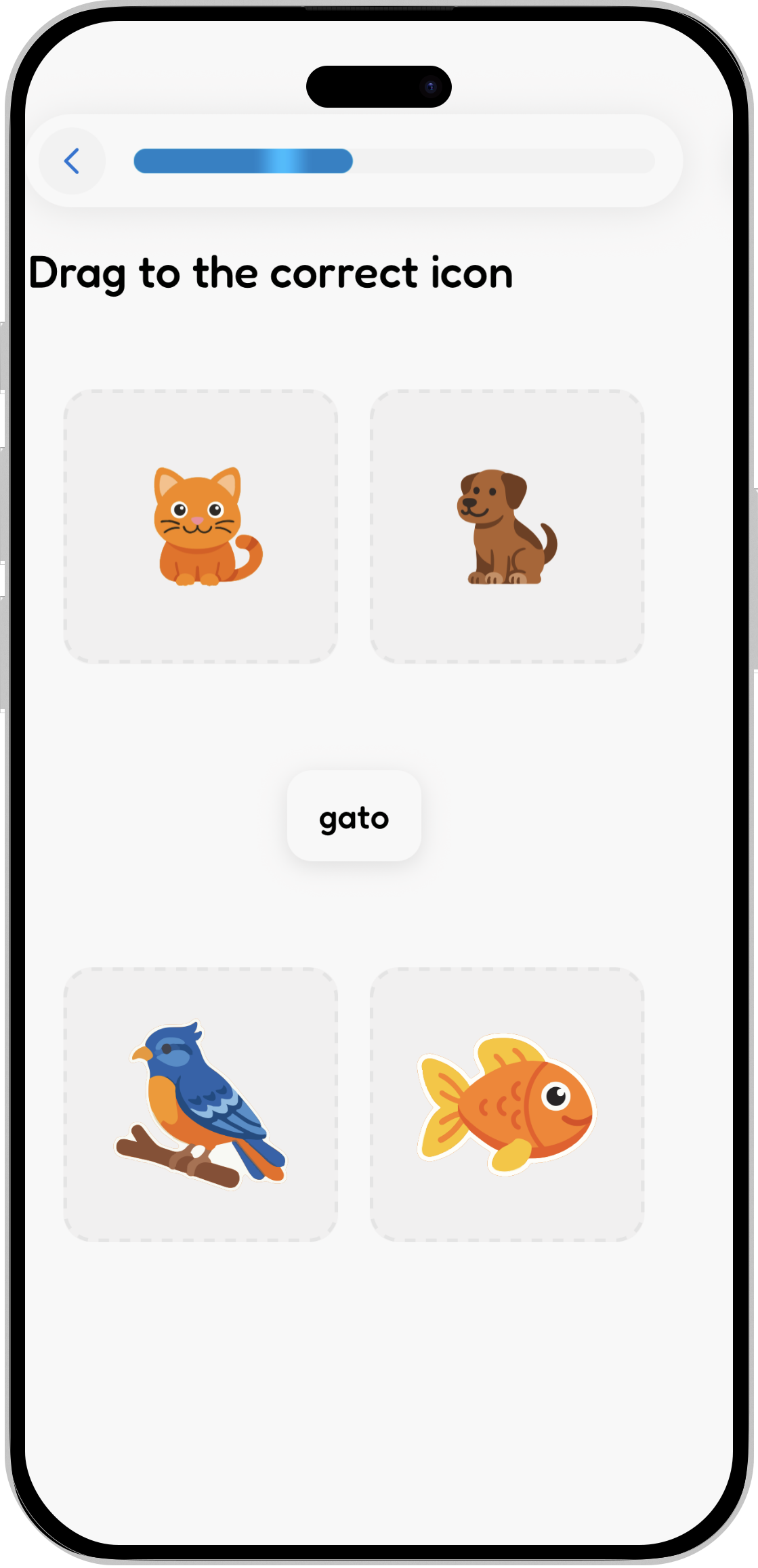
Interactive Games
A variety of games to help you learn and remember new words and phrases.


Your Foundation: What Are Spanish ER Verbs?
So, what exactly are Spanish -er verbs? They’re simply verbs whose most basic, dictionary form—the infinitive—ends in the letters “-er,” like comer (to eat) or aprender (to learn). They are an absolute cornerstone of the language, popping up in conversations every single day.
Spotting and Using ER Verbs
Finding an -er verb is the easy part. Just look at the end of the word. If you see that "-er," you've got one.
Putting it to use, or "conjugating" it, is a simple two-step dance:
- Find the stem: Just drop the -er from the end. For comer, the stem is com-.
- Add the right ending: Tack on a new ending that matches who is doing the action.
These endings are the secret code. They tell you if I am eating, you are eating, or they are eating. Getting them right not only makes you grammatically correct but also makes you sound much clearer—a huge step in avoiding those common Spanish pronunciation mistakes we all make at first.
A great way to see these verbs in their natural habitat is by reading simple texts, like beginner Spanish stories, where you can see the patterns repeat over and over.
To get you started, here’s a quick-glance table for the present tense.
Quick Reference for Regular ER Verb Endings in the Present Tense
This chart breaks down the essential endings you'll need for regular -er verbs when talking about the here and now.
| Subject Pronoun (English) | Subject Pronoun (Spanish) | Present Tense Ending |
|---|---|---|
| I | Yo | -o |
| You (informal) | Tú | -es |
| He/She/You (formal) | Él/Ella/Usted | -e |
| We | Nosotros/Nosotras | -emos |
| They/You all | Ellos/Ellas/Ustedes | -en |
Just stick these endings onto the verb stem, and you're officially speaking Spanish! For example, "I eat" becomes Yo como, and "We learn" is Nosotros aprendemos. It’s that straightforward.
Conjugating Regular ER Verbs Across Key Tenses
Alright, now that you’ve got the basic formula down, let's see how these -er verbs work across different timelines. Think of verb tenses like different camera lenses. The present tense is your live, in-the-moment shot, while the past and future tenses are like snapshots of what’s already happened or previews of what's to come. Getting these down is how you start telling real stories in Spanish.
We're going to stick with our trusty verb comer (to eat). It’s a perfect, predictable -er verb that clearly shows you the patterns you need to lock into your brain. By using just one example, you'll see how the endings change systematically to shift the meaning in time.
This diagram breaks down the whole process visually. You start with the infinitive, identify your subject, and then snap on the right ending. It's a clean, logical system.
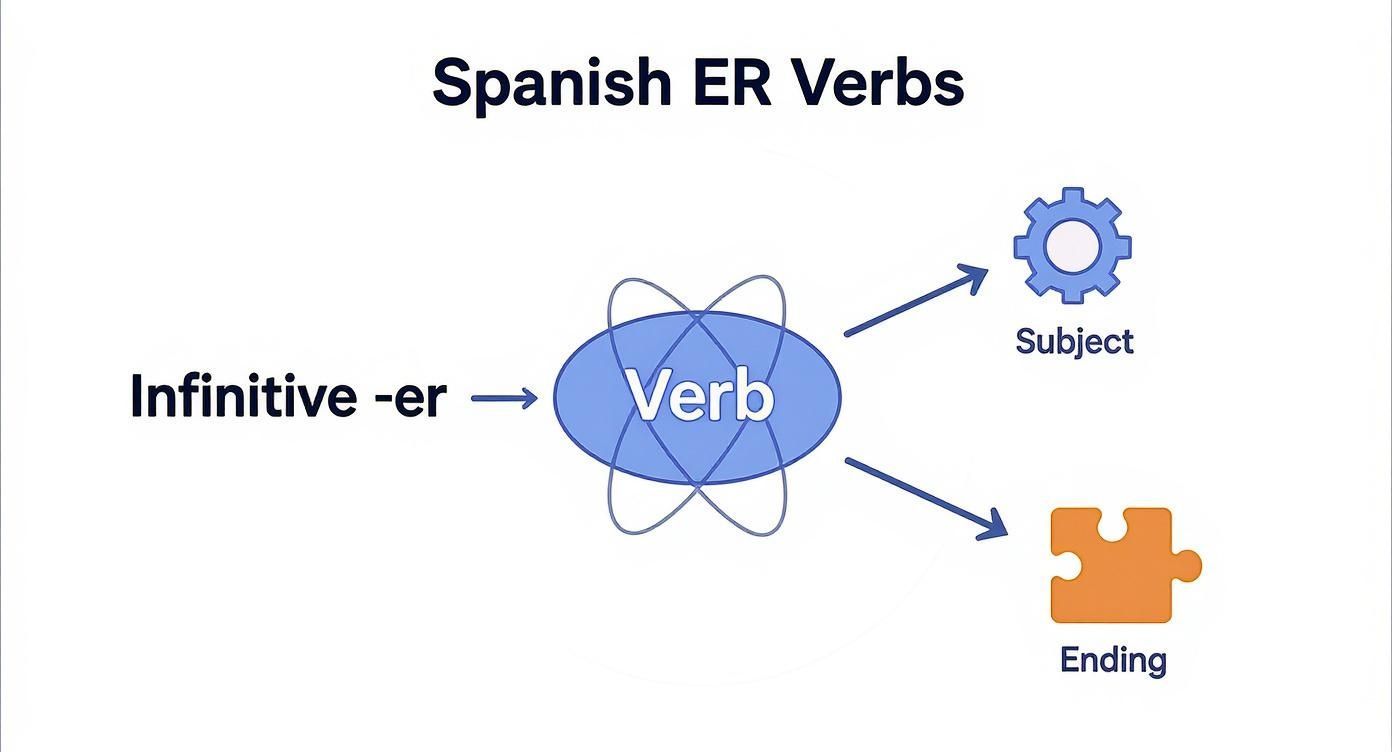
As you can see, conjugation is just a predictable process: infinitive -> subject -> ending. Simple as that.
To give you a full picture, here’s a map of how a regular -er verb like comer conjugates across the five most essential tenses. This is your cheat sheet for seeing all the patterns in one place.
Full Conjugation Map for a Regular ER Verb (Example Comer)
| Subject Pronoun | Present Tense | Preterite Tense | Imperfect Tense | Future Tense | Conditional Tense |
|---|---|---|---|---|---|
| Yo | como | comí | comía | comeré | comería |
| Tú | comes | comiste | comías | comerás | comerías |
| Él/Ella/Usted | come | comió | comía | comerá | comería |
| Nosotros/as | comemos | comimos | comíamos | comeremos | comeríamos |
| Vosotros/as | coméis | comisteis | comíais | comeréis | comeríais |
| Ellos/Ellas/Ustedes | comen | comieron | comían | comerán | comerían |
Seeing them all laid out like this really helps solidify the patterns. You can start to notice the similarities and differences, like how the future and conditional tenses keep the full infinitive verb.
Now, let's break down each of these tenses one by one.
Talking About Now: The Present Tense
The present tense is your bread and butter. It's for actions happening right now, routines, and general truths. You'll be using this one constantly in everyday conversations, so it’s the first one to master.
The endings are straightforward and follow the core pattern we already covered: -o, -es, -e, -emos, -éis, -en.
- Yo como una manzana. (I eat an apple.)
- Tú comes demasiado rápido. (You eat too fast.)
- Nosotros comemos juntos los domingos. (We eat together on Sundays.)
Looking Back: The Preterite Tense
The preterite tense is for completed actions in the past. If it happened at a specific point in time and it’s over and done with, you need the preterite. Think of it like a dot on your timeline—a finished event.
For regular -er verbs, the preterite endings are: -í, -iste, -ió, -imos, -isteis, -ieron.
Example: Ayer, comí en un restaurante nuevo. (Yesterday, I ate at a new restaurant.) The action is complete. It started and ended yesterday.
Setting the Scene: The Imperfect Tense
While the preterite is a snapshot, the imperfect tense is like the background scenery in a film. It describes ongoing past actions, habits, or what was happening when something else interrupted. This is your "used to" or "was -ing" tense in Spanish.
The imperfect endings are beautifully consistent and easy to remember: -ía, -ías, -ía, -íamos, -íais, -ían.
- Yo comía con mis abuelos cada fin de semana. (I used to eat with my grandparents every weekend.)
- Ella leía un libro cuando sonó el teléfono. (She was reading a book when the phone rang.)
Planning Ahead: The Future Tense
The future tense might just be the easiest one of all. Seriously. Instead of dropping the "-er," you just keep the entire infinitive and tack the ending right onto it. This tense is for talking about what will happen.
The future endings are: -é, -ás, -á, -emos, -éis, -án.
- Comer + é = Comeré (I will eat)
- Aprender + án = Aprenderán (They will learn)
Example: Mañana comeremos paella. (Tomorrow we will eat paella.)
Discussing "What Ifs": The Conditional Tense
Just like the future tense, the conditional keeps the full infinitive and adds its own set of endings. This tense is for hypotheticals—what would happen under certain conditions. It's also used for making polite requests.
The conditional endings are: -ía, -ías, -ía, -íamos, -íais, -ían. Yes, they look identical to the imperfect endings, but the key difference is they attach to the full infinitive, not the stem.
- Yo comería más verduras, pero no me gustan. (I would eat more vegetables, but I don't like them.)
- ¿Beberías un café conmigo? (Would you drink a coffee with me?)
Turning these rules into an automatic skill takes repetition. You have to drill them until they become second nature. Interactive exercises can make this feel less like a chore and more like a game. In fact, many learners find that adding a fun, competitive element is a huge motivator, a concept we explore in our guide to gamification in language learning.
Navigating the Most Common Irregular ER Verbs
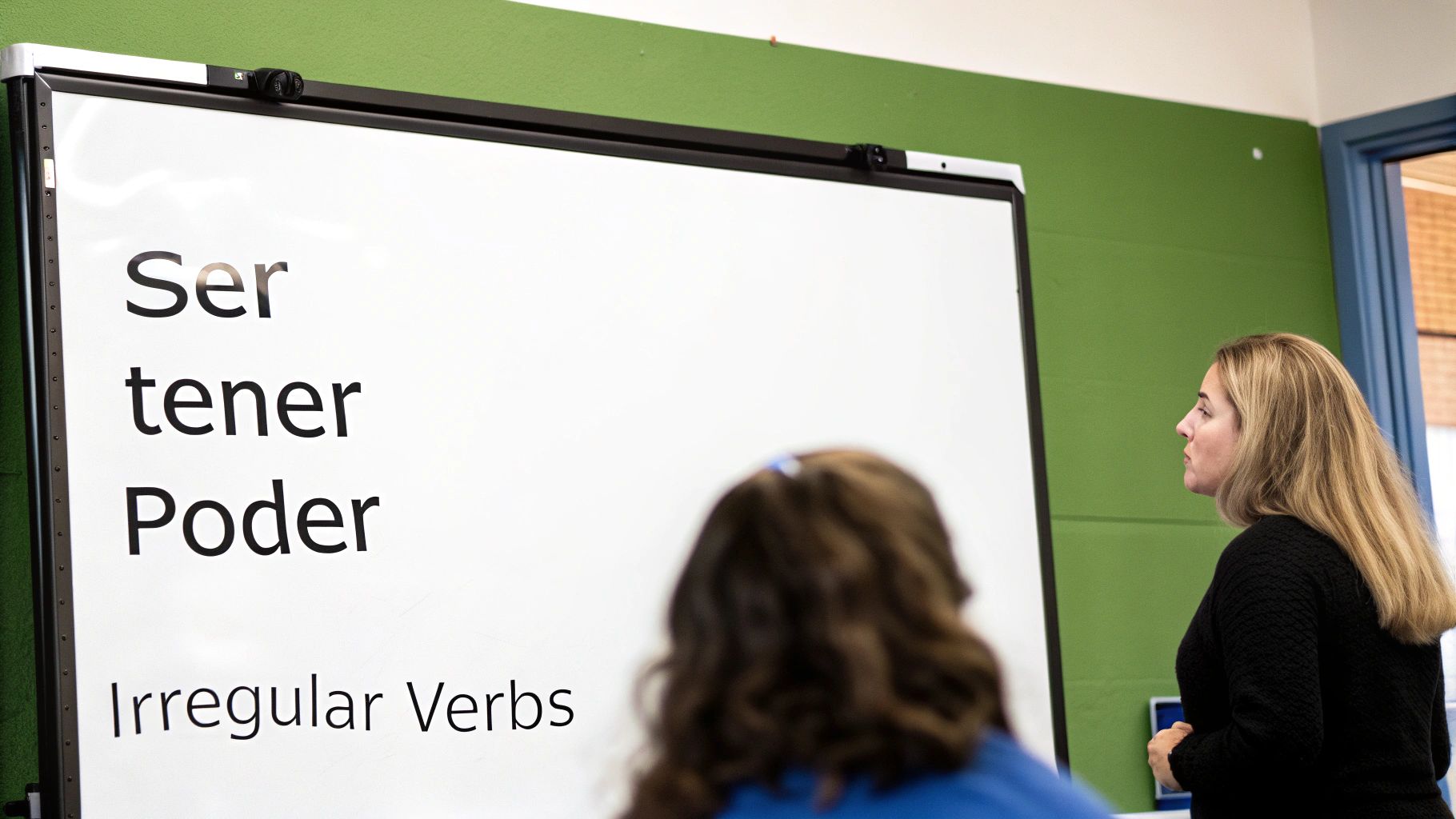
Alright, you’ve wrestled with the predictable patterns of regular verbs. Now it's time to meet their rebellious, unpredictable cousins: the irregulars.
These are the verbs that just don't play by the rules, but don't let that spook you. They aren't random troublemakers; they're actually some of the most important and frequently used words in the entire Spanish language.
Think about it in English. We have verbs like "to go" or "to be." We don't say "I goed" or "I beed." The weird forms (went, was) feel totally natural simply because we use them all the time. Spanish works the same way. The most common er verbs in Spanish are often irregular precisely because they’re used so much.
In fact, there's a clear link between how often a verb is used and its tendency to break the rules. Powerhouse verbs like ser (to be) and tener (to have) have been so central to daily conversation for centuries that their unique forms have been burned into the language, resisting the simplifications that regular verbs went through.
So, instead of trying to memorize a massive, intimidating list, let's just focus on the essentials—the ones you’ll hear and use every single day.
The Power Trio: Ser, Tener, and Poder
These three verbs are the absolute bedrock of Spanish conversation. Each has its own quirks, but once you get them down, you unlock the ability to express core ideas about who you are, what you have, and what you can do.
Ser (To Be - permanent)
Ser is all about identity, permanent characteristics, and where you're from. It's wildly irregular in pretty much every tense, and its present tense forms are completely unique. There's no pattern here; you just have to learn them.
Key Irregularity: The entire verb changes unpredictably.
- Yo soy (I am)
- Tú eres (You are)
- Él/Ella/Usted es (He/She/You are)
Example: Yo soy de México. (I am from Mexico.)
Tener (To Have)
Tener is a true workhorse verb. It features a common irregularity pattern: a stem change (e becomes ie) plus a funky first-person form (yo tengo). Once you spot this "-go" verb pattern, you'll see it everywhere.
Key Irregularity: The 'yo' form ends in '-go' and the stem changes in other forms.
- Yo tengo (I have)
- Tú tienes (You have)
- Él/Ella/Usted tiene (He/She/You have)
Example: Nosotros tenemos dos gatos. (We have two cats.)
Poder (To Be Able To / Can)
Poder is your go-to for asking permission or talking about abilities. It has a classic "stem-changing" irregularity where the 'o' flips to a 'ue' in most present-tense forms (the nosotros and vosotros forms always escape this change).
Key Irregularity: The stem vowel 'o' changes to 'ue'.
- Yo puedo (I can)
- Tú puedes (You can)
- Él/Ella/Usted puede (He/She/You can)
Example: ¿Puedes ayudarme, por favor? (Can you help me, please?)
Other Must-Know Irregular Verbs
Beyond that main trio, a handful of other irregular er verbs in Spanish will pop up constantly. Getting these under your belt will give your fluency and understanding a massive boost.
- Hacer (To Do/Make): This one is only irregular in the yo form in the present tense, where it grabs that "-go" ending. (Yo hago)
- Poner (To Put/Place): Just like hacer, poner gets a "-go" ending for the yo form. Easy to group together. (Yo pongo)
- Saber (To Know): The yo form is the only odd one out here (Yo sé). The rest of the conjugations are perfectly normal.
- Ver (To See): The yo form (Yo veo) is just slightly irregular, while the other forms are completely predictable.
Once you’ve got a handle on these verbs, tackling another common irregular like estar will feel much more manageable. For a deep dive, this guide to the conjugation of 'estar' is a fantastic next step.
Honestly, the best way to get these verbs to stick is to use them. PolyChat’s conjugation practice tools are designed for exactly this, turning what could be a boring memorization drill into a fun, engaging game. By using verbs like ser, tener, and poder over and over in exercises, their weird forms will start to feel just as natural as the regular ones.
Going Deeper: Using Participles and Gerunds
Once you've got a good handle on the basic tenses, it's time to add some real texture to your sentences. Two of the most powerful tools for this are the past participle and the gerund.
These aren't tenses on their own. Instead, think of them as special verb forms that team up with other verbs to express more complex, nuanced ideas. Getting these down is a major step toward sounding less like a textbook and more like a native speaker.
For regular er verbs in Spanish, the patterns are wonderfully simple and consistent, making them a great place to start.
The Past Participle: Describing Completed Actions
The past participle is the Spanish version of English words like "eaten," "drunk," or "learned." It describes something that has already happened. For any regular -er verb, you just knock off the -er and add -ido. It's that easy.
- Comer → Comido (Eaten)
- Beber → Bebido (Drunk)
- Aprender → Aprendido (Learned)
So, where do you use it? The most common place is with the verb haber (to have) to build what we call the "perfect" tenses. These tenses are perfect for talking about actions that are completed but still relevant to another point in time.
For instance, to say "I have eaten," you combine haber with the participle: Yo he comido. This structure is your go-to for connecting the past to the present.
The Gerund: Highlighting Actions in Progress
The gerund is the Spanish equivalent of the "-ing" form in English. You use it to show that an action is happening right now, as we speak. To form the gerund of a regular -er verb, you drop the -er and stick -iendo on the end.
- Comer → Comiendo (Eating)
- Correr → Corriendo (Running)
- Leer → Leyendo (Reading) — Heads up! When the stem ends in a vowel, you use a 'y' (-yendo) to keep the sound right.
The gerund's best friend is the verb estar (to be). Together, they form the "progressive" or "continuous" tenses, which really emphasize that an action is in motion.
Key Takeaway: If you want to say something is happening at this very moment, use estar + the gerund. "Estoy comiendo ahora mismo" ("I am eating right now") has a much stronger sense of immediacy than the simple present tense.
Most er verbs in Spanish play by these rules, but keep an eye out for a few common irregular participles you just have to memorize. The big ones are ver → visto (seen) and poner → puesto (put). Fortunately, the gerund form is much more predictable.
By mastering these two forms and pairing them with helper verbs like haber and estar, you can start building richer, more descriptive, and far more natural-sounding sentences.
Making Sense of the Subjunctive Mood with ER Verbs
Alright, let's talk about what often feels like the final boss of Spanish grammar: the subjunctive mood. But here’s a little secret—it’s not nearly as scary as it looks. The trick is to stop thinking of it as just another tense and start seeing it for what it is: a mood. It's a special way of talking about things that aren't concrete, objective facts.
Think of it this way. The indicative mood (pretty much everything we've covered so far) is for reporting the news. It states facts, truths, and things you're certain about. The subjunctive, on the other hand, is for the "what ifs," the doubts, and the desires. It's the language of wishes, emotions, and hypotheticals.
Forming the Present Subjunctive
For regular -er verbs, forming the present subjunctive follows a surprisingly simple pattern. It’s a classic switcheroo. You take the yo form of the present indicative, drop the -o, and then add the opposite vowel endings. Since -er verbs normally use "e," their subjunctive endings will use "a."
The Subjunctive Formula:
- Start with the present tense yo form (e.g., from comer -> como).
- Drop the final -o (e.g., com-).
- Add the subjunctive endings: -a, -as, -a, -amos, -áis, -an.
That simple swap is your key to unlocking this new mode of expression. It’s a predictable pattern you can lean on time and time again.
Subjunctive in Action Examples
Let's put this into practice with our trusty verb comer (to eat). The yo form is como. We drop the -o to get the stem com- and then tack on our new endings.
- que yo coma (that I eat)
- que tú comas (that you eat)
- que él coma (that he eats)
- que nosotros comamos (that we eat)
- que ellos coman (that they eat)
Did you notice the trigger word que (that)? The subjunctive rarely flies solo. It's almost always introduced by a main clause expressing desire, doubt, emotion, or some kind of uncertainty.
For example:
- Mi madre quiere que yo coma más verduras. (My mother wants me to eat more vegetables.)
- Es importante que aprendamos español. (It's important that we learn Spanish.)
This mood is absolutely essential for expressing nuanced ideas. Getting this pattern down for -er verbs in Spanish will dramatically improve your ability to communicate complex thoughts and feelings, moving you from simply stating facts to truly discussing possibilities.
Your Common ER Verb Questions Answered
Even when the rules seem clear, a few tricky questions always pop up when you're tackling -er verbs in Spanish. This quick FAQ hits the most common sticking points, giving you straightforward answers to clear up any lingering confusion. Think of it as your on-demand tutor for those final nagging details.
What Is the Fastest Way to Memorize ER Verb Conjugations?
Honestly, the best method isn't just staring at charts until your eyes glaze over. It’s a mix of recognizing the patterns and actually using the verbs.
Instead of trying to cram every tense at once, focus on one at a time and start making your own simple sentences. Writing and speaking phrases with common verbs like comer, beber, and aprender builds muscle memory way faster than just reading. Active recall is your best friend here—use flashcards or a practice tool to quiz yourself. Consistent, hands-on practice will always win against passive learning.
Are Stem-Changing ER Verbs Considered Irregular?
Yep, they sure are. Stem-changing verbs are a specific flavor of irregular. While their endings usually follow the normal -er pattern, a vowel in the verb's stem morphs in most forms (typically all of them except for nosotros and vosotros).
Take entender (to understand), for instance. The 'e' in the stem flips to 'ie' in the present tense, giving you yo entiendo. Because the core of the verb—the stem—changes, it gets the "irregular" label.
Pro Tip: Don't learn these verbs one by one. Group them by their change type (like e → ie, or o → ue). This makes the pattern much easier to spot when you run into new verbs down the road.
How Do I Know When to Use Preterite Versus Imperfect?
Ah, the classic preterite vs. imperfect dilemma. This trips up almost everyone, but a simple analogy makes it much clearer.
Think of the preterite as a 'snapshot' of the past. It captures a single, completed action with a definite beginning and end. It’s a finished event, sealed and delivered.
- Ayer comí pizza. (Yesterday I ate pizza.) - It happened, it's over.
The imperfect, on the other hand, is like the 'video footage' of the past. It describes what was happening, what used to happen, or sets the background scene. It’s for ongoing actions, habits, or descriptions.
- Cuando era niño, comía pizza todos los viernes. (When I was a child, I used to eat pizza every Friday.) - A repeated routine, not a single event.
Why Are Ser and Estar Both ER Verbs and How Are They Different?
They both mean "to be," but they are absolutely not interchangeable. They describe two totally different kinds of 'being'. The easiest way to keep them straight is to think of 'ser' for permanence and 'estar' for temporary states.
- Ser: Use this for the permanent stuff—who you are, where you're from, your job, or core characteristics. It's for the essence of something. (Yo soy de España. - I am from Spain.)
- Estar: Use this for temporary conditions—where you are, how you're feeling, or your physical state right now. It's for the here and now. (Yo estoy cansado. - I am tired.)
Getting this difference down is a massive leap toward sounding natural in Spanish. If you want more targeted feedback, check out our guide on finding the best online Spanish teachers who can help you master tricky concepts like this.
Ready to turn all this theory into an actual skill? PolyChat offers the market's best conjugation practice tool, which turns boring drills into fun, interactive games. Stop just reading the rules and start mastering them. Download PolyChat today and make your practice actually count. Visit https://www.polychatapp.com to learn more.

Jean-Baptiste Bolh
Co-Founder
Applied AI