A Simple Guide to the Past Tense of Vivir in Spanish
When you talk about the past in Spanish, it's not quite as simple as just one past tense. For the verb vivir (to live), Spanish gives you two main options to tell your story: the Preterite and the Imperfect.
Choosing the right one is less about grammar rules and more about the story you're trying to tell. Think of it this way: using the Preterite (viví - I lived) is like showing a photo of a specific, finished event. The Imperfect (vivía - I was living/used to live), on the other hand, is like painting the background scenery—it sets the stage and describes an ongoing state.
Your Quick Guide to Using Vivir in the Past
Getting a handle on these two tenses is a huge step forward for any Spanish learner. It’s what separates clunky, direct translations from natural, flowing conversation. This is especially true for a word like vivir, which is easily one of the top 20 most common verbs you'll hear in daily Spanish.
The preterite form nails down specific life events that are done and dusted. The imperfect paints a picture of how life used to be over a period of time. To dig deeper into how other common verbs work, the verb tables on Babbel.com are a fantastic resource.
Vivir Past Tense Quick Conjugation Chart
Before we dive into the details, let's get a clear picture of what we're working with. Here’s a side-by-side look at how vivir changes in its two main past tenses. Keep this chart handy—it's your go-to reference for talking about where you lived, how you were living, and all the experiences that shaped your past.
| Pronoun | Preterite Tense (Completed Action) | Imperfect Tense (Ongoing Action) |
|---|---|---|
| Yo (I) | viví (I lived) | vivía (I was living / used to live) |
| Tú (You) | viviste (you lived) | vivías (you were living / used to live) |
| Él/Ella/Ud. (He/She/You) | vivió (he/she lived) | vivía (he/she was living / used to live) |
| Nosotros/as (We) | vivimos (we lived) | vivíamos (we were living / used to live) |
| Vosotros/as (You all, informal) | vivisteis (you all lived) | vivíais (you all were living / used to live) |
| Ellos/Ellas/Uds. (They/You all) | vivieron (they lived) | vivían (they were living / used to live) |
One little catch to watch out for: the nosotros form, vivimos, is spelled exactly the same in both the present tense ("we live") and the preterite tense ("we lived"). How do you tell them apart? Context is everything. The surrounding words will always make the meaning clear.
Using the Preterite Tense for Completed Actions
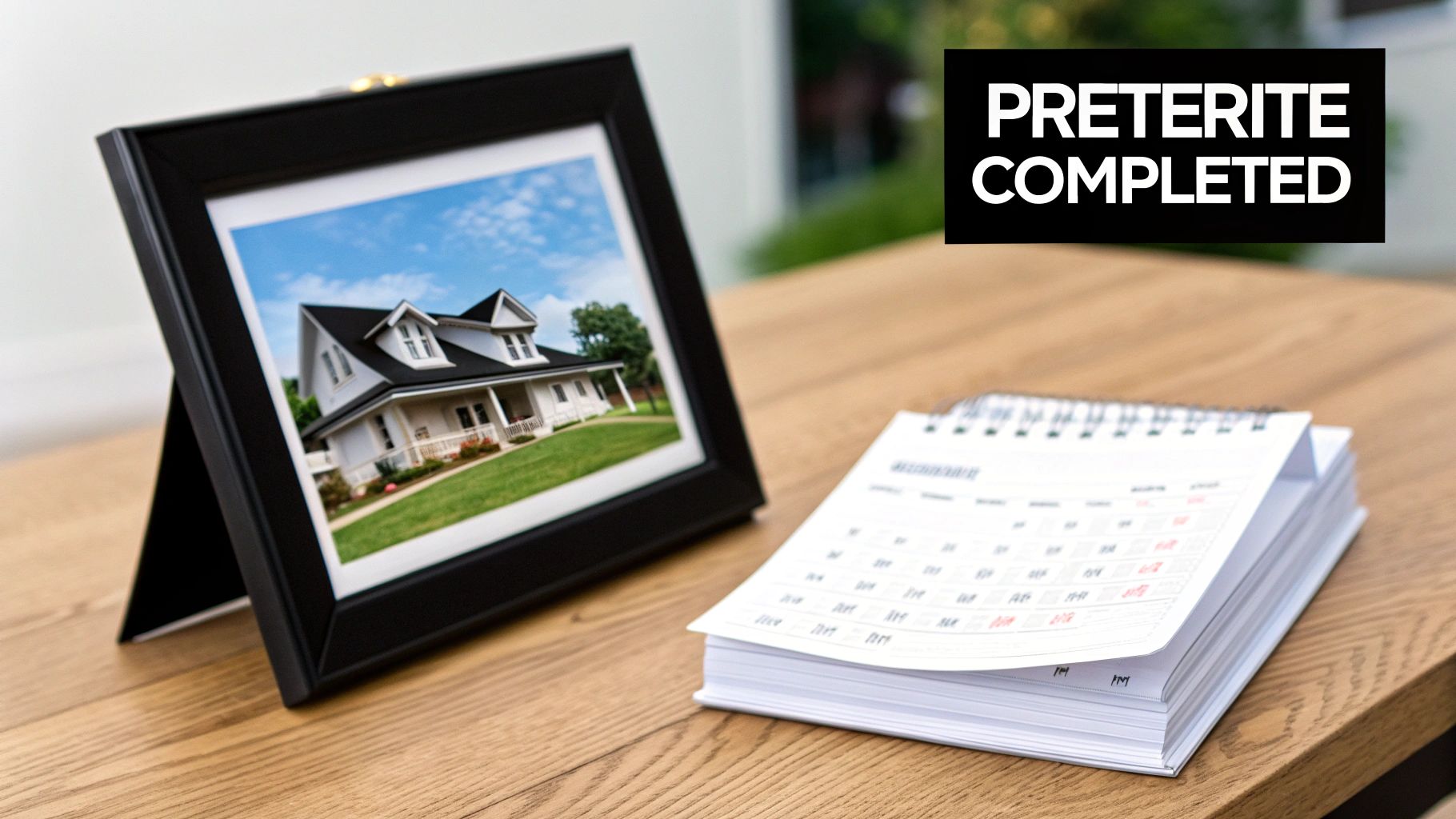
Think of the preterite tense as a spotlight. It shines on a single, specific moment in the past and says, "This happened right here, and then it was over." When you use the preterite with vivir, you’re talking about a period of living that has a clear start and a definite finish. It's done.
This tense is all about precision. It answers the question, "What happened?" by pointing to a finished event. If you say, “Viví en esa ciudad,” you’re making it clear that your time living there is a closed chapter.
How to Conjugate Vivir in the Preterite
The good news? Vivir is a regular -ir verb, which means its preterite conjugation follows a simple, predictable pattern. Once you nail these endings, you can apply them to tons of other regular verbs.
Here’s the full breakdown for the past tense of vivir:
| Pronoun | Preterite Conjugation | English Meaning |
|---|---|---|
| Yo | viví | I lived |
| Tú | viviste | You lived |
| Él/Ella/Ud. | vivió | He/She/You lived |
| Nosotros/as | vivimos | We lived |
| Vosotros/as | vivisteis | You all lived |
| Ellos/Ellas/Uds. | vivieron | They lived |
Pay close attention to the accent marks on viví and vivió. They aren't just for decoration—they're crucial for pronunciation, telling you to put the stress on that final syllable.
When to Use the Preterite with Vivir
The key is to listen for signals of completion. The preterite is your go-to tense whenever an action happened at a specific point in the past or lasted for a defined period that has since ended.
The preterite tense acts like a historical marker. It doesn't just tell you that someone lived somewhere; it tells you that their time living there is a finished part of their life story.
Take a look at these examples. Each one clearly defines a finished period:
- Mi abuela vivió en Argentina por diez años. (My grandmother lived in Argentina for ten years.)
- Vivimos en esa casa el año pasado. (We lived in that house last year.)
- ¿Viviste en el extranjero durante la universidad? (Did you live abroad during college?)
This role isn't new; the preterite has been framing Spanish stories for centuries. Ever since the Spanish Golden Age in the 1500s, this tense has been the primary tool for marking clear endpoints in historical accounts and narratives, a tradition that's just as strong today. You can dive deeper into the history of Spanish verbs on SpanishDict.com.
Describing Past Life with the Imperfect Tense
If the preterite tense is a spotlight on a single, finished event, then the imperfect tense is the soft, ambient lighting for your whole story. It’s what you use to set the scene, describe the background, and talk about ongoing habits from the past. When you use the past tense of vivir in the imperfect, you’re not talking about a period of living that’s over and done with; you’re describing what life was like.
Think of it this way: the preterite is a single photograph, while the imperfect is a long, panning video shot. The imperfect paints a picture of continuity, showing how things used to be or what was happening over an undefined stretch of time.
How to Conjugate Vivir in the Imperfect
Here’s some good news: just like in the preterite, vivir is a completely regular -ir verb in the imperfect. Once you learn the pattern for its endings, you’ve mastered it for good.
| Pronoun | Imperfect Conjugation | English Meaning |
|---|---|---|
| Yo | vivía | I was living / used to live |
| Tú | vivías | You were living / used to live |
| Él/Ella/Ud. | vivía | He/She/You were living / used to live |
| Nosotros/as | vivíamos | We were living / used to live |
| Vosotros/as | vivíais | You all were living / used to live |
| Ellos/Ellas/Uds. | vivían | They were living / used to live |
You probably noticed that the yo and él/ella/usted forms (vivía) are identical. Don’t worry about this causing confusion—the context of your sentence will always make it clear who you’re talking about. This predictable pattern is a huge relief for learners, and you can see it in action in our complete guide to imperfect conjugation in Spanish.
When to Use the Imperfect with Vivir
The imperfect is your go-to tense for providing context and describing the backdrop of a story. It answers questions like, "What was going on?" or "What were things like back then?"
Use the imperfect to talk about past habits, ongoing conditions, or to set a scene. It's all about the duration and repetition of an action, not its completion.
Here are the main situations where you’ll reach for the imperfect:
- To describe past habits or routines: Things that happened over and over again. For example, "Cuando éramos niños, vivíamos cerca del mar." (When we were children, we used to live near the sea.)
- To describe ongoing situations: This is for setting the background for another event. For instance, "Yo vivía en Madrid cuando la conocí." (I was living in Madrid when I met her.)
- To provide general descriptions: Use it to talk about age, feelings, the time, or the weather in the past.
Keep an eye out for trigger words like siempre (always), a menudo (often), todos los días (every day), and mientras (while). These words are huge clues that you should be using the imperfect because they signal a continuous or habitual action—exactly what this tense was made for.
Putting It All Together: Preterite vs. Imperfect
This is where the magic happens. Choosing between the preterite and imperfect forms of vivir is where Spanish storytelling truly comes alive. Forget thinking of this as just a grammar rule—it’s a creative choice that completely changes the feel of your sentence.
Think of it like this: one tense acts like a pin dropping on a map to mark a specific spot, while the other paints the entire landscape around it.
Let's say you want to talk about someone who lived in a certain house. The tense you pick for the past tense of vivir tells a completely different story.
- Preterite: Él vivió en esa casa. (He lived in that house.)
- Imperfect: Él vivía en esa casa. (He was living / used to live in that house.)
See the difference? The preterite, vivió, presents his time there as a finished chapter. It's a fact with a clear beginning and end, even if you don't say the dates. In contrast, the imperfect, vivía, sets a scene. It feels more descriptive, describing an ongoing situation in the past, almost like it's the backdrop for something else that happened.
The Storytelling Difference
Let’s dig into that a little more. If you say, "Él vivió en esa casa por cinco años," you're boxing that time up. It's a defined, completed block of time. The action is over.
But if you say, "Él vivía en esa casa cuando adoptó un perro," his living there is the background music for the main event—adopting the dog. The focus isn't on the living; it's on the adopting.
Nailing this distinction is one of the biggest hurdles in Spanish, but once you get it, your ability to tell stories skyrockets. For a deeper dive, our guide on choosing between the imperfect or preterite has tons more examples to really make it click.
The core difference is all about perspective. The preterite looks at an action from the outside, seeing it as a single, completed event. The imperfect takes you inside the action, describing the ongoing experience as it was happening.
This little decision tree can help you visualize when the imperfect is the right call.
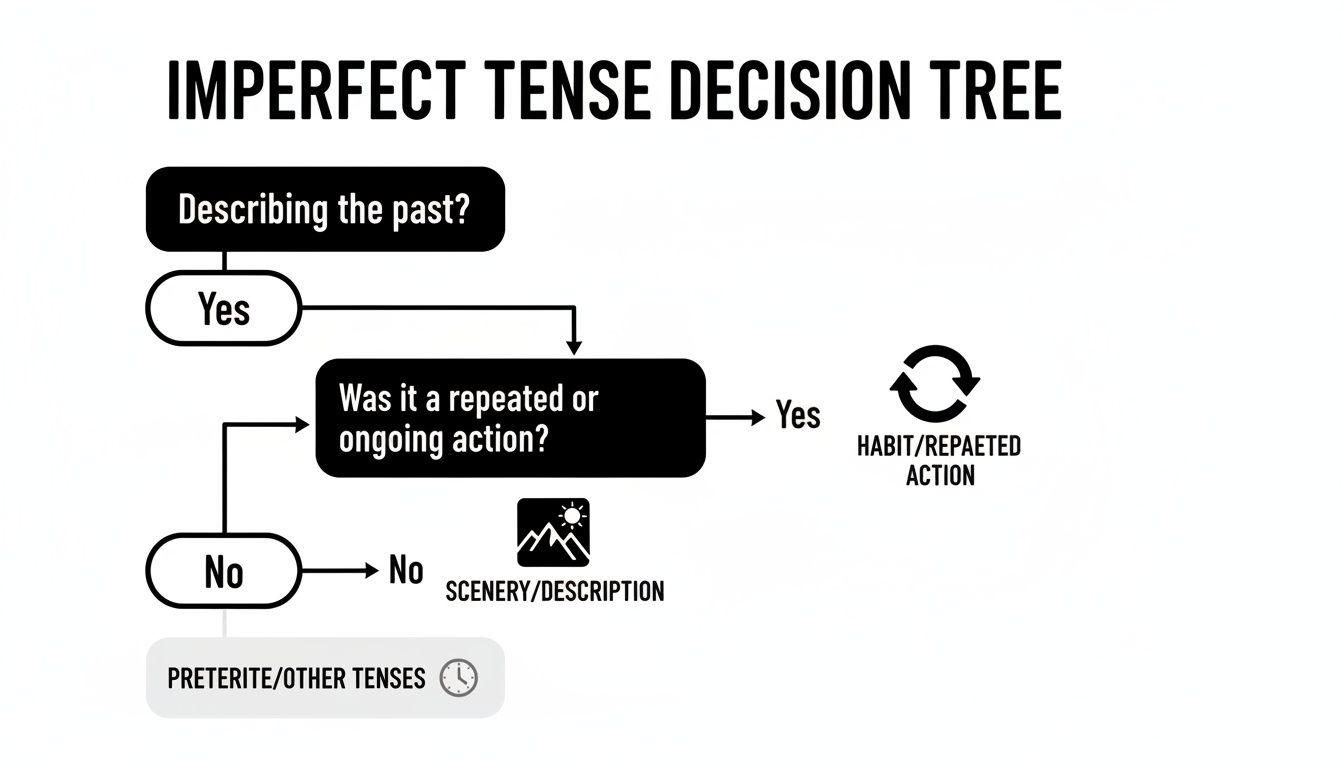
As you can see, if you're setting the scene, describing how things used to be, or talking about habits, the imperfect is your go-to tense.
Choosing Your Tense: Vivir Preterite vs. Imperfect
To make this crystal clear, let's lay it all out side-by-side. Think of this table as your cheat sheet for those moments when you're stuck wondering which tense to use for vivir.
| Aspect | Preterite (e.g., vivió) | Imperfect (e.g., vivía) |
|---|---|---|
| Meaning | The action is completed and finished. | The action was ongoing or habitual. |
| Focus | On the beginning and end of an action. | On the process or background of an action. |
| Story Role | Reports the main events of a story. | Sets the scene and provides context. |
| Example | Viví en Chile en 2010. (I lived in Chile in 2010 - a specific, finished period.) | Vivía en Chile cuando aprendí a esquiar. (I was living in Chile when I learned to ski.) |
At the end of the day, picking the right past tense of vivir all comes down to the story you want to tell. Are you listing life events that are now in the rearview mirror? That’s the preterite. Are you painting a picture of how life used to be or setting the stage for a specific moment? The imperfect is the perfect tool for the job.
Going Beyond with the Present Perfect Tense
So far, we’ve covered the bread and butter of the Spanish past: the preterite and the imperfect. But there’s another layer we can add to sound more natural and tell richer stories: the present perfect tense.
This tense is your go-to for talking about past experiences that still feel relevant right now. It’s how you build a bridge between what you’ve done and who you are. When you use the past tense of vivir this way, like saying “He vivido en tres países” (I have lived in three countries), you’re not just stating a dry fact. You’re sharing a piece of your life story.
Forming the Present Perfect with Vivir
Putting this tense together is surprisingly simple. You just need two ingredients: the helping verb haber (to have) and the past participle of vivir, which is always vivido.
The best part? Vivido never changes. You just need to learn the forms of haber.
Here’s a quick look at how it works:
| Pronoun | Present Perfect Conjugation | English Meaning |
|---|---|---|
| Yo | he vivido | I have lived |
| Tú | has vivido | You have lived |
| Él/Ella/Ud. | ha vivido | He/She/You has lived |
| Nosotros/as | hemos vivido | We have lived |
| Vosotros/as | habéis vivido | You all have lived |
| Ellos/Ellas/Uds. | han vivido | They have lived |
The formula is always the same: [form of haber] + vivido. That’s it.
The present perfect is all about connecting a past action to the present. You’ll use it for life experiences or for things that happened in a time frame that isn’t over yet, like hoy (today) or esta semana (this week).
For instance, if you say, "Nunca hemos vivido en una ciudad tan grande" (We have never lived in such a big city), you’re saying that this is still true for you today. It’s part of your current reality.
It’s also perfect for asking about someone’s life story up to this point. Think of a question like, "¿Has vivido alguna vez en el extranjero?" (Have you ever lived abroad?). You’re not asking about a specific trip last year; you’re asking about their entire life experience. This is how you add depth and a personal touch to your conversations about the past.
Turn Your Knowledge into Fluent Speech
Understanding the grammar rules is a fantastic first step. But the real goal, the thing that separates learners from speakers, is being able to make those split-second decisions in a real conversation. The challenge isn't just knowing the past tense of vivir; it's using the right one without even thinking about it.
That's where active practice comes in. It’s the bridge from knowing something to owning it. Just staring at conjugation charts won't build the muscle memory you need for fluent, natural speech. You have to actively pull that information from your brain, over and over, until it becomes second nature.
From Theory to Automatic Skill
So many learners get stuck right here. In fact, conjugation slip-ups with vivir are a classic hurdle, tripping up an estimated 62% of intermediate learners. But here's the good news: a 2022 analysis from FluentU found that gamified repetition can slash those error rates by a massive 47% in just 30 days. You can dig into more insights on Spanish tenses over at FluentU.com.
This is exactly why interactive tools are such a game-changer. They create a safe space to drill conjugations, build speed, and get it right without the pressure of a live conversation.
The key to fluency is moving from conscious translation to subconscious recall. Consistent, targeted practice is the only way to build that bridge.
For instance, the conjugation tools in PolyChat let you practice as much as you want without annoying limits like hearts or timers. This lets you focus completely on getting it right, not on gaming a system.
You can see how a dedicated tool lets you zero in on specific verbs and tenses. By repeatedly testing yourself, you're not just memorizing—you're turning that theoretical knowledge into a practical, automatic skill.
Practice That Feels Like Play
The absolute best way to make these tenses stick is to use them in context. That's what interactive conversation games and targeted drills are designed for. They mimic real-world situations, forcing your brain to choose between the preterite and imperfect under a little bit of pressure, which is exactly what you need to build recall speed.
For more ideas on building this skill, check out our guide on how to improve speaking skills. The whole point is to make using the correct past tense of vivir feel as effortless as speaking your native language.
Common Questions About the Past Tense of Vivir
Even after you've got the rules down, a few common questions always seem to pop up when you start using the past tense of vivir in real conversations. Let's tackle these head-on to clear up any confusion and get you feeling confident.
What Is the Fastest Way to Memorize the Tenses?
Staring at conjugation charts is a recipe for boredom and slow progress. The best way is to connect the why with the how. First, really get the core concepts: preterite is for the finished story, and imperfect is for the background scenery.
Once that clicks, use active drills to build muscle memory. Playing a quick conjugation game for five minutes is way more powerful than passively reading a textbook for twenty. Make sure you get comfortable with one tense before you start mixing them together—it'll save you a lot of headaches.
Is Vivir an Irregular Verb in the Past Tense?
Here’s some fantastic news: no, it isn't. Vivir is a completely regular “-ir” verb in both the preterite and the imperfect.
This is a huge win for learners. It means once you learn the standard endings for any regular “-ir” verb, you’ve also learned them for vivir and hundreds of others. No weird exceptions or special forms to memorize here.
Think of vivir as your model verb. If you can master its past tense forms, you’ve cracked the code for a whole family of other Spanish verbs.
Can I Use the Preterite and Imperfect in the Same Sentence?
Absolutely! In fact, this is where your Spanish storytelling skills really start to shine. Mixing these two tenses is how you weave together background details with specific actions, creating a much richer picture for your listener.
You use the imperfect to set the stage—describing what was happening—and then drop in the preterite to narrate the specific action that interrupted or took place within that scene.
- Example: Yo vivía en el campo cuando mi hermano nació.
See how that works? Vivía (imperfect) paints the background: I was living in the countryside. Then, nació (preterite) introduces the main event: my brother was born. This combo is the key to telling stories that are engaging and full of detail.
Ready to make this second nature? With PolyChat, you can practice the past tense of vivir using fun, interactive games and unlimited conjugation drills. Stop just memorizing and start actually speaking with confidence. Give our tools a try today at https://www.polychatapp.com.

Jean-Baptiste Bolh
Co-Founder
Applied AI