Mastering Imperfect Conjugation Spanish A Practical Guide
When you want to tell a story in Spanish, you need more than just a list of things that happened. You need to set the scene, describe the background, and talk about things that used to happen all the time. This is where the Spanish imperfect tense comes in. Think of it as your tool for painting a rich picture of the past—it’s the tense for “used to” or “was/were doing.”
Mastering the imperfect conjugation in Spanish is a huge step toward sounding more natural and telling stories that truly come to life.
Ready to Learn Spanish?
Try PolyChat's engaging language lessons, interactive learning games and put your Spanish vocabulary to the test!
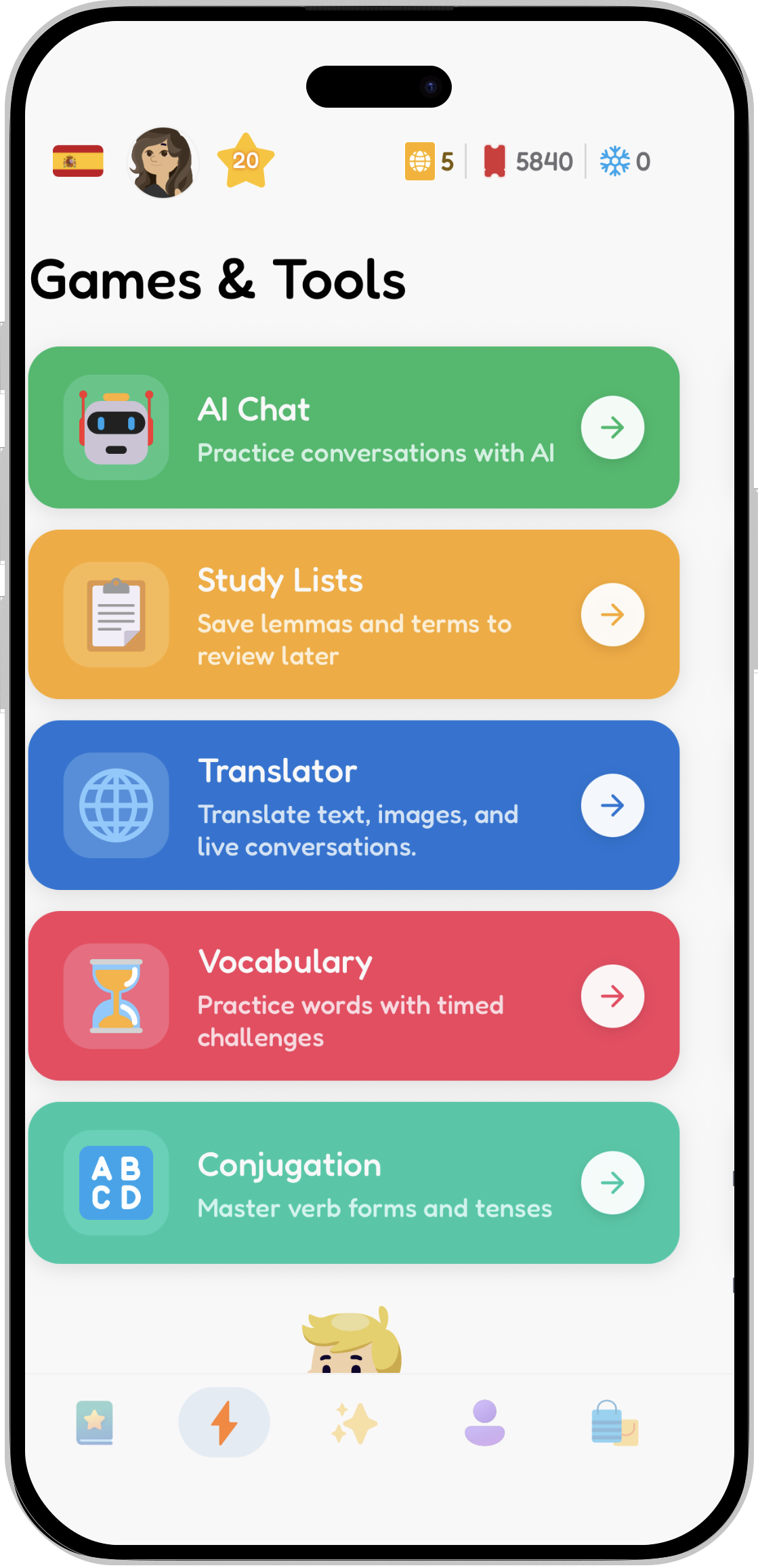
Games & Tools
Tools that every language learner needs at all stages of their learning journey.
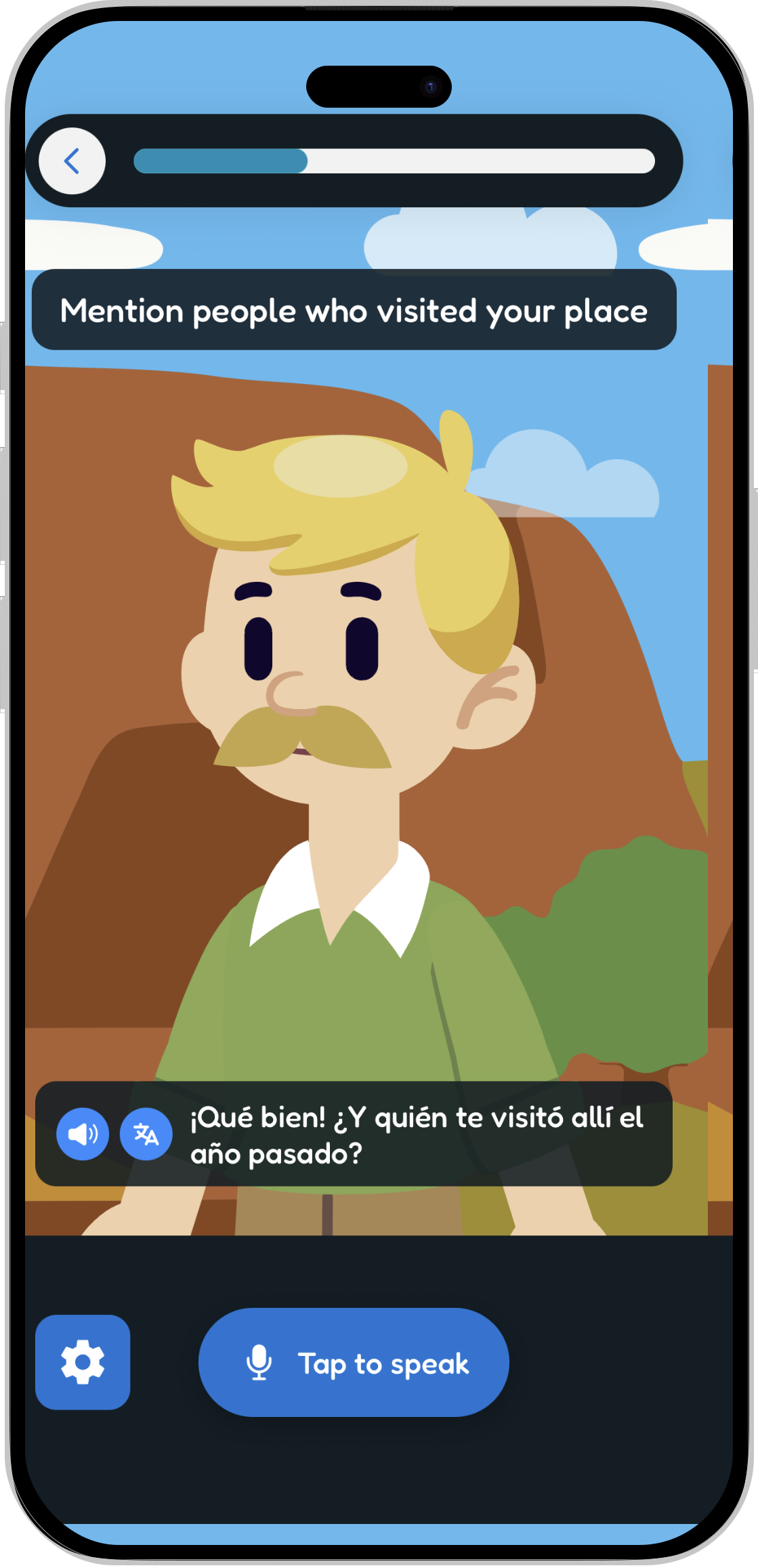
AI Chat Tutor
Practice real conversations with an AI tutor that helps you speak with confidence.
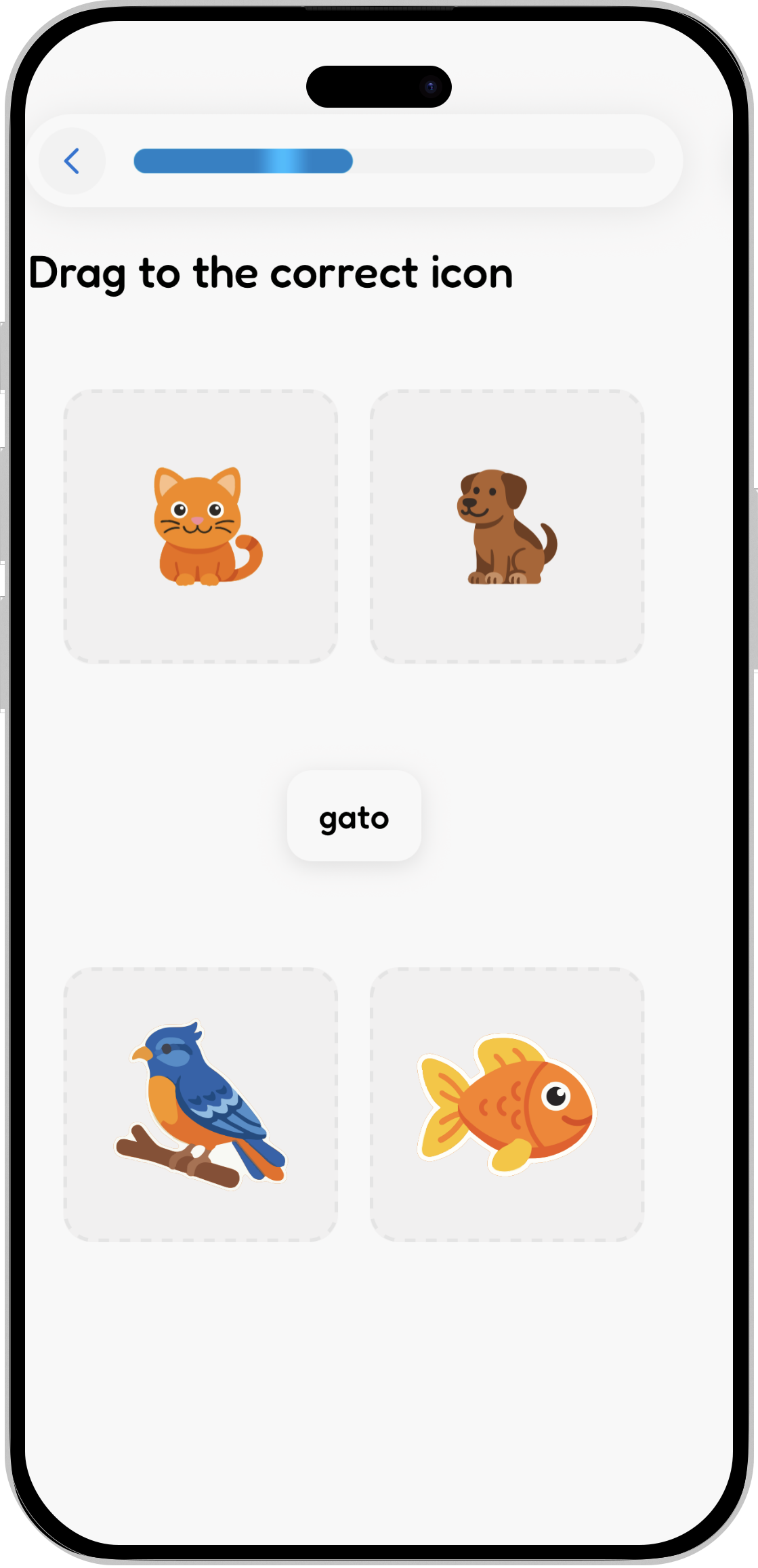
Interactive Games
A variety of games to help you learn and remember new words and phrases.


What Is the Spanish Imperfect Tense?

Picture yourself describing a childhood memory. You wouldn’t just state facts like, "I went to the park. I played. I came home." Instead, you’d paint a picture: "The sun was shining, the birds were singing, and we always played for hours." That's the imperfect tense, or el imperfecto, in action.
The preterite tense is like a camera flash—it captures a single, finished moment. The imperfect, on the other hand, is like a video camera left running, recording all the continuous background action without a clear start or end.
The Storytelling Tense
Think of the imperfect as the soundtrack to a movie. It sets the mood and describes the world where the main action happens. It’s what you use to give context and fill your stories with descriptive detail. In fact, a study of Spanish literature found that descriptive imperfect verbs like había (there was/were) and era (it was) are some of the most common verbs used, which just shows how vital they are for setting a scene. You can check out the analysis of Spanish verb usage for yourself.
You'll find yourself reaching for the imperfect in a few key situations:
- Habitual Actions: For things you "used to" do over and over. (Yo caminaba a la escuela. – I used to walk to school.)
- Ongoing Past Actions: To describe something that was in progress. (Él leía un libro. – He was reading a book.)
- Descriptions: For setting the scene—people, places, weather, feelings. (La casa era grande y azul. – The house was big and blue.)
- Age and Time: For telling time or stating someone's age in the past. (Yo tenía diez años. – I was ten years old.)
The name "imperfect" itself gives you a clue. It refers to an action that was im-perfectus—Latin for "not finished" or "incomplete." It’s all about the continuous flow of the past, not a single, completed event.
Here's the best part for learners: the rules for the imperfect conjugation in Spanish are incredibly regular. There are only two sets of endings to learn for regular verbs and just three irregular verbs in the entire tense: ser (to be), ir (to go), and ver (to see). This makes it one of the most straightforward Spanish tenses to get under your belt.
How To Form Regular Verbs in the Imperfect
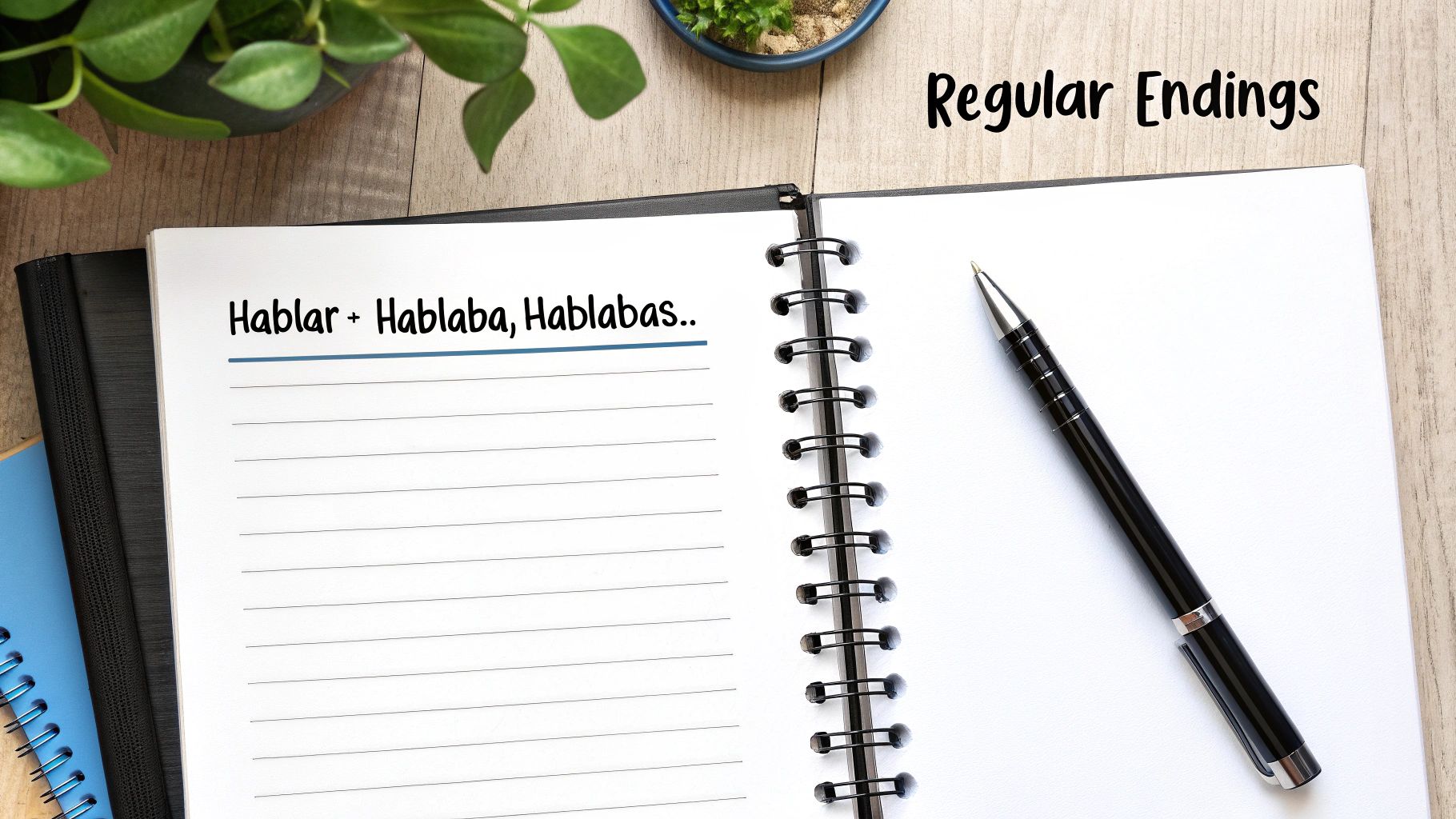
If you've ever felt overwhelmed by Spanish verb charts, get ready for a breath of fresh air. The imperfect tense is one of the most consistent and straightforward tenses in the entire language.
The imperfect conjugation in Spanish for regular verbs follows a simple, two-step pattern that you can apply to thousands of verbs.
- Find the Verb Stem: Start with the verb's infinitive form (like hablar, comer, or vivir) and chop off the last two letters: -ar, -er, or -ir. What’s left is your stem.
- Add the Correct Ending: Just attach the imperfect ending that matches the verb type (-ar, -er, or -ir) and the subject of your sentence.
That’s really it. No tricky stem changes or unexpected curveballs. Once you learn the two sets of endings below, you're good to go.
Conjugating Regular -ar Verbs
For any regular verb ending in -ar—like hablar (to speak), caminar (to walk), or cantar (to sing)—you'll use a set of endings built around -aba.
You just tack these endings right onto the verb's stem. Let's see how it works for hablar (stem: habl-).
This simple table shows you the regular endings for -ar, -er, and -ir verbs in the imperfect tense.
| Pronoun | -ar Verbs (e.g., hablar) | -er Verbs (e.g., comer) | -ir Verbs (e.g., vivir) |
|---|---|---|---|
| Yo | hablaba | comía | vivía |
| Tú | hablabas | comías | vivías |
| Él/Ella/Usted | hablaba | comía | vivía |
| Nosotros/as | hablábamos | comíamos | vivíamos |
| Vosotros/as | hablabais | comíais | vivíais |
| Ellos/Ellas/Ustedes | hablaban | comían | vivían |
Did you notice the accent mark on the nosotros form, hablábamos? It’s crucial for pronunciation, making sure you put the stress on the right syllable.
A Quick Tip: The yo and él/ella/usted forms (hablaba) are identical. How do you know who’s talking? It all comes down to context. If you say, "Cuando yo era niño, hablaba mucho," it’s clear you’re talking about yourself.
Conjugating Regular -er and -ir Verbs
Here's more good news: the imperfect endings for regular -er and -ir verbs are exactly the same. You only need to memorize one set of endings to cover two huge groups of verbs. These endings are all built around -ía.
Let’s look at comer (to eat) and vivir (to live) side-by-side. See? Identical. If you want to dive deeper, you can explore more about conjugating -er verbs in Spanish.
- Yo comía en ese restaurante. (I used to eat at that restaurant.)
- Yo vivía en Madrid. (I used to live in Madrid.)
Every single one of these endings starts with an accented í. This is a non-negotiable rule and helps distinguish the imperfect from other tenses.
Just like with the -ar verbs, the yo and él/ella/usted forms (comía, vivía) are identical and rely on the surrounding conversation for clarity. This simple, predictable pattern is exactly why so many learners find the imperfect tense to be a welcome relief.
After coasting through the easy, predictable patterns of regular verbs, hearing the word "irregular" can send a shiver down any Spanish learner's spine. But I've got some fantastic news for you when it comes to the imperfect tense: there are only three irregular verbs. That's it!
Seriously, just three. It’s a huge relief, especially if you’re still recovering from the dozens of irregulars in the preterite tense. For the imperfect, you just need to get cozy with ir (to go), ser (to be), and ver (to see).
Let's break down each one so you can nail them every time.
Irregular Verb 1: Ser (To Be)
The verb ser is your go-to for describing what people or things were like in the past—their essential qualities, jobs, or relationships. Its imperfect forms are totally unique, so this is one you’ll just have to memorize. The good news is that you'll use it so often it'll become second nature.
Here’s how ser looks in the imperfect:
| Pronoun | Imperfect Form | Example Sentence |
|---|---|---|
| Yo | era | Yo era un niño muy tímido. (I was a very shy child.) |
| Tú | eras | Tú eras el capitán del equipo. (You were the team captain.) |
| Él/Ella/Usted | era | La casa era antigua. (The house was old.) |
| Nosotros/as | éramos | Nosotros éramos buenos amigos. (We were good friends.) |
| Vosotros/as | erais | Vosotros erais los únicos allí. (You all were the only ones there.) |
| Ellos/Ellas/Ustedes | eran | Ellos eran de México. (They were from Mexico.) |
Heads up! Don't forget the accent mark on éramos. It’s small, but it’s critical for getting the pronunciation just right.
Irregular Verb 2: Ir (To Go)
Next up is ir, which you'll use all the time to talk about where you "used to go" or "were going." Its forms are super simple and all start with ib-.
Memory Tip: This might sound silly, but it works. Try saying the English phrase "I 'ba' going to the store." That iba sound is exactly what you’re aiming for. It’s a goofy little trick that can help the form stick in your brain.
Here's the full conjugation for ir:
- Yo iba (I was going / used to go)
- Tú ibas (You were going / used to go)
- Él/Ella/Usted iba (He/She/You were going / used to go)
- Nosotros/as íbamos (We were going / used to go)
- Vosotros/as ibais (You all were going / used to go)
- Ellos/Ellas/Ustedes iban (They were going / used to go)
Just like with ser, watch out for that accent on íbamos. For example: Cada verano, nosotros íbamos a la playa. (Every summer, we used to go to the beach.)
Irregular Verb 3: Ver (To See)
Last but not least is ver, meaning "to see." This one is kind of a "fake" irregular. It keeps its original stem (ve-) and then just adds the standard -ía endings you already learned for regular -er and -ir verbs. So if you know those, you pretty much know this one already.
Let's run through the conjugations for ver:
- Yo veía (I was seeing / used to see)
- Tú veías (You were seeing / used to see)
- Él/Ella/Usted veía (He/She/You were seeing / used to see)
- Nosotros/as veíamos (We were seeing / used to see)
- Vosotros/as veíais (You all were seeing / used to see)
- Ellos/Ellas/Ustedes veían (They were seeing / used to see)
You might use it in a sentence like this: Desde mi ventana, veía las montañas. (From my window, I used to see the mountains.)
And that's it! By focusing on just these three verbs, you've officially conquered every irregular in the Spanish imperfect tense. Getting them down is all about practice, and using tools like PolyChat’s conjugation drills will help lock these forms into your long-term memory.
When to Use the Spanish Imperfect Tense
Knowing how to form the imperfect is a great first step, but the real magic happens when you know exactly when to use it. Honestly, picking the right past tense is one of the biggest hurdles on the path to fluency.
Think of it this way: the preterite tense is like a snapshot—a quick photo of a finished event. The imperfect, on the other hand, is your wide-angle video camera, capturing the entire scene as it was unfolding. It’s all about the background, the context, and the ongoing vibe of the past.
To make this super simple, let's use a memorable acronym: WATERS. This little tool will help you remember the six core situations where the imperfect conjugation in Spanish is always the right call.
W Is for Weather
When you're setting a scene in a story, what’s one of the first things you describe? The weather, right? The imperfect is perfect for this because weather is a background condition, not a single, completed action.
- Hacía mucho sol ese día. (It was very sunny that day.)
- Llovía cuando salimos del cine. (It was raining when we left the cinema.)
- Nevaba sin parar en las montañas. (It was snowing non-stop in the mountains.)
A Is for Age
Talking about how old someone was in the past is another classic use of the imperfect. Age isn't something that happens in a flash; it's a state of being over time. For this, you’ll almost always be using the verb tener.
- Yo tenía diez años en esa foto. (I was ten years old in that photo.)
- ¿Cuántos años tenías cuando aprendiste a nadar? (How old were you when you learned to swim?)
T Is for Time
Just like with age, telling time in the past requires the imperfect. You're describing the state of the clock at a particular moment. The go-to verb here is ser.
Key Rule: When telling time in the past, use the singular form era for one o'clock. For all other hours, use the plural form eran.
- Era la una de la tarde cuando llegó. (It was one in the afternoon when he arrived.)
- Eran las nueve de la noche y todavía no habíamos cenado. (It was nine at night and we still hadn't eaten dinner.)
E Is for Emotion and Mental States
How someone was feeling, what they were thinking, or what they wanted are all internal states. They don't have a clear beginning or end, and the imperfect tense is built to capture this ongoing, fuzzy nature of feelings and thoughts.
Here are a few common verbs you'll see used this way:
- Estar (to be feeling): Yo estaba muy contenta. (I was very happy.)
- Sentirse (to feel): Ella se sentía nerviosa antes del examen. (She was feeling nervous before the exam.)
- Pensar (to think): Nosotros pensábamos que era una buena idea. (We thought it was a good idea.)
- Querer (to want): Él quería ser astronauta. (He wanted to be an astronaut.)
R Is for Repetition
This is probably one of the most common uses you'll encounter. If you're talking about something you "used to do" or a habitual action, you need the imperfect. These were routines, not one-off events.
You’ll often see sentences with "trigger words" that signal this kind of repetition. Keep an eye out for phrases like:
- Siempre (always)
- A menudo (often)
- Cada día/semana/año (every day/week/year)
- Todos los lunes (every Monday)
- Normalmente (normally)
Check out these examples:
- Nosotros visitábamos a nuestros abuelos cada verano. (We used to visit our grandparents every summer.)
- De niño, jugaba al fútbol con mis amigos. (As a child, I used to play soccer with my friends.)
S Is for Setting and Description
Finally, the imperfect is the ultimate tool for storytelling. It allows you to paint a picture of the past by describing what people, places, and situations were like. It provides the background context for the main action (which is often told using the preterite).
It's like setting the stage for a play. Before the main character walks in and does something (preterite), you first describe what the room looked like, who was there, and what they were doing (imperfect).
- La casa era grande y tenía un jardín bonito. (The house was big and had a pretty garden.)
- El sol brillaba y los pájaros cantaban. (The sun was shining and the birds were singing.)
By keeping WATERS in mind, you'll start to build a strong intuition for when to reach for the imperfect. Getting this right will make your Spanish stories sound much more authentic and engaging.
Imperfect vs. Preterite: Choosing the Right Tense
Welcome to what many learners consider the final boss of Spanish past tenses: figuring out when to use the imperfect and when to use the preterite. Getting this right is a huge leap toward sounding natural, but it can feel incredibly tricky at first.
The secret isn't to think of them as enemies, but as partners in storytelling.
Imagine you're the director of a movie. You use the imperfect tense to set the scene—describing the weather, what characters were doing in the background, the time of day, and the overall mood. Then, you bring in the preterite tense for the main plot points—the specific actions that happen one after another and push the story forward.
The imperfect gives you the "was/were -ing" context, while the preterite delivers the "it happened" action.
Head-to-Head Tense Comparison
Let's put these two tenses side-by-side to make their roles perfectly clear. The preterite is all about completed actions with a clear beginning and end. The imperfect, on the other hand, deals with the ongoing, descriptive, and habitual nature of the past.
Think of it as a snapshot (preterite) versus a flowing video (imperfect).
This chart really helps to break down their core jobs and even gives you some common trigger words that can signal which tense you probably need.
Spanish Imperfect vs. Preterite Tense Comparison
Here's a direct comparison of the primary uses and trigger words for the imperfect and preterite tenses to clarify their distinct functions.
| Usage Scenario | Imperfect Tense (Ongoing Past) | Preterite Tense (Completed Past) |
|---|---|---|
| Main Function | Describes background, sets the scene | Reports specific, finished actions |
| Duration | Unspecified, ongoing duration | Clear beginning and end |
| Repetition | Habitual, repeated actions ("used to") | Single, one-time events |
| Storytelling Role | "The stage was set..." | "And then this happened..." |
| Trigger Words | siempre, a menudo, cada día, mientras | ayer, anoche, una vez, el lunes pasado |
Seeing them laid out like this makes it easier to spot the fundamental difference: the preterite is for the main event, and the imperfect is for everything happening around it.
This handy flowchart is another great way to visualize when to reach for the imperfect.
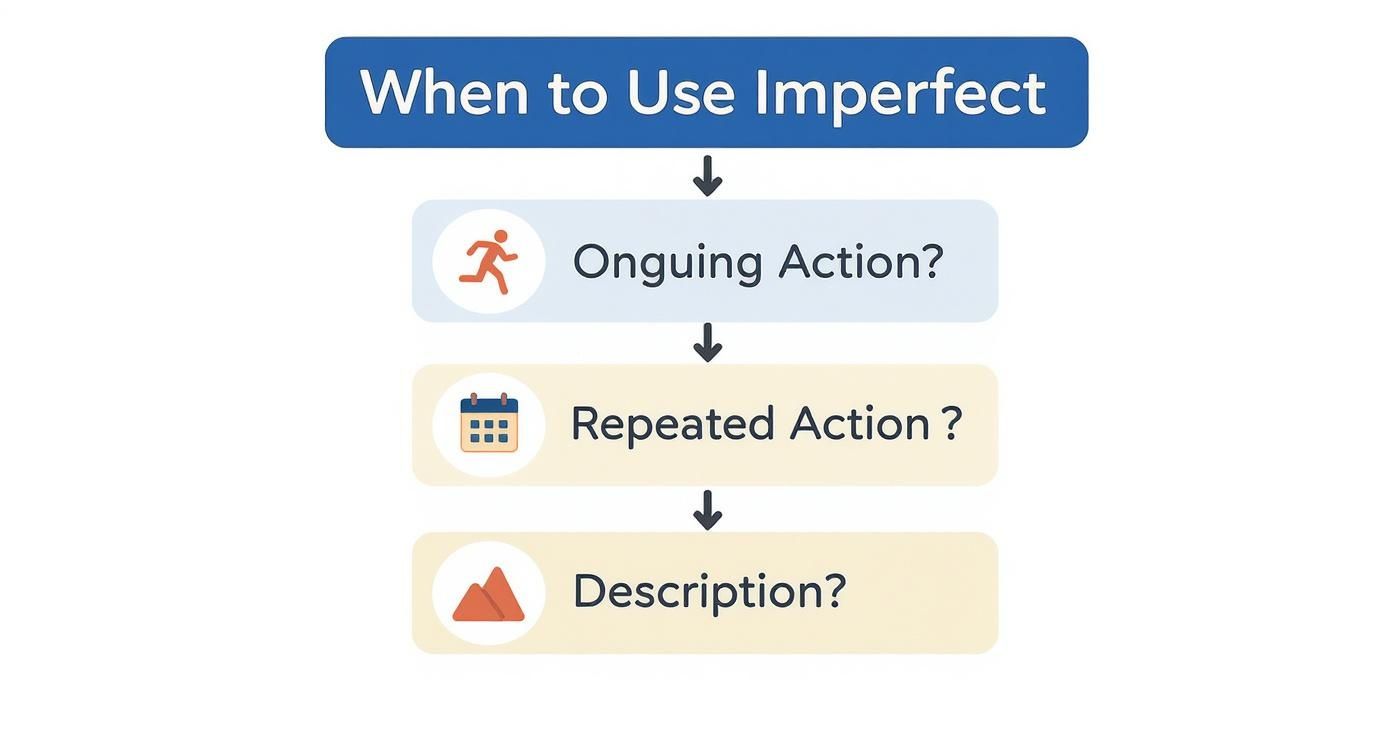
It reinforces the idea that the imperfect is your go-to tool for anything in the past that lacks a definitive start or endpoint.
When Tense Changes Meaning
Now for the really interesting part. With some verbs, the meaning changes completely depending on whether you use the imperfect or preterite. This is where mastering the difference truly pays off, as it can totally alter what you're trying to say. This subtlety is a key part of mastering imperfect conjugation in Spanish.
Here are a few of the most important verbs where this happens:
-
Conocer
- Imperfect: Yo conocía a María. (I knew María. - We were acquainted over a period of time.)
- Preterite: Yo conocí a María ayer. (I met María yesterday. - The single, completed event of meeting her for the first time.)
-
Saber
- Imperfect: No sabía la respuesta. (I didn't know the answer. - A state of not knowing.)
- Preterite: Nunca supe la respuesta. (I never found out the answer. - The action of finding out never happened.)
-
Querer
- Imperfect: Ella quería ir a la fiesta. (She wanted to go to the party. - Her ongoing desire or intention.)
- Preterite: Ella quiso ir, pero no pudo. (She tried to go, but couldn't. - Implies an attempt was made.)
- Negative Preterite: Ella no quiso ir. (She refused to go. - A definite action of refusal.)
A great way to remember this is to see the preterite as an action or event, even for mental state verbs. Conocí is the event of meeting, supe is the event of finding out, and quise is the event of trying or refusing.
Putting It All Together in a Story
Okay, let's see how these two tenses work together in a real narrative. Watch how the imperfect sets the scene, and then the preterite comes in to move the plot along.
Imperfect (Setting the Scene): Era una noche oscura y llovía mucho. Yo leía un libro en mi sofá y mi perro dormía a mis pies. (It was a dark night and it was raining a lot. I was reading a book on my sofa and my dog was sleeping at my feet.)
Preterite (Main Actions): De repente, escuché un ruido fuerte. Me levanté y caminé a la ventana. ¡Vi a un gato en el jardín! (Suddenly, I heard a loud noise. I got up and walked to the window. I saw a cat in the garden!)
See how that works? The imperfect paints the cozy, rainy picture, giving us all the background details. Then, the preterite delivers the sequence of events that actually happened. Mastering this interplay is the real key to telling great stories in Spanish.
Common Mistakes With the Imperfect and How to Fix Them
Navigating the Spanish imperfect is a journey, and every learner hits a few bumps along the way. The good news is that most people make the same few mistakes. Recognizing these common tripwires is the first step to avoiding them and making your Spanish sound way more authentic.
Let's break down the most frequent errors and, more importantly, how to fix them.
Mixing Up Imperfect and Preterite Endings
This is probably the biggest one. You know you're talking about the past, so your brain instinctively reaches for preterite endings it already knows, like -é or -ió. But the imperfect has its own unique set of clothes: the classic -aba and -ía endings.
You have to train your brain to connect those endings with the feeling of the imperfect—ongoing, habitual, or descriptive past actions.
- Mistake: Cuando era niño, yo jugué con mis amigos todos los días.
- Correction: Cuando era niño, yo jugaba con mis amigos todos los días. (That "every day" is a dead giveaway that we need the habitual feel of the imperfect).
The "Who Am I Talking About?" Problem
Here's a subtle trap that catches almost everyone. The imperfect conjugation for yo (I) and él/ella/usted (he/she/you formal) is exactly the same. So, “yo hablaba” (I was speaking) and “él hablaba” (he was speaking) sound identical.
This can get confusing fast if you're not careful.
The fix is simple: rely on context. If it’s not completely obvious who you're talking about from the rest of the conversation, just add the pronoun. Saying "Comía mucho" out of the blue could mean anyone. But "Yo comía mucho" leaves no room for doubt.
This isn't just a learner problem; it's a known complexity in Spanish. In fact, some studies on pronoun use have found error rates around 8.2% even among native speakers when context is tricky, which shows just how vital those little pronouns can be. If you want to dive deeper, you can discover more insights about Spanish verb processing and the cognitive side of learning.
Forgetting Those Pesky Irregulars
Okay, there are only three irregular verbs in the imperfect (ser, ir, ver), which is fantastic. But in the heat of a conversation, it's incredibly easy to forget them and try to force a regular ending onto them.
A classic slip-up is conjugating ser into something like “sía” instead of its true form, era.
- Mistake: De niño, yo sía muy alto.
- Correction: De niño, yo era muy alto. (As a child, I was very tall.)
Fixing these mistakes is all about mindful practice and repetition until the correct forms feel natural. To really lock in the imperfect, students can benefit from incorporating powerful learning strategies for students that go beyond just memorizing charts. Another great way to solidify these patterns is through targeted drills, and our guide on how to learn Spanish fast is packed with practical tips.
By spotting these common errors in your own speech, you can turn them into learning opportunities and build much stronger, more accurate language habits.
Your Top Questions About the Spanish Imperfect Tense, Answered
Even when the rules seem straightforward, a few tricky questions about the imperfect tense always seem to pop up. Let's clear up some of the most common points of confusion so you can use it with confidence.
Is "Used To" Always Imperfect?
Yep, you can pretty much count on it. Whenever you want to say you "used to do" something, the imperfect is your go-to tense. The phrase "used to" is the perfect signal for a habitual action in the past with no clear end, which is exactly what the imperfect is all about.
- Yo jugaba al tenis. (I used to play tennis.)
Why Do "Yo" and "Él/Ella" Have the Same Ending?
It's just one of those quirks you get used to in Spanish. For the imperfect tense, the first-person (yo) and third-person (él, ella, usted) conjugations look exactly the same. Think hablaba, comía, vivía.
So how do you tell them apart? Context is everything. If it's not totally obvious who you're talking about, just include the pronoun to be safe. For example: Yo vivía allí, pero ella vivía en otra ciudad. (I lived there, but she lived in another city.)
The rule of thumb is simple: when in doubt, use the pronoun. It instantly clears up any ambiguity and makes your meaning precise.
What’s the Easiest Way to Remember the Irregular Verbs?
You're in luck—there are only three irregular verbs in the imperfect: Ser, Ir, and Ver. The trick isn't just memorizing the charts, but connecting each verb to its most common job.
Here’s a simple way to think about them:
- Ser (era, eras...): Think of it for descriptions. La casa era grande. (The house was big.)
- Ir (iba, ibas...): Connect it to places you used to go. Yo iba al parque. (I used to go to the park.)
- Ver (veía, veías...): Link it to things you were watching. Yo veía la televisión. (I was watching television.)
Nailing these three will make you feel much more comfortable with the tense. If you find yourself struggling, getting personalized feedback from one of the best online teachers for Spanish can be a game-changer, helping these irregulars become second nature.
Ready to stop memorizing and start mastering? PolyChat has the best conjugation practice tool on the market, designed to help you master the imperfect tense with fun, interactive exercises. Give it a try at https://www.polychatapp.com.

Jean-Baptiste Bolh
Co-Founder
Applied AI