Nouns in Spanish: Gender Rules, Plurals and Exceptions
 Free interactive quizSpanish Noun Gender & Plurals10 questions · 10 seconds each · no signupPlay now
Every Spanish noun is either masculine or feminine, and the articles and adjectives around it have to match. Most nouns ending in -o are masculine (el libro) and most ending in -a are feminine (la casa), but a handful of common exceptions are worth learning early.
| Rule | Masculine | Feminine |
|---|---|---|
| Typical endings | -o, -or, -aje, and many words ending in -ma | -a, -ción, -sión, -dad, -tad, -tud, -umbre |
| Examples | el libro, el color, el viaje, el problema | la casa, la canción, la ciudad, la costumbre |
| Common exceptions | el día, el mapa, el planeta | la mano, la foto, la flor |
| Plural | add -s after a vowel: los libros | add -es after a consonant: las ciudades |
Two more rules catch learners out. Nouns ending in -z change to -ces in the plural (el lápiz → los lápices). And feminine nouns that start with a stressed a- sound take el in the singular to make them easier to say (el agua, el águila), while staying feminine in the plural (las aguas).
The sections below cover gender, plurals, agreement and special cases in more detail, with a practice quiz at the end.
The First Step to Spanish Noun Mastery
I like to think of noun gender as a kind of "team jersey." Every noun belongs to either Team Masculine or Team Feminine. Any other words that describe that noun, like articles ("the," "a") and adjectives ("big," "red"), have to wear the same jersey to match. This concept, called agreement, is the absolute heart of Spanish grammar.
So, where do we start? With the most basic tool for figuring out which team a noun is on: the definite articles. These are just the Spanish words for "the."
- el: This is the jersey for singular, masculine nouns.
- la: This is the jersey for singular, feminine nouns.
Here’s the single most effective habit you can build: learn every new noun with its article. Don't just memorize "libro" for book; burn "el libro" into your brain. This simple trick helps you develop an intuitive feel for a noun's gender from day one, saving you from having to memorize tedious lists of rules later on.
Why Gender Is Your Starting Point
Once you get a handle on gender, everything else just clicks into place. Adjective agreement, how to make nouns plural, and basic sentence structure all depend on this core principle. It really is the foundation of the entire house.
Getting comfortable with noun gender is less about memorizing lists and more about building a habit. Pairing every new noun with 'el' or 'la' transforms a daunting rule into a natural part of your learning process.
Trying to master Spanish nouns on your own can feel tricky, and getting expert guidance can make all the difference. You might want to explore comprehensive Spanish tutoring services to build a really solid foundation. This kind of focused help can demystify the topic and get you started with confidence. And for a wider view of the basics, you can check out our related guide on basic Spanish grammar.
How to Identify Spanish Noun Gender
While it’s a great habit to learn every new noun with its article (el or la), you don’t have to guess blindly. Spanish actually leaves clues hidden in the endings of words, letting you predict the gender of most nouns with pretty surprising accuracy. Think of it as a cheat sheet built right into the language.
The most common pattern is beautifully simple: nouns ending in -o are almost always masculine, and nouns ending in -a are almost always feminine.
- Masculine: el libro* (the book), el chico* (the boy), el gato* (the cat)
- Feminine: la casa* (the house), la chica* (the girl), la mesa* (the table)
This one rule covers a massive number of common nouns. It’s the perfect starting point for building your gender-spotting instincts.
Common Endings for Feminine Nouns
Beyond the basic -a, a few other endings are dead giveaways for a feminine noun. Learning to recognize these will take your educated guesses to the next level.
If you see a noun with one of these endings, you can bet it's feminine:
- -ión: la canción* (the song), la televisión* (the television)
- -dad: la ciudad* (the city), la universidad* (the university)
- -tad: la libertad* (the liberty), la amistad* (the friendship)
- -tud: la actitud* (the attitude), la juventud* (the youth)
- -umbre: la costumbre* (the custom), la muchedumbre* (the crowd)
Memorizing these helps you instantly categorize a huge group of abstract nouns that you’ll hear all the time in everyday conversation.
This decision tree gives you a great visual for the most common paths to figuring out a noun’s gender.
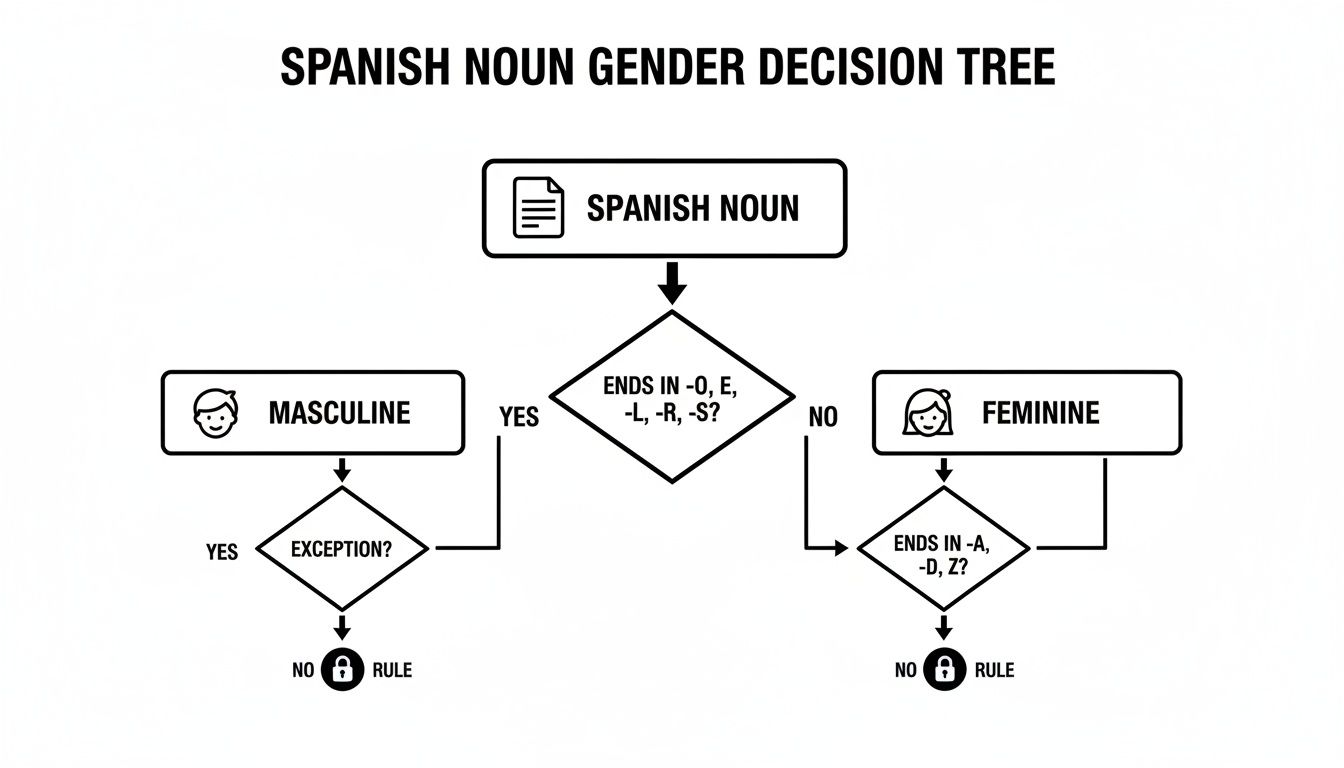
As the flowchart shows, checking the ending is the most direct route. It gives you clear branches for the most common masculine and feminine patterns.
Masculine Endings and Common Exceptions
Just like some endings scream "feminine," others point straight to masculine. For instance, words ending in -aje are consistently masculine, like el garaje* (the garage) or el mensaje* (the message).
Of course, no language rule is complete without its rebels. Spanish has a handful of common exceptions that you just have to memorize.
The key exceptions often feel counterintuitive at first, but they’re used so frequently in daily speech that they’ll stick in your memory over time. Don't stress about perfection; just focus on getting the most common ones down.
Here are the rule-breakers you’ll run into most often:
- Masculine nouns ending in -a: el día* (the day), el mapa* (the map)
- Feminine nouns ending in -o: la mano* (the hand), la foto* (the photo)
There's one more tricky group: many words that came to Spanish from Greek and end in -ma are masculine. This includes some really important words like el problema* (the problem), el sistema* (the system), and el idioma* (the language).
Learning these patterns is a huge step in mastering a language spoken by nearly 500 million native speakers as of 2023. This global reach stems from its evolution from Vulgar Latin, which was also heavily influenced by Arabic—contributing up to 8% of modern Spanish vocabulary. Many of these borrowed words are nouns, like almohada (pillow). To master all these gendered nouns, apps like PolyChat gamify vocabulary building without daily limits. With timed challenges and personal dictionaries, you can conquer words like el libro and la casa in a way that feels more like play than study. Learn more about the global spread of the Spanish language.
Making Spanish Nouns Plural

Alright, you've got a handle on figuring out if a Spanish noun is masculine or feminine. The next logical step is learning how to talk about more than one of them.
Thankfully, making nouns plural in Spanish is surprisingly straightforward. Forget the wild exceptions you see in English (like mouse/mice or person/people). Spanish follows a couple of very reliable rules that will get you from single-word vocabulary to building complete, accurate sentences.
Think of it this way: if a noun's gender is its team jersey, its plural form is what the whole team wears. The good news is, there are only a few simple uniform changes you need to learn.
The Two Core Rules for Plural Nouns
Almost every noun you'll run into will follow one of two simple patterns. The rule you use depends entirely on the very last letter of the singular noun.
1. If the noun ends in a vowel (a, e, i, o, u): Just add an -s to the end. That's it. This is the most common rule, and it works exactly like it does for most English words. Easy win.
- el libro (the book) becomes los libros* (the books)
- la casa (the house) becomes las casas* (the houses)
- el chico (the boy) becomes los chicos* (the boys)
2. If the noun ends in a consonant: For these words, you'll need to add an -es to the end. This little addition makes the plural form flow much more smoothly off the tongue.
- la ciudad (the city) becomes las ciudades* (the cities)
- el animal (the animal) becomes los animales* (the animals)
- el color (the color) becomes los colores* (the colors)
Get these two rules down, and you’ll be able to pluralize the vast majority of nouns in Spanish correctly. You're already most of the way there.
The Special Case: Nouns Ending in -Z
There’s one common exception to the consonant rule that's worth calling out. It’s a simple spelling change that’s all about keeping the language's pronunciation consistent and sounding good.
For any noun that ends in the letter -z, you first have to change the -z to a -c before adding the -es.
The Z-to-C Rule: Nouns ending in -z change the 'z' to a 'c' and then add -es. For example, el lápiz (the pencil) becomes los lápices (the pencils), and la voz (the voice) becomes las voces (the voices).
This might feel a bit random at first, but it preserves the soft "s" sound of the letter 'c' in Spanish. You'll see this pattern pop up with words like el pez (the fish) becoming los peces (the fish) and la luz (the light) becoming las luces (the lights).
To help you keep these rules straight, here's a quick cheat sheet.
Spanish Pluralization Rules at a Glance
| If a Noun Ends In... | How to Make it Plural | Singular Example | Plural Example |
|---|---|---|---|
| A vowel (a, e, i, o, u) | Add -s | la silla (chair) | las sillas* |
| A consonant (not -z) | Add -es | el hotel (hotel) | los hoteles* |
| The letter -z | Change -z to -c, then add -es | el pez (fish) | los peces* |
Bookmark this little table! It covers the overwhelming majority of cases you’ll encounter as you start building sentences.
One Last Thing: The Articles Must Agree!
Finally, don't forget that agreement is everything in Spanish. When you make a noun plural, its article has to become plural, too. The whole team needs to wear the same jersey, remember?
Here's how the definite articles change:
- el (masculine singular) becomes los (masculine plural)
- la (feminine singular) becomes las (feminine plural)
So, when you turn el libro plural, you get los libros*. And when you pluralize la mesa (the table), it becomes las mesas*. This isn't an optional step; it's a non-negotiable part of forming correct phrases in Spanish.
Making Everything Agree with Your Noun

Okay, this is where it all starts to click. Everything we've covered about gender and plurals is about to come together to help you build real, natural-sounding sentences. The key concept you need to grasp is called concordancia, or agreement.
Think of it like a team uniform. The noun is the star player, and every word that describes it—like articles and adjectives—has to wear the exact same uniform.
So, if your noun is masculine and singular, its article and adjective have to be masculine and singular, too. Feminine and plural? You guessed it—everything else has to match. This rule is what makes Spanish flow so logically and melodically.
Meet the Two Types of Articles
First up, let's get the articles straight. In Spanish, you've got two main types. They both have to match the noun's gender and number, but they do slightly different jobs.
- Definite Articles (the): These point to a specific, known noun. You use them when you're talking about the book on your desk or the houses on your street. In Spanish, these are
el,la,los, andlas. - Indefinite Articles (a/an, some): These refer to a general, non-specific noun. Think a book (any old book), a car, or some houses. These are
un,una,unos, andunas.
Picking the right one is your first step in getting the noun's "uniform" correct. It’s a small detail that makes a huge difference in how clear your sentences are.
Adjective agreement is the final piece of the puzzle. It’s how you go from saying "the car" to "the red car." In Spanish, the adjective must change its ending to perfectly match the noun’s gender and number.
Getting these fundamentals down is more important than ever. The Spanish-speaking population is massive and growing. In the United States alone, there are over 45 million native speakers, making it the second-largest Spanish-speaking country in the world, right after Mexico. From everyday words like familia (family) to crucial terms in business and healthcare, a solid grasp of Spanish is a huge asset. It's no surprise that bilingualism can boost employability by 20-30%. You can learn more about the Spanish language's global influence and its deep roots to see just how far this skill can take you.
Putting Adjective Agreement into Practice
This is where the magic happens. Most adjectives that end in -o in their basic masculine form will change to match the noun in four different ways. Let's take the adjective rojo (red) and see how it adapts.
- Masculine Singular: el coche rojo* (the red car)
- Feminine Singular: la casa roja* (the red house)
- Masculine Plural: los coches rojos* (the red cars)
- Feminine Plural: las casas rojas* (the red houses)
See how rojo changes its ending every single time? This simple pattern is your key to describing the world around you with precision.
But what about adjectives that don't end in -o, like grande (big) or azul (blue)? The rules are even simpler. Many of these only change for the plural, not for gender.
- el coche grande (the big car) -> los coches grandes* (the big cars)
- la casa grande (the big house) -> las casas grandes* (the big houses)
Mastering agreement is what separates someone who just knows a list of Spanish words from someone who can actually build sentences. It's the glue that holds everything together.
Diving Into Special Cases and Common Exceptions
Okay, you've got the basics of gender and plurals down. Now we get to the fun stuff—the quirks and special cases that give Spanish its personality. Mastering these little details is what will take you from sounding like you're reading from a textbook to sounding like a natural.
One of the first giveaways of an English speaker is capitalization. In Spanish, you still capitalize names of people (María, Juan) and places (España, México), just like in English. But a whole lot of other words that we capitalize stay lowercase.
This is a small change that makes a big difference in how your writing looks to a native speaker. Keep an eye out for these:
- Days of the week: lunes, martes, miércoles
- Months of the year: enero, febrero, marzo
- Languages and nationalities: español, inglés, mexicano, americana
Cracking the Code on Compound Nouns
Compound nouns are cool little words made by squishing two other words together to create a new meaning. Spanish loves to do this by mashing a verb and a noun together, and the result is almost always masculine.
A perfect example is el paraguas (the umbrella), which literally comes from para aguas—it "stops water." See how it already ends in an -s? This is a key feature: the singular and plural forms of these nouns are the same. Only the article changes to tell you how many there are.
- Singular: el paraguas (the umbrella)
- Plural: los paraguas (the umbrellas)
You’ll see this pattern all the time with words like el sacacorchos (the corkscrew, from saca corchos - "pulls corks") and el abrelatas (the can opener, from abre latas - "opens cans").
Collective Nouns and Expressive Suffixes
Collective nouns can trip people up because they feel plural but act singular. The classic example is la gente (the people). Even though we say "the people are" in English, in Spanish, la gente is a singular, feminine noun.
Correct: La gente es amable aquí. (The people are nice here.) Incorrect: La gente son amable.
This is where Spanish gets really expressive. Suffixes can be tacked onto nouns to change their meaning, often to show size or add a little emotion. The two you'll hear constantly are diminutives and augmentatives.
-
Diminutives (-ito/-ita): This is the "cute" suffix. Adding it to a noun makes it smaller or shows affection. A perro (dog) becomes a perrito (little doggie), and a casa (house) becomes a casita (little house or cozy home). Honestly, mastering this will make you sound so much more natural in conversation. If you want to dive deeper into these kinds of details, check out our guide on how to add accents in Spanish.
-
Augmentatives (-ón/-ona, -ote/-ota): These suffixes do the opposite—they make things bigger. Sometimes, they can even add a slightly negative or clunky feel. A libro (book) can turn into a librón (a big, heavy book), and cabeza (head) becomes cabezón (which can mean big-headed or just plain stubborn).
Learning to spot and use these special cases is a huge step. It moves you past the rigid rules and into the lively, colorful world of how people actually speak Spanish every day.
Common Questions About Nouns in Spanish
As you start getting the hang of Spanish nouns, you'll probably run into a few tricky spots. These are the same questions that trip up almost every learner, so let's tackle them head-on. Getting these concepts down will help you build a ton of confidence and keep your learning journey moving forward.
What Is the Fastest Way to Learn Spanish Noun Genders?
There's no single magic trick, but a combo of smart strategies works wonders. The real goal isn't to memorize endless lists; it's to build an intuition for how gender works in Spanish.
First, focus on the big patterns we've already covered, like words ending in -o usually being masculine and words in -a being feminine. That one simple rule gets you surprisingly far, covering a massive chunk of the words you'll use every day.
Next, make this a non-negotiable habit: learn every single new noun with its article. Don't just learn libro; burn el libro into your brain. Don't just learn mesa; learn la mesa. This simple trick forges a powerful mental link between the noun and its gender right from the start.
Finally, active recall is your best friend here. Use flashcards or fun app games to drill these noun-article pairs. That kind of consistent, spaced-out practice is what moves knowledge from your short-term memory into your long-term memory. If you're looking for more great study habits, check out our guide on the best way to memorize vocabulary.
Are There Nouns That Can Be Both Masculine and Feminine?
Yes, absolutely! And they’re more common than you might think. We call these common gender nouns (sustantivos de género común), and they almost always refer to people, especially professions. The noun itself doesn't change, but the article and any adjectives have to switch to match the gender of the person you’re talking about.
Take a word like estudiante (student). It can refer to anyone:
- El estudiante inteligente (The intelligent male student)
- La estudiante inteligente (The intelligent female student)
You'll see this all the time with words like artista (artist), dentista (dentist), and periodista (journalist). The article is the key—it tells you exactly who is being discussed.
How Important Is Correct Noun Gender in Conversation?
When you’re just starting out, the number one goal is just to communicate. Native speakers are usually very forgiving and will totally understand you even if you mix up el and la. Making mistakes is not just normal; it's a required part of learning.
While early mistakes with noun gender won't break a conversation, mastering it is a critical step toward fluency. Correct agreement is what makes your Spanish sound natural, polished, and authentic.
That said, as you get better, getting gender right becomes a huge part of sounding fluent. Constant gender mistakes are one of the clearest giveaways of a non-native speaker. Nailing noun gender shows you have a real command of the language's structure and makes your speech flow smoothly. It's a key milestone on the path from just getting by to speaking with real proficiency.
Ready to turn these rules into reflexes? PolyChat offers gamified drills and a personal dictionary to help you master Spanish nouns in a way that feels like play, not work. Start learning without limits at https://www.polychatapp.com.
Practice: Spanish Noun Gender & Plurals
Choose the right article or plural for each noun.
Embed this game on your siteFree for teachers, schools and bloggersGet code
Paste this where you want the game. It includes a credit link back to this article.
<iframe src="https://www.polychatapp.com/widget/quickshot-game?data=N4IgLiBcIMoA4EMB2BLAzgCwAQDkD2ArklgOICmSAJmQE5YBkWACgDYE0ItogA0INUANqgA7lBAB9KVgDGCNAl4g8QkC0V8yLJSzzc+67gF0+M8epABfHqPFSJWODTwAjFmQC2G5aq07vuvpq8iAmIGbQfta20PZYXkgqfCqQgsFKfgZ6-sam5orRIGKx0pQAt94paZnpWUGGoXmR2oXFktJySDIoAM9ISlW1IDWBOY3h+VY2RXbSXogDvtoGAdkruRPNUzHtDiwoLrRgCJSLqUMja8EbEemtsw4IAOYElUv+OlcNYbdR022sdicLB4ABmWBYAEO4CgAF5nNJQmEyMj1aFw1E6dGwtEw+E-czolHce7QQEcFgg8HdAiUE4I8IoWknTGmJl0yhBGkckJs5mnAnQbksklGSxAA&prompt=choose" title="Language game" style="width: 440px; height: 520px; border: none; display: block;"></iframe>
<p style="font-size: 12px; margin: 4px 0 0;">Free language games by <a href="https://www.polychatapp.com/blog/nouns-in-spanish">PolyChat</a></p>

Jean-Baptiste Bolh
Co-Founder
Applied AI