The Best Way to Learn Vocabulary in 2026

Learning new words often feels like a losing battle. You spend hours cramming flashcards only to find them vanishing from your memory days later. The problem usually is not effort but design: words stick better when you revisit them on a schedule, meet them in real context, and then use them yourself.
For most learners, the best way to learn vocabulary is a combination of spaced repetition, contextual exposure, and active recall. If you need to remember a lot of words efficiently, start with review intervals. If you understand words but cannot use them, prioritize sentence creation, translation, and conversation. If you are a beginner who needs momentum, habit-friendly tools can help, but they work best as support rather than as the main learning method.
Different methods perform different jobs: some help you recognize words, some help you retrieve them under pressure, and some help you use them naturally in speech and writing. For those just starting out, understanding the basics is key. For an overview of foundational principles, explore these 7 tips for the best way to learn English language effectively.
Quick Answer: The Best Way to Learn Vocabulary for Your Situation
If you want one practical recommendation, use this rule:
- Need long-term retention? Start with Spaced Repetition and short daily reviews.
- Need words you can say and write? Add sentence creation, reverse translation, and conversation practice.
- Need words to feel natural, not memorized? Learn them through reading, listening, and immersive examples.
- Need consistency more than theory? Use gamified practice to protect the habit, then pair it with active recall.
In my view, most learners go wrong by picking only one lane. Flashcards alone can build recognition without fluency; immersion alone can feel rich but slow; conversation alone can expose gaps without enough repetition to fix them. The strongest setup is usually: collect words from real content, review them with spacing, use them in one sentence, and try to recall them again later the same day.
A useful way to choose is to match the method to the bottleneck:
| Your bottleneck | What to prioritize first | What to add second |
|---|---|---|
| You forget words after a few days | Spaced repetition | Sentence-based examples |
| You recognize words but cannot produce them | Active recall and reverse translation | Conversation practice |
| You get bored and quit | Gamified review | Personal dictionary and short listening |
| You want more natural phrasing | Contextual reading and listening | SRS for the words you keep seeing |
| You need exam-style retention | SRS and retrieval practice | Mnemonics for stubborn terms |
1. Spaced Repetition System (SRS)
Quick recommendation
If you want the single most reliable starting point, begin with spaced repetition. It is the strongest fit when your main problem is forgetting words you already studied. If your bigger problem is understanding how words are used, context-heavy learning is better as the first step. If you want both retention and fluency, combine the two: review words with an SRS, but store them with example sentences and then reuse them in speech or writing.
Spaced repetition works because it brings a word back just as memory begins to weaken. That pattern is well supported in vocabulary research. A 2024 study on vocabulary learning with spaced-repetition tasks found learners improved from a mean pre-test score of 11.57 to 21.93 on the post-test, while delayed recall stayed near 79.77% after 10 days and remained around 75.27% even after 60 days without practice, according to the 2024 SRS study. That is why this method is so often the backbone of an efficient system rather than just another study option.
Retrieval matters just as much as timing. In the classic repeated-testing research by Karpicke and Roediger, repeated retrieval practice produced more than 150% improvement in long-term retention over repeated study, as shown in the retrieval practice paper. In plain terms, trying to remember a word is not merely evidence that you learned it; the act of recall helps create the learning.
I find this is the section where most advice gets oversimplified. SRS is excellent for keeping words alive, but it becomes much more effective when each card carries meaning: a sentence, a collocation, a translation prompt, or a short audio cue.
Which vocabulary method fits which learner?
| Method | Best for | Main tradeoff |
|---|---|---|
| Flashcards / SRS | Learners who forget quickly and want efficient review | Can become decontextualized if cards are too bare |
| Reading in context | Learners building recognition and nuance | Slower for active recall if you never review |
| Listening | Learners who need pronunciation and real rhythm | New words pass by quickly without capture |
| Writing sentences | Learners trying to move from recognition to production | Takes more effort per word |
| Conversation practice | Learners who need active, real-time use | Hard to sustain without prior exposure and review |
A good rule: use SRS as the storage system, context as the meaning system, and output as the activation system.
How to Implement SRS
- Dedicated SRS Apps: Platforms like Anki and Memrise are built around this principle. You can download pre-made decks or create your own flashcards with words you encounter.
- Integrated Learning Tools: PolyChat seamlessly integrates an adaptive review system into its daily lessons. As you learn new vocabulary through conversations and exercises, PolyChat’s SRS algorithm automatically schedules those words for future review, helping you catch important review opportunities.
- Manual Method: You can create a physical flashcard system using the Leitner system, which involves moving cards through different boxes based on how well you know them.
Actionable Tips for Success
Keep review sessions short and daily. Ten focused minutes usually beats a long weekly cram session because spacing works over time, not through sheer volume. Put target words into example sentences on your cards, and whenever possible make the prompt require recall rather than recognition. Research comparing vocabulary methods also suggests retrieval practice tends to be stronger for productive learning than methods that only support recognition, as discussed in this vocabulary methods comparison.
If a card keeps failing, do not just review it more. Simplify it, add a memorable example, or connect it to a phrase you would say. Overloaded cards are one of the fastest ways to make a strong method feel ineffective.
2. Contextual Learning & Immersive Sentences
Learning a word in isolation is like learning a single musical note without a melody. Contextual learning embeds vocabulary within meaningful sentences and real-world scenarios, allowing you to grasp not just a word's definition, but its nuance, connotations, and common usage patterns. This method, supported by research from linguists like Stephen Krashen, focuses on acquiring language naturally through "comprehensible input."

By encountering a new word in a full sentence, your brain creates a stronger network of associations. You learn which prepositions follow a verb, what adjectives typically describe a noun, and the overall tone a word conveys. This rich, multi-layered understanding is what separates fluent speakers from those who know a list of definitions, making it a cornerstone strategy for anyone seeking the best way to learn vocabulary for practical use.
How to Implement Contextual Learning
- Sentence-Based Apps: Tools like Duolingo introduce vocabulary through sentence exercises. LingQ allows you to see words in the context of articles and stories you’re reading.
- Interactive Dialogue: PolyChat excels here by presenting new vocabulary within its interactive conversation games. You don’t just see the word; you use it in a simulated dialogue, solidifying your understanding in a practical, communicative setting.
- Native Content: Reading children’s books, news articles, or watching films in your target language exposes you to authentic, natural context that textbooks often lack.
Actionable Tips for Success
To maximize this method, actively create your own immersive sentences with new words. Instead of just memorizing "manzana = apple," write a sentence like "I love the crisp crunch of a green apple in the morning." Study words in thematic clusters (e.g., all kitchen-related vocabulary at once) to build a web of related concepts. When you engage with native media, pay close attention to the sentences surrounding a new word; these clues are essential for deep comprehension and long-term retention.
3. Gamification & Competitive Challenges
Gamification can help vocabulary learning, but mostly as a consistency tool rather than a memory system on its own. Points, streaks, timers, and leaderboards are useful because they make it easier to show up every day. That matters: review only works if you do it. What these features do not automatically do is create durable recall or flexible word use. For that, you still need retrieval practice and contextual use.
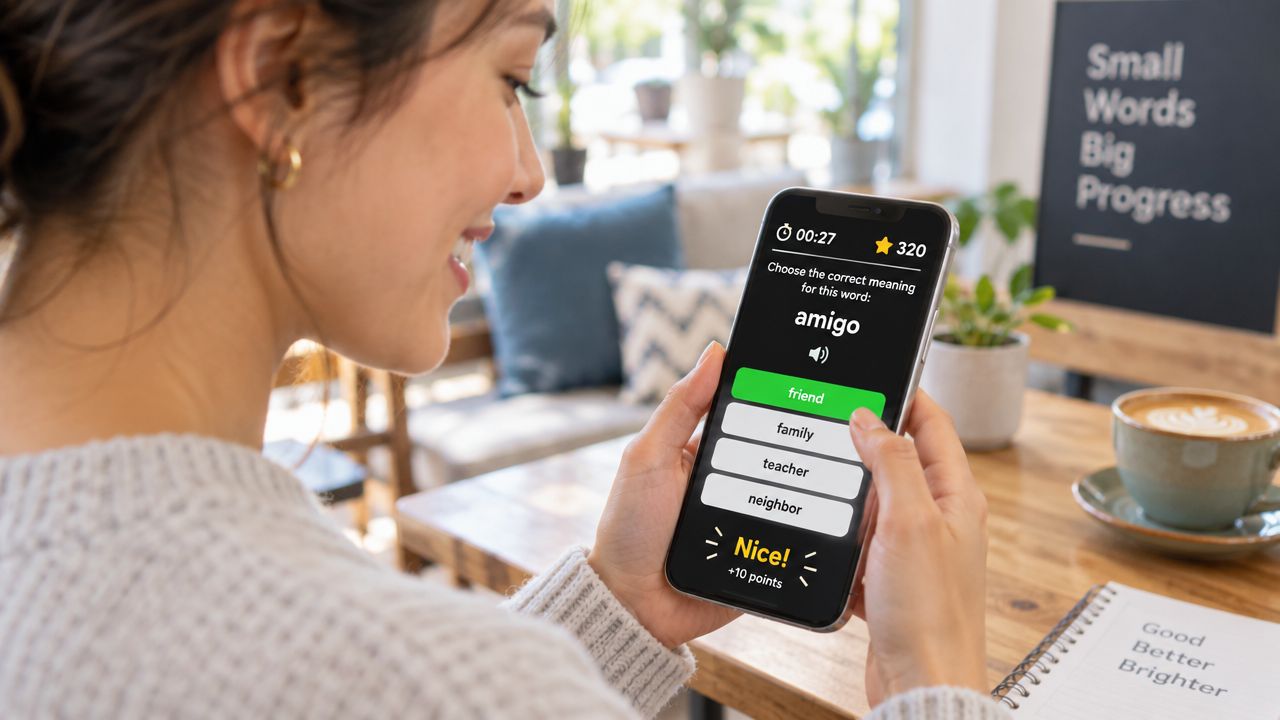
Research on motivation and habit formation consistently points to the value of immediate feedback and repeated cues in sustaining behavior, which is why game mechanics can support learning routines when used well. As a broad overview, the APA’s motivation resources are helpful for understanding why engagement tools matter in education. The practical takeaway is simple: gamification helps most with review compliance, beginner motivation, and reducing friction.
Where it helps most:
- learners who struggle to study consistently
- beginners who need low-pressure repetition
- review sessions that benefit from speed, feedback, and visible progress
Where it falls short:
- replacing active recall with passive tapping
- creating the illusion of progress through streaks alone
- teaching nuance, collocations, or natural usage without context
How to Implement Gamification
- Gamified Learning Apps: Tools like Duolingo built their entire model on this, using streaks and XP to keep users engaged. Kahoot applies this to a group quiz setting, making learning a social competition.
- Integrated Challenge Modes: PolyChat offers unlimited timed vocabulary challenges and games that let you test your recall against the clock. This creates a low-stakes, high-reward environment to practice and improve your speed and accuracy. These examples of gamification in education show just how effective this approach can be.
- Set Personal Challenges: You can gamify your own learning by setting goals with rewards. For example, challenge yourself to learn 10 new words daily for a week and reward yourself if you succeed.
Actionable Tips for Success
Use gamification to protect the habit, not to replace the work. A strong setup is one timed challenge after your SRS review, or a streak tied to creating one original sentence with a new word. I have seen points and streaks help most at the start of a routine; once they become the only goal, they can distract from accuracy and depth. Prioritize correct recall and actual usage over speed, especially early on.
4. Personal Dictionary & Active Vocabulary Building
Creating and maintaining a personal dictionary is a powerful method for taking ownership of your language learning journey. Instead of relying solely on pre-made lists, you actively curate a collection of words and phrases that are personally relevant and interesting to you. This active engagement transforms vocabulary acquisition from a passive exercise into a deliberate, customized process.
This approach ensures that the words you learn are directly applicable to your life, whether they come from a movie you enjoyed, a book you're reading, or a conversation you had. By capturing vocabulary from real-world contexts, you build a stronger connection to each word, making it more memorable and easier to integrate into your active vocabulary. This personalized resource becomes your go-to tool for targeted review and practice.
How to Implement a Personal Dictionary
- Integrated App Features: PolyChat includes a built-in personal dictionary where you can instantly save new words you encounter during AI conversations or lessons. This seamlessly connects discovery with a structured review process.
- Digital Notebooks: Tools like Evernote, Notion, or OneNote work well for building organized dictionaries. You can tag words by theme, difficulty, or context and add example sentences, images, or audio clips.
- Dedicated Flashcard Apps: You can use an app like Anki to build your personal dictionary in the form of flashcard decks. This method combines personalization with the power of spaced repetition for maximum efficiency. Explore some of the best vocabulary-building apps to find one that fits your style.
Actionable Tips for Success
To make this the best way to learn vocabulary, you must be consistent in capturing new words as you encounter them. Don’t just list the word; add personal context, such as where you heard it or why it's important to you. Organize your dictionary by theme or priority to make review sessions more focused. Regularly review your dictionary before activities where you might need specific vocabulary, like a work meeting or a social event. Finally, periodically "prune" words you have completely mastered to keep your list focused on active learning challenges.
5. Comprehensible Input & Active Listening
Acquiring vocabulary naturally, much like a child learns their first language, is possible through the principle of comprehensible input. This theory, popularized by linguist Stephen Krashen, suggests that we learn best when we are exposed to language that is just slightly beyond our current level of understanding. By engaging with content you can mostly grasp, your brain works to fill in the gaps, acquiring new words and structures organically from their natural environment.
This method transforms learning from a chore into an enjoyable activity. Instead of memorizing isolated word lists, you absorb vocabulary through compelling stories, interesting podcasts, or engaging videos. Active listening, a key component of this approach, means you are not just hearing the words but are actively trying to understand the meaning, context, and emotion behind them. This deepens your connection to the language and makes vocabulary stick.
How to Implement Comprehensible Input & Active Listening
- Graded Content Platforms: Services like LingQ or Olly Richards' "Short Stories" series offer libraries of text and audio content categorized by difficulty, allowing you to find material at your "i+1" level.
- Podcasts and YouTube: Start with podcasts designed for learners, such as "Coffee Break Languages," or find YouTube channels on topics you love that are hosted by native speakers who speak clearly.
- Interactive Conversation Games: PolyChat offers a dynamic way to apply this principle. Its interactive games provide contextual, spoken input from a native-sounding AI. You hear words used in realistic dialogues, helping you understand their meaning and pronunciation simultaneously.
Actionable Tips for Success
To make this the best way to learn vocabulary, choose content that interests you. Motivation matters, and you're more likely to persist if you're learning about your favorite hobby or watching a compelling TV show. Start with subtitles in your target language, not your native one, to connect the spoken and written forms. As your listening skills improve, challenge yourself to turn them off. Combine this passive listening with active practice; after hearing a new word in a podcast, try using it in a conversation with PolyChat to solidify your understanding and move from recognition to production.
6. Conjugation & Grammar Pattern Practice
Memorizing a word is only half the battle; understanding how it changes and functions within a sentence is what leads to fluency. Structured practice of verb conjugations and grammatical patterns teaches you how words adapt based on tense, mood, and subject. This method moves beyond isolated definitions, enabling you to construct meaningful, grammatically correct sentences from scratch.
By focusing on these patterns, you learn the underlying logic of a language. Instead of seeing "run," "ran," and "running" as three separate words, you recognize them as variations of a single concept governed by predictable rules. This framework-based approach makes learning vocabulary more efficient, as you can apply a single conjugation pattern to hundreds of different verbs, vastly expanding your expressive capabilities.
How to Implement Conjugation & Grammar Practice
- Integrated Practice Tools: PolyChat features an advanced conjugation practice tool with hundreds of crafted lessons. It moves beyond rote memorization by presenting verbs in contextual sentences, allowing you to practice them in a natural, conversational format.
- Reference Websites: Online resources like Conjugation.com and SpanishDict offer detailed conjugation trainers and reference tables, which are excellent for targeted practice or quick look-ups.
- Live Practice: Services like Verbling allow you to practice live with a native-speaking tutor who can correct your verb usage and conjugation in real-time conversation.
Actionable Tips for Success
To make this the best way to learn vocabulary, focus on application over memorization. Start by mastering the irregular verbs, as they are often the most common. Practice one tense at a time until you are comfortable before mixing them. A powerful technique is to practice conjugations aloud; this builds oral muscle memory and makes correct usage more automatic in conversation. Use contextual sentences for every verb you practice, as this links the abstract rule to a concrete meaning. For a deeper dive into foundational structures, you can learn more about basic Spanish grammar and apply those principles to your practice.
7. Mnemonics & Memory Palaces
Mnemonics and memory palaces tap into our brain's powerful spatial and visual memory systems to create unforgettable links to new words. This technique bypasses rote memorization by connecting abstract vocabulary to vivid, bizarre, or personal mental imagery, making recall feel intuitive rather than effortful. It is a creative approach that transforms the learning process into an act of imagination.
Instead of just reading a word and its definition, you create an association. For the Spanish word abeja (bee), you might picture a bee wearing a tiny Abe Lincoln hat. The more absurd the image, the more it sticks. This method transforms abstract data into a memorable story or scene, which is a highly effective way to anchor new information in your mind.

How to Implement Mnemonics & Memory Palaces
- Simple Association: Link a new word to a sound-alike word in your native language and create a visual story. For the German word Stuhl (chair), you might imagine stealing a chair.
- The Memory Palace (Method of Loci): Use a familiar location, like your house, as a mental blueprint. To learn vocabulary for food, you can "place" items in different rooms: an apple (manzana) on your living room sofa, milk (leche) flooding the hallway, and so on. To recall the words, take a mental walk through your house.
- Story-Based Learning: Weave a set of related vocabulary words into a short, cohesive story. Apps like Memrise often feature user-generated mnemonics that provide creative visual aids for thousands of words.
Actionable Tips for Success
To make this the best way to learn vocabulary, prioritize creativity and personalization. The weirder and more emotionally charged your mental images are, the better they will stick. Don't be afraid to create associations that are funny, strange, or even ridiculous. For themed vocabulary sets, like kitchen items or clothing, the memory palace technique is exceptionally powerful. Periodically "walk through" your palace to refresh the connections and solidify them in your long-term memory.
8. Translation & Reverse Translation Practice
Translation and reverse translation are powerful active recall exercises that bridge the gap between understanding a word and being able to use it. This method involves converting sentences from your target language to your native language (translation) and then from your native language back into the target language (reverse translation). This two-way process forces you to actively engage with grammar, syntax, and word choice.
This practice quickly reveals gaps in your knowledge. While translating into your native language tests comprehension, reverse translation tests your production skills, forcing you to move beyond passive recognition. It’s one thing to understand a phrase; it's another to construct it correctly from scratch. This makes it an effective way to solidify vocabulary in a practical context.
How to Implement Translation Practice
- Integrated Learning Tools: PolyChat features dynamic translation games that provide sentences and evaluate your translations with flexibility, focusing on meaning rather than rigid, literal accuracy. This creates a low-pressure environment for honing your skills.
- Contextual Examples: Websites like Reverso Context are excellent for seeing words used in bilingual, parallel texts. You can see how a phrase is translated in multiple real-world scenarios, which helps build an intuitive sense of nuance.
- Manual Practice: Take a short paragraph from a news article or book in your target language, translate it into your native language, and then a day later, try to translate it back into the target language without looking at the original. Compare your version to the source text to identify errors and areas for improvement.
Actionable Tips for Success
To make this the best way to learn vocabulary, focus on conveying the core meaning rather than a strict word-for-word translation. Languages rarely map onto each other perfectly. When you encounter a concept, challenge yourself to find multiple ways to express it in the target language. This builds flexibility and a deeper understanding of synonyms and phrasing. Use content you care about, like a song lyric or a movie quote, as this personal connection makes the practice far more memorable and engaging.
9. Social Learning & Language Exchange
Learning vocabulary in isolation is useful, but using it in conversation with real people is what makes it stick. Social learning and language exchange move vocabulary from a passive list in your head to an active tool for communication, providing authentic context, immediate feedback, and cultural nuance that textbooks can't offer.
This method transforms learning from a solitary chore into a dynamic, interactive experience. When you converse with a native speaker or a fellow learner, you’re forced to actively recall words and structures under real-time pressure. This active retrieval, combined with the emotional and social context of the conversation, forges powerful memory links and is an effective best way to learn vocabulary.
How to Implement Social Learning
- Language Exchange Apps: Platforms like Tandem and ConversationExchange connect you with native speakers who are learning your language, allowing for a mutually beneficial partnership.
- Live Conversation Lessons: Services like Verbling offer one-on-one lessons with professional tutors, providing structured conversation practice and expert feedback.
- Community Interaction: PolyChat fosters a vibrant user community where you can participate in group challenges and discussions. This lets you practice newly acquired vocabulary with peers in a supportive and engaging environment.
- Local Meetups: Search for language exchange meetups in your city to practice face-to-face, which adds another layer of immersion and social connection.
Actionable Tips for Success
To get the most out of your exchanges, preparation is vital. Before a session, use PolyChat to review relevant vocabulary and prepare a few conversation topics or questions. Arrange regular, consistent meetings with your partner to build rapport and momentum. During the conversation, don’t be afraid to make mistakes and ask your partner to correct your pronunciation and word usage. Finding a partner with shared interests will make conversations flow more naturally and help you learn vocabulary useful to you.
10. Multi-Sensory & Total Physical Response Learning
Engaging multiple senses is a powerful way to anchor new vocabulary deep in your memory. Multi-sensory learning involves using visual, auditory, kinesthetic (movement), and tactile (touch) pathways to create stronger, more interconnected neural memories. This approach goes beyond reading a word; it makes learning an active, physical experience.
This method often incorporates Total Physical Response (TPR), a technique developed by Dr. James Asher. TPR links language to physical action. You hear a command or a word and respond with a specific movement, mimicking how children learn their first language. By connecting a word like "jump" to the physical act of jumping, you create a direct, non-verbal association that is durable and makes recall almost automatic.
How to Implement Multi-Sensory & TPR Learning
- Physical Actions: When learning verbs, physically act them out. For "to write," mime writing. For "to drink," pretend to lift a cup to your mouth. This kinesthetic link is a potent memory aid.
- Visual and Auditory Tools: Use apps and platforms that combine visuals, sounds, and interaction. YouTube channels often demonstrate actions while teaching vocabulary, providing a clear model to follow.
- Integrated Learning Games: PolyChat’s interactive games are designed to engage multiple senses. You might see a picture (visual), hear the word pronounced (auditory), and type the answer (kinesthetic/tactile), creating a rich learning experience that reinforces vocabulary from several angles.
Research reviews on Total Physical Response continue to support it as especially helpful for beginners and for linking meaning with action in low-stress settings; this overview of TPR in language teaching gives a useful summary of why movement can reduce friction in early vocabulary learning.
Actionable Tips for Success
To make this the best way to learn vocabulary, fully commit to the physical aspect. Don't be shy about gesturing or acting out words, even when studying alone. Create your own simple hand gestures or signs for abstract nouns or tricky adjectives. Combine this with color-coding your notes (visual) and saying the words aloud as you write them (auditory and kinesthetic). The more senses you involve, the more pathways your brain has to retrieve the word later. This method is especially effective for beginners and kinesthetic learners who thrive on activity.
Top 10 Vocabulary Learning Methods Comparison
| Goal | Time per day | Level fit | Best primary method | Best companion method |
|---|---|---|---|---|
| Remember words for the long term | 10–15 min | Beginner to advanced | Spaced repetition | Contextual sentences |
| Understand words while reading and listening | 15–30 min | Beginner to advanced | Contextual learning | Personal dictionary |
| Turn passive vocabulary into active use | 15–20 min | Intermediate to advanced | Reverse translation | Conversation practice |
| Build a habit you can maintain daily | 5–15 min | Beginner | Gamified review | SRS |
| Improve pronunciation and listening recall | 15–30 min | Beginner to advanced | Active listening | Sentence shadowing or speaking |
| Speak more accurately with verbs and structures | 10–20 min | Beginner to intermediate | Grammar pattern practice | Writing sentences |
| Memorize difficult or abstract terms | 10–15 min | Intermediate to advanced | Mnemonics | SRS review |
| Prepare for real conversation | 20–30 min | Intermediate to advanced | Social learning | Pre-session review with SRS |
| Learn action words quickly | 10–15 min | Beginner | Multi-sensory / TPR | Listening and visual cues |
| Build topic-specific vocabulary for work or study | 10–20 min | Intermediate to advanced | Personal dictionary | SRS + reading |
The strongest combinations are usually not complicated. Spaced repetition plus contextual sentences is the most reliable all-purpose pairing because it covers both retention and meaning. Listening plus conversation practice works especially well when pronunciation and real-time access are the main bottlenecks. For learners who need productive control, reverse translation plus sentence writing is often the fastest bridge from “I know this word” to “I can use it.”
| Method | Implementation Complexity 🔄 | Resource Requirements 💡 | Expected Outcomes ⭐ / 📊 | Ideal Use Cases ⚡ | Key Advantages 📊 |
|---|---|---|---|---|---|
| Spaced Repetition System (SRS) | Moderate — algorithm setup & consistent review | Low–Medium: flashcard app & initial card creation | ⭐⭐⭐⭐⭐ — excellent long-term retention, efficient reviews | Vocabulary memorization, long-term retention plans | Time-efficient reviews; measurable progress |
| Contextual Learning & Immersive Sentences | Medium — requires curated contextual content | Medium: sentence corpora, authentic materials | ⭐⭐⭐⭐ — strong natural usage and semantic links | Conversation prep, real-world usage, phrase learning | Teaches usage in context; reduces interference |
| Gamification & Competitive Challenges | Low–Medium — design game mechanics & balance rewards | Medium: platform features, leaderboards, timers | ⭐⭐⭐⭐ — high engagement and habit formation | Motivation boosters, daily practice, beginner engagement | Increases engagement and consistent practice |
| Personal Dictionary & Active Vocabulary Building | Low — user-curated entry and organization | Low: notes/tools, occasional tagging effort | ⭐⭐⭐⭐ — highly relevant vocabulary growth | Tailored vocab for travel, work, personal interests | Personal relevance; prioritizes useful words |
| Comprehensible Input & Active Listening | Low–Medium — content selection and leveling | Medium: native audio/video, transcripts | ⭐⭐⭐⭐ — improved listening, pronunciation, fluency | Listening skills, immersion, pronunciation practice | Natural input; cultural & idiomatic exposure |
| Conjugation & Grammar Pattern Practice | Medium — structured lesson planning required | Medium: drills, exercises, targeted examples | ⭐⭐⭐⭐ — increased grammatical accuracy and production | Formal writing/speaking, tense mastery, accuracy training | Builds reliable sentence construction skills |
| Mnemonics & Memory Palaces | Medium–High — creative mental mapping required | Low–Medium: time and imagination investment | ⭐⭐⭐⭐⭐ — exceptional recall for specific items | Memorizing abstract terms, exams, low-frequency words | Powerful long-term encoding; memorable associations |
| Translation & Reverse Translation Practice | Low–Medium — needs flexible evaluation criteria | Low: texts, reference tools, feedback | ⭐⭐⭐⭐ — stronger production and comprehension | Writing practice, precise meaning transfer, nuance work | Reveals gaps; trains production and nuance |
| Social Learning & Language Exchange | Medium — coordinating partners and topics | Variable: partners, scheduling, platform access | ⭐⭐⭐⭐⭐ — high fluency gains and real-time feedback | Speaking practice, cultural exchange, conversation skills | Most realistic practice; immediate corrective feedback |
| Multi-Sensory & Total Physical Response (TPR) | Medium — multimodal materials and activities | Medium: multimedia, space, props for TPR | ⭐⭐⭐⭐ — strong encoding for visual/kinesthetic learners | Young learners, action verbs, kinesthetic learners | Engages multiple senses; enhances embodied memory |
From Theory to Fluency: Creating Your Perfect Vocabulary System
The most effective vocabulary systems are operational, not inspirational. You do not need ten methods every day. You need a repeatable loop that helps you collect useful words, review them before they fade, and then use them before they stay passive.
The daily practice loop
Use this four-step cycle:
- Collect 3 to 8 useful words from reading, listening, class, or conversation.
- Review them with spaced repetition or a short recall drill.
- Use each word in one original sentence.
- Recall later by saying or writing the word again the same day without looking.
That last step is where many learners improve fastest. A word feels learned when you see it; it becomes usable when you can retrieve it hours later.
Sample routines by available time
10 minutes per day
- 4 minutes: SRS review
- 3 minutes: collect 2 to 3 new words from one short piece of content
- 2 minutes: write one sentence with each word
- 1 minute: quick spoken recall before you stop
This is the minimum routine I would trust for steady progress. It is small, but it covers review, context, and output.
20 minutes per day
- 7 minutes: SRS review
- 5 minutes: read or listen to a short text and collect 3 to 5 words
- 4 minutes: write or say one sentence per word
- 4 minutes: later recall through reverse translation or a quick voice note
This is probably the most sustainable setup for busy adults because it is long enough to create momentum without becoming fragile.
30 minutes per day
- 10 minutes: SRS review
- 8 minutes: reading or listening with note-taking
- 6 minutes: sentence writing or short translation exercise
- 6 minutes: conversation practice, shadowing, or spoken recall
At this level, you can alternate goals by day: one day more listening-heavy, one day more writing-heavy, one day more conversation-heavy.
How many new words should you learn at once?
Most learners do better with a small number they can recycle than with a large list they only touch once. A practical range is 3 to 8 new words per day for sustained learning. If you add more, make sure they are tightly related by theme or immediate need. Too many unrelated words create overload, and the review pile grows faster than your retention.
A simple warning sign: if your review sessions keep getting longer but your ability to use the words in speech is not improving, you are probably collecting faster than you are processing.
What progress should look like after 2–4 weeks
After two weeks of consistent work, most learners should notice faster recognition and less complete forgetting. After three to four weeks, you should start seeing some words appear spontaneously in writing or conversation, especially the ones you have reviewed and used several times. If that is not happening, the fix is usually not more exposure; it is more retrieval and more active use.
Building Your Personal Vocabulary Engine
Build your system around one source of input and one source of review. For example, you might collect words from podcasts, short articles, or PolyChat conversations, then move them into SRS with one example sentence each. If you want extra reading practice, a tool like Cathoven can help generate level-appropriate material around the vocabulary you are trying to reinforce.
Here is a clean weekly structure:
- Daily: review, collect a few words, use them once
- Twice per week: do reverse translation or short writing with recent words
- Two or three times per week: speak with a tutor, partner, or AI conversation tool
- Once per week: prune your list, keeping only useful or still-unstable words in heavy rotation
Customizing Your Approach for Long-Term Success
Your ideal learning system will evolve as you progress from a beginner to an advanced speaker. To optimize that system, it helps to understand your own preferences by exploring various learning styles in adults and how they affect study comfort and consistency. I would treat style as a preference filter, not a hard rule: visual learners may enjoy color and imagery, but they still benefit from retrieval and real usage.
The best routine is the one you can repeat without negotiation. If a method is theoretically excellent but you avoid it for weeks, it loses to a simpler routine you do.
Ready to stop just learning words and start using them? PolyChat is designed to be the engine for your personal vocabulary system, combining unlimited, gamified lessons, SRS, and contextual learning into one powerful platform. Build your perfect routine and start speaking with confidence today by visiting PolyChat.
Frequently Asked Questions
What is the easiest way to learn new vocabulary?
The easiest approach is usually to learn words in short, useful sentences and review them daily with spaced repetition. That reduces friction because you are not memorizing isolated definitions, and it improves recall because the words keep coming back before you forget them.
What is the fastest way to memorize vocabulary?
The fastest reliable method is active recall on a spaced schedule. In practice, that means trying to remember the word, not just rereading it, then seeing it again over several days. If you need the word for real use, add one original sentence and one later recall attempt the same day.
Why do learners struggle to retain words?
Most vocabulary disappears because it is encountered only once or reviewed passively. Words are easier to lose when they are learned without context, without retrieval, and without any later use in writing or speech.
Should I learn words in lists or in context?
Context is better for meaning, nuance, and natural use. Lists can still help if they are transformed into good review material, especially when each item includes an example sentence, collocation, or recall prompt.
How much daily vocabulary practice is enough?
For many learners, 10 to 20 minutes per day is enough to create visible progress if the routine includes review plus active use. More time helps, but consistency matters more than occasional long sessions.
Is reading enough to build vocabulary?
Reading is excellent for recognition and for learning how words behave in real sentences. By itself, though, it often leaves words passive. If you want faster access in speaking or writing, save useful words and review them with retrieval practice.
Are flashcards still worth using in 2026?
Yes, if they are designed for recall and not just recognition. The best cards are simple, contextual, and connected to language you want to use.
Jean-Baptiste Bolh
Co-Founder
Applied AI

Jean-Baptiste Bolh
Co-Founder
Applied AI