How to Say Goodbye in Spanish Like a Native Speaker
Tired of just saying 'adiós' every time you leave a conversation in Spanish? While it’s the one everyone knows, relying on it all the time is a dead giveaway that you're a beginner. The Spanish-speaking world has a whole toolbox of goodbyes, and picking the right one is a huge step toward sounding more natural.
This guide will show you how to move beyond the basics and start saying goodbye like you actually speak the language.
Ready to Learn Spanish?
Try PolyChat's engaging language lessons, interactive learning games and put your Spanish vocabulary to the test!
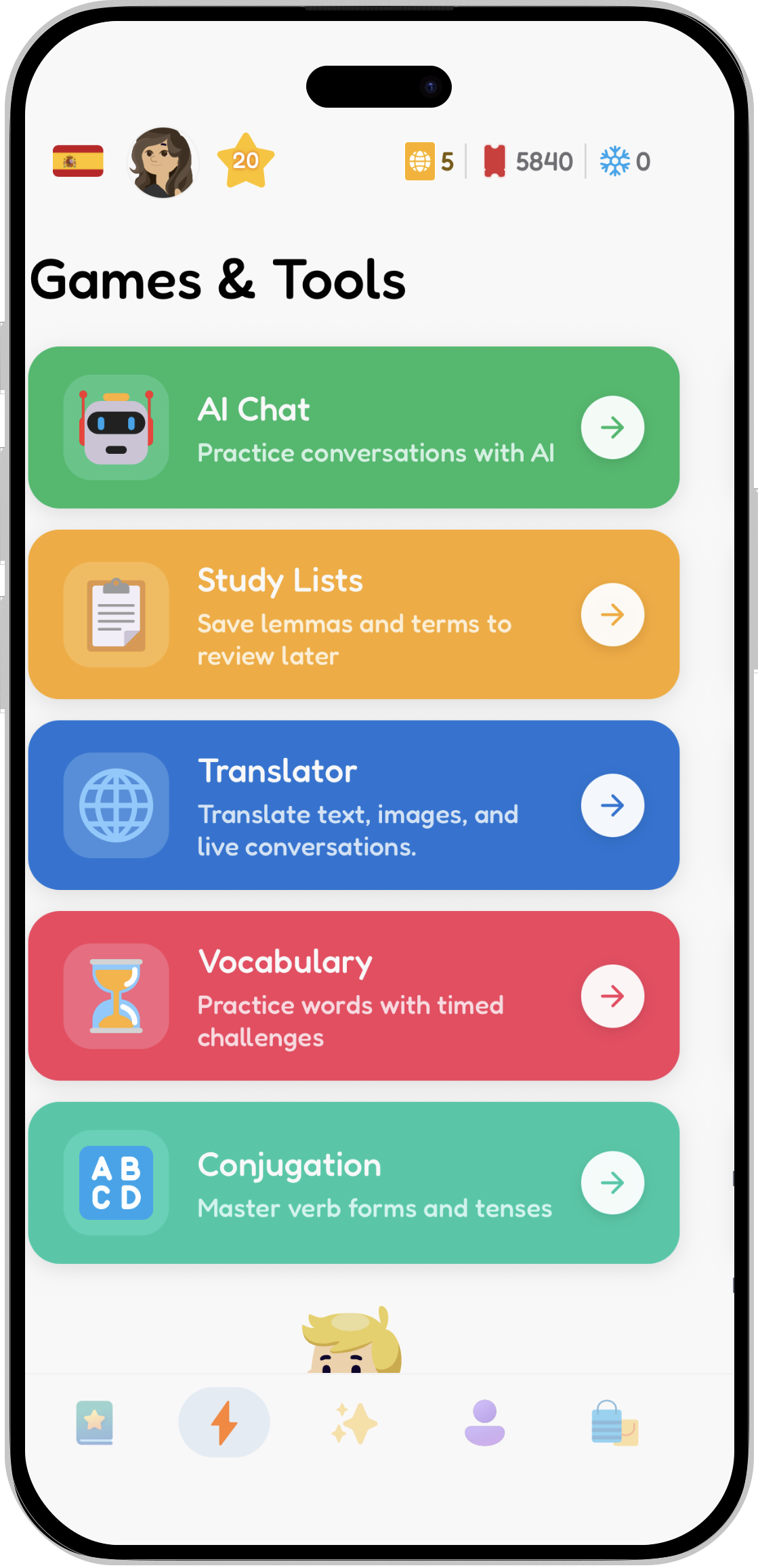
Games & Tools
Tools that every language learner needs at all stages of their learning journey.
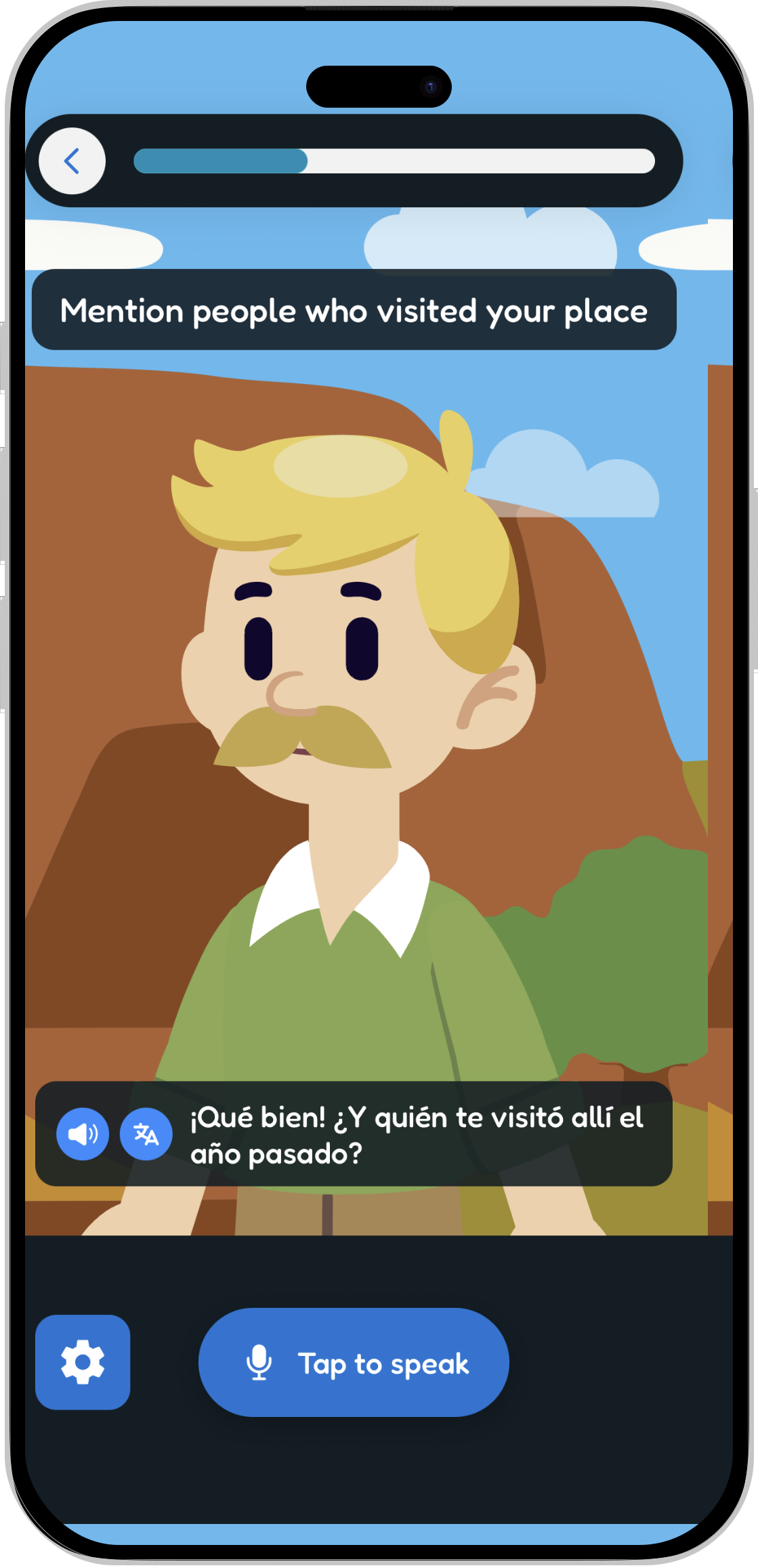
AI Chat Tutor
Practice real conversations with an AI tutor that helps you speak with confidence.
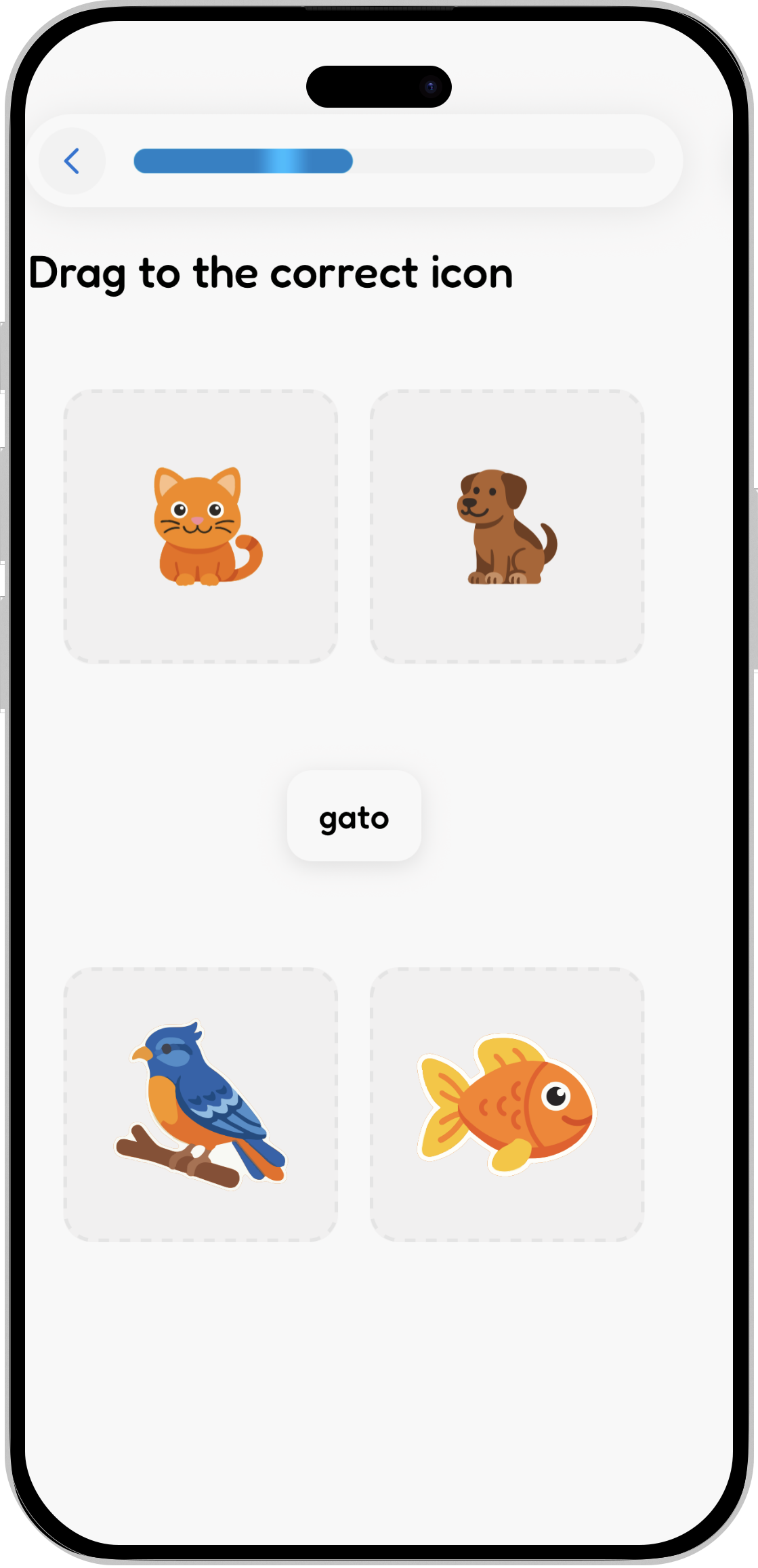
Interactive Games
A variety of games to help you learn and remember new words and phrases.


More Than Just "Adiós": A World of Spanish Farewells
Learning the right way to say goodbye in Spanish is about more than memorizing words—it’s about reading the room and connecting with people on their terms. With over 636 million Spanish speakers projected for 2025, you're tapping into a massive global community. That's a staggering 7.6% of the world's population, making it the third most spoken language on the planet.
For language learners, especially those using practice tools like PolyChat, nailing these social cues is what separates knowing words from actually communicating. As you can see from this deep dive into Spanish-speaking countries, the language's reach is immense.
Why Context Is Everything
Think of Spanish goodbyes like different outfits. You wouldn't wear a tuxedo to the beach, and you wouldn't use a super formal farewell with a close friend. The phrase you choose sends a subtle signal about your relationship and when you think you'll see them next.
You've got to ask yourself a few quick questions:
- Formality: Am I talking to my boss or my buddy?
- Finality: Is this "see you tomorrow" or "see you never"?
- Region: Am I in Madrid, Mexico City, or Buenos Aires?
This flowchart breaks down the thought process for picking the right phrase in a casual vs. formal setting.
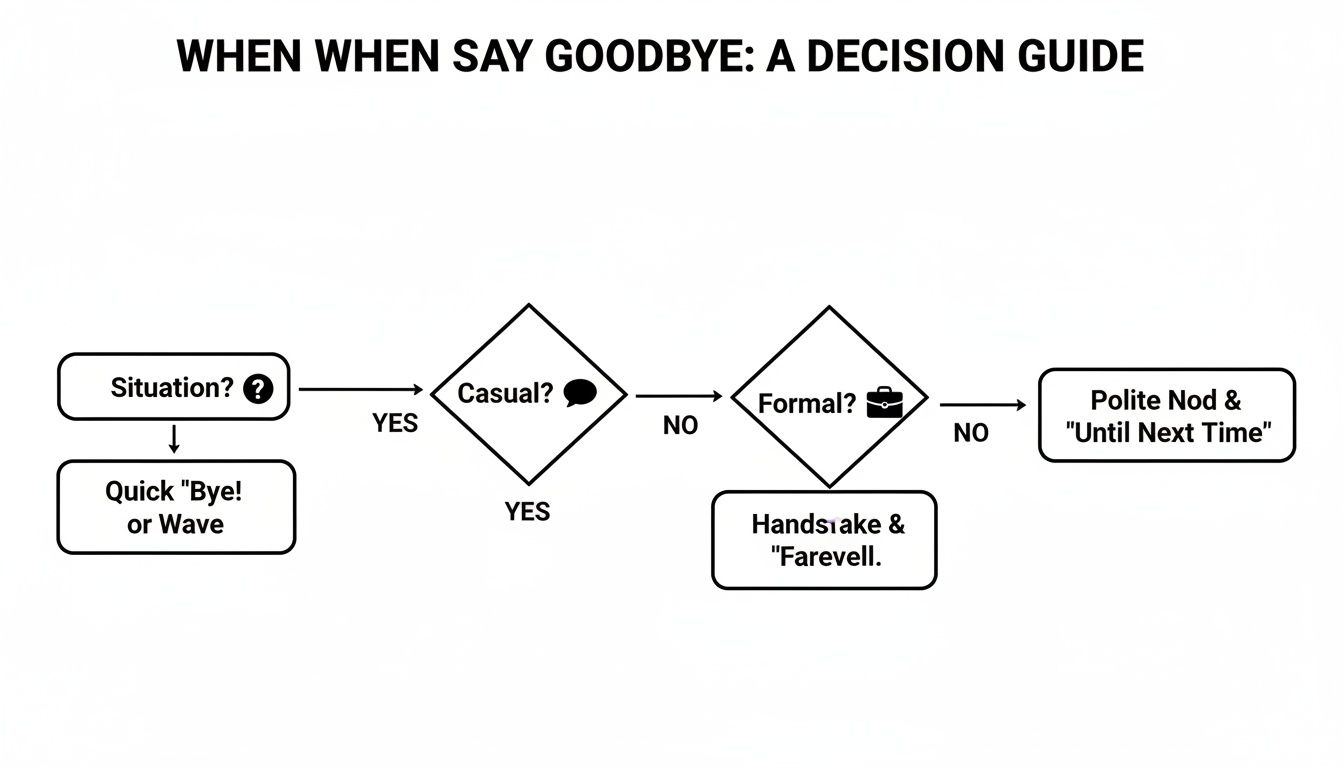
As you can see, it all starts with the situation. From there, your choices branch out, guiding you to the most natural-sounding option.
Quick Guide to Common Spanish Goodbyes
To get you started, let's run through the greatest hits. While everyone understands adiós, native speakers often save it for more permanent goodbyes, a bit like the English "farewell." In your day-to-day chats, you'll hear a much wider, more nuanced variety of phrases.
The word hasta (meaning "until") is probably the most useful tool in your goodbye toolkit. You can stick almost any time-related word after it and create a perfectly natural farewell.
Here’s a quick rundown of the phrases you'll hear and use most often.
| Spanish Phrase | English Meaning | When to Use It |
|---|---|---|
| Hasta luego | See you later | The all-purpose, safe bet for almost any situation. |
| Nos vemos | See you / We'll see each other | A friendly, common choice that implies you'll meet again soon. |
| Chao (or Chau) | Bye | A quick, casual goodbye, perfect for friends and informal settings. |
| Cuídate | Take care | A warm and caring farewell used with friends and family. |
Mastering Your Everyday Goodbyes
While you might know adiós, it often carries a heavy, almost final feeling, a bit like saying "farewell" in English. To really sound natural in your day-to-day chats, you'll want to master the phrases that native speakers actually use. These are your conversational workhorses.

We're talking about hasta luego, nos vemos, and chao. They might all roughly translate to "see you later," but each one has its own specific flavor. Picking the right one is a small detail that makes your Spanish sound so much more authentic.
Hasta Luego: The All-Purpose Farewell
Think of hasta luego (ah-stah loo-EH-go) as your safest bet. It's your go-to, all-purpose goodbye. Literally meaning "until later," it works in just about any situation you can think of. It's polite enough for a shopkeeper you've just met but still friendly enough for a casual acquaintance.
The real beauty of hasta luego is that it's non-committal. You're not making a solid promise to see the person again, which makes it a comfortable and easy way to wrap up a quick interaction.
Pro Tip: In many parts of Spain, you'll hear hasta luego constantly. It's almost a verbal reflex people use to end a conversation, even with strangers they know they'll probably never see again. It's just a polite way of saying, "We're done here."
Nos Vemos: The Friendly "See You Around"
If hasta luego is a polite handshake, then nos vemos (nohs VEH-mohs) is more like a friendly wave. It translates to "we'll see each other," which automatically implies you'll probably cross paths again. This makes it a warmer and more personal option.
You'd use nos vemos with friends, classmates, or colleagues—anyone you have a recurring connection with. It’s perfect when you're leaving a place you both go to often, like the office, the gym, or a local café. Beyond the ubiquitous 'Adiós', there are many nuanced Spanish farewells; for instance, you might want to learn about common farewells like 'See You Soon' for casual departures.
For example:
- Leaving a café where you met a friend: “Bueno, me voy. ¡Nos vemos!” (Well, I'm off. See you!)
- Ending a phone call about weekend plans: “Perfecto. Nos vemos el sábado.” (Perfect. See you Saturday.)
Chao: The Quick and Casual "Bye"
Borrowed from Italian, chao (or chau in places like Argentina) is the undisputed king of the quick, casual goodbye. It’s breezy, informal, and you'll hear it absolutely everywhere in both Spain and Latin America.
Reach for chao when you're:
- Ending a call with a friend.
- Ducking out of a party.
- Saying bye to a cashier in a casual shop.
- Sending a quick farewell text.
Just remember one crucial rule: unlike the Italian ciao, the Spanish chao is only for saying goodbye, never for hello. Nailing the pronunciation is also a big part of sounding natural. For more help with that, check out our guide on avoiding common Spanish pronunciation mistakes. Getting these little details right will make a huge difference in how fluent you sound.
Using Time-Specific Spanish Farewells
While a general goodbye like hasta luego is your all-purpose tool, sometimes you need to get more specific. This is where time-based farewells come in. They’re your secret weapon for making concrete plans and sounding much more like a natural speaker when you say goodbye in Spanish.
Think of it like this: they take the guesswork out of your conversation. Instead of a vague "see you later," you're locking in a timeline, which is essential for everything from office meetings to planning a night out with friends.

The magic word that unlocks all of this is hasta, which means "until." Just by pairing it with a time-related word, you can create a huge variety of natural-sounding goodbyes. It’s a simple, powerful formula that instantly levels up your Spanish.
Building Your Time-Based Goodbyes
The structure couldn't be easier: Hasta + [Timeframe]. That's it. You can swap out that timeframe to fit almost any situation you can think of, making this one of the most flexible tools in your vocabulary.
Here are the absolute essentials you'll hear and use constantly:
- Hasta mañana – This means "see you tomorrow." It’s perfect for when you're leaving work for the day or saying goodbye to classmates. You'll hear this one everywhere.
- Hasta pronto – Use this for "see you soon." It has a bit more intention behind it than hasta luego, suggesting you genuinely expect to see the person again shortly.
- Hasta la próxima – Meaning "until next time," this is great for things that happen regularly but aren't on a strict schedule, like after a book club meeting or a casual get-together.
These are your building blocks. Now, let's have some fun and start customizing them.
The formula "Hasta + [time reference]" is your best friend for making plans. It transforms a simple goodbye into a clear statement of intent, making your Spanish sound both natural and organized.
Customizing Farewells for Any Occasion
Ready to get even more precise? You can easily tweak the hasta formula for any day of the week or time of day. This kind of detail is super common in everyday Spanish and will make your conversations flow much more smoothly.
Just follow the pattern:
- Days of the week: Use hasta el for masculine days. For instance, "hasta el lunes" is your go-to for "see you on Monday" as you head out of the office on a Friday.
- Parts of the day: Use hasta la for feminine nouns like tarde (afternoon) or noche (night). A quick "hasta la noche" means "see you tonight."
- Other timeframes: The pattern works for bigger chunks of time, too. "Hasta la próxima semana" is a perfect way to say "see you next week."
And a cool regional tip: in many parts of Latin America, you'll hear the super casual "hasta al rato" or "hasta el rato," which means "see you in a bit." It’s a relaxed, friendly way to sign off when you know you'll be seeing them again very soon.
Getting these time-specific phrases down will help you navigate your schedule and social life like a pro.
Navigating Formal and Professional Goodbyes
In casual chats with friends, a quick chao or nos vemos is perfect. But the moment you step into a professional setting—a business meeting, a formal introduction, or even just addressing an older person—your choice of goodbye suddenly carries a lot more weight.
Using the right phrase isn't just about being polite; it shows respect and cultural awareness, leaving a polished, lasting impression.
Understanding Adiós
The classic adiós, while famous, can be a bit of a landmine. In English, we might think of it as a simple "goodbye," but in many Spanish-speaking contexts, it carries a heavy sense of finality, like saying "farewell" for good.
Using it at the end of a business meeting can sound a little dramatic, almost as if you never expect to see them again. While it’s not technically rude, it can feel out of place. It’s best to save adiós for more permanent departures.
The Go-To Polite Farewell
For most professional or formal encounters, your safest and most reliable phrase is que tenga un buen día (have a good day). Think of this as the gold standard of polite goodbyes.
It's respectful, warm, and perfectly suited for speaking with clients, store clerks, new acquaintances, or anyone you're addressing formally with usted.
You can also easily adapt it to the time of day to sound even more natural:
- Que tenga una buena tarde (Have a good afternoon/evening)
- Que tenga una buena noche (Have a good night)
This simple structure is your key to ending conversations on a high note. It shows both courtesy and a solid grasp of Spanish social etiquette.
When in doubt, a polite, time-appropriate wish like "que tenga un buen día" is always a safe and respectful choice. It's the professional equivalent of a firm handshake—confident, appropriate, and universally appreciated.
Other Formal Options to Keep in Your Back Pocket
Beyond wishing someone a good day, you have a few other excellent options for maintaining a professional tone when you say goodbye in Spanish. These are perfect for wrapping up meetings or leaving a great first impression.
A fantastic phrase to use is fue un placer conocerle (it was a pleasure to meet you). This is the perfect sign-off after meeting someone for the first time in a business context. If you already know the person and are ending a positive interaction, a simple fue un placer (it was a pleasure) works beautifully.
Another useful, though slightly more rigid, option is me despido, which roughly means "I take my leave." While it sounds quite stiff in English, it’s used in Spanish to formally signal the end of a presentation or a meeting, making it clear the interaction is over.
Finally, con permiso (excuse me, or with your permission) is a subtle and respectful way to exit a conversation or a room without being abrupt. It's a polite signal that you need to depart.
To make things a little clearer, let's break down when to use certain phrases.
Formal vs. Informal Spanish Farewells
This table gives you a quick snapshot of which goodbyes fit which situations, helping you choose the right level of formality every time.
| Situation | Informal/Casual Phrase | Formal/Polite Phrase |
|---|---|---|
| Leaving a friend's house | ¡Chao! or ¡Nos vemos! | Not applicable |
| Ending a call with a family member | Hablamos luego (Talk later) | Not applicable |
| After a business meeting | Hasta luego (See you later) | Fue un placer (It was a pleasure) |
| Leaving a store or restaurant | ¡Gracias, hasta luego! | Gracias, que tenga un buen día |
| Meeting a client for the first time | Not applicable | Fue un placer conocerle |
| Politely exiting a room or group | Con permiso (Excuse me) | Con permiso (Works for both) |
Choosing the right phrase is all about reading the room. The more you listen and practice, the more intuitive it will become.
How Spanish Goodbyes Change by Region
Saying goodbye in Spanish isn't a one-size-fits-all deal. The language is spoken in over 20 countries, and every single one adds its own local spice to the conversation. What sounds perfectly normal in Madrid might get you a slightly confused look in Buenos Aires.
Think of it like local slang. When you use the right regional farewell, you're showing you've done more than just memorize a textbook. It’s a small detail that signals you're paying attention to the culture, and that can make a huge difference in how people connect with you.
The Reign of Chao and Chau
Head down to the Southern Cone of South America, and you'll find one word is king. Chau, borrowed from Italian immigrants generations ago, is the undisputed champ of goodbyes in countries like Argentina and Uruguay. It's fast, casual, and you’ll hear it a hundred times a day.
Go a little further north to places like Chile, and you'll hear the same word, but usually spelled and said as chao. The spelling is a tiny bit different, but the vibe is identical: a breezy, informal "bye."
The widespread use of chau/chao in South America is a living piece of history, a direct echo of the wave of Italian immigration in the late 19th and early 20th centuries. It’s a word that literally crossed an ocean and found a new home.
Warm Wishes in Mexico and Colombia
As you travel up into Mexico and parts of Central America, the goodbyes often get a little warmer and more personal. A really common and heartfelt way to part ways is with cuídate, which means "take care." It just adds this wonderful layer of genuine concern to your farewell.
In Mexico, you might also hear the super informal ahí te ves, which is a slangy way of saying "see you around." This one is definitely best saved for your friends. Over in Colombia, a similarly warm and common farewell is que estés bien, meaning "hope you're well." These phrases go way beyond a simple "see you later" by adding a personal touch.
Other Regional Gems
Of course, the local flavors don't stop there. Every region has its own quirks that can make your Spanish sound much more authentic. If you want to dive deeper into these kinds of local expressions, you can learn more about unique Spanish slang words from all over the map.
Here are a couple more to listen for on your travels:
- Spain: You’ll frequently hear venga used to wrap up a conversation. It's often tacked onto another goodbye, like, "¡Venga, hasta luego!"
- Colombia: A fun, super casual option you might hear between friends is nos pillamos, which translates roughly to "catch you later."
Paying attention to these regional differences is your ticket to sounding less like a student and more like a local. It shows respect for the culture and helps you build much stronger connections, no matter where you are in the Spanish-speaking world.
Putting Your Spanish Farewells into Practice
Knowing the difference between adiós and hasta luego is one thing, but actually using these phrases in the heat of the moment is a whole different ballgame. The fastest way to make the right Spanish farewell feel like second nature is through consistent, low-pressure practice.
Think of it this way: you can read a dozen cookbooks, but you won't learn to cook until you get in the kitchen. Language is the same. Using a tool like PolyChat, you can gather all the goodbyes from this guide into a custom practice set. This is how you turn head knowledge into an active, usable skill. And if you're really aiming to sound natural, blending in with the local culture is a huge part of it—our guide on how to travel like a local can help you build those deeper connections.
Build Confidence with Real Scenarios
The real secret is to practice for real-world situations. Don't just flip through flashcards; challenge yourself to pick the right goodbye for different scenarios.
- Role-play a formal exit: Picture yourself leaving a business meeting. You’d want to practice saying something like que tenga un buen día.
- Simulate a casual hangout: Run through ending a phone call with a friend. This is the perfect time to use a quick chao or nos vemos.
Adding in timed challenges or conversation games can make this kind of practice feel way less like a chore.
You can see here how easy it is to create a custom practice set right in the PolyChat app.
This lets you zero in on exactly what you need to master: how to say goodbye in Spanish. And don't forget, getting the pronunciation right—accents and all—is what makes you sound authentic. If you need a refresher, you can learn more about how to add accents when typing to keep your written practice just as sharp.
Got Questions About Saying Goodbye in Spanish?
Even with a solid list of phrases, some of the finer points can feel a little fuzzy. When you're learning how to say goodbye in Spanish, it’s totally normal to second-guess which phrase fits the moment and which ones might make you sound… well, like a tourist.
Let's clear up some of the most common hangups. Answering these questions is how you go from just knowing the words to actually understanding the culture behind them. That’s the secret sauce to making your Spanish sound authentic.
Is It Rude to Say Adiós?
Here’s the short answer: No, saying adiós isn't rude, but it’s a lot heavier than a simple "goodbye." Think of it more like "farewell." It carries a real sense of finality, almost like you don’t expect to see the person again for a very long time, if ever.
Because of that weight, using it with a coworker you’ll see tomorrow morning would sound overly dramatic and honestly, a little weird. For everyday goodbyes, you'll want to stick with lighter, more common options.
Key Takeaway: Save adiós for when you’re actually saying a permanent goodbye. For your daily interactions, phrases like hasta luego or nos vemos are way more natural and appropriate.
What Is the Difference Between Hasta La Vista and Hasta Luego?
This is a classic question, and we can thank Hollywood for the confusion. While both technically translate to something like "see you later," their real-world use couldn't be more different. Hasta luego is one of the most common, all-purpose farewells in Spanish, something you'll hear every single day in all sorts of situations.
Hasta la vista, on the other hand, is basically never used in modern conversation. Its fame comes almost entirely from Arnold Schwarzenegger's iconic line in The Terminator. If you use it today, people will immediately think you're quoting the movie, which will probably come across as theatrical or just a bit silly.
Can I Just Say Bye in Spanish?
Yes, absolutely. The English word "bye" has gone global and is widely understood and used in most Spanish-speaking countries. It’s especially common in casual situations and among younger people, often popping up right alongside the equally informal chao.
While learning the real Spanish goodbyes will definitely make you sound more fluent, don't stress about dropping a "bye" when you're in a pinch. In any informal chat, you'll be perfectly understood.
Ready to practice these farewells until they feel second nature? PolyChat offers interactive conversation games and custom vocabulary sets to build your confidence fast. Stop memorizing and start speaking. Try PolyChat today by visiting https://www.polychatapp.com.

Jean-Baptiste Bolh
Co-Founder
Applied AI