A Practical Guide to Using Commands in Spanish
Imagine walking into a café in Madrid and confidently ordering your morning coffee, asking a local for directions in Mexico City, or even leading a business meeting in Bogotá. How do you do it? With commands. They are the absolute key to direct, effective, and clear communication in Spanish.
This guide isn't about dry grammar rules you'd find in a textbook. It's about showing you how Spanish commands are practical tools for real-world situations—and why they're so much more than just bossy orders.
Why Mastering Spanish Commands Unlocks Fluent Conversation

Learning to use commands is about way more than just memorizing verb endings. It’s about being able to actively engage with the world around you. Think of commands as the action-oriented part of the language—they let you make requests, give instructions, offer friendly suggestions, and navigate daily life with confidence.
Without them, your conversations can feel a bit passive. You might know how to describe what you want, but you lack the tool to actually ask for it directly. Getting a handle on the imperative mood is what takes you from being a spectator to being an active participant in any Spanish-speaking environment.
The Global Importance of Spanish Commands
This isn't just a niche skill, either. Spanish is a global powerhouse. With approximately 636 million speakers worldwide, it makes up a huge 7.6% of the global population. It's now the third most widely spoken language, making the ability to communicate directly more valuable than ever.
This guide will give you a clear, actionable roadmap to using commands like you've been doing it for years. We'll cover all the essentials:
- Formal vs. Informal: So you know how to choose the right tone for any situation.
- Affirmative & Negative: The simple ins and outs of saying "do this" versus "don't do that."
- Irregular Verbs: We'll conquer the common exceptions that trip everyone up.
- Pronoun Placement: You'll learn how to attach pronouns smoothly, just like a native speaker.
Beyond just ordering a coffee, mastering these skills opens up a massive cultural landscape. It’s a crucial step toward everything from deeper travel experiences to expanding your reach to millions of Spanish readers if you’re a writer.
By the time we're done, you'll see commands not as a boring list of rules, but as a powerful key to unlocking true fluency.
The Two Faces of 'You': Formal vs. Informal Commands

In English, telling someone to do something is pretty simple: "Speak," "Eat," "Listen." But in Spanish, who you're talking to completely changes the words you use. This distinction between formal and informal is one of the most crucial concepts for mastering commands in Spanish, as it's woven into the very fabric of social respect.
Think of it like the difference between calling someone "Bob" versus calling them "Mr. Smith." The informal tú command is your go-to for friends, family, kids, or anyone you're on a first-name basis with. On the other hand, the formal usted command is what you use to show respect to elders, your boss, a new acquaintance, or a client.
Nailing this difference is key. Using the wrong form can make you sound either a bit too forward or awkwardly distant. The good news? The patterns for forming these commands are surprisingly consistent and easy to get the hang of.
Forming Informal Tú Commands
Ready for a shortcut? A regular, positive tú command is one of the easiest conjugations in Spanish. You just use the exact same form as the third-person singular (él/ella) in the simple present tense. If you already know your basic present tense verbs, you're halfway there.
It's a simple, two-step pattern:
- For -AR verbs, you just add -a. (Example: Hablar -> Habla)
- For -ER and -IR verbs, you add -e. (Example: Comer -> Come; Abrir -> Abre)
Let's see this in action:
- Habla más despacio, por favor. (Speak more slowly, please.)
- Come toda la verdura. (Eat all your vegetables.)
- Abre la ventana. (Open the window.)
See? It's the same verb form as él habla, ella come, or usted abre. Easy.
Forming Formal Usted Commands
When you need to be more polite, you'll use the formal usted command. This one follows a different (but just as reliable) pattern that I like to call the "opposite vowel" rule. These forms actually come from a different verb mood—the present subjunctive—which is why the endings are swapped.
Key Takeaway: For formal commands, just flip the verb's default vowel ending. Verbs that are normally -AR verbs get an -e ending, and verbs that are normally -ER or -IR verbs get an -a ending.
This simple swap is what signals politeness and respect.
- For -AR verbs, you add -e. (Example: Hablar -> Hable)
- For -ER and -IR verbs, you add -a. (Example: Comer -> Coma; Escribir -> Escriba)
Here are a few examples you might use in a professional or respectful setting:
- Hable con el gerente. (Speak with the manager.)
- Coma algo antes de la reunión. (Eat something before the meeting.)
- Escriba su nombre aquí. (Write your name here.)
To really see the difference side-by-side, this table breaks down how a regular verb changes based on who you're talking to and whether you're telling them to do or not do something.
Regular Affirmative and Negative Commands (Tú vs. Usted)
| Verb Type | Informal (Tú) Affirmative | Informal (Tú) Negative | Formal (Usted) Affirmative | Formal (Usted) Negative |
|---|---|---|---|---|
| -AR (Hablar) | Habla (Speak) | No hables (Don't speak) | Hable (Speak) | No hable (Don't speak) |
| -ER (Comer) | Come (Eat) | No comas (Don't eat) | Coma (Eat) | No coma (Don't eat) |
| -IR (Vivir) | Vive (Live) | No vivas (Don't live) | Viva (Live) | No viva (Don't live) |
(Don't worry, we'll cover how to form those negative commands in just a bit!)
For now, just focus on the core difference between tú and usted. Getting this right is a huge step toward making your Spanish sound more natural and situation-appropriate.
Just when you start getting the hang of regular commands, Spanish throws you a curveball. It turns out some of the most common verbs—the ones you’ll use every single day—are completely irregular.
But don't panic. While it sounds intimidating, the good news is there are only eight essential irregular affirmative tú commands you absolutely have to know.
Think of them as the "super verbs" of Spanish. They're used so often that their command forms have been worn down over centuries, making them short, punchy, and quick to say. Nailing these eight is a massive shortcut to sounding more natural.
The Unforgettable Eight Irregulars
So, let's meet the eight verbs that break all the rules. The fastest way to learn them is straight-up memorization, and luckily, there’s a great mnemonic to help you out.
Just remember this slightly absurd phrase: "Vin Diesel has ten weapons." The bolded parts are dead ringers for the Spanish commands.
Here are the eight irregulars you'll be using constantly:
- Venir (to come) → Ven (Come)
- Decir (to say/tell) → Di (Say/Tell)
- Salir (to leave) → Sal (Leave)
- Hacer (to do/make) → Haz (Do/Make)
- Tener (to have) → Ten (Have)
- Ir (to go) → Ve (Go)
- Poner (to put) → Pon (Put)
- Ser (to be) → Sé (Be)
Pro Tip: Notice how short and direct these are? Most are just one syllable. That's what makes them so common in the flow of real conversation. You'll hear things like “¡Ven aquí!” (Come here!) all the time.
Irregular Commands in Real Conversations
Memorizing a list is one thing, but seeing these verbs in the wild is what really makes them click. Irregular commands are the bedrock of everyday interactions, from making plans with friends to asking for a simple favor.
Here’s how you’ll actually hear and use them:
- Haz la tarea ahora. (Do the homework now.)
- Pon la mesa, por favor. (Set the table, please.)
- Di la verdad. (Tell the truth.)
- Sé paciente. (Be patient.)
Just remember, this special irregular form only works for the affirmative tú command. The moment you make it negative (telling someone not to do something), the verb snaps back to the regular subjunctive pattern we talked about earlier.
While these eight are the main outlaws for affirmative tú commands, other verbs can have their own quirks, like stem changes. You can dive deeper into that in our detailed guide on ER verbs in Spanish.
Getting these eight verbs down will do wonders for your fluency and confidence. Practice them until they become second nature, and you'll find yourself navigating Spanish conversations with a whole lot more ease.
Speaking to a Crowd: Plural and Group Commands
Talking to one person is a great start, but let's be real—life is full of groups. Whether you're trying to rally your friends for a night out, lead a team meeting at work, or just get your family to the dinner table, you're going to need plural commands in Spanish. This is where we shift from telling "you" what to do to telling "you all," or making a suggestion like "let's do this."
The good news is that the rules for plural commands are incredibly consistent. We'll focus on the two heavy hitters: ustedes (for talking to any group) and nosotros (for suggestions that include you). Nail these, and you'll be able to guide, suggest, and lead in any group setting.
The Universal Command: Ustedes
Think of the ustedes command as your Swiss Army knife for addressing more than one person. In Latin America, which is home to the vast majority of Spanish speakers, ustedes is king. It's used for every single group, whether you're talking to your best friends, your bosses, a bunch of kids, or total strangers. It's truly universal.
The rule for forming these commands is simple and reliable—it uses the exact same "opposite vowel" trick as the formal usted command. It all comes from the present subjunctive.
- For -AR verbs, just add the ending -en. (e.g., Hablar → Hablen)
- For -ER and -IR verbs, add the ending -an. (e.g., Comer → Coman; Escribir → Escriban)
Let's see it in action:
- Hablen más alto, por favor. (Speak louder, please.)
- Coman antes de salir. (Eat before you leave.)
- Escriban sus nombres en la lista. (Write your names on the list.)
Getting the ustedes command down is a massive step forward. It connects you to how Spanish is spoken across a huge part of the world. Spanish is an official language in over 20 countries, and knowing your plural commands opens the door to clear communication with more than 500 million native speakers. You can get a sense of this incredible reach by checking out the global distribution of the Spanish language on Wikipedia.
Making Suggestions with Nosotros
So what happens when you want to include yourself in the command? For those "Let's go" or "Let's eat" moments, you'll need the nosotros command. This form is a game-changer for teamwork, whether you're deciding on a restaurant with friends or kicking off a project with colleagues.
Just like the ustedes command, the nosotros form is pulled straight from the present subjunctive.
The Simple Rule for 'Let's' Commands: It's the same "opposite vowel" pattern. If the verb is -AR, you'll use an -ER/-IR style ending, and if it's -ER/-IR, you'll use an -AR style ending. Easy.
- For -AR verbs, add -emos. (Caminar → Caminemos - Let's walk)
- For -ER and -IR verbs, add -amos. (Correr → Corramos - Let's run; Abrir → Abramos - Let's open)
This is your go-to for making inclusive suggestions and getting things moving as a group.
Placing Pronouns in Commands Like a Native Speaker
Once you've got the hang of basic commands, the next step is to make them sound truly natural by adding pronouns. Instead of saying the clunky “Da el libro a mí” (Give the book to me), you can say it just like a native speaker would: “Dámelo” (Give it to me).
Mastering this little trick will make your Spanish sound incredibly fluid and efficient. While attaching pronouns to commands in Spanish might seem intimidating, it all comes down to two simple, unbreakable rules.
The Two Golden Rules of Pronoun Placement
Think of these rules as your North Star for commands. No matter the verb, no matter the pronoun, they always apply.
- Affirmative Commands: The pronoun always gets attached directly to the end of the verb. It becomes one single word.
- Negative Commands: The pronoun always goes before the verb, standing as a separate word.
That's really it. Once you internalize this, the rest is just practice.
Let’s see it in action:
- Affirmative: ¡Cómpralo! (Buy it!) — Here, the pronoun lo (it) gets tacked right onto the end of compra.
- Negative: ¡No lo compres! (Don't buy it!) — Now, the pronoun lo jumps in front of compres.
This flowchart breaks down how you decide which command form to use, which is the first step before you can even think about adding pronouns.
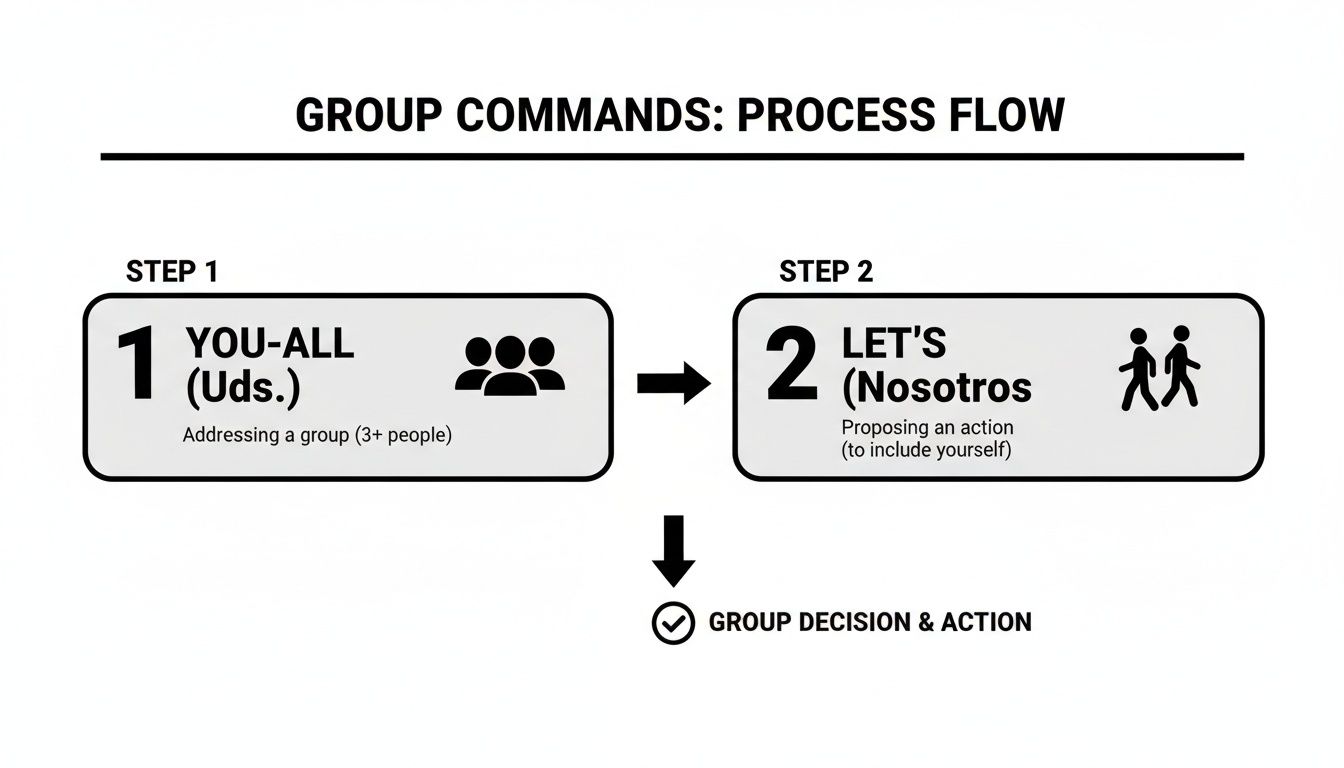
As you can see, understanding whether you're making an inclusive suggestion (Nosotros) or giving a direct order to a group (Ustedes) sets the stage for building these more complex sentences.
Why You Suddenly Need Accent Marks
Okay, so you've attached a pronoun to your affirmative command. You're not quite done. By adding a pronoun (or two), you’ve added extra syllables to the word, and this can mess up the natural stress of the original verb. To fix this, you often need to add a written accent mark.
Key Takeaway: The accent mark isn't there for decoration. Its only job is to preserve the verb's original pronunciation, making sure the stress falls on the exact same vowel it did before you added the pronoun.
Let’s take the verb mira (look). The natural stress falls on the "i" — MI-ra. When we add the pronoun lo (it), the word becomes miralo. Without an accent, the rules of Spanish pronunciation would force the stress to shift: mi-RA-lo. It just sounds wrong.
To keep that original rhythm, we add an accent right over the original stressed vowel: míralo. Now the stress stays exactly where it belongs: MÍ-ra-lo.
Here are a few more examples to make it click:
- Di + me → dime (Tell me) — No accent needed. The original verb was only one syllable, so adding me doesn't violate any stress rules.
- Lava + te → lávate (Wash yourself) — We need an accent to keep the stress on that first "a," just like in the original Lava.
- Escribe + me + lo → escríbemelo (Write it to me) — Attaching two pronouns adds two syllables, so the accent is crucial to keep the stress on the "i."
Getting comfortable with these rules is a huge leap forward. If you feel like you need a quick review of other fundamentals, our guide on basic Spanish grammar is a great place to solidify your foundation.
To wrap this all up, here’s a quick-reference table summarizing where pronouns go and when you need to think about adding an accent.
Pronoun Placement for Spanish Commands
| Command Type | Pronoun Position | Example (with verb) | Accent Rule |
|---|---|---|---|
| Affirmative | Attached to the end of the verb | Dámelo (Give it to me) | Add an accent to preserve the original stress if the verb has 2+ syllables. |
| Negative | Before the verb (separate word) | No me lo des (Don't give it to me) | No accent is needed because the verb and pronoun are separate words. |
Keep this table handy as you practice. With a little repetition, attaching pronouns to commands will become second nature, and your Spanish will sound much more authentic.
From Theory to Practice: Real-World Command Drills
Knowing the rules for commands in Spanish is a fantastic start, but let's be honest—turning that knowledge into a reflex during a real conversation is a whole different ball game. This is where you bridge the gap between just knowing something and actually using it without thinking.
The key is targeted practice that feels like real life. You have to make commands an automatic part of your vocabulary, not something you have to stop and conjugate in your head.
Isolate the Tricky Stuff First
First things first, tackle the parts that trip everyone up. Those eight irregular tú commands (ven, di, sal, haz, ten, ve, pon, sé) are notorious. Don't just read them; make them your best friends.
Put them on flashcards. Drill them every day. The goal is to build the muscle memory you need so that when you want to say "do it," hazlo just comes out.
Immerse Yourself in Authentic Commands
Next, it's time to train your ear. Start paying close attention to commands when you're listening to Spanish music or watching a show. You'll suddenly notice them everywhere, from a dramatic plea like ¡dime! (tell me!) in a telenovela to a simple suggestion like ¡vamos! (let's go!) in a song.
This kind of passive listening is huge. It helps you internalize the natural rhythm and context of how native speakers actually use commands.
Role-playing is another game-changer. Grab a language partner and invent simple scenarios. One person can be a tourist asking for directions while the other gives instructions using formal usted commands. This kind of active practice is absolutely crucial for building real conversational confidence.
Use Tech to Your Advantage
Modern language apps have incredible tools for this. Many, like PolyChat, include conversation exercises that simulate real-world dialogues, giving you a safe space to try out your commands without the pressure of a live conversation. These drills can seriously speed up your learning curve.
Ultimately, the goal is to use commands as naturally as any other part of your speech. For more strategies on building this kind of active fluency, check out our guide on how to improve speaking skills.
By mixing these different drills, you'll quickly move from someone who just knows the rules to someone who uses them effortlessly.
Answering Your Top Questions About Spanish Commands
As you start using commands, a few questions always seem to pop up. These are the tricky spots where learners get stuck. Let's clear up the most common points of confusion so you can give commands with total confidence.
Tú Versus Usted: When to Use Each
The choice between the informal tú and the formal usted command is all about the social situation. It’s a measure of respect and familiarity.
You'll use tú commands with people you're on a first-name basis with—think friends, family members, kids, or close colleagues. It sends a message of closeness and comfort.
On the other hand, usted commands are for showing politeness and professional distance. Use them with a boss, an elderly person, a new client, or anyone you've just met.
A Golden Rule: If you’re ever on the fence, just use usted. It's always better to come across as a little too formal than unintentionally disrespectful. It’s the safest, most polite bet every single time.
Vosotros Versus Ustedes: What’s the Difference?
This one is purely about geography. The informal plural command, vosotros, is really only used in Spain. It’s the plural version of tú, used when you’re talking to a group of friends or peers.
Everywhere else—all of Latin America and even parts of Spain—people use ustedes for all plural commands, whether the group is formal or informal. So, if you're learning Latin American Spanish, you can pretty much focus on mastering ustedes and you'll be set for any group you talk to.
Why Do We Add That Accent Mark with Pronouns?
That little accent mark you add to affirmative commands isn't just for decoration—it’s crucial for pronunciation.
When you tack a pronoun (or two) onto the end of a command, you're adding syllables. Think about turning da (give) into dámelo (give it to me). Spanish has very consistent rules about where the natural stress of a word should fall.
The accent mark’s only job is to preserve the verb's original stress. It’s like a pin that holds the emphasis in place, making sure the word’s natural rhythm doesn’t get thrown off by the extra syllables. Without it, the stress would shift, and the word would sound clunky and unnatural to a native speaker.
Ready to stop just reading about commands and actually start using them? PolyChat offers awesome conversation games and the best conjugation practice tool on the market to make mastering Spanish commands feel natural, not robotic. It's time to stop memorizing and start speaking.

Jean-Baptiste Bolh
Co-Founder
Applied AI