A Practical Guide to Mastering Verbs in French
Feeling totally overwhelmed by the sheer number of verbs in French? You're not alone. But here's a little secret most textbooks won't tell you: you only need to master a small fraction of them to handle almost any daily conversation.
Your Smart Shortcut to French Verb Fluency
Most learners stare at a mountain of conjugations and just want to give up. The truth is, a focused approach is way more effective. Instead of treating every verb like it's equally important, we're going to apply the Pareto principle—focusing on the 20% of verbs that deliver 80% of the results. This shifts your learning from painful memorization to smart, strategic mastery.
This strategy gives you a clear, doable path to prioritize what actually matters right from day one. You're about to discover how a small handful of high-frequency verbs are your golden ticket to speaking and understanding French way faster than you thought possible.
The Power of High-Frequency Verbs
At the very heart of this strategy are two absolute powerhouse verbs: être (to be) and avoir (to have). These two aren't just common; they are the fundamental building blocks of countless expressions and the compound tenses you'll use all the time. Getting these two down cold is completely non-negotiable if you're serious about learning French.
Studies of spoken French show that around 500 verbs account for a massive 95% of all verb usage in casual conversation. The big two, être and avoir, make up 15-20% of all verbs used in daily chats all by themselves.
Think about that. Once you add in a few more heavy hitters like faire (to do/make), devoir (to have to), dire (to say), and aller (to go), you've already covered around 30% of all the verbs you'll hear and use.
To put it in perspective, let's round up the most critical verbs and why they're so essential.
The High-Impact French Verb Hit List
This isn't just a list; it's your roadmap to conversational fluency. Mastering these will give you the biggest bang for your buck.
| Verb Category | Example | Why It's a Priority |
|---|---|---|
| The Core Auxiliaries | être, avoir | Absolutely essential. They form the foundation of compound tenses like the passé composé. You can't speak French without them. |
| The Top 10 Irregulars | aller, faire, pouvoir, vouloir | These verbs are everywhere. They cover basic actions and intentions, letting you express needs, desires, and abilities. |
| High-Frequency -ER Verbs | parler, demander, penser | Learning the regular -ER pattern unlocks thousands of verbs at once. These examples are used in everyday conversations constantly. |
| Key -IR/-RE Verbs | finir, prendre, dire | Though less common than -ER verbs, this group includes many indispensable verbs for daily life. They're your next logical step. |
By zeroing in on this "hit list," you ensure that every minute you spend studying translates directly into real-world communication skills.
The key takeaway is simple: by prioritizing the most common verbs in French, you build a solid foundation that accelerates your progress toward fluency. This strategic focus is one of the pillars of the best way to learn French.
Building Your Core Verb Vocabulary
So, instead of getting lost in the back of a textbook, your first goal should be to make this core group of verbs second nature. This practical approach means you can start putting meaningful sentences together right away.
For a bigger picture of how these concepts are taught in a formal setting, checking out the official Canadian French subject curriculum can offer some valuable context. Don't worry, though—this guide will walk you through exactly which verbs to learn and in what order. Let's get started.
Cracking the Code of French Verb Groups
Think of French verbs as sprawling family trees, each with its own set of traditions and quirks. Instead of trying to memorize every single member—a truly impossible task—you can get to know the three main family branches. This little organizational trick turns conjugation from a frantic memory game into a logical, pattern-based skill.
Once you understand these groups, you start building a mental framework for all French verbs. You'll stop seeing thousands of unique words and start recognizing predictable family traits. This is the absolute foundation for conjugating with confidence, and it all starts with the biggest and most well-behaved family of them all.
The First Group: Your Most Reliable Ally
The first group is made up of verbs ending in -er. This is, by a huge margin, the most important family to master right away. Think of them as the friendly neighbors who always follow the same routine; once you know one, you practically know them all. Verbs like parler (to speak), aimer (to love), and manger (to eat) all belong here.
The pattern is beautifully simple: you just lop off the -er ending from the infinitive (the verb's original form) to find its "stem," and then you tack on the correct ending for your subject. This consistent formula is a massive shortcut on your learning journey.
In fact, an overwhelming majority of French verbs, around 80-90%, are regular verbs that fall into predictable groups. The -er verbs dominate this category, making them your highest-priority target for making quick progress. To conjugate them in the present tense, just drop the -er and add the standard endings: -e, -es, -e, -ons, -ez, -ent. You can dive deeper into these patterns on Rosetta Stone's blog.
The Second Group: Expanding Your Skills
Next up, we have the second group: verbs that end in -ir, like finir (to finish) and choisir (to choose). This family is smaller and a little more complex than the first, but its members are still quite predictable. Think of them as the cousins who have a few unique quirks but are generally easy to get along with once you learn their ways.
The key feature of this group is the little "-iss-" that appears in the plural forms (nous, vous, ils/elles). This small addition is the main thing that sets them apart from their -er relatives and some of their more rebellious -ir cousins.
Here’s how the pattern for a regular -ir verb like finir plays out in the present tense:
- Je finis (I finish)
- Tu finis (You finish)
- Il/Elle/On finit (He/She/One finishes)
- Nous finissons (We finish)
- Vous finissez (You finish)
- Ils/Elles finissent (They finish)
Once you spot that "-iss-" in the plural forms, you can be pretty sure you're dealing with a well-behaved second-group verb.
The Third Group: The Rebellious Rule-Breakers
Finally, we get to the third group. This is the family of rebels, misfits, and total individualists. It’s a catch-all category for all the irregular verbs, including those ending in -re (like prendre - to take), many irregular -ir verbs (like partir - to leave), and the one and only irregular -er verb, aller (to go).
Mastering the third group is essential for fluency. This is where you'll find the most common and vital verbs in the entire language, including être (to be), avoir (to have), faire (to do/make), and vouloir (to want).
These verbs don't follow one single pattern, which is why they often seem so intimidating. But even these rebels have smaller gangs that share similar quirks. The best approach isn't to look for one master rule, but to learn them in small, manageable batches and start recognizing the mini-patterns that connect them.
The Four Essential Tenses for Real Conversations
French technically has over 20 different tenses and moods, but let's be real—the day-to-day reality is much simpler. For authentic, flowing conversations, you only need to truly master four. Think of these as the pillars that will hold up almost every story you'll ever tell or hear in French.
By focusing your energy on these workhorses, you build a powerful foundation that lets you talk about what’s happening now, what already happened, and what’s coming up next. It’s a strategic approach that lets you build complete narratives without getting lost in obscure grammar you’ll rarely encounter in the wild.
The Présent: Your Foundation for Everything
First up is the Present Tense, or le Présent. This is the most fundamental tense of all verbs in French and your absolute starting point. It’s how you describe actions happening right now, state general truths, and talk about your habits. Mastering this tense is non-negotiable because its patterns are the building blocks for so many other tenses.
For example, when you say, "Je parle français" (I speak French), you're using the Présent. This could mean you're speaking at this very moment, or it could mean you speak French in general. Its versatility makes it the most common tense in the language.
Key Insight: Don't just think of the Présent as "now." It's your multi-tool for the present moment, covering habits, ongoing actions, and universal facts. Getting comfortable with its regular and irregular forms is the first giant leap toward real conversational ability.
Describing the Past: Two Essential Tools
When it comes to the past, French gives you two main options, each with a very specific job. This is often a huge sticking point for English speakers, but a simple analogy makes it crystal clear. Think of the Passé Composé as a snapshot and the Imparfait as a blurry, long-exposure photograph.
The Passé Composé is for finished, specific actions that happened at a particular time. It captures a single, completed event.
- J'ai mangé une pomme. (I ate an apple.) - The action is done and dusted.
- Il a fini son travail. (He finished his work.) - A specific, completed task.
- Nous sommes allés au cinéma hier. (We went to the cinema yesterday.) - A one-time event in the past.
The Imparfait, on the other hand, sets the scene. It describes ongoing conditions, background details, habits, or actions that were in progress when something else happened.
- Il faisait beau. (The weather was nice.) - Describing the background conditions.
- Je lisais quand le téléphone a sonné. (I was reading when the phone rang.) - An ongoing action interrupted by a snapshot event.
- Quand j'étais petit, j'habitais à Paris. (When I was little, I used to live in Paris.) - A past habit or state of being.
Getting this distinction right is the secret to good storytelling. You use the Imparfait to paint the background and the Passé Composé to narrate the key events that drive the story forward. A great way to build this intuition is to practice telling simple stories, which is a core part of developing your speaking skills. For more on this, check out our detailed guide on how to improve speaking skills in a new language.
The infographic below shows how learners typically progress through the different verb groups, which is essential for forming these tenses correctly.
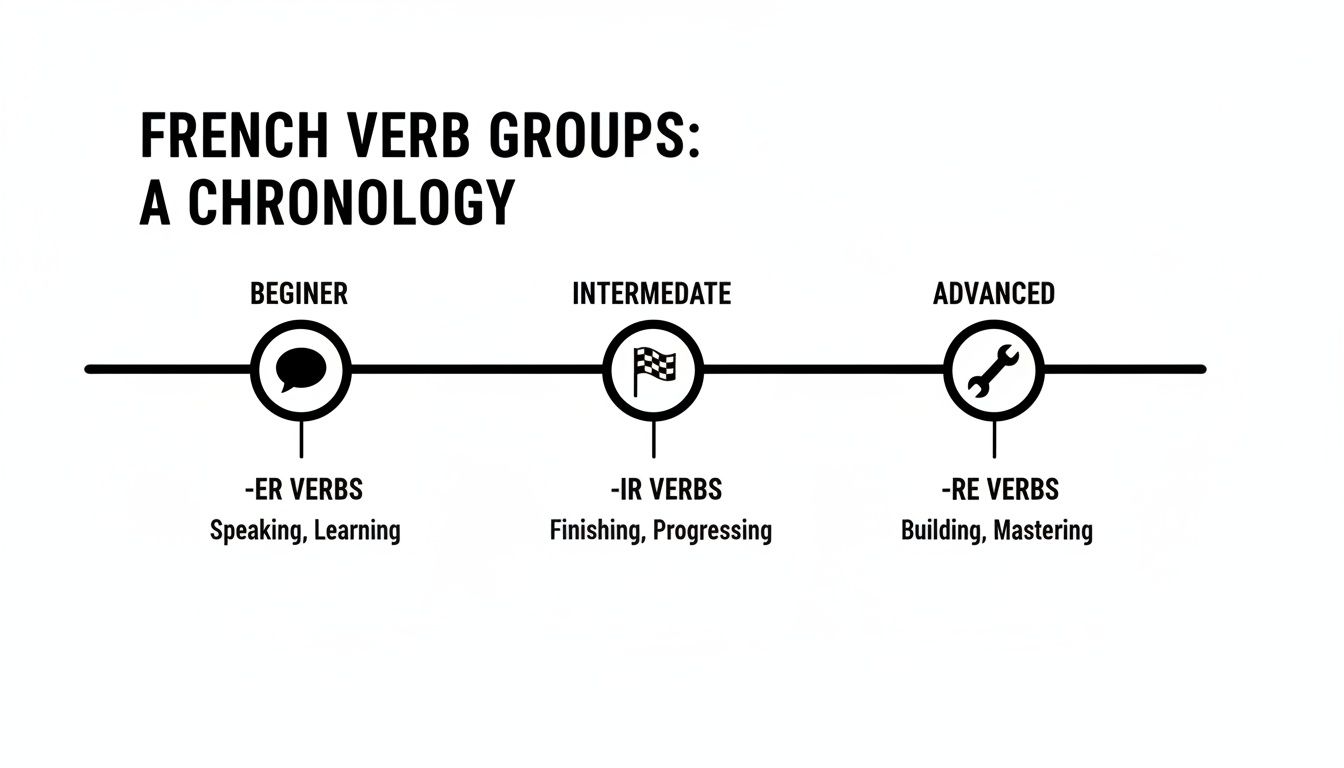
This visual timeline illustrates the logical path from the highly regular -ER verbs to the more complex -IR and -RE groups, building a solid foundation for conjugating across all tenses.
The Futur Simple: Looking Ahead
The final pillar is the Futur Simple. While French has a simpler way to talk about the immediate future (le futur proche, using aller + infinitive), the Futur Simple is essential for discussing more distant or formal future plans. It’s what you use to say what "will" happen.
Happily, it’s also one of the easier tenses to form. For most regular verbs, you just take the entire infinitive (like parler) and tack on the future endings.
- Je parlerai (I will speak)
- Tu finiras (You will finish)
- Il vendra (He will sell)
Mastering these four tenses—Présent, Passé Composé, Imparfait, and Futur Simple—gives you the power to handle the vast majority of everyday conversations. They are the narrative toolkit you need to express yourself clearly and confidently, whether you're chatting about your day, sharing a memory, or making plans for the weekend.
Navigating Moods and Specialized French Verbs
Once you get past simple, declarative sentences, you start running into French verbs that do more than just state facts. They add layers of nuance, doubt, and possibility to your speech. These aren't just for grammar nerds; they're the key to expressing opinions, hypotheticals, and even daily routines like a native speaker.
Let's break down two crucial "moods"—the Subjunctive and the Conditional—and a super common verb type that trips up almost every learner: pronominal (or reflexive) verbs. Getting a handle on these will take your French from basic communication to truly expressive conversation.
Expressing Nuance with the Subjunctive and Conditional
First off, don't think of moods as tenses. Think of them as attitudes. They reveal how you feel about what you're saying. The two most important ones for adding a bit of sophistication are the Subjunctive and the Conditional.
The Conditional is your best friend for all those "what if" scenarios. It’s what you use to talk about what would happen if things were different. For instance, "Si j'avais le temps, je voyagerais plus" (If I had the time, I would travel more). It's also the secret to sounding polite when making requests, softening a command into a gentle suggestion: "Je voudrais un café" (I would like a coffee).
The Subjunctive, on the other hand, is all about subjectivity. It pops up when you're expressing feelings like doubt, desire, emotion, or uncertainty. It's almost always triggered by certain phrases followed by que (that).
Key Insight: The Subjunctive isn't about whether something is real or not. It’s about the speaker's emotional or uncertain take on it. Phrases like Il faut que... (It's necessary that...) or Je veux que... (I want that...) are dead giveaways that the subjunctive is coming.
Take this example: "Il faut que tu fasses tes devoirs" (It is necessary that you do your homework). The action isn't a fact; it's a necessity or an order. That's the kind of subjective situation that demands the subjunctive.
Understanding Pronominal (Reflexive) Verbs
Ever wondered why the French say "je m'appelle" (I call myself) instead of just "j'appelle"? That's a pronominal verb in action. Often called reflexive verbs, these are used when the subject is doing something to itself. They are everywhere in French, especially when you talk about your daily routine.
You can spot them easily because their infinitive form has the little pronoun se tacked onto the front, like in se lever (to get up) or se laver (to wash oneself). That pronoun changes to match the person doing the action:
- Je me lève (I get up)
- Tu te lèves (You get up)
- Il/Elle se lève (He/She gets up)
- Nous nous levons (We get up)
- Vous vous levez (You get up)
- Ils/Elles se lèvent (They get up)
Learning these patterns is non-negotiable. So many everyday actions in French are reflexive, even when they aren't in English.
Auxiliary Verbs and Past Participle Agreement
When you build compound tenses like the passé composé, you need a helping verb, or auxiliary. French gives you two choices: avoir (to have) and être (to be). The good news is that most verbs use avoir. A small, specific club of verbs, however, uses être.
The être verbs are mostly about motion or a change of state—think aller (to go), venir (to come), partir (to leave), and naître (to be born). Here’s the kicker: all pronominal verbs use être as their auxiliary verb. For example, "Je me suis levé" (I got up).
This choice of auxiliary verb matters for one huge reason: past participle agreement.
- When you use avoir, the past participle almost never changes.
- When you use être, the past participle must agree in gender and number with the subject.
See the difference in action:
- Elle a mangé une pomme. (She ate an apple) - No change to mangé.
- Elle est allée au marché. (She went to the market) - You add an -e to allé because "elle" is feminine.
- Ils sont partis en vacances. (They went on vacation) - You add an -s to parti because "ils" is plural.
This is one of those fundamental rules that, once mastered, makes your written and spoken French sound so much more polished and correct.
Taming the Most Common Irregular Verbs
Let's talk about the rule-breakers of French: the irregular verbs. While most verbs play by the rules, these rebels seem to march to the beat of their own drum. But here’s the good news: they're not nearly as chaotic as they seem, and they also happen to be some of the most useful words you'll ever learn.
Instead of seeing them as a terrifying list to memorize, think of them as small, manageable gangs, each with its own internal logic. If you tackle them strategically, you can turn a major point of frustration into an area of genuine confidence.
Finding Patterns in the Chaos
The real key to mastering irregular verbs in French is to hunt for hidden similarities. Don't just stare at conjugation tables in isolation. By grouping verbs based on their quirks, you make them far easier to remember, because many verbs that seem totally random actually share patterns with others.
For example, a huge number of common verbs like pouvoir (to be able to), vouloir (to want), and devoir (to have to) follow a similar rhythm in the present tense. Look at how their plural forms (nous, vous) often look and sound different from their singular forms (je, tu, il).
- Je peux (I can), but nous pouvons (we can)
- Je veux (I want), but nous voulons (we want)
- Je dois (I must), but nous devons (we must)
Suddenly, seeing that connection transforms three separate memorization tasks into one single pattern. This approach works for many of the most crucial verbs in the language.
Spotlight on the Heavy Hitters
Let's focus on a few of the most essential irregular verbs you’ll bump into every single day. Getting a handle on their logic is a massive step toward sounding natural.
Faire (to do/make) This verb is a true workhorse. You’ll use it for everything from talking about the weather (il fait beau) to describing your hobbies (je fais du sport). Its conjugation is pretty unique, but because you'll see and use it constantly, it will become second nature sooner than you think.
Prendre (to take) This verb is the head of its own little family. Any verb that ends in -prendre—like apprendre (to learn) or comprendre (to understand)—follows the exact same pattern. Master prendre, and you’ve automatically mastered all its relatives.
Strategic Learning Tip: Instead of memorizing endless lists, focus on a "parent" verb like prendre. Once you know its pattern, you instantly unlock the ability to conjugate other verbs in its family, like apprendre and comprendre. It’s a classic "work smarter, not harder" situation.
Pattern Recognition for Key Irregular Verbs
Even among the most common irregulars, you can spot patterns that make them easier to digest. This table highlights a few of the biggest players, showing how their forms change across key tenses. Notice the similarities in endings, especially in the futur simple.
| Verb | Présent (je) | Passé Composé (j'ai) | Futur Simple (je) |
|---|---|---|---|
| être (to be) | je suis | j'ai été | je serai |
| avoir (to have) | j'ai | j'ai eu | j'aurai |
| aller (to go) | je vais | je suis allé(e) | j'irai |
| faire (to do/make) | je fais | j'ai fait | je ferai |
| pouvoir (to be able) | je peux | j'ai pu | je pourrai |
| vouloir (to want) | je veux | j'ai voulu | je voudrai |
Looking at them side-by-side reveals connections you might otherwise miss. Recognizing that the future stems for pouvoir and vouloir both end in -ourr- and -oudr- helps glue them together in your mind.
The reality is, true, complete irregularity is rarer than you think. Some encouraging stats show that of the nearly 800 verbs often labeled as 'irregular' -er verbs, almost all follow precise, predictable patterns. This drastically reduces the chaos, as you can group most under semi-predictable rules. You can discover more insights about French verb patterns and see just how manageable they can be.
This means that even within the "irregular" category, there are rules and patterns you can rely on. By focusing on these connections, you make the learning process much more efficient and far less intimidating.
Your Action Plan for True Verb Mastery
Knowing the rules of French verbs is one thing. Actually using them without having to stop and think? That's a whole different ball game.
This final step is all about closing the gap between passive knowledge and active skill. Real mastery comes from consistent, targeted practice—the kind that builds the muscle memory you need to speak fluidly. Here’s a clear roadmap to turn what you’ve learned into a real, sustainable habit.
Build Your Daily Practice Habit
Consistency is king. Seriously. Just 15 minutes of focused practice every single day will do more for you than a heroic, two-hour cram session once a week.
The goal is to make verb practice a non-negotiable part of your routine, like brushing your teeth. Pick a time, stick to it, and watch what happens. This daily exposure is what moves verb conjugations from your fragile short-term memory into your rock-solid long-term recall.
Key Takeaway: Don't try to boil the ocean. A small, sustainable habit is your best friend. This approach keeps you from burning out and gives your brain the time it needs to actually absorb the information.
Active Learning Exercises for Real Progress
You can't get to fluency by just reading. You have to get your hands dirty and actively use the verbs in French to make them stick. Here are a few simple but powerful exercises to fold into your daily routine:
- Write a Daily Mini-Journal: Just three or four sentences. Describe something you did (passé composé), what the weather was like (imparfait), something you're doing now (présent), and what you’ll do tomorrow (futur simple). This is a fantastic way to force yourself to use the core tenses in a meaningful way.
- Flashcard the Irregulars: Use a flashcard app to drill the most common irregular verbs. Hammer one tense until you feel good about it, then start mixing them up. This method is a proven powerhouse for memorization. You can learn more about why this works by reading up on the best way to learn vocabulary.
- Tell a Story with a Target Verb: Pick one tricky verb for the day—maybe pouvoir or vouloir. Your mission, should you choose to accept it, is to create a short, silly story that uses that verb in as many different tenses and forms as you can dream up.
Leverage Tools for Smart Reinforcement
Why make it harder on yourself? Modern tools can seriously speed up your progress. Language learning apps designed for practice and reinforcement should be your go-to.
For example, PolyChat’s gamified conjugation practice turns what could be a boring drill into a fun, engaging challenge. Timed quizzes and interactive games are perfect for building the quick-recall you need for a real conversation.
These tools give you instant feedback, catching your mistakes right away so you don't accidentally learn them the wrong way. By mixing these smart exercises with smart tools, you create a powerful learning loop that will take you from just knowing the rules to using them with confidence and ease.
Your Top French Verb Questions, Answered
As you start wrestling with French verbs, a few questions always seem to pop up. Let's be honest, they're the ones that trip up almost every learner. This section is your go-to guide for those moments when you're feeling a bit stuck.
Think of it as the cheat sheet you wish you had from day one.
How Many Verbs Do I Actually Need to Know?
This is the big one, isn't it? While French has thousands of verbs, you absolutely do not need to learn them all to start having real conversations. The secret is to focus on the high-frequency players first.
If you can master the top 50-100 verbs, you'll be shocked at how much of everyday French you can understand and speak. These are the workhorses of the language, and they show up everywhere.
What’s the Real Difference Between Passé Composé and Imparfait?
Ah, the classic stumbling block. Getting this right is a game-changer for telling stories. Here's a simple way to think about it:
Use the Passé Composé for specific, completed actions in the past. It’s like taking a snapshot of a single moment. On the other hand, use the Imparfait to describe ongoing states, habits, or the background scene. Think of it as a long-exposure photograph, capturing the atmosphere.
For example: "J'ai mangé (I ate - a snapshot action) quand il faisait beau (while the weather was nice - the background scene)." Nailing this distinction is a major step toward sounding like a native speaker.
Why Do Some Verbs Use Être Instead of Avoir?
This one feels random at first, but there's a pattern. Most verbs build their past tenses with avoir (to have), which is straightforward enough. But a special group, often called the "house of être," uses être (to be) instead.
These are typically verbs of movement (like aller - to go, partir - to leave) or a change of state (naître - to be born). And here’s a crucial rule: all pronominal (or reflexive) verbs, like se lever (to get up), always use être.
Just remember that when a verb takes être, its past participle has to agree in gender and number with the subject. It's a key detail that really cleans up your grammar.
Ready to stop just reading the rules and actually make them stick? PolyChat offers gamified conjugation drills and interactive exercises that turn these tricky concepts into muscle memory. It’s time to stop memorizing and start practicing with PolyChat today.

Jean-Baptiste Bolh
Co-Founder
Applied AI