French -ER Verbs: Conjugation Chart, Rules and 20 Common Verbs
Regular French -er verbs all follow one pattern in the present tense: drop the -er and add -e, -es, -e, -ons, -ez, -ent. About 90% of French verbs belong to this group, including parler, aimer, regarder and travailler.
| Subject | Ending | parler (to speak) |
|---|---|---|
| je | -e | je parle |
| tu | -es | tu parles |
| il / elle / on | -e | il parle |
| nous | -ons | nous parlons |
| vous | -ez | vous parlez |
| ils / elles | -ent | ils parlent |
In speech, parle, parles and parlent all sound identical; only the nous and vous forms have endings you can hear. Watch for small spelling changes in verbs like manger (nous mangeons) and commencer (nous commençons), and remember that aller looks like an -er verb but is irregular.
Below you'll find the other essential tenses, the spelling-change verbs, the 20 -er verbs you'll use most, and a practice quiz at the end.
The Golden Key to Mastering French Verbs
Forget those scary, endless conjugation charts. The real magic of -er verbs is their beautiful consistency. Once you learn one simple set of rules, you suddenly have the power to correctly use thousands of different verbs. It's a total game-changer for building momentum and, most importantly, confidence.
Why Start with ER Verbs?
The logic is simple but incredibly powerful. When you prioritize this group, you're setting yourself up for success.
- Communicate Faster: Think about the words you use every day. Verbs like parler (to speak), manger (to eat), and travailler (to work) are all -er verbs. Mastering the pattern means you can start building useful, real-world sentences almost immediately.
- Build a Strong Foundation: The conjugation patterns you learn here will become your mental blueprint. This makes it so much easier to tackle other verb groups and even the tricky irregular ones later on. For a bird's-eye view, check out our guide on the main types of verbs in French.
- Reduce Memorization: Instead of brute-forcing hundreds of verbs one by one, you learn a single, reusable system. This frees up so much mental space to focus on what really matters: expanding your vocabulary and nailing your pronunciation.
You really can't overstate the importance of this group. French -er verbs make up approximately 90% of all verbs in the language. With well over a thousand regular -er verbs, this category is the absolute backbone of French communication. It's the most logical and effective starting point for any learner, hands down.
Getting this single pattern down is your first huge step toward speaking French with the kind of ease and confidence you're aiming for.
Conjugating -ER Verbs in Essential Tenses
Alright, let's move from theory to practice. The great news is that conjugating French verbs ending in -er is surprisingly straightforward once you get the hang of the pattern. It's a bit like building with LEGOs—you have a base piece (we call this the root or stem) and a specific ending that clicks into place depending on who is doing the action.
The formula is a simple two-step process:
- Find the root: Just drop the -er from the end of the verb. So, for parler (to speak), the root is parl-.
- Add the ending: Attach the correct ending for the specific tense and subject pronoun (je, tu, il, etc.).
This simple system is your key to unlocking thousands of verbs. We'll focus on the most essential tenses you absolutely need for everyday conversation: the present, the two main past tenses, and the future.
This little map breaks down why focusing on regular -er verbs is such a powerful shortcut for learners.
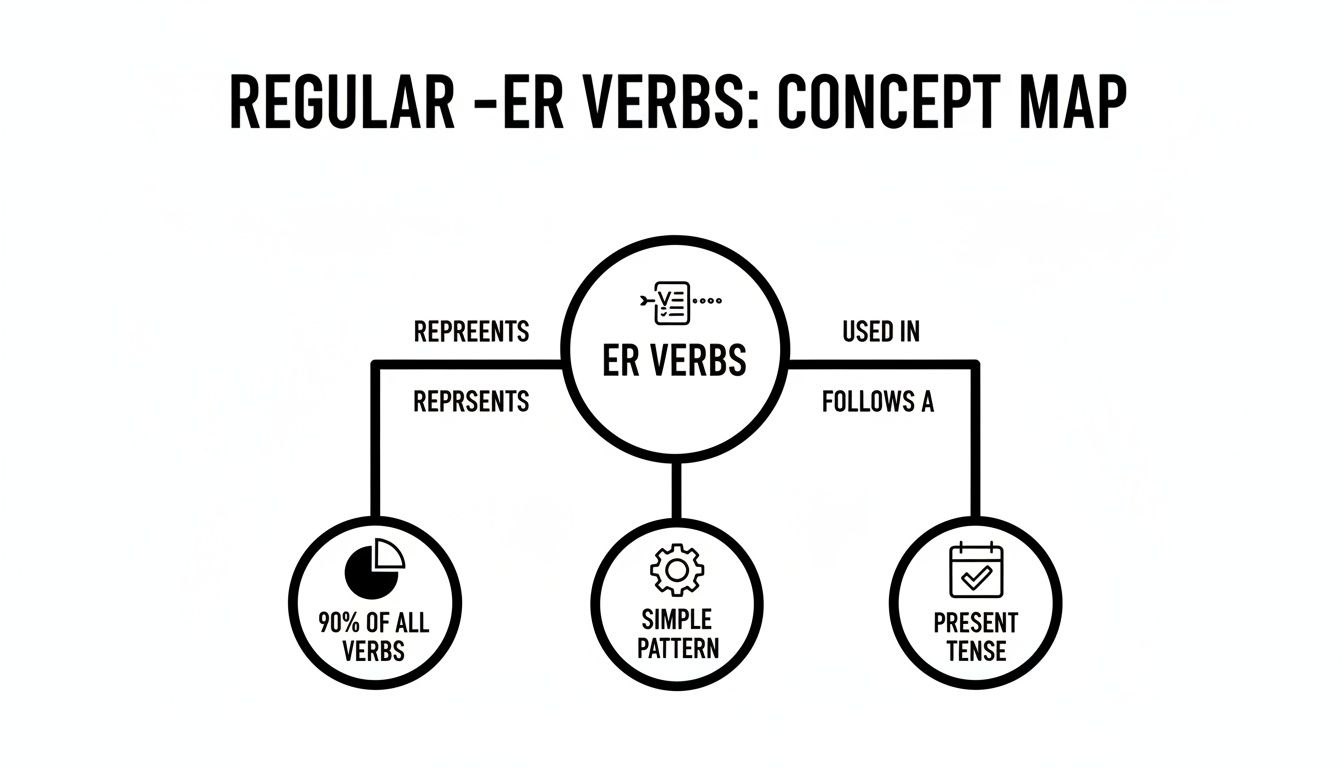
As you can see, the vast majority of French verbs fall into this group, and they all follow one predictable pattern. That makes the present tense the perfect place to start.
Le Présent (The Present Tense)
The present tense is your workhorse. It describes actions happening right now, general truths, or habits. Think of it as your default setting for most daily chats. The endings are consistent and, with a little practice, become second nature.
Here are the standard endings for regular -er verbs in the present tense:
- je: -e
- tu: -es
- il/elle/on: -e
- nous: -ons
- vous: -ez
- ils/elles: -ent
Let's plug these into the verb chanter (to sing). The root is chant-.
- Je chante une chanson. (I sing/am singing a song.)
- Nous chantons ensemble. (We sing/are singing together.)
Le Passé Composé (The Compound Past)
The passé composé is how you'll talk about the past most of the time. It’s used for specific, completed actions, like "I ate breakfast" or "She visited Paris last year."
It’s called "compound" because it's built with two parts: a helping verb—almost always avoir (to have) for -er verbs—plus the past participle. For regular -er verbs, creating the past participle is a breeze: just change the -er ending to -é.
The Formula: Subject + Conjugated avoir + Past Participle (-é)
Take parler (to speak). The past participle is parlé.
- J'ai parlé avec mon ami. (I spoke with my friend.)
- Vous avez regardé un film. (You watched a movie.)
L'Imparfait (The Imperfect Past)
While the passé composé handles finished actions, the imparfait is all about setting the scene. It describes ongoing or habitual actions in the past—what used to happen or what was happening. Think of it as the "was/were -ing" or "used to" tense in English.
You add the imperfect endings to the same root you use for the present tense.
The endings are:
- je: -ais
- tu: -ais
- il/elle/on: -ait
- nous: -ions
- vous: -iez
- ils/elles: -aient
Let's use jouer (to play). The root is jou-.
- Quand j'étais petit, je jouais au parc tous les jours. (When I was little, I used to play at the park every day.)
- Il pleuvait quand nous sommes partis. (It was raining when we left.)
Le Futur Simple (The Simple Future)
The futur simple is for talking about things that will happen. It’s the direct equivalent of "will" in English. And here’s some more good news: for French verbs ending in -er, you don't even need to find the root. You just attach the endings to the full infinitive verb!
Here are the future endings:
- je: -ai
- tu: -as
- il/elle/on: -a
- nous: -ons
- vous: -ez
- ils/elles: -ont
Let's see it in action with travailler (to work).
- Je travaillerai demain. (I will work tomorrow.)
- Elles voyageront en France l'année prochaine. (They will travel to France next year.)
Navigating Spelling Changes and Irregularities
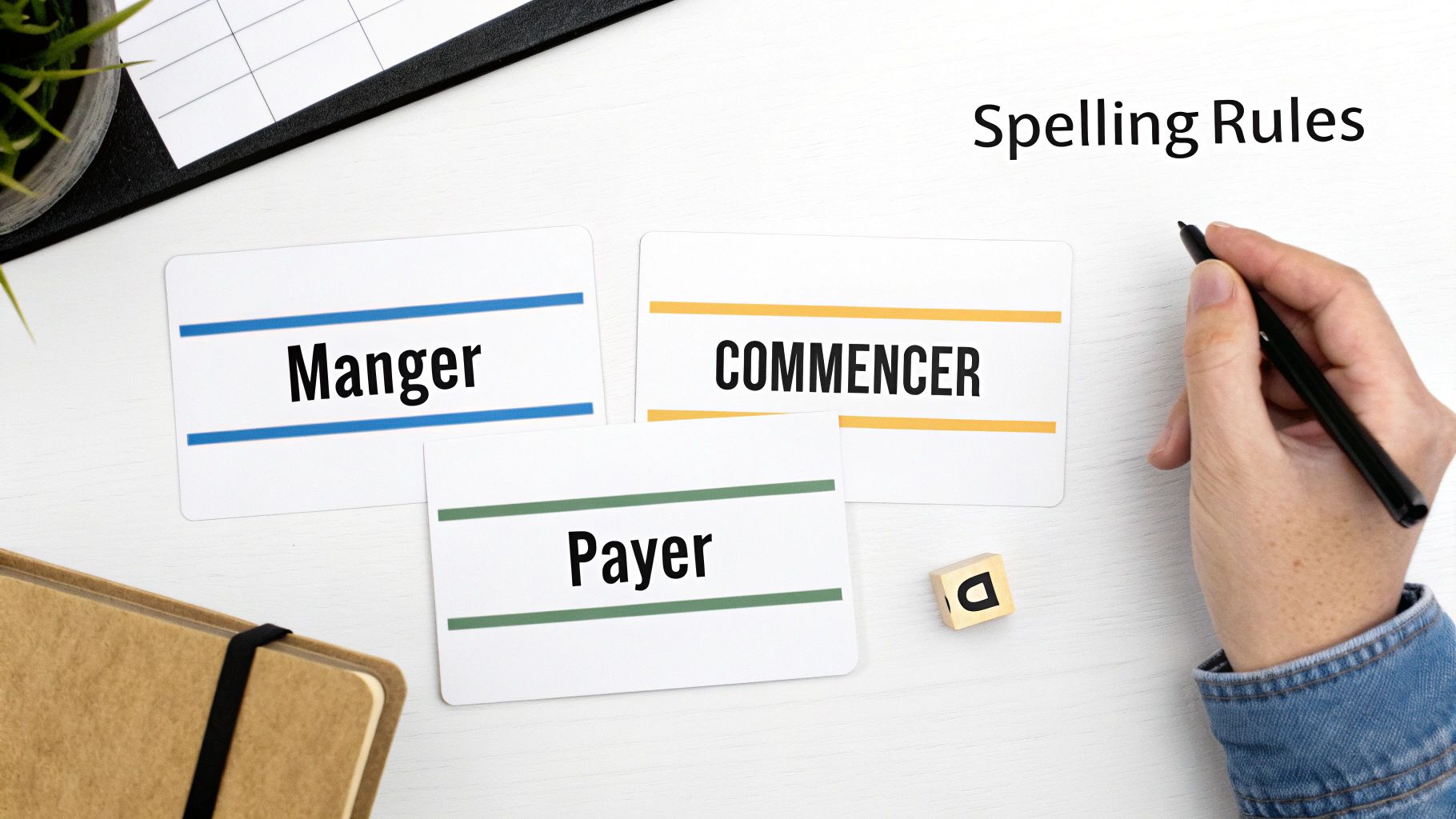
Just when you think you’ve got the pattern down, the word “irregular” shows up to spoil the party. But here’s a little secret about French verbs ending in -er: most of what we call irregularities are just minor, predictable spelling tweaks made to keep the pronunciation smooth.
Think of it less like a rule being broken and more like a clever adjustment to make the words sound right. These aren't random exceptions designed to trip you up; they're logical patterns that, once you spot them, are actually pretty easy to remember.
Verbs Ending in -ger
One of the most common tweaks happens with verbs ending in -ger, like manger (to eat) or voyager (to travel). In French, the letter 'g' makes a hard sound (like in "go") before 'a' or 'o', but a soft sound (like "gesture") before 'e' or 'i'.
To keep that soft 'j' sound in the nous form, which ends in '-ons', you just slide a silent 'e' between the 'g' and the 'o'. That’s it.
- Standard verb: Nous parlons (We speak)
- -ger verb: Nous mangeons (We eat) — See that extra 'e'? It’s just there to keep the 'g' soft.
This simple pronunciation fix pops up in any tense where a 'g' would otherwise meet an 'a' or an 'o'.
Verbs Ending in -cer
You’ll find similar logic with verbs ending in -cer, such as commencer (to begin) or lancer (to throw). The letter 'c' makes a hard 'k' sound before 'a' or 'o', but a soft 's' sound before 'e' or 'i'.
To hold onto that soft 's' sound in the nous form, the 'c' changes to a 'ç' (called a cédille).
- Standard verb: Nous parlons
- -cer verb: Nous commençons (We begin) — The little tail on the 'ç' tells you to pronounce it like an 's'.
Again, this is a rule driven completely by sound, making it a predictable and logical shift.
Verbs Ending in -yer
Verbs ending in -yer, like payer (to pay) or envoyer (to send), have their own small spelling shuffle. For the je, tu, il/elle, and ils/elles forms, the 'y' flips to an 'i'.
This just reflects a slight shift in how it's said out loud. The nous and vous forms, though, keep the original 'y'.
- Je paie par carte. (I pay by card.)
- Mais, nous payons en espèces. (But, we pay in cash.)
What feels like chaos is actually a highly organized system. Research shows that among the roughly 800 verbs that deviate from the standard model, nearly all follow predictable sub-patterns like these. In fact, only about two verbs are truly exceptional cases, proving that 'irregularity' is far rarer than it seems. You can explore more encouraging French verb statistics and see just how systematic the language truly is.
Once you see these little groups, an intimidating topic becomes a set of easy micro-rules. Instead of trying to memorize hundreds of exceptions, you just need to learn three simple, sound-based adjustments. And with that, you realize the overwhelming majority of French verbs ending in -er are way more regular than you thought.
The 20 Most Important ER Verbs for Conversation
Alright, you've got the patterns down. Now, where do you focus your energy? Instead of trying to memorize hundreds of French verbs ending in -er all at once, let's get strategic. The goal is to learn the verbs that give you the biggest conversational bang for your buck. It’s all about working smarter, not harder.
This isn’t just a random list. These are the high-frequency verbs you'll actually hear and use every single day in France. Mastering these 20 verbs is your launchpad to building real-world sentences and gaining confidence fast. We’re talking about the essentials—verbs for talking about what you do, think, find, and love.
Here's the prioritized list of the verbs that will do the most heavy lifting in your daily conversations.
Top 20 High-Frequency French ER Verbs
| Rank | French Verb | English Meaning |
|---|---|---|
| 1 | Parler | to speak, talk |
| 2 | Aimer | to like, love |
| 3 | Penser | to think |
| 4 | Trouver | to find |
| 5 | Donner | to give |
| 6 | Demander | to ask |
| 7 | Regarder | to watch, look at |
| 8 | Manger | to eat |
| 9 | Travailler | to work |
| 10 | Écouter | to listen to |
| 11 | Jouer | to play |
| 12 | Passer | to pass, spend time |
| 13 | Rester | to stay |
| 14 | Arriver | to arrive |
| 15 | Chercher | to look for, search for |
| 16 | Entrer | to enter |
| 17 | Habiter | to live (in a place) |
| 18 | Monter | to go up, get on |
| 19 | Porter | to wear, carry |
| 20 | Tomber | to fall |
Think of this table as your cheat sheet. If you internalize these 20 verbs, you'll be shocked at how many sentences you can suddenly build.
How to Use These Verbs: Examples in Action
Let's break down why these specific verbs are so powerful. We can group them by how you'll use them in real life.
Core Communication Verbs
These are the absolute bedrock of any conversation. They’re how you express thoughts, ask for things, and simply interact with people. You can't get by without them.
- Parler (to speak/talk)
- Je parle français un peu. (I speak a little French.)
- Donner (to give)
- Il donne un cadeau à sa mère. (He gives a gift to his mother.)
- Penser (to think)
- Nous pensons que c'est une bonne idée. (We think that it's a good idea.)
- Trouver (to find)
- Je ne trouve pas mes clés. (I can't find my keys.)
- Demander (to ask)
- Elle demande une question. (She asks a question.)
Just how important are these? Well, when you look at frequency lists of all French verbs, -er verbs like parler consistently show up in the top 20. Once you combine these with heavy hitters like être (to be) and avoir (to have), you've unlocked the ability to form a huge percentage of everyday French sentences. You can find more details on essential French verb conjugation on preply.com.
Daily Life & Action Verbs
Next up are the verbs that help you talk about your day. From your morning routine to your evening plans, these words narrate your life in French.
- Manger (to eat)
- Vous mangez au restaurant ce soir. (You are eating at the restaurant tonight.)
- Aimer (to like/love)
- J'aime le chocolat. (I love chocolate.)
- Regarder (to watch/look at)
- Tu regardes un film. (You are watching a movie.)
- Travailler (to work)
- Ils travaillent ensemble. (They work together.)
- Écouter (to listen to)
- J'écoute de la musique. (I listen to music.)
- Jouer (to play)
- Les enfants jouent dans le jardin. (The children are playing in the garden.)
Movement & Location Verbs
This last group is crucial for describing where you are, where you're going, and how you're getting there. They're essential for making plans, giving directions, and explaining a sequence of events.
- Arriver (to arrive)
- Entrer (to enter)
- Monter (to go up)
- Rester (to stay)
- Tomber (to fall)
- Habiter (to live)
Pro Tip: While many common movement verbs in French use être as the helping verb in the passé composé (like partir or venir), you'll notice that the popular -er movement verbs above—like arriver, entrer, and monter—are exceptions to this rule and also use être. It’s a tricky but important detail to remember!
Focusing on this list of 20 high-impact French verbs ending in -er is the fastest way to turn your study time into actual conversational skill. You’re not just learning words; you’re building the foundation of fluency.
Turn Knowledge Into Skill with Active Practice
Understanding the patterns behind French verbs ending in -er is a huge milestone, but let's be honest—true mastery only comes from using them. Think of it like learning to play an instrument. You can read all the sheet music in the world, but until you start practicing scales, your fingers won't know where to go.
This is where we shift from passive knowledge to an active, instinctive skill. The goal is to build that muscle memory so conjugating becomes second nature, not a slow, painful calculation every time you want to form a sentence. You need to get your brain firing on all cylinders, recalling and applying these rules on the fly.
From Drills to Games
We've all been there—staring at endless verb charts until our eyes glaze over. While traditional drills have their place, modern learning tools have turned this tedious process into something you'll actually want to do. By gamifying practice, you can lock in those complex patterns without the boredom.
This is where an app like PolyChat becomes your personal conjugation coach. Instead of just reading, you can jump into interactive exercises that make practice feel more like a game than homework.
- Timed Challenges: These force you to recall verb endings quickly, mimicking the split-second thinking you need in a real conversation.
- Fill-in-the-Blank Sentences: This gives you crucial context, helping you connect verb forms to their actual meaning.
- Verb Recognition Games: These sharpen your ability to spot and identify different tenses and moods in the wild.
The secret is consistent, low-stakes practice. Spending just a few minutes a day with interactive tools builds stronger mental connections than one long, exhausting cram session. It’s all about making practice a sustainable habit, not a chore you dread.
Making Your Practice Stick
To really speed things up, you need a system that gives you instant feedback and lets you see your progress. PolyChat’s conjugation tool is built for this. It allows you to take the concepts from this guide and immediately put them to the test.
You can zero in on specific tenses you find tricky or mix them all up for a comprehensive review. This hands-on approach is what closes the gap between knowing the rules and using them without thinking.
As you practice, you’re not just memorizing endings; you're laying the essential groundwork for real fluency. For more ideas on closing that gap, check out our guide on how to improve your speaking skills. By mixing structured learning with fun, interactive practice, mastering French verbs becomes not just an achievable goal, but an enjoyable one.
Common Questions About French ER Verbs
As you start to get the hang of French verbs ending in -er, a few common questions always seem to surface. It’s totally normal. This last section is all about tackling those tricky points head-on so you can walk away feeling confident.
Let’s clear up any lingering doubts you might have. We'll cover the biggest troublemaker, the best way to actually remember all this stuff, and what to learn next.
Is Aller a Regular ER Verb?
Okay, let's get this one out of the way immediately, because it’s the number one question for a reason. The answer is a hard no. Even though it ends in -er, the verb aller (to go) is the black sheep of the family. It's wildly irregular and marches to the beat of its own drum.
You just have to memorize its unique pattern. For example, look at its present tense forms—they don't follow the rules at all:
- je vais (I go)
- tu vas (you go)
- il/elle va (he/she goes)
- nous allons (we go)
- vous allez (you go)
- ils/elles vont (they go)
Since aller is one of the most common verbs in the entire French language, learning these forms is non-negotiable.
What Is the Best Way to Memorize ER Verb Endings?
Staring at a conjugation chart and trying to force it into your brain is probably the worst way to do it. The real secret is active recall—practicing verbs in a way that makes you produce the answer, not just recognize it.
Start small. Pick one tense, like the present, and immediately start building your own simple sentences. Say them out loud. Write them down. Mix up the subjects (je, nous, ils, etc.). This is how you build muscle memory, which is far more powerful than just reading a list over and over.
The smartest learners I know don’t just memorize; they turn it into a game. Using an interactive tool with instant feedback, like PolyChat’s conjugation trainer, flips a boring task into a fun challenge. It’s the kind of practice that actually makes the patterns stick.
How Do I Handle Verbs With Spelling Changes Like Manger?
These verbs can feel like annoying exceptions, but they’re not random. They’re actually just small, predictable tweaks made to keep the pronunciation consistent. Once you learn the logic, it’s easy.
There are really only two you need to know:
- Verbs ending in -ger (like manger): Just slip in a silent e before the -ons ending for nous (nous mangeons). This little e keeps the ‘g’ sound soft, like the ‘g’ in "gesture," instead of hard like in "go."
- Verbs ending in -cer (like commencer): The ‘c’ gets a little tail (a ç) in the nous form (nous commençons). This cedilla tells you to keep the soft ‘s’ sound.
That’s it. Master these two simple pronunciation rules, and these verbs become 100% predictable.
Are There Other Important Tenses for ER Verbs?
Absolutely. The Présent, Passé Composé, Imparfait, and Futur Simple will get you through most daily conversations, but other tenses are crucial for expressing more complex ideas.
The great news is that regular French verbs ending in -er are just as consistent and predictable in these more advanced forms. Once your foundation is solid, learning tenses like the Conditionnel (to say you "would" do something) or the Subjonctif (to express doubt or desire) feels much less intimidating. That reliable -er pattern just keeps paying off.
If you’re ready to tackle these advanced topics but want some guidance, our article on the best online French teachers can connect you with an expert who can help.
Ready to turn what you've learned into a real skill? With PolyChat, you can practice conjugation with fun, interactive games that build muscle memory fast. Ditch the boring drills and start mastering French verbs the engaging way. Download PolyChat today and accelerate your journey to fluency.
Practice: French -ER Verbs: Present Tense
Conjugate each -er verb in the present tense.
Embed this game on your siteFree for teachers, schools and bloggersGet code
Paste this where you want the game. It includes a credit link back to this article.
<iframe src="https://www.polychatapp.com/widget/quickshot-game?data=N4IgLiBcIGIE4FMB2BjAFgAgLQFEBKGAagnAEYDOkGACoucmBgCrL0gA0IcUA2qAO5QQAKwQYAFAAcAhnAA2JAJQcQAe14gZ8hCq0Lyu2XNVIDnPQgBeIALqcUQiyAC+7AULABXCdICWAWyUVdUgeED9As3CAnU4IqxV4pAg7EAdoeINXd2gkVU9yCX9pJABzIM4QsOKyhBMomtL6lUaEzlbk23shVubskEFoXzlC8XQSsAq1DXHkhhVZyajFtrS0CebU9LWJ+f7BkAA3fNHEUtkAEymqrgRzuCvrTjPLhCiXh-nnu8vN7ugPo8XG4BkI8gUJChVP5AqhrjNobCAOfNeyI5BQ0wLdFwp5pHEoeZbIRQmHIFFY-ZCBByBQSMBwaSHPy0+GhcCM5nDBQqBlMln6XmcgVfDn87kJYnQPlc1nAnIiMTiACXUM8kzgykqGmEAHJVflJipRBgDerYiJ9WqlsarYa-mkhHqzUaqdLvOJhPk2WEvZ43sbvYH-Xi-UT-iJvVkQQdjhDxOtSL4NVrpuzE8nVhnJp1ONmA3npEmwA7tvnrM4bM4gA&prompt=choose" title="Language game" style="width: 440px; height: 520px; border: none; display: block;"></iframe>
<p style="font-size: 12px; margin: 4px 0 0;">Free language games by <a href="https://www.polychatapp.com/blog/french-verbs-ending-in-er">PolyChat</a></p>

Jean-Baptiste Bolh
Co-Founder
Applied AI