A Practical Guide to Mastering ER Verbs Spanish
Welcome to your roadmap for mastering one of the three core verb families in Spanish. If you think about the language's structure, -ar, -er, and -ir verbs are the foundational pillars. Each group follows its own predictable set of rules, and once you crack one, the others become much easier.
Why Mastering ER Verbs Unlocks Spanish Fluency
The Spanish er verbs are your ticket to talking about real, everyday life. Think about it—from eating (comer) and drinking (beber) to understanding (comprender) and running (correr), these words are the absolute backbone of routine conversation.
This guide is a practical journey designed to build your skills step-by-step. We'll start with the simple present tense patterns everyone needs, then move through past and future forms, and finally demystify the most common irregular verbs that always seem to pop up.
Building a solid foundation like this is a core part of learning basic Spanish grammar.
By focusing on high-frequency verb groups like the -er family, learners can make the most significant leap in their conversational ability in the shortest amount of time. It's a strategy that prioritizes practical communication over memorizing obscure vocabulary.
What You Will Learn
This guide will give you clear explanations, real-world examples, and proven practice strategies. You'll get a deep understanding of how and when to use these verbs, which will help you turn fragmented phrases into complete, confident sentences.
Of course, fluency is about more than just verb charts; it's about putting the language to use. For a deeper dive into written skills, this practical guide to mastering Spanish documents is a great resource that complements the speaking and listening skills we're building here.
By the end of this article, you'll see why getting a solid handle on er verbs in Spanish is such a massive step forward in your ability to communicate naturally and effectively. Let's start building that confidence.
Conjugating Regular ER Verbs in the Present Tense
The present tense is the absolute workhorse of everyday conversation. It’s what you use to talk about what’s happening right now, what you do every day, and general truths. For regular -er verbs, this is your first big win, because the pattern is simple and incredibly consistent.
Once you nail this formula, you’ll be able to conjugate hundreds of verbs on the fly. It’s just two quick steps.
First, you start with the infinitive—that’s the “to” form of the verb you’d find in a dictionary, like comer (to eat). Then, you just chop off the -er ending to find the verb’s core, which we call the stem. For comer, the stem is com-.
From there, you stick a new ending onto that stem. The ending you choose depends entirely on who is doing the action (yo, tú, él, etc.).
The Six Key Endings for the Present Tense
Think of these endings as little flags that tell your listener exactly who you're talking about. Each person gets their own special ending, and for regular -er verbs in Spanish, they never change.
Here are the only six endings you need to memorize for this group:
- -o for yo (I)
- -es for tú (you, informal)
- -e for él, ella, usted (he, she, you formal)
- -emos for nosotros/as (we)
- -éis for vosotros/as (you all, informal Spain)
- -en for ellos, ellas, ustedes (they, you all)
That’s it. Whether you’re talking about aprender (to learn), correr (to run), or vender (to sell), as long as the verb is regular, these endings are your keys to the kingdom.
The beauty of regular verbs is their predictability. Mastering this one set of endings for -er verbs instantly expands your conversational ability, allowing you to form thousands of accurate sentences about present actions.
Let's plug these endings into a real verb to see how it works. Below is the full conjugation for comer (to eat), showing how the stem com- pairs up with each ending.
Present Tense Endings for Regular Spanish ER Verbs
| Pronoun | Ending | Example (Comer - to eat) |
|---|---|---|
| Yo | -o | Yo como |
| Tú | -es | Tú comes |
| Él/Ella/Usted | -e | Él come |
| Nosotros/as | -emos | Nosotros comemos |
| Vosotros/as | -éis | Vosotros coméis |
| Ellos/Ellas/Ustedes | -en | Ustedes comen |
See that pattern? Com- stays the same, and the ending tells you who’s eating. Simple, clean, and reliable.
Putting It into Practice
Reading the chart is one thing, but building muscle memory is what really counts. The best way to do that is to grab a common regular -er verb like aprender (to learn) and just say the conjugations out loud.
Go through the list: "Yo aprendo, tú aprendes, él aprende..." This little drill helps burn the pattern into your brain. The goal is to get to a point where you don't even have to think about the rules—the right word just comes out, making your Spanish sound that much more fluid and natural.
Discussing the Past and Future with ER Verbs
Once you've got the present tense down, it's time to become a time traveler. Moving beyond the immediate "now" is what unlocks real storytelling in Spanish. By grabbing hold of the past and future tenses for -er verbs, you can share memories, lay out your plans, and talk about what could be.
First, let's look in the rearview mirror. Spanish has two main past tenses, and knowing which one to use is all about context.
The Preterite Tense: Pinpointing Past Actions
Think of the preterite tense as a camera flash. It captures a specific, completed action that happened at a clear point in the past. If you can say "it happened, it finished, it's over," then you need the preterite.
To conjugate in the preterite, you just drop the -er and add a new set of endings:
- -í (yo)
- -iste (tú)
- -ió (él/ella/usted)
- -imos (nosotros)
- -isteis (vosotros)
- -ieron (ellos/ellas/ustedes)
Take comer (to eat). In the preterite, you get comí (I ate), comiste (you ate), and comió (he ate). It’s perfect for listing off a series of events, like, “Primero, corrí, luego bebí agua” (First, I ran, then I drank water).
This visual guide breaks down the simple process of finding a verb's stem and adding the correct ending to bring it to life in a sentence.
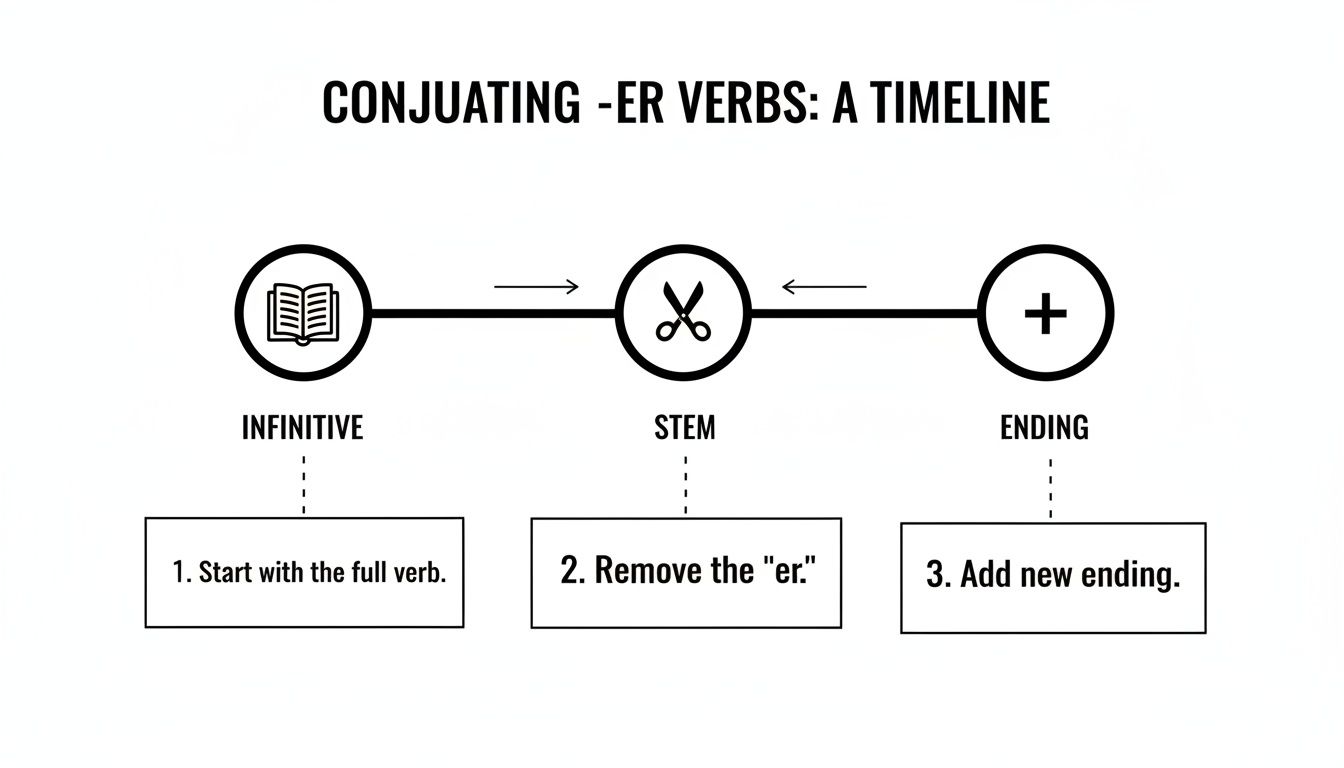
As you can see, conjugation is just a systematic process of taking a verb apart and putting it back together with a new ending. This logic applies across all the tenses, not just the present.
The Imperfect Tense: Painting the Scene
If the preterite is a camera flash, the imperfect is the mood lighting. It doesn’t focus on a single, finished action. Instead, it sets the scene, describes the background, or talks about habitual things you "used to do" in the past. It’s your go-to for "was/were doing" or "used to."
The endings for the imperfect are even easier to remember:
- -ía (yo)
- -ías (tú)
- -ía (él/ella/usted)
- -íamos (nosotros)
- -íais (vosotros)
- -ían (ellos/ellas/ustedes)
Using comer again, you get comía (I was eating / I used to eat). You’d use this to say something like, "Cuando era niño, comía muchos dulces" (When I was a child, I used to eat a lot of candy). Getting the feel for these two past tenses is a huge step toward sounding more natural. For a deeper dive, check out this detailed guide on the imperfect conjugation in Spanish.
Looking Ahead: The Future and Conditional Tenses
Alright, let's jump forward in time. Here's some great news: the future and conditional tenses are probably the easiest to learn for er verbs in Spanish. Why? Because you don't even have to drop the -er ending.
For the future simple tense, which is how you say you "will do" something, you just take the whole infinitive (like comer) and tack these endings right onto it:
- -é (yo)
- -ás (tú)
- -á (él/ella/usted)
- -emos (nosotros)
- -éis (vosotros)
- -án (ellos/ellas/ustedes)
So, "I will eat" becomes comeré. "You will learn" is aprenderás. It’s beautifully simple and works the same way for every regular verb.
The conditional tense follows the exact same logic. This is the tense for what "would" happen. You just attach a different set of endings to the full infinitive:
- -ía (yo)
- -ías (tú)
- -ía (él/ella/usted)
- -íamos (nosotros)
- -íais (vosotros)
- -ían (ellos/ellas/ustedes)
Wait, these look familiar... and you're right! They're the same endings as the imperfect tense. The key difference is you're adding them to the full infinitive, not the stem. So, "I would eat" becomes comería, and "She would understand" is comprendería. Once you get these patterns down, you're ready to chat about the past, present, and future with confidence.
Tackling the Most Common Irregular ER Verbs
While regular verbs give you a nice, predictable pattern to follow, the irregular verbs are where Spanish really shows its personality. Don't think of them as rule-breakers. Instead, see them for what they are: super common words that have been smoothed out over centuries of daily use, making them quicker and easier to say.
They might feel random at first, but here’s a secret: getting a handle on just a handful of these powerhouse -er verbs is the single fastest way to level up your conversation skills. Why? Because you’ll hear and use these words all the time.
Why Irregular Verbs Are So Important
You don't need to memorize hundreds of irregular verbs to start speaking fluently. The trick is to focus on the ones that do the heavy lifting. Verbs like ser (to be), tener (to have), hacer (to do/make), and poder (to be able to) are the skeleton keys that unlock natural, fluid conversation.
The data backs this up. A massive statistical analysis of Spanish verbs in famous literary works showed that irregular -er verbs form the absolute backbone of the language. In that study, ser (to be) was the most frequent infinitive, popping up a staggering 8,066 times. This just proves that by concentrating on this core group, you're learning the words that truly matter.
Let's dive into the common patterns of irregularity you'll actually run into.
The "Yo-Go" Verbs: A Simple Pattern to Spot
One of the most common—and easiest—patterns to remember is the "-go" ending in the first-person singular (yo) form. Several essential -er verbs in Spanish follow this rule in the present tense, even if their other forms are perfectly regular.
Here are the main players you’ll see constantly:
- Tener (to have): Yo tengo (I have)
- Hacer (to do/make): Yo hago (I do/make)
- Poner (to put/place): Yo pongo (I put/place)
- Valer (to be worth): Yo valgo (I am worth)
Once you recognize this group, their yo form becomes second nature. You’ll stop being tempted to say something like "yo teno" because your brain will automatically jump right to tengo.
Stem-Changing Verbs: The Shape-Shifters
Another big category of irregulars involves a little vowel swap in the verb's stem. This change usually happens in all forms except for nosotros (we) and vosotros (you all, informal). If you look at a conjugation chart, it creates a shape like a boot, which is why they're often called "boot verbs."
The most common stem change you'll find with -er verbs is e → ie.
- Querer (to want): Yo quiero, tú quieres, but nosotros queremos
- Entender (to understand): Ella entiende, ustedes entienden, but nosotros entendemos
- Perder (to lose): Él pierde, ellos pierden, but nosotros perdemos
A slightly less common but still vital change is o → ue.
- Poder (to be able to): Yo puedo, tú quieres, but nosotros podemos
- Mover (to move): Ella mueve, ustedes mueven, but nosotros movemos
Pro Tip: Don't try to learn all the irregular verbs at once. That's a recipe for burnout. Focus on one pattern at a time. Spend a day just practicing "yo-go" verbs, and once that feels comfortable, move on to the "e → ie" stem-changers. This targeted approach works way better.
Unique Irregulars: Verbs That Play by Their Own Rules
Finally, you have a few verbs that are so special they basically ignore all the rules. The most important one is ser (to be)—a true cornerstone of the Spanish language. Its present tense conjugation is completely unique and just has to be memorized.
Let's put three of the most vital irregular verbs side-by-side. You'll use these every single day, and it's helpful to see how each one has its own distinct personality.
Conjugation of Key Irregular ER Verbs (Present Tense)
Here's a look at how three of the most crucial irregular -er verbs behave in the present tense. Pay attention to how ser is completely unique, tener mixes two different patterns, and hacer just has one little quirk.
| Pronoun | Ser (to be) | Tener (to have) | Hacer (to do/make) |
|---|---|---|---|
| Yo | soy | tengo | hago |
| Tú | eres | tienes | haces |
| Él/Ella/Usted | es | tiene | hace |
| Nosotros/as | somos | tenemos | hacemos |
| Vosotros/as | sois | tenéis | hacéis |
| Ellos/Ellas/Ustedes | son | tienen | hacen |
As you can see, ser doesn't follow any rules but its own. Tener is a hybrid, combining the "yo-go" pattern with an "e → ie" stem change. Meanwhile, hacer is a classic "yo-go" verb but stays regular everywhere else. Learning these three is non-negotiable on your path to speaking Spanish well.
Using Advanced Moods for Nuanced Communication
So far, we've mostly talked about stating facts—what is, what was, and what will be. But to really start expressing yourself with nuance, you need to step into the world of desires, doubts, and commands. This is where we move beyond basic tenses and into two powerful "moods": the Subjunctive and the Imperative.
Think of the moods you already know (present, past, future) as the indicative mood. It's for things that are objective, real, and certain. The subjunctive mood, on the other hand, is for everything else. It’s the mood of the subjective world—emotions, uncertainty, personal wishes, and hypotheticals.
Mastering the Subjective World with the Subjunctive
The subjunctive can feel a bit abstract at first, but there's a neat trick for forming it with regular -er verbs. You just flip the script and borrow the endings from -ar verbs. So, instead of the familiar -o, -es, -e, you'll use -a, -as, -a.
Let’s see how that looks:
- The indicative (the fact): él come (he eats).
- The subjunctive (the wish/doubt): él coma (that he eat).
This mood almost never stands alone. It's usually triggered by a specific phrase that signals you're entering subjective territory. Common triggers are expressions of hope, desire, or doubt.
- Espero que (I hope that)
- Quiero que (I want that)
- Dudo que (I doubt that)
For example, you’d say, "Espero que comas bien" (I hope that you eat well). You need the subjunctive comas because you're expressing a hope, not stating a fact.
Giving Commands with the Imperative Mood
The other key to unlocking fluent communication is the imperative mood, which is just a fancy name for giving direct commands. The form you use changes depending on who you're talking to and how formal you want to be.
For an informal "you" command (tú), the rule for regular -er verbs is beautifully simple: just use the same form as the third-person singular (él/ella) in the present tense.
- Comer → ¡Come! (Eat!)
- Beber → ¡Bebe! (Drink!)
- Correr → ¡Corre! (Run!)
When you need to be more formal (usted) or you're addressing a group (ustedes), you once again borrow from the subjunctive. The command form is identical to the present subjunctive form.
- Comer → ¡Coma! (Eat! - formal) / ¡Coman! (Eat! - plural)
- Beber → ¡Beba! (Drink! - formal) / ¡Beban! (Drink! - plural)
Getting comfortable with these forms allows you to give instructions and make requests that are appropriate for any situation. For a deeper dive, our guide on how to use commands in Spanish has tons more examples.
It's clear that certain -er verbs are absolute cornerstones of the language. In fact, an analysis of 27.4 million words from subtitles showed that irregular -er verbs like hacer, poder, and querer are some of the most common verbs in the entire language, making up a whopping 10-15% of all verb usage.
Mastering the subjunctive and imperative moods is what separates a proficient speaker from a fluent one. It allows you to express not just what is, but what you want, hope for, or command, adding incredible depth and precision to your Spanish.
Proven Drills to Make ER Verbs Second Nature

Knowing the rules for conjugating er verbs in Spanish is a great first step. But the real goal? Using them in a real conversation without freezing up to remember a chart.
Making that leap from knowledge to instinct doesn't happen by just staring at verb tables. It's all about active, targeted practice. You need drills that force your brain to pull out the right verb form on the fly, building that crucial "muscle memory."
This isn't just about random repetition, either. Smart practice means zeroing in on high-frequency verbs that give you the most bang for your buck in conversation. Think about it: you'll use verbs like comer (to eat) and beber (to drink) a thousand times more than you'll use a verb like proceder (to proceed). Psycholinguistic research even backs this up, showing that targeted drills can speed up verb recall in conversation by as much as 25%.
Active Recall Exercises
This is where you move past simple flashcards and start demanding more from your brain. Active recall exercises force you to create sentences, which cements the connection between a situation and the right verb form much more effectively.
Here are three simple but incredibly powerful drills to get you started:
- Fill-in-the-Blanks: Write out sentences with a missing er verb. For example: "Cada mañana, yo ______ (correr) en el parque." This makes you conjugate based on the subject pronoun.
- Translation Challenges: Start with a simple English sentence and translate it to Spanish, focusing on getting the verb right. Start with something easy like "I learn Spanish" and build up to trickier ones like "We used to understand the lessons."
- Story Building Prompts: Give yourself a simple starting prompt like, "Ayer, mi amigo..." (Yesterday, my friend...) and just keep the story going. Try to cram in as many different er verbs as you can in different tenses.
The whole point of these drills is to make conjugation automatic. You want to get to where you think of the meaning you want to express, and the right verb form just shows up—no mental gymnastics required.
Leveraging Modern Tools for Practice
Let's be honest, consistency is everything, and modern tech can make daily practice a lot less of a chore. Gamified apps can turn what used to be boring, repetitive drills into fun little challenges, and they often give you instant feedback so you can fix mistakes before they become bad habits.
To take your practice to the next level, it's worth exploring the best AI study tool options available today. These platforms can offer personalized exercises and immediate corrections on your conjugation skills. They can track your progress, pinpoint your weak spots, and even create custom quizzes that target the specific verbs or tenses you struggle with. By weaving these tools into your study routine, you can turn hesitant verb use into a confident, second-nature skill much faster.
Common Questions About Spanish ER Verbs
As you get comfortable with -er verbs, a few tricky questions always seem to come up. Don't worry, hitting these roadblocks is a totally normal part of the learning curve. Let's clear up some of the most common points of confusion so you can keep moving forward.
What Is the Main Difference Between ER and IR Verbs?
At first glance, -er and -ir verbs look like twins. In most tenses, their endings are practically identical, which is great news for learners. The real difference—the one you really need to watch out for—pops up in the present tense, specifically in the nosotros (we) and vosotros (you all) forms.
- For -er verbs, the endings are -emos and -éis. Think nosotros comemos (we eat) and vosotros coméis (you all eat).
- For -ir verbs, they switch to -imos and -ís. Think nosotros vivimos (we live) and vosotros vivís (you all live).
Nailing this small but crucial detail is one of those little things that makes your Spanish sound much more authentic.
What Are the Best Tricks for Remembering Irregular Verbs?
Trying to memorize dozens of unique verb charts is a recipe for burnout. A much smarter approach is to look for patterns and group the rebels together. This changes a painful memorization chore into a more manageable pattern-spotting game.
For example, why not make a list of all the "yo-go" verbs? These are the ones that sneak in a "-go" ending in the first-person present tense.
- Tener -> yo tengo
- Hacer -> yo hago
- Poner -> yo pongo
Next, you could tackle a group of common stem-changing verbs like querer (e->ie). By focusing on one type of irregularity at a time, the whole process feels way less overwhelming.
The most successful learners don't just memorize verbs; they recognize patterns. Grouping irregular verbs by their shared quirks—like a "-go" ending or a stem change—is the secret to making them stick.
How Important Is Learning the Vosotros Form?
This one is simple: it depends entirely on where you plan to use your Spanish.
If you’re heading to Spain or plan on chatting with Spaniards, learning vosotros is non-negotiable. It's the standard, everyday way to talk to a group of friends, family, or colleagues. Ignoring it would be like never using "y'all" in the American South.
However, if your focus is Latin America, you can breathe a little easier. Across almost all of Latin America, ustedes is the go-to for addressing any group, whether you know them well or not. In this case, you can safely prioritize ustedes and just learn to recognize vosotros when you come across it in movies or books from Spain.
Ready to turn verb charts into real conversation skills? PolyChat offers the market's best conjugation practice tool, alongside fun, gamified lessons that build your confidence. Stop memorizing and start speaking with PolyChat.

Jean-Baptiste Bolh
Co-Founder
Applied AI