A Practical Guide to French ER Verb Conjugation
If you're just starting your French journey, you've probably noticed that a ton of verbs end in -er. This isn't a coincidence—it's your biggest shortcut to speaking the language. Learning how to handle this one group of verbs is like getting a master key that unlocks over 90% of all French verbs.
Ready to Learn a Language?
Try PolyChat's engaging language lessons, interactive learning games and put your new vocabulary to the test!
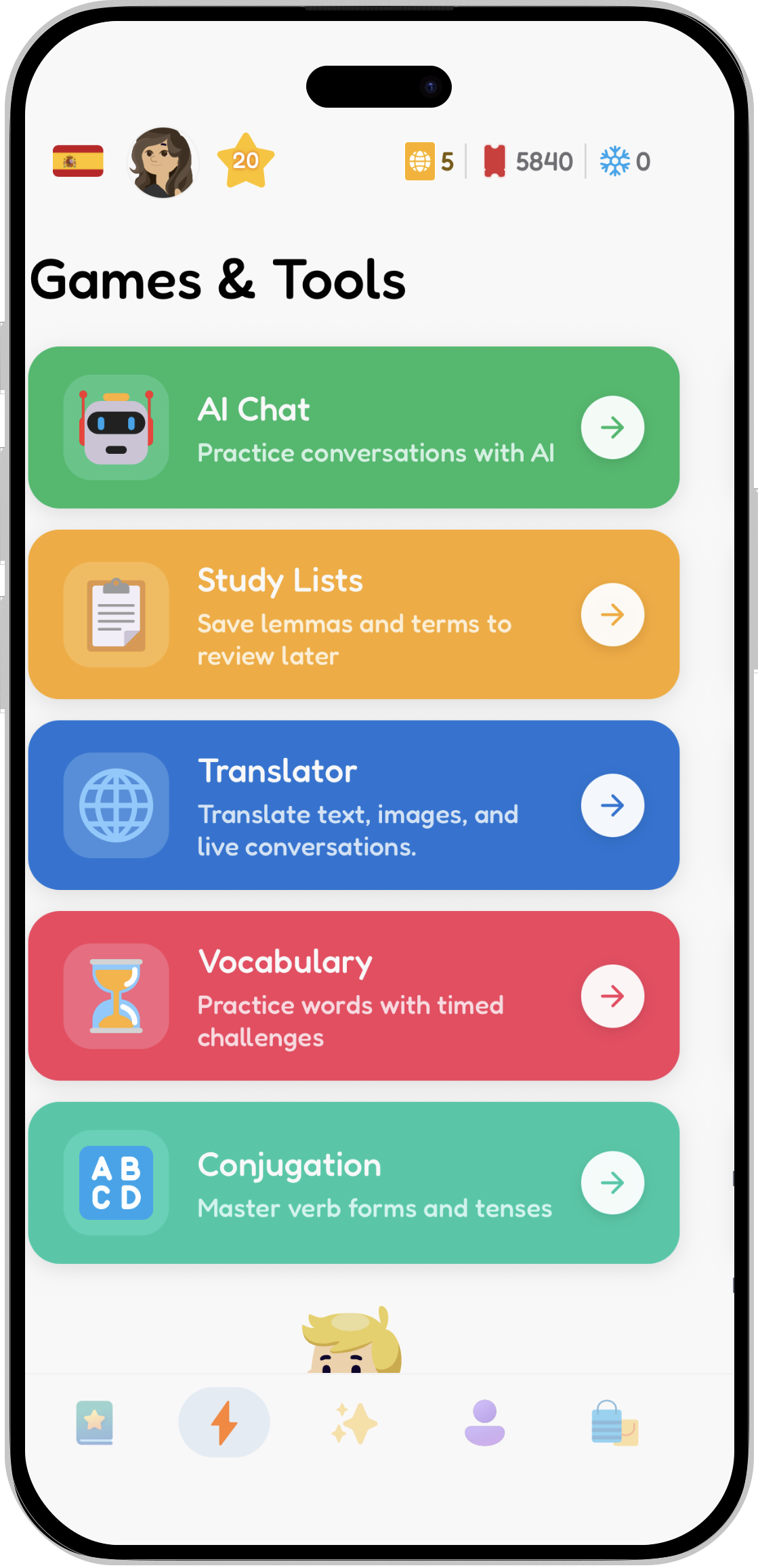
Games & Tools
Tools that every language learner needs at all stages of their learning journey.
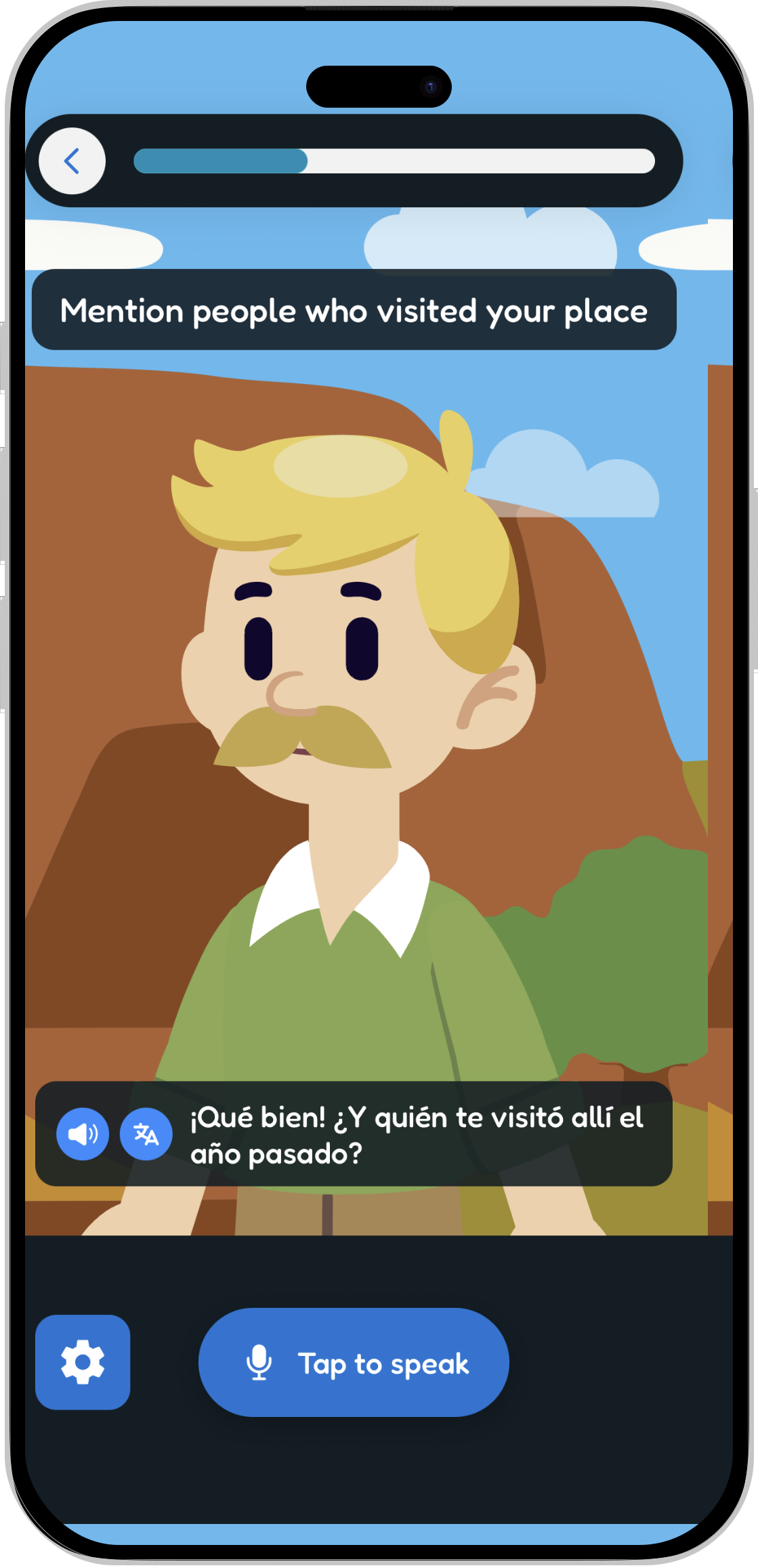
AI Chat Tutor
Practice real conversations with an AI tutor that helps you speak with confidence.
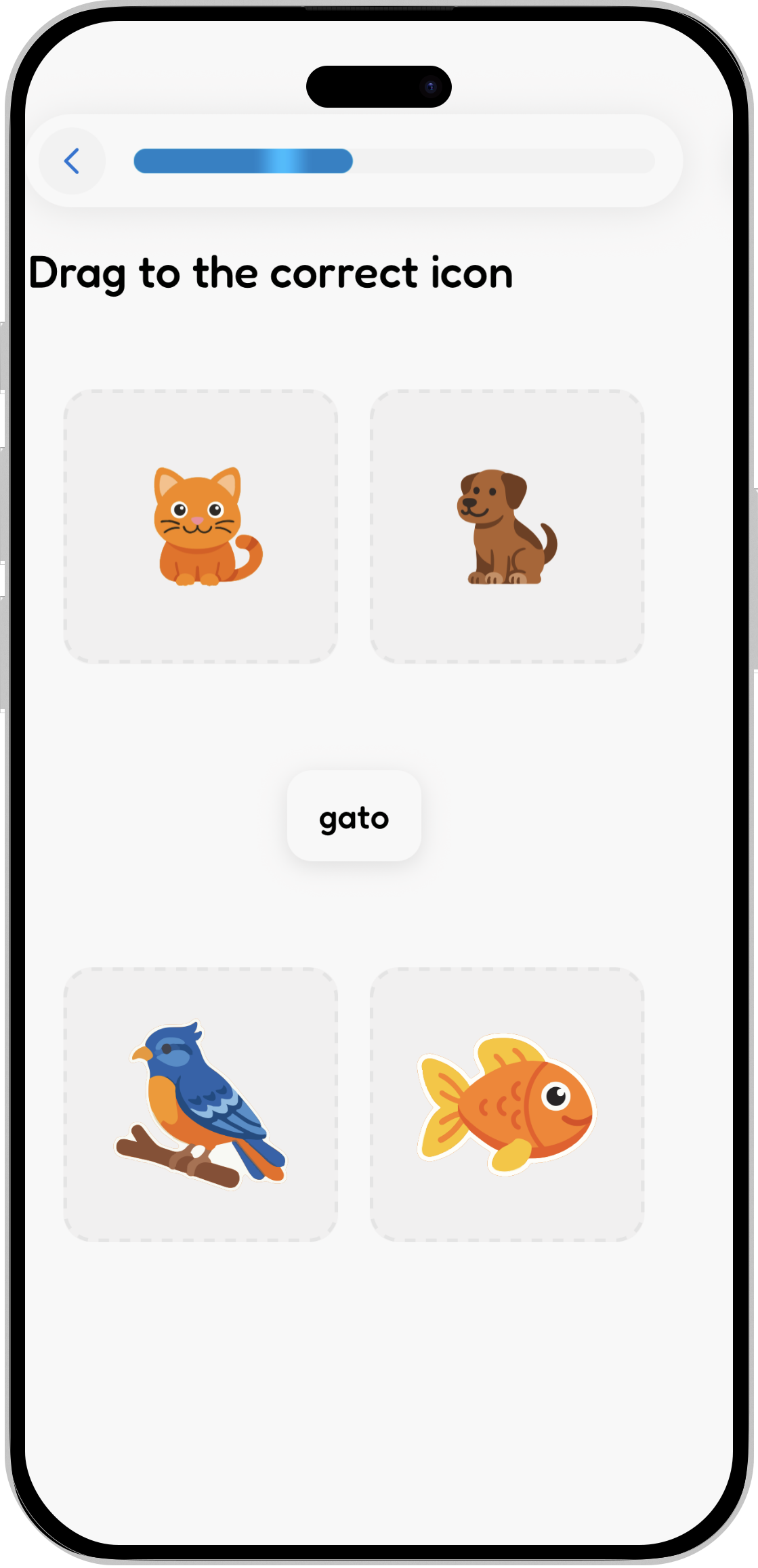
Interactive Games
A variety of games to help you learn and remember new words and phrases.


Why ER Verbs Are Your First Step to Fluency
Think of -er verbs as the foundational recipe for French conversation. Once you get the hang of their simple, predictable pattern, you’ll have a reliable system you can use in thousands of different situations. This isn't just about memorizing rules; it's about building real confidence.
Mastering -er verb conjugation is a massive strategic advantage. These verbs completely dominate everyday French. Verbs like parler (to speak), manger (to eat), and aimer (to love) are everywhere. In fact, simple present tense forms are used in over half of all casual conversations, making this skill immediately useful.
The Simple Formula for Success
At its heart, conjugating a regular -er verb is a straightforward, two-step dance. It’s less about memorizing endless charts and more about learning one repeatable move.
Here’s all you need to do:
- Find the Stem: Just chop off the -er from the end of the verb. For parler (to speak), the stem is parl-.
- Add the Ending: Attach a new ending to the stem based on who is doing the action (I, you, we, etc.).
That’s it. Once you can do this for parler, you can do it for countless other verbs. It’s a system, not a list.
This approach helps you build a mental framework that makes speaking French feel intuitive, not academic. It's how you move from just knowing the words to actually using them in a conversation.
Building Your Conversational Framework
Getting comfortable with verbs is non-negotiable for fluency, and starting with the -er group gives you the biggest return on your effort. Verbs like chercher (to look for) and jouer (to play) all follow this exact same pattern. For a deeper dive into how verbs work in French, check out our guide on the different types of verbs in French.
This initial win builds incredible momentum. As we go through this guide, you’ll see how this core knowledge becomes the launchpad for tackling the past, future, and even those pesky irregular verbs later on.
Conjugating ER Verbs in the Present Tense
Alright, now that you have the basic formula down, let's put it to work in the most important tense for any beginner: the present tense, or le présent de l'indicatif.
This is your go-to tense for talking about what's happening right now, things you do regularly, and just general truths. The best part? For regular -er verbs, the pattern is incredibly consistent and shockingly easy to get the hang of.
Think of it like a simple two-step assembly line. First, you get your base component ready (the verb stem), and then you snap on the correct part (the ending) for each specific person doing the action.
The Two-Step Conjugation Process
The real beauty of er verb conjugation in the present tense is its predictability. Once you nail this simple process, you can apply it to hundreds upon hundreds of verbs without even thinking.
Let's use a classic verb, parler (to speak), to walk through it.
- Find the Stem: First thing's first, you need to find your base. Just chop the -er off the end of the infinitive. For parler, that leaves us with the stem parl-. This is the foundation you'll build every conjugation on.
- Add the Correct Ending: Each subject pronoun (je, tu, il, etc.) has its own special ending. Your only job is to match the pronoun to its ending and attach it to your stem.
These endings are the same for almost every single regular -er verb out there. If you memorize them now, you've just unlocked a massive piece of the French language.
The key takeaway is simple: one set of endings works for the vast majority of -er verbs. Mastering this single pattern is your fastest route to forming correct sentences in French.
Present Tense Endings for ER Verbs
The six present tense endings you absolutely need to know are: -e, -es, -e, -ons, -ez, and -ent.
Look closely. The endings for je, il, and elle are exactly the same. That makes your job even easier.
Let’s stick these endings onto our stem, parl-:
- For je (I), add -e → je parle (I speak)
- For tu (you, informal), add -es → tu parles (you speak)
- For il/elle/on (he/she/one), add -e → il parle (he speaks)
- For nous (we), add -ons → nous parlons (we speak)
- For vous (you, formal/plural), add -ez → vous parlez (you speak)
- For ils/elles (they), add -ent → ils parlent (they speak)
Here's a quick pronunciation tip that trips up a lot of beginners: the endings for je, tu, il, and ils are all silent. That means parle, parles, and parlent all sound identical when you say them out loud!
Your Quick-Reference Conjugation Table
Sometimes, seeing the whole pattern laid out visually is what makes it finally click. Here’s a simple table breaking down the conjugation for parler. Think of this as your blueprint for any regular -er verb you run into.
Regular ER Verb Present Tense Endings Using Parler
| Pronoun | Stem | Ending | Full Conjugation |
|---|---|---|---|
| Je (I) | parl- | -e | je parle |
| Tu (You, informal) | parl- | -es | tu parles |
| Il/Elle/On (He/She/One) | parl- | -e | il parle |
| Nous (We) | parl- | -ons | nous parlons |
| Vous (You, formal/plural) | parl- | -ez | vous parlez |
| Ils/Elles (They) | parl- | -ent | ils parlent |
This structure is your go-to guide. Just swap out "parl-" for the stem of another regular -er verb, and you're good to go.
Reinforcing the Pattern with More Verbs
This isn't just some trick that only works for parler. The exact same system applies to tons of other common verbs. Let's try a couple more, like chanter (to sing) and chercher (to look for).
With chanter, the stem is chant-. Easy.
- Nous chantons (We sing)
- Elle chante (She sings)
With chercher, the stem is cherch-.
- Vous cherchez (You look for)
- Ils cherchent (They look for)
See? The er verb conjugation process is identical. By practicing with a few different verbs, you start building the muscle memory to do it automatically, without having to stop and think through the rules every time. This is the bedrock your conversational fluency will be built on.
Navigating Past and Future Verb Tenses
While the present tense is your day-to-day workhorse, real conversations jump all over the timeline. You need to talk about what you did last night, describe what used to happen when you were a kid, and share your plans for tomorrow. This is where your -er verb conjugation skills really start to shine.
The good news? Just like the present tense, these other tenses follow predictable patterns. Once you get the formula down for each one, you can apply it to nearly every regular -er verb you come across. Let's break down three of the most essential tenses: the Passé Composé, the Imparfait, and the Futur Simple.
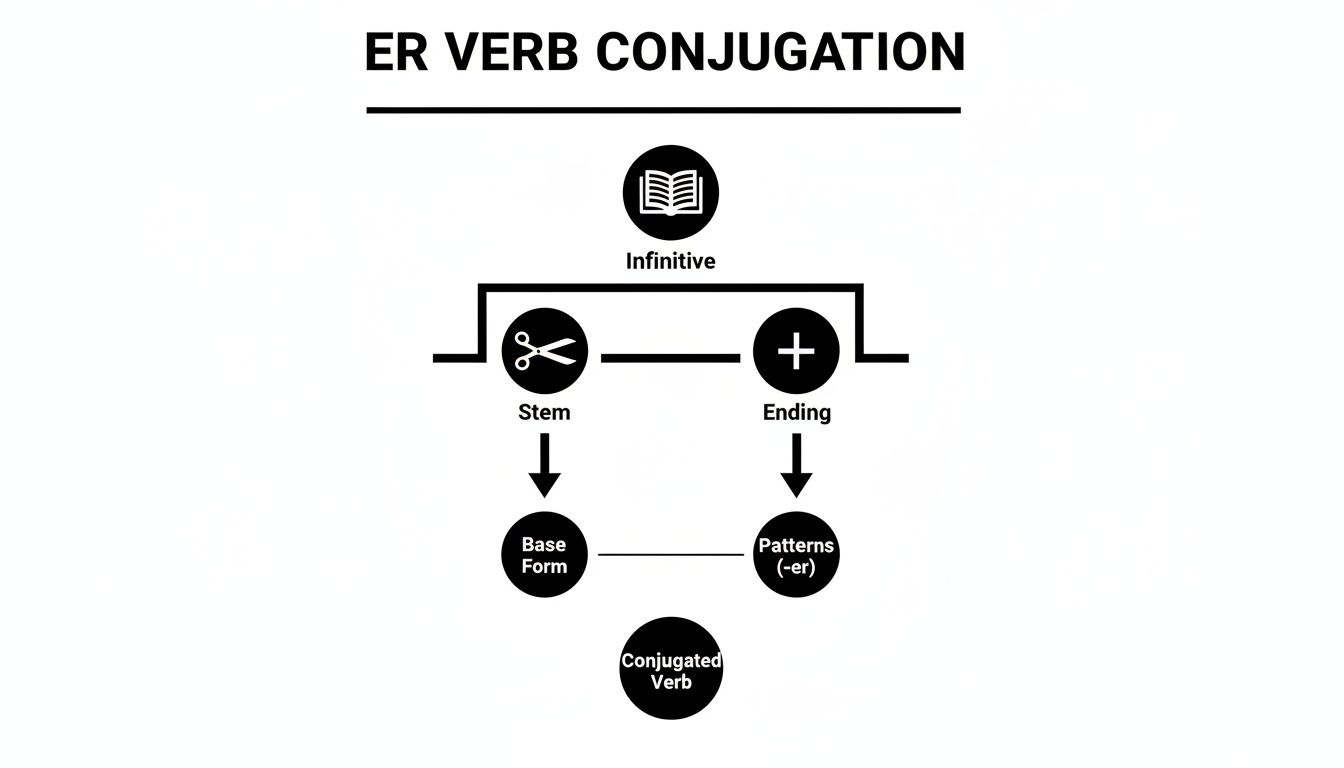
This diagram shows how any infinitive -er verb is broken down into a stem and an ending before being conjugated.
The Passé Composé for Completed Actions
The Passé Composé is your go-to past tense in spoken French. It's for specific, finished actions. If you can pinpoint when it happened in the past and it's definitely over, you're probably going to use the Passé Composé.
For instance:
- J'ai mangé une pomme. (I ate an apple.)
- Nous avons regardé un film. (We watched a movie.)
The formula is a two-part deal. It needs a "helper" verb and a "past participle."
The Passé Composé is like building with two Lego blocks. You need the helper verb block (usually avoir) and the past participle block (the verb with an -é ending) to make a complete past tense verb.
Here’s the simple recipe:
- Helper Verb: Use the present tense of avoir (to have).
- Past Participle: Take your -er verb, chop off the -er, and stick an -é on the end.
For manger (to eat), the past participle becomes mangé. Let's see how it looks all put together.
Passé Composé Conjugation of Manger (to eat)
| Pronoun | Helper Verb (Avoir) | Past Participle | Full Conjugation |
|---|---|---|---|
| J' (I) | ai | mangé | j'ai mangé |
| Tu (You) | as | mangé | tu as mangé |
| Il/Elle/On (He/She) | a | mangé | il a mangé |
| Nous (We) | avons | mangé | nous avons mangé |
| Vous (You) | avez | mangé | vous avez mangé |
| Ils/Elles (They) | ont | mangé | ils ont mangé |
The Imparfait for Descriptions and Habits
While the Passé Composé handles the main events, the Imparfait (imperfect) is all about setting the scene. It describes the background, ongoing actions, and things you used to do. It paints the picture for the story.
You'll use the Imparfait for things like:
- Describing what was happening: Le soleil brillait. (The sun was shining.)
- Talking about habits: Quand j'étais petit, je jouais au parc. (When I was little, I used to play at the park.)
The formula for the Imparfait is clever and almost foolproof. The secret is to start with the nous form of the present tense.
- Take the nous form of the verb (e.g., from parler you get nous parlons).
- Drop the -ons ending to find your stem (so, parl-).
- Add the classic Imparfait endings: -ais, -ais, -ait, -ions, -iez, -aient.
Let's try it with parler (to speak). The nous form is parlons, giving us the stem parl-.
- Je parlais (I was speaking/I used to speak)
- Tu parlais (You were speaking)
- Il parlait (He was speaking)
- Nous parlions (We were speaking)
- Vous parliez (You were speaking)
- Ils parlaient (They were speaking)
The Futur Simple for Future Plans
Alright, let's jump into the future with the Futur Simple. This tense is how you talk about what will happen. It’s the French equivalent of saying "I will do something" in English.
The best part? Finding the stem is the easiest trick in the book. You don't take anything away! The stem for the Futur Simple is simply the entire infinitive verb. For chanter (to sing), the stem is chanter. For danser (to dance), it's danser. Easy.
Once you've got your stem, you just tack on the future endings, which happen to look a lot like the verb avoir.
- The endings are: -ai, -as, -a, -ons, -ez, -ont.
Let’s conjugate chanter (to sing) in the future.
Futur Simple Conjugation of Chanter (to sing)
| Pronoun | Stem (Infinitive) | Ending | Full Conjugation |
|---|---|---|---|
| Je (I) | chanter | -ai | je chanterai |
| Tu (You) | chanter | -as | tu chanteras |
| Il/Elle/On (He/She) | chanter | -a | il chantera |
| Nous (We) | chanter | -ons | nous chanterons |
| Vous (You) | chanter | -ez | vous chanterez |
| Ils/Elles (They) | chanter | -ont | ils chanteront |
Getting a handle on these three tenses pushes your -er verb conjugation skills beyond the basics. It lets you tell actual stories, describe memories, and make plans with way more confidence and color.
Handling Common Irregular and Stem-Changing Verbs
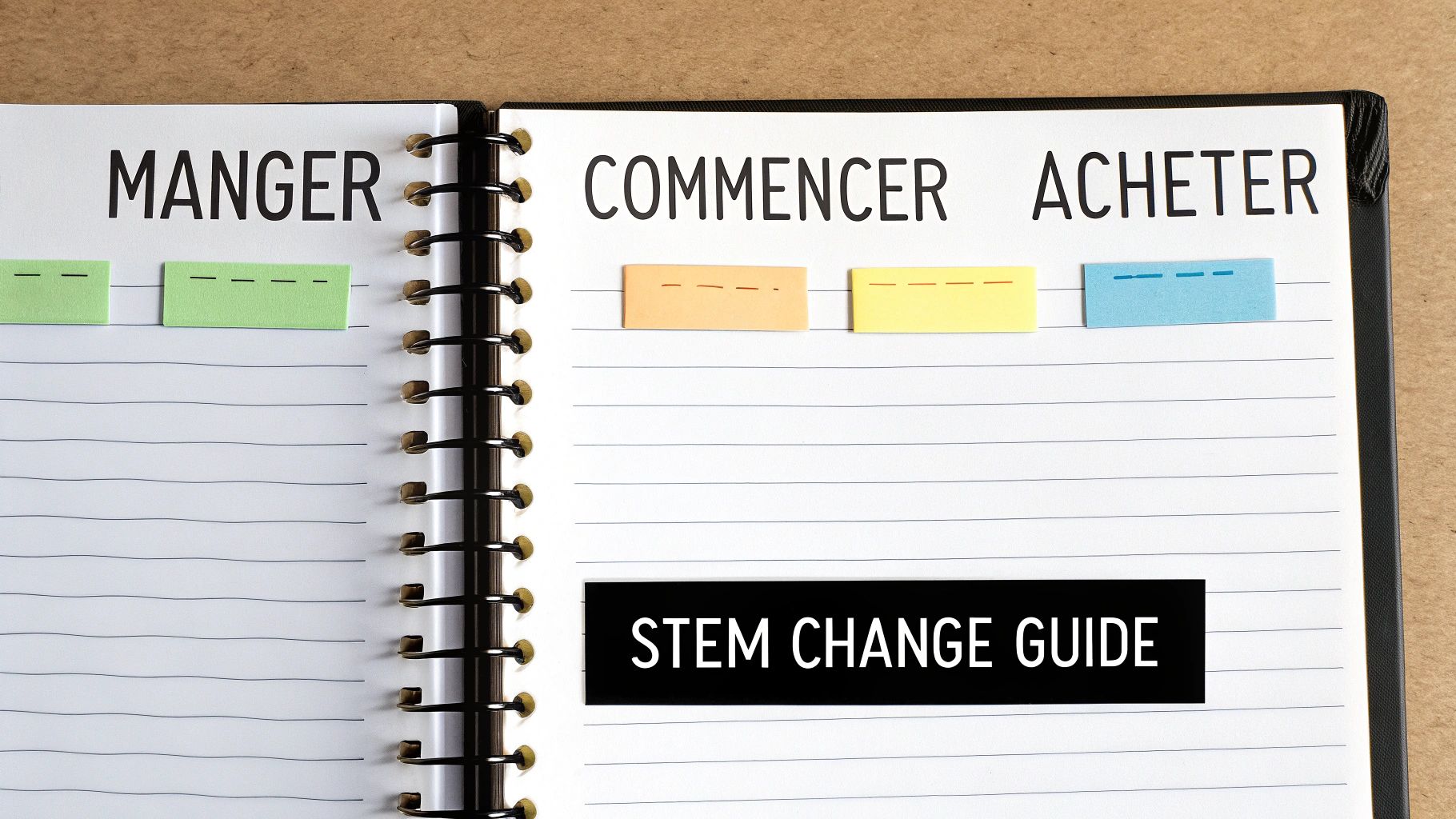
Just when you get comfortable with the beautiful consistency of regular -er verb conjugation, French decides to throw a few curveballs. But don't worry—these aren't totally wild, rule-breaking verbs. They’re more like regulars with tiny spelling quirks that are surprisingly easy to master once you see the pattern.
Think of them as verbs that need a minor tweak here and there, mostly to keep their pronunciation sounding smooth and elegant. We’ll break them down into a few simple groups so you can handle them like a pro.
Verbs Ending in -GER
First up are verbs ending in -ger, like the delicious manger (to eat) or the useful changer (to change). These guys are almost entirely regular, except for one tiny change in a single form: the nous (we) form.
It all comes down to pronunciation. The letter 'g' in French makes a soft "zh" sound (like the 's' in 'pleasure') when it’s followed by an 'e' or 'i'. But when an 'o' or 'a' follows it, it makes a hard "g" sound (like in 'go'). To keep that soft "zh" sound consistent in the nous form, we just slide a silent -e- between the 'g' and the '-ons' ending.
- What it would be: nous mangons (with a hard 'g' sound)
- What it actually is: nous mangeons (with the correct soft 'zh' sound)
That’s it! This simple trick preserves the verb's sound. Every other form (je mange, tu manges, etc.) is completely regular.
Verbs Ending in -CER
A very similar thing happens with verbs ending in -cer, like commencer (to begin) or placer (to place). The letter 'c' makes a soft "s" sound before an 'e' or 'i', but a hard "k" sound before an 'o' or 'a'. You see where this is going, right?
To keep the soft "s" sound in the nous form, the 'c' changes to a ç (called a cédille). That little tail on the 'c' is a signal that it should always be pronounced like an "s," no matter what vowel comes next.
- What it would be: nous commencons (with a hard 'k' sound)
- What it actually is: nous commençons (with the correct soft 's' sound)
Just like the -ger verbs, this is the only change you need to remember. All the other conjugations follow the standard pattern.
Understanding Stem-Changing Verbs
Now we get to a slightly different kind of quirk: stem-changing verbs. You might hear these called "boot verbs," and they have a spelling change in their stem for most—but not all—of the present tense forms.
A classic example is acheter (to buy). The 'e' in the stem changes to an è (with a grave accent) to alter its pronunciation. This happens for je, tu, il/elle/on, and ils/elles.
The easiest way to remember this is the "boot verb" trick. If you draw a line around the je, tu, il, and ils forms on a conjugation chart, the shape looks like a boot. The nous and vous forms are "outside the boot" and keep the original stem.
Let's see this in action with acheter:
| Pronoun | Conjugation | Inside/Outside the Boot |
|---|---|---|
| J' | achète | Inside |
| Tu | achètes | Inside |
| Il/Elle/On | achète | Inside |
| Nous | achetons | Outside |
| Vous | achetez | Outside |
| Ils/Elles | achètent | Inside |
Other common verbs follow this pattern, like préférer (to prefer), which changes its é to è, and appeler (to call), which doubles the 'l' to become j'appelle. The boot concept works for all of them, making it a powerful visual shortcut for correct er verb conjugation.
The Ultimate Irregular -ER Verb: Aller
Finally, we have the king of all irregular -er verbs: aller (to go). It ends in -er, but that’s where the similarities stop. Its conjugation is completely unique and follows no predictable pattern at all.
This is the one -er verb you simply have to memorize. Because aller is used constantly in daily conversation—especially to form the near future tense (le futur proche)—knowing it by heart is non-negotiable for anyone serious about fluency.
Here’s the present tense conjugation for aller:
- Je vais (I go)
- Tu vas (You go)
- Il/Elle/On va (He/She/One goes)
- Nous allons (We go)
- Vous allez (You go)
- Ils/Elles vont (They go)
Mastering these common exceptions—the tiny spelling tweaks for -ger and -cer verbs, the boot pattern for stem-changers, and the wild forms of aller—will turn potential stumbling blocks into proof of your growing command of the French language.
Putting Your Knowledge into Practice
Okay, you've seen the charts and you understand the rules for -er verb conjugation. That's a huge first step. But the real goal is to use these verbs without even thinking about it, right? To make it instinctive.
This is where theory hits the road. To get truly fluent, you have to build that muscle memory through active, consistent practice. It’s not enough to just passively read conjugation tables.
Think about it like learning guitar chords. You can stare at the sheet music all day, but your fingers won't know where to land until you've physically practiced them over and over. Verb drills do the exact same thing for your brain—they turn knowledge you have into a skill you can use.
Effective Practice Techniques
Building this mental reflex takes more than just willpower; it takes smart practice. To really get these conjugations locked in, it's worth exploring some effective learning strategies that help information stick. Simple, focused drills are your best friend here.
Here are a few powerful ways to get started:
- Flashcard Drills: Old school but effective. Put an infinitive verb on one side and a pronoun (like nous) on the other. Your job is to say the conjugated verb out loud before you flip the card to check.
- Create Sentences: Don't just conjugate in a vacuum. Push yourself to build a simple but complete sentence. Instead of just saying "je parle," try saying, "Je parle français avec mes amis." This gives the verb context.
- Timed Challenges: This is great for simulating the pressure of a real conversation. Set a timer for two minutes and see how many different -er verbs you can correctly conjugate for a single pronoun, like tu.
These methods are all about active recall—forcing your brain to pull the information out instead of just recognizing it. That's the secret sauce for building long-term memory. And if you want to really fast-track your progress, working one-on-one with a great instructor can make a massive difference. You can find some of the best online teachers for French who fit your style.
Accelerate Your Progress with Interactive Tools
While manual drills are great, modern tools can seriously supercharge your practice by giving you instant feedback in a format that’s actually fun. This is where a good conjugation trainer becomes an essential part of your toolkit.
The goal of practice isn't just to get the answers right; it's to get them right faster and with less mental effort each time. Interactive tools are specifically designed to accelerate this process.
PolyChat’s conjugation tool, for instance, transforms what could be a repetitive chore into an engaging, gamified experience. You’re given a verb and a pronoun, and you have to type the correct form as quickly as you can. This combination of active recall and immediate correction helps you pinpoint and fix your weak spots on the fly.
One of the biggest advantages is the unlimited practice. Unlike apps that frustrate you with a hearts or energy system, PolyChat lets you practice as much as you want, whenever you want. You can drill that one tricky verb until it finally clicks, without being forced to stop right when you're in the zone. As you get each verb right, you’re not just learning—you’re building confidence for real-world conversations.
Got Questions About -ER Verbs? We've Got Answers.
Even when the rules seem straightforward, a few tricky questions always pop up. That’s a good thing! It means you're thinking like a language learner. Let's tackle some of the most common hurdles right now to clear the path forward.
Getting these sticking points sorted out is one of the best ways to solidify your understanding and start using these verbs with real confidence.
What’s the Fastest Way to Learn the Endings?
The quickest way is a simple combo: pattern recognition plus active recall.
First, just memorize the six present tense endings: -e, -es, -e, -ons, -ez, -ent. You'll immediately notice that three of them sound exactly the same—the endings for je, il/elle, and ils/elles are all silent. That’s half the battle right there.
But don't just stare at a chart. You have to pull the information out of your brain. Use flashcards, quiz yourself with a conjugation app, or just scribble them out on a piece of paper from memory. Spending 10-15 minutes a day doing this is way more effective than an hour of just passively reading. It builds the mental reflexes you need to speak without hesitating.
To really lock it in, using active learning strategies is key. It’s all about doing instead of just watching.
Why Is Aller an -ER Verb If It’s So Weird?
This is a fantastic and very logical question. The short answer is: tradition.
Grammatically, aller (to go) gets lumped in with the first group of verbs for one reason and one reason only: its infinitive form ends in -er. That’s it. The classification is based on its "dictionary" form, not how it actually behaves in a sentence.
It's the rebel of the family—the only verb in this huge group that is completely, wildly irregular. Its conjugations (vais, vas, va, allons, allez, vont) look nothing like the standard pattern.
Think of aller as a historical quirk. It wears the '-er' uniform but plays by an entirely different set of rules. Since it’s one of the most common verbs in all of French, your best bet is to memorize it as a unique, special case.
Any Tricks for Remembering Those Stem-Changing Verbs?
Absolutely! The best trick in the book is the "boot verb" concept. It's a simple visual that makes a confusing rule easy to remember.
For verbs like acheter (to buy), the stem change only happens for je, tu, il/elle/on, and ils/elles. If you draw a line around those forms on a conjugation table, the shape you make looks just like a boot.
Here’s how to picture it:
- Inside the boot: These forms get the stem change (e.g., j'achète).
- Outside the boot: The nous and vous forms are left out in the cold and stay the same (e.g., nous achetons).
Once you see the boot, you can't unsee it. This little mental image makes it so much easier to remember which forms need that spelling tweak.
How Important Is It to Learn the Imparfait and Passé Composé?
It is absolutely critical. If you want to move beyond "tourist French" and have real conversations, you need both. Without them, you're stuck in the present tense, unable to tell a story, share a memory, or explain anything that happened in the past.
Think of them as two different camera lenses for looking at the past.
- The Passé Composé is for specific, completed actions. It’s for the main events of your story. ("I visited Paris," — J'ai visité Paris).
- The Imparfait is for descriptions, background details, and ongoing past actions. It sets the scene. ("The sun was shining," — Le soleil brillait).
Mastering how these two work together is your ticket to having nuanced, interesting conversations about pretty much anything. For more tips on building these core skills, check out our guide on the best way to learn French.
Ready to turn all this theory into an instinctive skill? The conjugation trainer from PolyChat is designed to build your muscle memory with fast-paced, interactive drills. Practice without limits, track your progress, and finally master French verbs. Try PolyChat today and start conjugating with confidence

Jean-Baptiste Bolh
Co-Founder
Applied AI