The Best Way to Learn French A Practical Fluency Roadmap

The absolute best way to learn French is to cleverly mix modern technology with the classic, proven techniques of immersion. I've found that a powerful strategy is pairing daily, bite-sized lessons from an interactive app like PolyChat with genuine, active speaking practice.
This combination flips language learning on its head—it stops feeling like a chore and becomes an engaging, almost game-like experience that you can actually fit into your busy life.
Ready to Learn French?
Try PolyChat's engaging language lessons, interactive learning games and put your French vocabulary to the test!
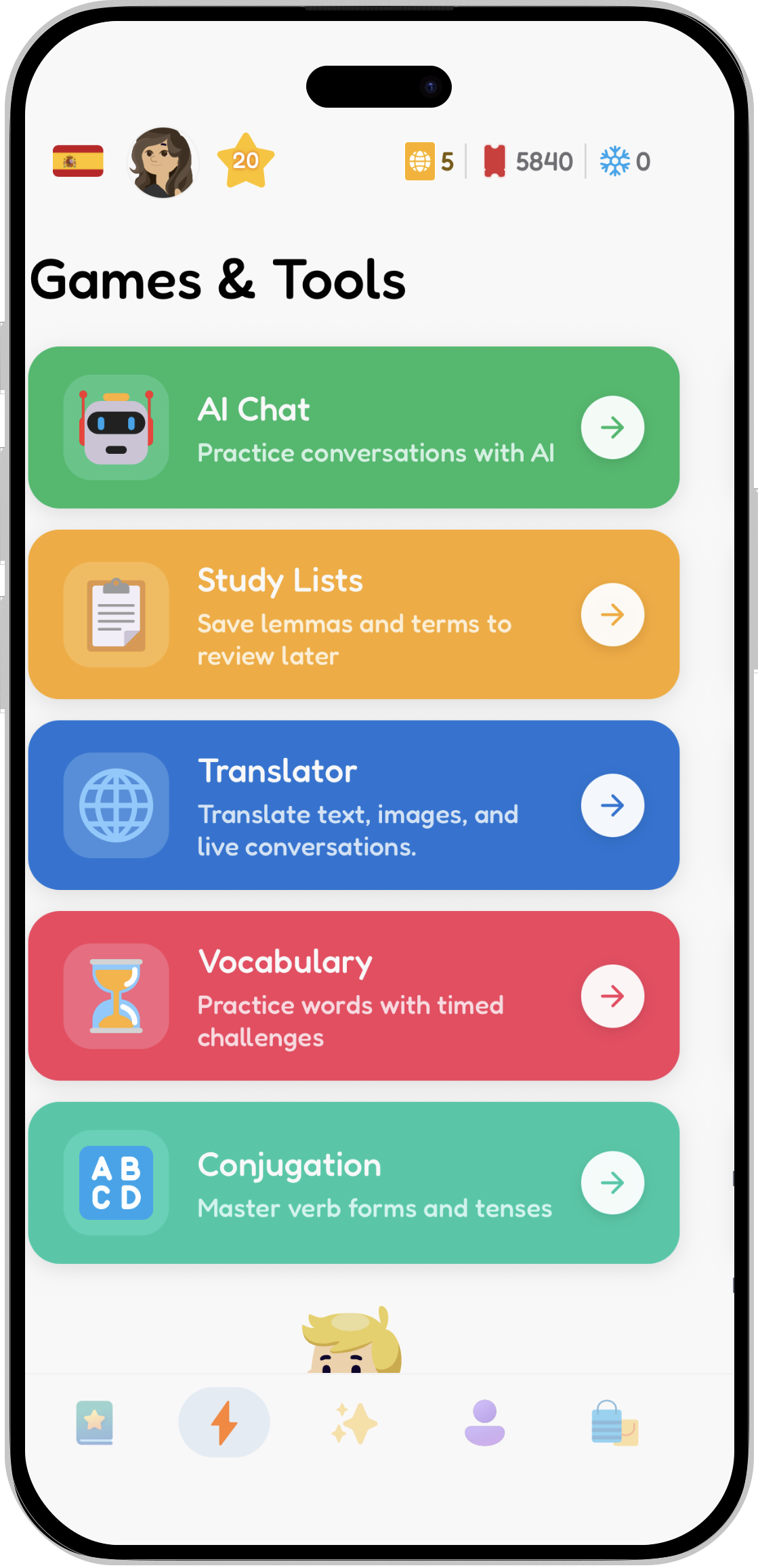
Games & Tools
Tools that every language learner needs at all stages of their learning journey.
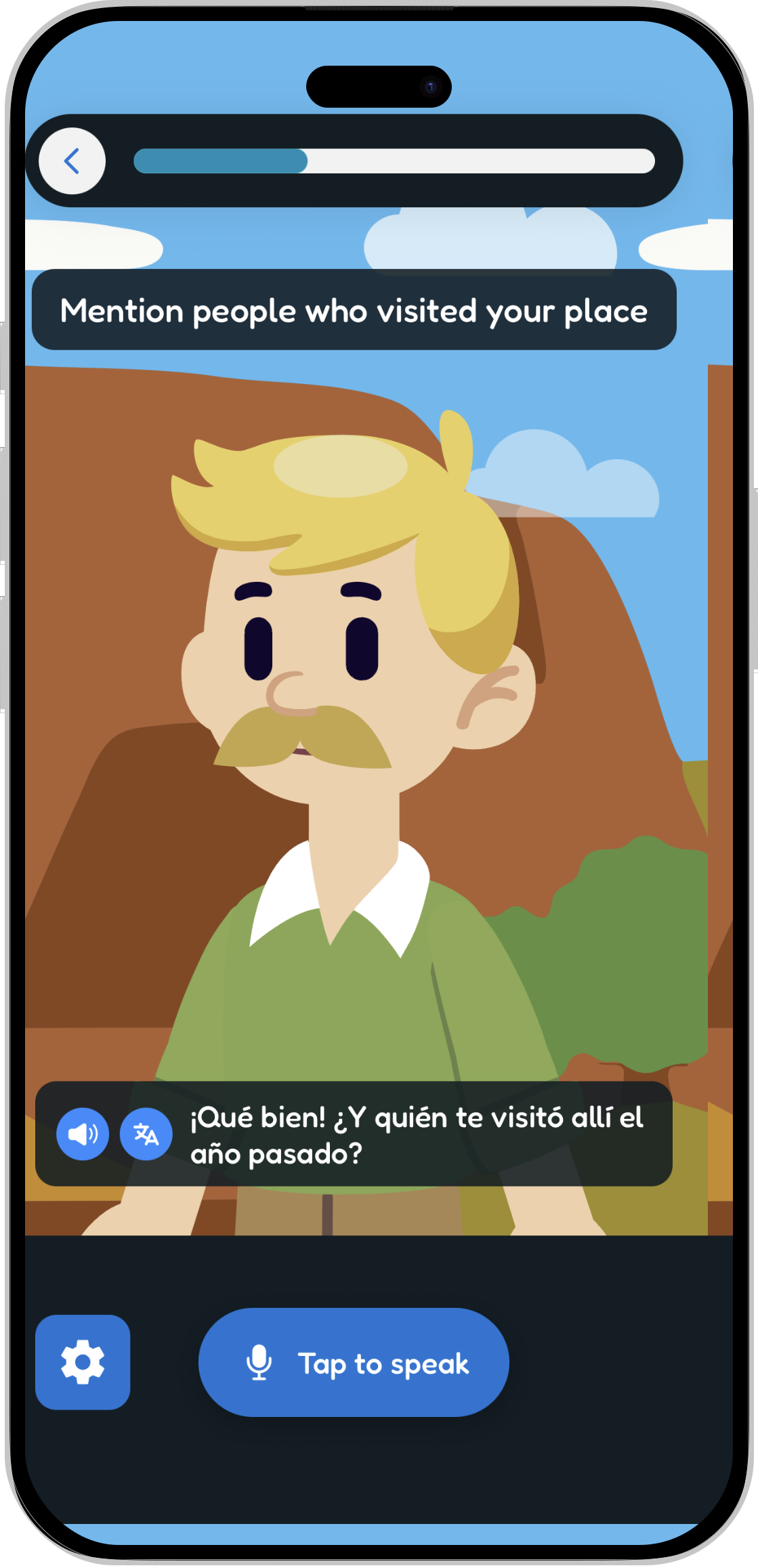
AI Chat Tutor
Practice real conversations with an AI tutor that helps you speak with confidence.
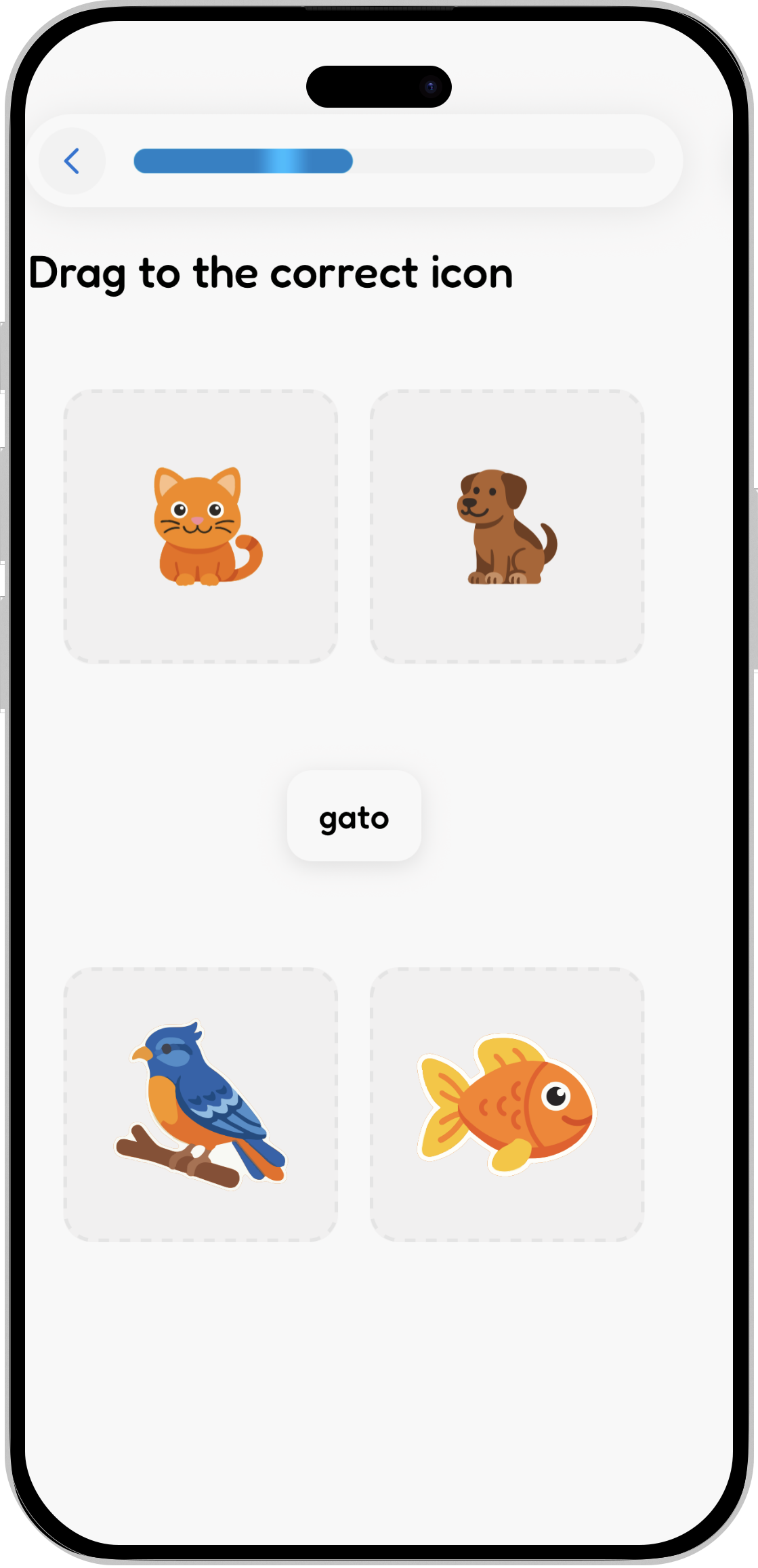
Interactive Games
A variety of games to help you learn and remember new words and phrases.


Your Modern Toolkit for Learning French
Forget about dusty old textbooks and the endless grammar drills from your school days. The most effective path to French fluency today starts right on your phone.
Interactive digital tools have completely changed the game, making the process more accessible, personalized, and honestly, a lot more fun. Apps like PolyChat use a smart blend of gamification, AI-driven feedback, and spaced repetition to make sure new words and concepts actually stick in your brain.
This isn’t just about memorizing random vocabulary lists; it's about building a real, intuitive feel for the language. These platforms create a learning path that adapts to you. If you breeze through a lesson on food, the app might challenge you with some restaurant conversation games. Struggle with a tricky verb conjugation? It'll serve up targeted exercises until you nail it. This turns what used to be dull memorization into a dynamic, responsive experience.
Leveraging Technology for Smarter Learning
The real magic of modern tools is how they make learning an active process. Instead of just passively reading, you're constantly doing something—matching words, building sentences, and even getting instant feedback on your pronunciation from AI. For even more innovative support, you can supplement your learning with dedicated AI teacher tools to help explain complex concepts.
This flowchart breaks down the simple but incredibly effective process for using tech to fast-track your journey to fluency.
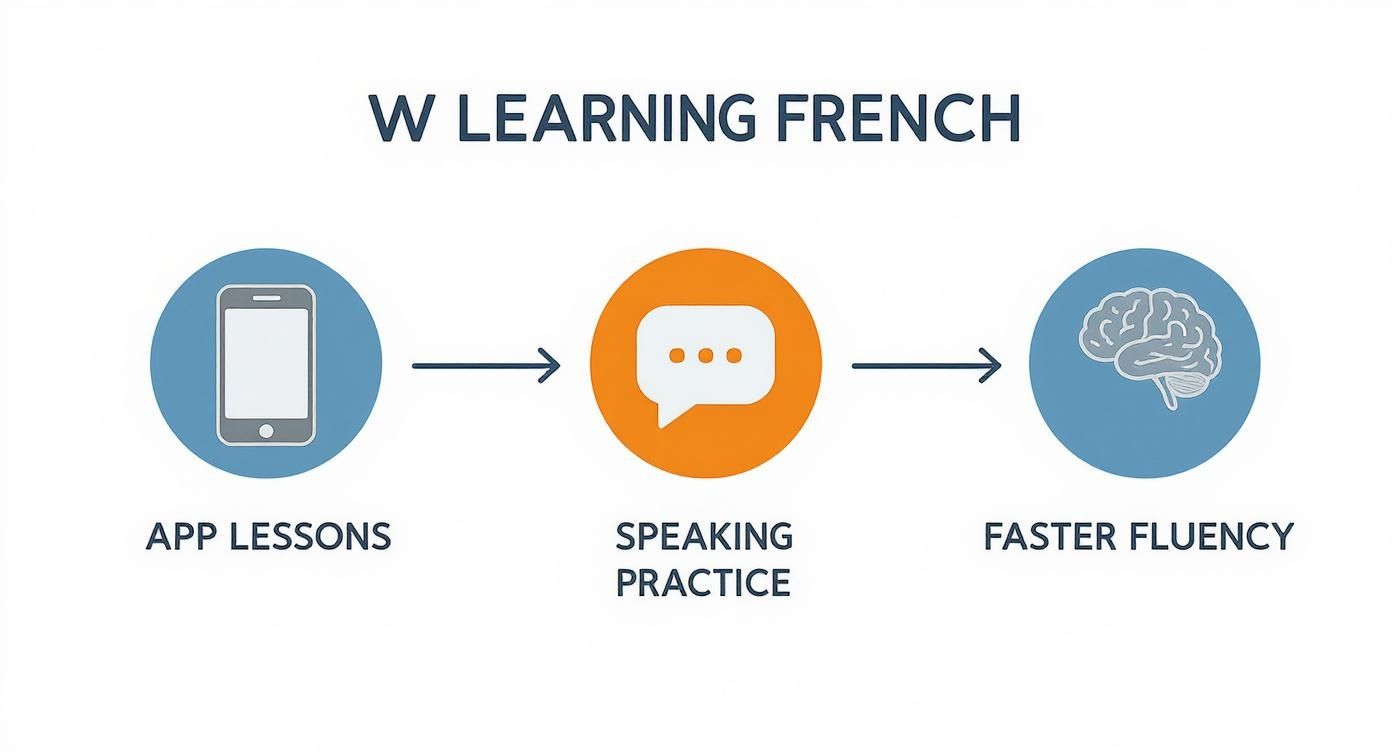
The flow is straightforward: consistent app lessons build your foundation, which you then bring to life through speaking practice. The result? You get fluent, faster.
The Power of Consistent, Gamified Practice
And the data backs this up. Interactive language apps have become one of the most effective ways to learn French, with millions of people jumping into short, focused lessons every day.
Research shows that consistent app users can grow their vocabulary up to 40% faster than people relying on traditional classroom settings alone. More importantly, learners who pair their app time with real speaking practice report a 30% higher fluency gain in just six months.
The biggest shift in language learning isn't just the tools themselves, but the mindset they foster. It’s all about making small, consistent efforts every single day, turning learning into a habit instead of a task.
The key is to weave these digital tools into a balanced routine. You're not just replacing old methods; you're supercharging them. You could run through an app lesson on your commute, practice with conversation games on your coffee break, and then apply what you've learned by listening to a French podcast later that evening.
To find the right platform for you, check out our guide on the best language learning apps to see how the top options compare. This strategy of learning smarter, not just harder, is what makes the path to fluency more intuitive and successful than ever before.
Laying the Foundation: French Grammar and Vocabulary
Grammar and vocabulary are the twin pillars of any language. But let's be honest—the old-school way of memorizing endless verb charts and word lists is a direct path to burnout. The smart way to learn French is to build these foundations using methods that work with your brain's natural learning process, not against it.
This means focusing on patterns over rigid rules and learning words in context, not in isolation. Think of grammar less like a stuffy instruction manual and more like the underlying logic of the language. The goal isn't to become a linguist; it's to communicate.
Hack Your Memory with Spaced Repetition
One of the most powerful tools you can use for vocabulary is the Spaced Repetition System (SRS). This isn't just a fancy term for flashcards; it's a proven method for jamming information into your long-term memory.
An SRS algorithm figures out the exact moment you're about to forget a word and prompts you to review it. This process of "active recall" makes the neural connections stronger, making the word stick for good. To really get the most out of every study session, you should explore these science-backed techniques for better information retention.
Modern apps like PolyChat have SRS built right into their games and lessons. When you learn new words, they’re automatically scheduled for review, so you don't even have to think about it.
Create Your Own Living Dictionary
The best vocabulary list is one that reflects your life and your interests. A generic, pre-made list just doesn't cut it. What you need is a dynamic, "living dictionary" that you build yourself.
This is where a tool like PolyChat’s personal dictionary feature becomes incredibly useful. You can instantly save words you find in lessons, games, or even when using its translator. Heard a cool phrase in a French song? Add it. Saw an interesting word on a menu while traveling? Save it.
This approach gives you two huge advantages:
- Context is King: Words are tied to a real memory, which makes them way more memorable than a random word from a list.
- It's All Relevant: You're learning the exact vocabulary you need for the conversations you actually want to have.
The most effective vocabulary isn't the one with the most words, but the one with the right words. Start by focusing on high-frequency words that pop up in everyday conversation.
Demystify French Grammar Hurdles
French grammar has a reputation for being tricky, especially when it comes to verb conjugations and gendered nouns. The key is to stop trying to memorize every single rule and start looking for patterns and shortcuts instead.
Tackling Verb Conjugations Please, don't try to learn all 16 tenses at once. You'll drive yourself crazy. Just start by mastering the present tense of the most common verbs: être (to be), avoir (to have), aller (to go), and faire (to do/make). PolyChat's conjugation tools are perfect for this, letting you drill these essential forms until they become second nature.
Mastering Noun Genders Instead of memorizing the gender of every noun you see, learn to spot the patterns in their endings. It's a massive shortcut.
- Nouns ending in -ion, -ure, and -ette are almost always feminine (la nation, la voiture, la baguette).
- Nouns ending in -eau, -ment, and -isme are typically masculine (le bateau, le monument, le socialisme).
Sure, there are exceptions, but these patterns work a surprising amount of the time. For the outliers, use mnemonic tricks. For instance, to remember that le livre (the book) is masculine, you could picture your brother (a male) reading a book. Tying the word to a gendered image makes it much easier to recall later.
From Knowing French to Using French
Let’s be honest. You can memorize every grammar rule in the book and have a killer vocabulary, but that’s only half the battle. The real goal, the reason you started this journey, is to actually use the language—to understand a fast-talking Parisian and to confidently order your own damn croissant.
This is where so many learners get stuck. They’re trapped with a head full of knowledge they can’t seem to activate. The key is to shift your focus from passively studying French to actively using it, every single day. You need to train your ears to decode the melody of native speech and get your mouth comfortable forming its unique sounds. It's time to go from being a student to being a speaker.
First, Train Your Ear
Just playing a French movie in the background while you do the dishes won’t cut it. That's just noise. Active listening, on the other hand, is a focused workout for your brain where the goal is real comprehension.
The trick is to find stuff that’s just a little bit beyond your current grasp. It should be challenging enough to stretch you, but not so hard that you feel totally lost and give up.
Start with content made specifically for learners before you dive into the deep end with native-level material.
- Beginner Podcasts: Check out shows like Coffee Break French or innerFrench. The hosts speak slowly and clearly, and they often break down tricky vocabulary right in the episode.
- Graded Readers: These are fantastic. They're books written with simplified language, and many come with audio. Listening while you read is a game-changer for connecting the written word to the spoken sound.
- YouTube Channels: There are tons of channels for French learners, offering everything from slow-paced vlogs to grammar explanations.
Once you feel your comprehension getting sharper, it’s time to level up. Try watching a French series on Netflix, but switch the subtitles to French, not English. This is tough at first, but it forces your brain to match the sounds you’re hearing with the words on the screen. Your listening speed will thank you for it.
Find Your French Voice with Shadowing
One of the most powerful techniques I've ever used to sound more natural is shadowing. It’s simple: you listen to a short clip of a native speaker, and you repeat what they say almost immediately, trying to copy their pronunciation, rhythm, and intonation exactly.
It feels a little weird when you first start, but the results are incredible. You're not just repeating words; you're mimicking the music of the language. This literally trains the muscles in your mouth to make sounds that don’t exist in English. Start small. Just one or two sentences at a time. Pause the audio, replay it, and repeat until you sound like a perfect echo.
Shadowing is like a hack for your brain. It bypasses the impulse to apply English pronunciation rules and forces you to reproduce sounds authentically. It's one of the fastest ways to soften a foreign accent.
Get Over the Fear and Just Speak
The single biggest wall between you and fluency? The fear of sounding stupid. We’ve all been there. But here's the good news: you don't need a plane ticket to France to start talking. The whole point is to get consistent, low-stakes practice to build up your confidence.
- Talk to an AI: This is a perfect, judgment-free zone. PolyChat’s AI conversation games let you practice speaking out loud without any pressure. You can stumble, try out new phrases, and fix your pronunciation without feeling self-conscious.
- Narrate Your Life: Seriously, talk to yourself in French. As you’re making coffee, say, "Je prépare mon café." See a cute dog on your walk? "C'est un chien mignon." This little habit weaves French into your daily thought process and makes it feel more natural.
- Find a Real Person: Language exchange apps like Tandem or HelloTalk are brilliant. You can find native French speakers who are learning English, and you split your time between the two languages. It’s free, it works, and you might just make a new friend.
If you’re craving more structure and personalized feedback, a tutor can make all the difference. You can find some of the best online French teachers who can tailor conversation practice to your specific goals and budget.
The goal is to make speaking a habit, not a special event. That’s how you turn all that passive knowledge into an active, confident skill.
Find Fluency in Your Everyday Life
You don't need a plane ticket to Paris to immerse yourself in French. The best way to learn the language and hit that fluency milestone is to weave it directly into the fabric of your daily life. It’s about creating a rich, French-speaking world right where you are.
Think of it this way: this approach turns learning from a chore into a natural, living experience. It's the difference between memorizing a recipe and actually cooking the meal—one is just theory, but the other is a hands-on skill that sticks with you. When you surround yourself with French, every new word finds a home in a real-world context.
Give Your Digital World a French Makeover
Let's be honest, your phone is probably the first thing you see in the morning and the last thing you see at night. This makes it the perfect, low-effort tool for daily immersion. Just a few simple tweaks to your digital life can expose you to hundreds of French words and phrases without adding a single minute of "study" time.
Start with the big one: switch your phone’s language to French. It’s going to feel weird for a day or two, navigating familiar apps with unfamiliar labels. But your brain will catch on shockingly fast. You already know where the "settings" icon is by muscle memory; now you'll learn it's called Réglages.
Here are a few other quick digital swaps you can make right now:
- Social Media: Follow French-speaking creators, journalists, and comedians on Instagram, X, or TikTok. Your feed will start filling up with short, authentic, and often entertaining content.
- Music Playlists: Fire up Spotify or Apple Music and create a playlist of Francophone artists. Explore musicians from France (like Stromae), Quebec (Cœur de pirate), or Senegal (Youssou N'Dour) to get your ears used to different accents and rhythms.
- News and Media: Switch the region on your news app or start browsing sites like Le Monde or Radio-Canada for your daily updates.
The goal isn't to understand every single word from the get-go. It's to make French feel normal. This constant, even passive, exposure helps your brain internalize the patterns, sounds, and flow of the language.
Look Beyond France: Explore the Global Francophone Culture
Focusing only on Parisian French is like learning English by watching nothing but British period dramas. The French-speaking world, la Francophonie, is huge and incredibly diverse, stretching from the Caribbean to Africa and North America. Tapping into these different cultures doesn't just make learning more interesting—it's essential for understanding French in the real world.
French is the fifth most spoken language globally, with around 321 million speakers. That number is set to jump to nearly 500 million by 2025, thanks in large part to population growth in sub-Saharan Africa. What this means for you is that a modern approach to learning French must include exposure to different accents and cultural flavors. You can learn more about this incredible linguistic diversity by checking out the French language's worldwide presence on en.wikipedia.org.
Your Digital Immersion Checklist
Turning your world into a French classroom is all about building small, sustainable habits. This checklist will help you integrate the language into your routine, creating a powerful learning environment without it feeling like work.
| Activity | Beginner Level Action | Intermediate Level Action |
|---|---|---|
| Entertainment | Watch a favorite movie you know well with French audio and English subtitles. | Watch a French series (like Lupin or Dix pour cent) with French subtitles. |
| Reading | Read a children's book or a graded reader in French. | Read news articles or blog posts on topics you already love, like tech or travel. |
| Cooking | Follow a simple French recipe from a YouTube video with visual cues. | Try to cook an entire meal using only a French-language recipe blog. |
| Gaming | Switch the language of a familiar video game to French. | Join a French-speaking Discord server for a game you play and try chatting. |
These little changes might not feel like much on their own, but they add up. Over time, they build a deep familiarity with the language that makes your active study sessions in PolyChat far more effective. You're connecting with French in a way that feels natural and personal, making the journey to fluency not just faster, but a whole lot more fun.
How to Measure Progress and Stay Motivated
Let’s be honest: learning a language is a marathon, not a sprint. Your motivation is the fuel that keeps you going, and without a way to see how far you've come, it’s easy to run out of steam. The best way to learn French for the long haul is to build a system for tracking your growth and celebrating the wins.
This isn't about chasing some vague idea of perfection. It’s about recognizing real, tangible progress. You’re going to have good days and bad days, but with the right mindset, you'll build the resilience to go from a hesitant beginner to a confident speaker.
Set Goals That Actually Work
Vague goals like "become fluent" are motivation killers. Why? Because you can't measure them. You need specific, tangible targets that give you something real to work toward. This is where SMART goals (Specific, Measurable, Achievable, Relevant, and Time-bound) are a game-changer.
Instead of "get better at speaking," try this: "In three months, I will be able to hold a five-minute conversation with my language partner about my weekend, using the passé composé correctly."
This goal is so much more powerful because it's:
- Specific: You’re targeting a topic (your weekend) and a grammar point (passé composé).
- Measurable: You can literally time the conversation. Did you hit five minutes?
- Achievable: Five minutes is a challenge, but it’s a realistic goal for three months of practice.
- Relevant: This directly helps you have the real-world conversations you want to have.
- Time-bound: A three-month deadline creates focus and a healthy sense of urgency.
Create Your Own Feedback Loop
One of the best ways to see how far you’ve come is to create your own feedback loop. This gives you undeniable proof of your improvement, which is a massive motivational boost when you feel like you're stuck in a rut.
Here’s a simple trick: Once a month, record yourself speaking French for one minute. Pick a topic—what you did today, a movie you just saw—and just talk. No script. Save the recording and forget about it.
After three or four months, go back and listen to that first recording. You will be absolutely shocked by how much more natural and confident you sound. This tangible evidence of progress is priceless.
Navigating the Dreaded Intermediate Plateau
Every language learner hits it. That frustrating stage where you feel like you’re studying just as hard, but your progress has slowed to a crawl. You know a lot, but fluency still feels miles away.
The intermediate plateau isn’t a sign that you’ve stopped learning; it's a sign that your learning needs to change. Progress is no longer about big vocabulary gains but about refining your nuance, speed, and accuracy.
To push through, you have to get a little uncomfortable. If you’ve been listening to podcasts for learners, it's time to switch to content made for native speakers. If you're comfortable talking about your hobbies, start trying to discuss more complex topics like current events. That deliberate push outside your comfort zone is exactly what reignites progress.
Celebrate Every Small Victory
Motivation isn't just about hitting big, long-term goals. It's about recognizing the small wins that happen every single day.
Did you finally understand a line in a song without looking up the lyrics? That’s a win. Did you manage to order your coffee entirely in French? That's a huge win.
Using a gamified app like PolyChat makes this almost automatic. Each completed lesson, won game, or mastered verb conjugation feels like a small, satisfying victory. These micro-successes create a positive feedback loop that keeps you coming back for more. You can dive deeper into how this works in our article on the psychology of gamification in language learning.
Acknowledging these little moments reminds you that you are making progress, even on days when it doesn’t quite feel like it.
Common Questions About Learning French
Diving into a new language like French always kicks up a few questions. Getting a handle on these common queries right from the start helps you set realistic goals, avoid the usual traps, and keep your motivation burning bright.
Think of this as your practical FAQ for the road ahead. With the right perspective, you can tackle your studies with confidence and make the whole process a lot more fun.
How Long Does It Realistically Take to Become Fluent in French?
This is the million-dollar question, isn't it? The honest answer is: it depends. But we can get pretty close.
For an English speaker, language experts estimate it takes somewhere between 600-750 hours of solid study to hit the B2 level—that’s what most people consider “conversationally fluent.”
If you put in about an hour a day, you're looking at a timeline of roughly 1.5 to 2 years. But this isn't set in stone. Several things can speed up or slow down your journey:
- Intensity: A few focused hours every week will always beat sporadic 15-minute sessions.
- Methodology: Active learning, like daily speaking and immersion, blows passive study out of the water. It’s the difference between knowing about French and actually using it.
- Prior Experience: Already know some Spanish or Italian? You've got a head start. The shared vocabulary and grammar in Romance languages give you a serious leg up.
At the end of the day, consistency beats cramming every single time. Build a sustainable daily habit, and fluency will follow.
What Is the Biggest Mistake Most French Learners Make?
By far, the most common pitfall is getting stuck in "passive learning mode" and never actually speaking. So many learners fall into the trap of thinking they need to "be ready" before they open their mouths. Spoiler alert: that day never comes.
This fear of making mistakes becomes the single biggest roadblock to progress. You can memorize verb charts and flashcard apps for months, but that knowledge just sits there, collecting dust, until you actively put it to use in a conversation.
The best way to learn French is to start speaking from day one. Embrace your mistakes—each one is a valuable piece of data telling you exactly what to work on. It’s not a failure; it’s feedback.
This is where an AI conversation partner becomes a game-changer. It gives you a judgment-free zone to practice, mess up, and build real confidence. It’s the perfect bridge from passive knowledge to active skill.
Should I Learn Parisian French or Another Dialect?
For almost everyone starting out, learning Metropolitan French (what people usually call "Parisian French") is the most practical move. Why? Because the vast majority of learning resources—textbooks, apps like PolyChat, and online courses—are all based on this standard.
But the "best" dialect really hinges on your personal goals.
- Planning to live and work in Montreal? Diving into Quebecois French is a no-brainer.
- Fascinated by West African culture? Exploring the dialects of Senegal or Côte d'Ivoire will make your experience so much richer.
Once you have a solid foundation, exposing yourself to different accents is key. The real goal is to understand French as it's spoken all over the world, not just in one city.
How Can I Practice Speaking Without a Native Speaker?
You don't need a plane ticket to Paris to get daily speaking practice anymore. This is where modern tools and a little creativity make all the difference.
A great place to start is simply narrating your day to yourself in French. It sounds a bit odd, but it gets your brain thinking in the language. "Je prépare le café." "Le chat dort sur la chaise." It works.
Next, lean on technology. Language apps with AI conversation partners offer you a chance to practice anytime, anywhere, without the pressure of a live conversation.
Finally, you can find real people online through language exchange platforms. You can connect with native French speakers who are learning English, and you teach each other for free. The key is turning speaking into a consistent, daily habit, no matter how you do it.
Ready to put these strategies into action and build a learning habit that sticks? PolyChat gives you the perfect toolkit, with gamified lessons, AI conversation practice, and powerful conjugation tools to lock in everything you learn. Stop waiting to feel "ready" and start your fluency journey today.

Jean-Baptiste Bolh
Co-Founder
Applied AI