What is the fastest way to learn french: Quick, proven steps to fluency
So, you want to learn French, and you want to do it fast. Forget the old-school approach. The real secret isn't some magic trick; it's about combining smart strategies with consistent, daily action.
The fastest method is an integrated one—a blend of digital immersion, a laser focus on the words that actually matter, and a whole lot of practice without the fear of getting it wrong.
Ready to Learn French?
Try PolyChat's engaging language lessons, interactive learning games and put your French vocabulary to the test!
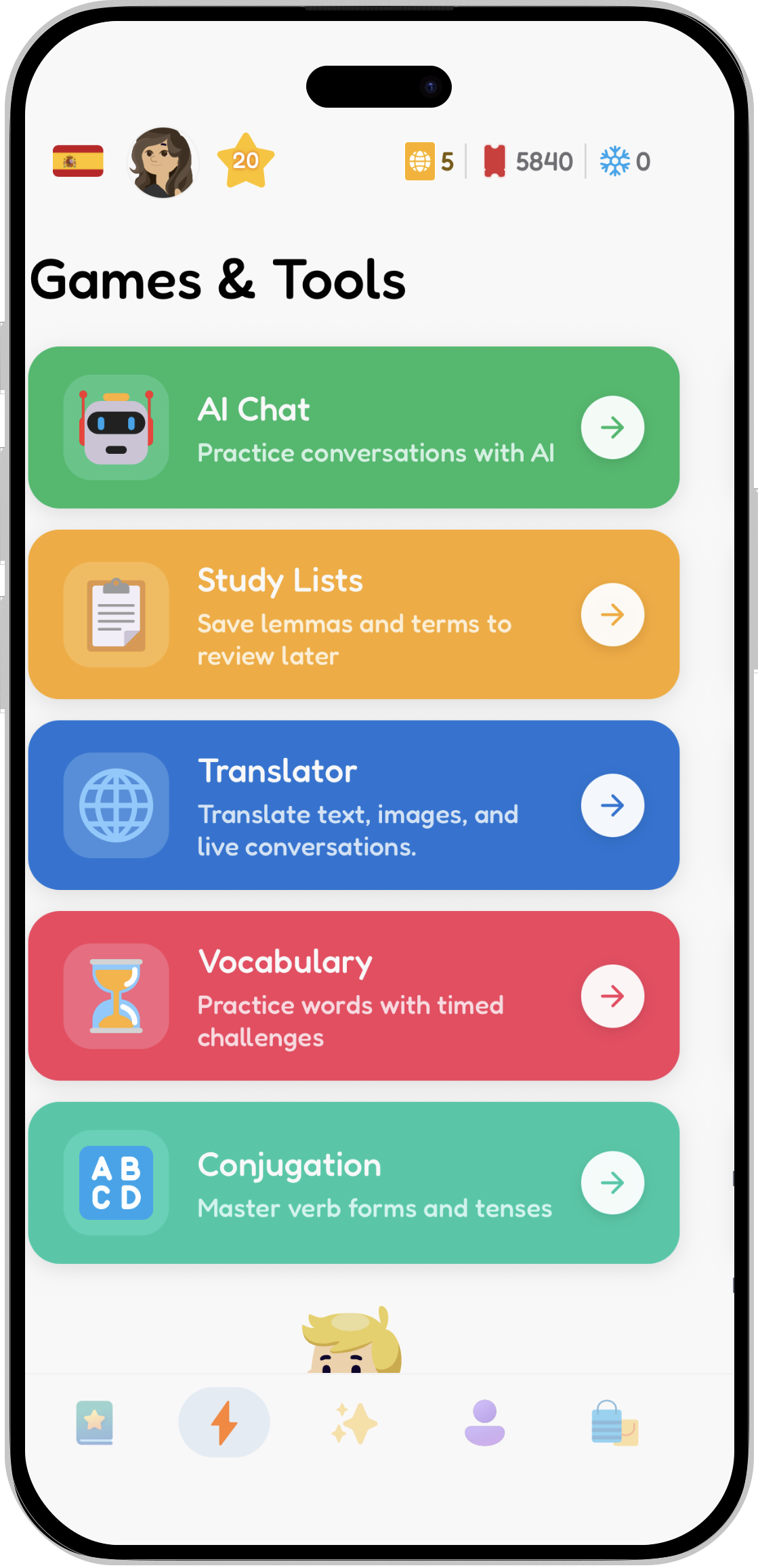
Games & Tools
Tools that every language learner needs at all stages of their learning journey.
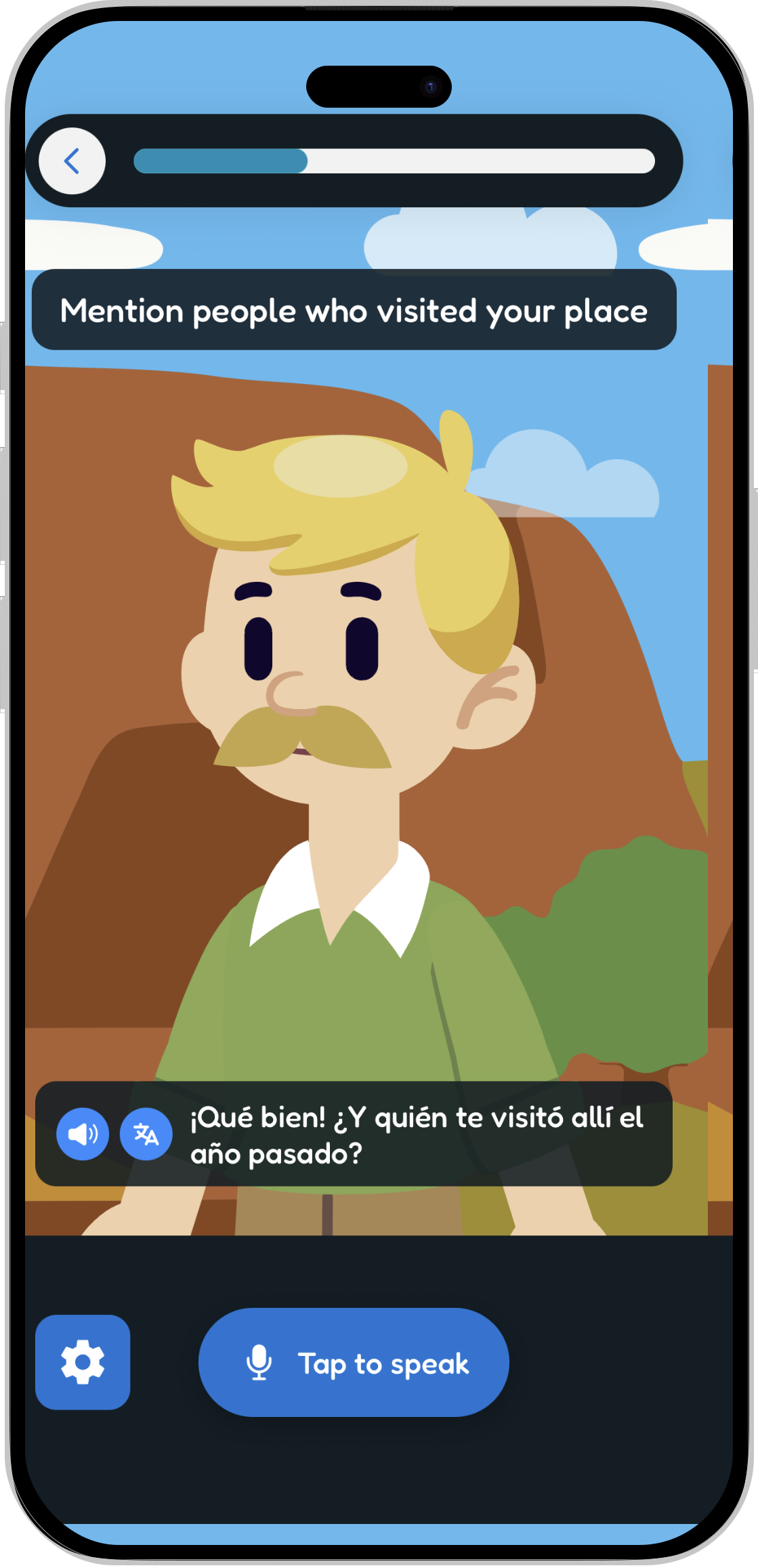
AI Chat Tutor
Practice real conversations with an AI tutor that helps you speak with confidence.
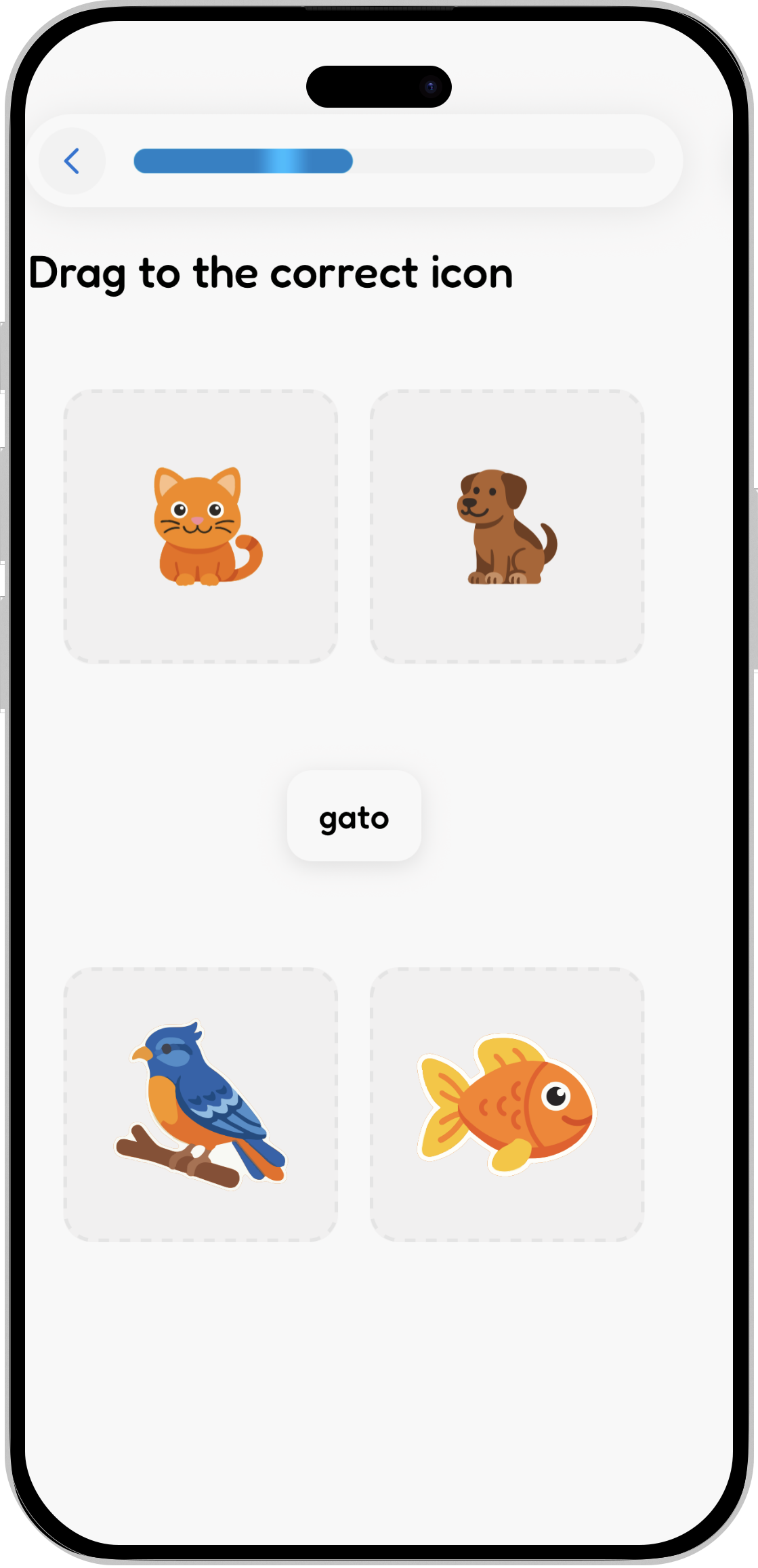
Interactive Games
A variety of games to help you learn and remember new words and phrases.


Your Accelerated Path to French Fluency Starts Here
This guide is your roadmap. We’re moving beyond the slow, traditional classroom methods that leave you feeling frustrated after years of study. Too many people spend ages memorizing obscure grammar rules, only to freeze up when trying to hold a simple conversation.
The key to rapid progress isn’t about studying harder; it’s about studying smarter. It's about zeroing in on what you actually need for real-world communication.
We'll show you how to build a "French bubble" right where you are, turning your everyday routine into a powerful learning engine. It’s all about using modern tools to create a fun, supportive space where you can practice without ever feeling penalized for making a mistake.
Unlocking Rapid Progress with Modern Tools
When you get it right, learning feels less like a chore and more like a game. For instance, did you know that immersing yourself through gamified apps like PolyChat can speed up your French learning by up to 3 times compared to old-school classroom methods?
Data from millions of learners shows that consistent daily practice without annoying restrictions—like PolyChat’s no-hearts system—is what leads to incredible progress. The 2023 Duolingo Language Report echoes these findings about the power of daily, accessible practice.
The foundation of learning French quickly is simple: Maximize your exposure to the language in ways you enjoy, and practice consistently without the fear of making mistakes.
This guide is built on four core pillars. Think of them as the engine that will drive your accelerated journey.
To get a clearer picture, here’s a quick breakdown of the core strategies we’ll be diving into. These are the foundations of any truly effective, high-speed French learning plan.
Key Pillars of Rapid French Learning
| Strategy | Why It Works | Practical Application |
|---|---|---|
| Digital Immersion | Surrounds you with the language, making it a natural part of your day rather than a separate subject to study. | Changing your phone language, listening to French podcasts, watching Netflix in French, following French creators online. |
| Prioritized Learning | Focuses your energy on the 20% of words and grammar that are used in 80% of daily conversations (the Pareto principle). | Mastering the top 1,000 most common words and essential grammar structures like the present, past, and future tenses first. |
| Spaced Repetition | Uses a smart algorithm to show you words right before you’re about to forget them, embedding them into your long-term memory. | Using flashcard apps like Anki or the built-in review features in language apps that automatically schedule your revisions. |
| Deliberate Practice | Involves actively using the language and targeting your specific weak spots, rather than just passively consuming it. | Practicing conversations with an AI tutor, writing a daily journal in French, or focusing on pronunciation exercises for sounds you struggle with. |
Each of these pillars works together to create a powerful, self-reinforcing learning cycle.
Get ready to discover how to put these proven strategies into action with a clear plan to start making real progress from day one.
Mastering the Core Pillars of Rapid Language Learning
If you want to find the fastest way to learn French, you have to work with your brain, not against it. Real speed doesn't come from a single hack. It comes from a solid foundation built on four proven principles that transform passive studying into active, accelerated learning.
These pillars are the secret to actually making sense of the language and using it with confidence.
The first and most powerful pillar is digital immersion. Think of it as creating your own personal "French bubble," even if you're thousands of miles from Paris. Instead of treating French like a subject you cram for an hour a day, you weave it into the very fabric of your life.
This means switching your phone's language to French. It means listening to French podcasts on your commute and watching your favorite Netflix shows with French audio. Your brain starts absorbing the sounds, rhythms, and common phrases naturally, much like a child learns their first language. It’s all about low-pressure exposure and repetition.
Prioritize and Conquer with the 80/20 Rule
Next up is prioritized learning, often known as the 80/20 Rule. Here’s the deal: a tiny fraction of French words and grammar rules are used in the overwhelming majority of daily conversations. In fact, studies show that knowing just the 1,000 most frequent words will allow you to understand around 80% of spoken French.
So, instead of trying to boil the ocean and learn everything at once, your mission is to master this high-impact core first. Focus on the most common verbs, essential sentence structures, and vocabulary that pops up in everyday life. This strategic approach is what separates frustratingly slow progress from the thrill of being able to communicate quickly.
By concentrating on the 20% of French that delivers 80% of the results, you build conversational momentum far faster than traditional methods allow.
This keeps you from getting bogged down in obscure vocabulary or complex grammar you'll almost never encounter. It’s about being smart and targeting what actually matters for real-world conversation.
Make Vocabulary Stick with Spaced Repetition
The third pillar is the Spaced Repetition System (SRS). Our brains are fantastic forgetting machines. SRS is a learning technique designed to fight this natural "forgetting curve" by showing you new words and phrases at increasing intervals—right before you're about to forget them.
Think of it as a flashcard system that’s gotten a PhD. An SRS algorithm tracks how well you know each word and schedules your reviews automatically.
- Nailed a word? You won't see it again for a few days or even weeks.
- Struggling with a word? It'll pop up again much sooner for another look.
- Completely forgot a word? The cycle starts over to rebuild that memory from scratch.
This method is incredibly efficient. It systematically forces information into your long-term memory, ensuring that all the high-frequency vocabulary you're learning actually sticks.
Turn Knowledge into Skill with Deliberate Practice
Finally, we have deliberate practice. This is the crucial bridge between knowing French and actually using French. It’s about moving beyond passively listening or reading and jumping into actively producing the language, spotting your weaknesses, and working specifically to fix them.
True fluency involves more than just speaking; as you immerse yourself, remember that strong writing skills are also vital for overall language mastery.
Deliberate practice means doing targeted exercises that hit your personal weak spots, like that one tricky pronunciation or a verb tense you always mix up. For instance, instead of just repeating phrases from a book, you could use PolyChat's AI to have a conversation, get instant feedback on a mistake you made, and then practice that specific correction until it feels second nature.
This is what turns practice from a guessing game into a focused, goal-oriented activity, and it's the fastest way to become truly fluent in a language. Check out our guide on how to become fluent in a language for more on this.
Building Your High-Speed French Learning Toolkit
Knowing the principles of rapid learning is half the battle. The other half? Picking the right tools for the job. To find the fastest way to learn French, you need a smart, integrated toolkit that actually supports the immersion and practice you’ll be doing. This isn’t about downloading dozens of random apps; it’s about creating a seamless learning ecosystem with one powerful app at its core.
Think of an app like PolyChat as your home base. It provides the structured lessons, vocabulary drills, and conjugation practice that form the backbone of your daily routine. But a great toolkit doesn't stop there. You need to supplement that foundation with real-world resources that keep the language alive, exciting, and, most importantly, relevant to you.
Crafting Your Learning Ecosystem
Your goal is to build a system where every tool has a clear purpose, smoothly moving you from structured, deliberate practice to spontaneous, real-world use. It’s about combining focused app sessions with more relaxed, immersive activities.
Here’s how to assemble your core toolkit:
- Your Core App: This is for your daily, focused practice. A gamified platform keeps you motivated, and built-in features like a personal dictionary and translator streamline your study sessions. For more ideas, check out our guide on the best language learning apps for adults.
- Real-World Media: You have to supplement lessons with content you genuinely enjoy. This could be binge-watching a Netflix series like Lupin with French audio and subtitles, or listening to a podcast like InnerFrench on your commute. This kind of passive exposure is absolutely vital for tuning your ear to the natural rhythm and flow of the language.
- Conversation Practice: Theory is useless if you can't apply it. Find a language exchange partner on a platform like Tandem or HelloTalk. Speaking with a native speaker, even for just 15 minutes a day, bridges that massive gap between knowing words and actually using them in a real conversation.
The most effective toolkit is one you actually use. Choose resources that align with your interests, whether that’s French cooking shows, football commentary, or fashion blogs. Engagement is the fuel for consistency.
Integrating Modern Aids for an Extra Edge
Beyond these core components, a few modern aids can give you an extra push. For instance, as you start reading French articles or news, you can use document translation software to quickly make sense of complex texts and expand your vocabulary on the fly. These tools are perfect for those moments when you need a quick comprehension boost without completely breaking your immersion flow.
This integrated approach ensures you're always surrounded by French. One moment you're mastering verb conjugations in PolyChat; the next, you're hearing those exact same verbs used naturally in a podcast. This constant reinforcement across different contexts is what truly cements new knowledge and accelerates your path to fluency.
Your 30-Day French Sprint: A Daily Action Plan
Let’s get one thing straight: the fastest way to learn French isn’t about finding eight free hours in your day. It’s about being smart with the time you do have. Consistency is the engine, and a solid daily plan is the fuel.
Forget marathon study sessions that leave you burnt out. The real magic happens in short, focused bursts. Think about it: a quick vocabulary game on PolyChat with your morning coffee, a French podcast on your commute, and a single, focused lesson in the evening. Each small effort builds on the last, creating powerful momentum.
You're not just using one tool; you're building a daily toolkit.
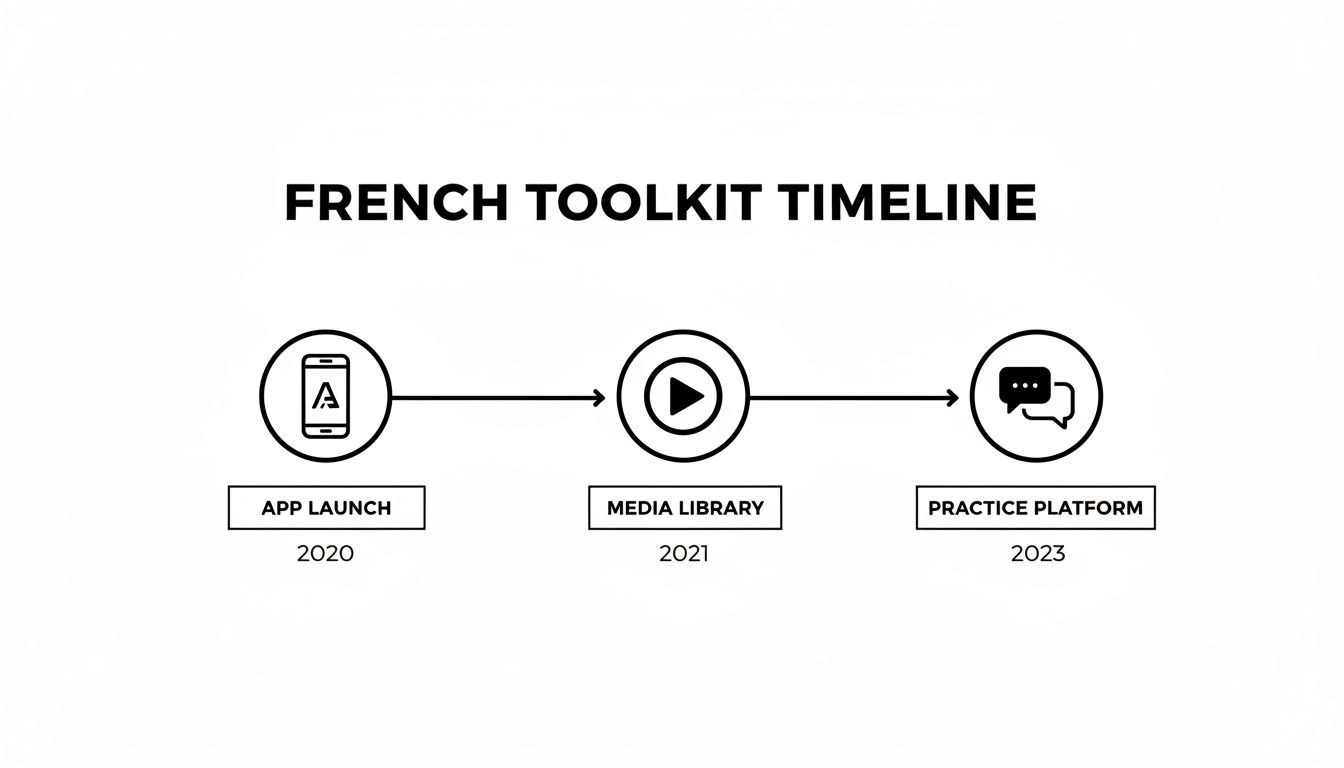
The idea is simple but powerful: make an app, media, and active practice work together every single day.
Your Daily Mission: Morning and Midday
Your brain is sharpest in the morning, which makes it the perfect time to tackle new material.
Morning (15–20 Minutes):
- Activity: Jump into PolyChat for a new lesson or vocabulary game. Your goal is to learn 10-15 new high-frequency words and one core grammar concept.
- Why it Works: You’re front-loading your brain with new information when it’s fresh and ready to learn. PolyChat’s game-like feel makes this a fun warm-up, not a chore. To really get ahead, check out these strategies for how to learn vocabulary fast.
Midday/Commute (20–30 Minutes):
- Activity: Pop on a French podcast (like Coffee Break French) or a playlist of French music. The key here is not to stress about understanding every single word.
- Why it Works: This is passive immersion. You’re training your ear to catch the rhythm, sounds, and natural flow of spoken French—a crucial skill that you can’t get from textbooks alone.
Your Evening Wind-Down
The evening is your time to connect the dots. You’ll take what you learned in the morning and apply it in a relaxed, low-pressure way.
The goal isn't perfection; it's consistency. Sticking with a focused 30-minute routine every day will beat a four-hour cram session once a week, every single time.
Here's a sample schedule that shows how to turn these ideas into a concrete daily plan. This template helps you integrate active learning, passive immersion, and practical application into even the busiest of days.
Sample Daily French Learning Schedule
| Time of Day | Activity (1-2 Hours Total) | Recommended Tool/Method |
|---|---|---|
| Morning Coffee (15-20 min) | Learn 10-15 new words + one grammar rule. | PolyChat Lesson or Quickshot Game |
| Commute/Lunch (20-30 min) | Listen to native speakers to train your ear. | French Podcast or Music Playlist |
| Early Evening (15-20 min) | Review the day's new words and phrases. | Spaced Repetition (PolyChat's dictionary or flashcards) |
| Late Evening (30-45 min) | Watch a French series with subtitles. | Netflix (Lupin, Dix Pour Cent) or YouTube |
This balanced approach ensures you’re hitting all the pillars of effective learning. Feel free to shift the times to fit your own schedule, but try to keep the core activities.
After just 30 days, this routine will feel less like a plan and more like a habit—a powerful, effortless habit that has built a rock-solid foundation in French.
Avoiding Common Pitfalls That Derail Your Progress
Knowing the fastest way to learn French isn’t just about adopting the right strategies—it’s also about sidestepping the common traps that will grind your progress to a halt. I’ve seen it time and time again: enthusiastic learners get stuck in predictable ruts that kill their momentum and motivation.
Let’s walk through the biggest mistakes so you can avoid them from day one.
The number one roadblock is the fear of making mistakes. So many learners wait until they feel “ready” to speak, chasing perfect grammar and pronunciation right out of the gate. This perfectionism is paralyzing.
Here's the truth: errors are not failures. They’re data points showing you exactly where you need to improve.
A supportive, low-stakes environment is the key to getting over this fear. In a gamified app like PolyChat, mistakes are just part of the game, not a reason to lose progress. This freedom to mess up without penalty is what builds real confidence and, eventually, fluency.
The Cram and Forget Cycle
Another classic mistake is treating French like a subject you need to cram for a test. Spending hours drilling vocabulary lists or complex verb tables right before a trip might feel productive, but that knowledge rarely sticks around. This “cram and forget” cycle is incredibly inefficient because it completely ignores how our brains actually learn.
The solution is simple: consistency over intensity.
Short, daily practice sessions are way more powerful than one marathon study session per week. Just committing to 15-20 minutes a day builds a durable habit and puts the magic of spaced repetition to work, moving French from your short-term memory into your long-term storage.
Focusing on the Wrong Things
It’s so easy to get lost in the weeds of French grammar. Many traditional courses obsess over obscure rules and exceptions that native speakers barely think about in daily conversation. While grammar is definitely important, getting bogged down in advanced concepts too early is a guaranteed way to slow yourself down.
Don’t let perfect be the enemy of good. Prioritize communication over grammatical perfection. The goal is to connect with people, not to pass a linguistics exam.
Instead, apply the 80/20 principle. Focus on the high-frequency vocabulary and essential grammar that power the vast majority of everyday interactions. You need to master the present tense long before you ever worry about the subjunctive. This practical approach ensures you're always learning something you can use right now.
On a similar note, many learners fall into the trap of passive consumption. Listening to French podcasts or watching movies is fantastic for immersion, but it isn’t enough on its own. You have to shift from being a passive listener to an active participant.
This means you need to get your hands dirty:
- Shadowing: Don’t just listen to a podcast. Pause it and repeat phrases out loud to work on your accent and rhythm.
- Interacting: Use PolyChat’s AI conversation games to practice responding in real-time. It’s the perfect bridge between learning a word and actually using it.
- Applying: Did you learn a new word from a Netflix show? Make it a mission to use it in your next practice session.
By actively using the language, you turn passive knowledge into an active skill. This hands-on approach is what separates the learners who make slow progress from those who get fluent, fast.
Burning Questions About Learning French Fast
So you're ready to learn French, and you want to do it fast. That's the right attitude, but it probably brings up a ton of questions. How fast is "fast," really? Where on earth do you even start? What happens when you get stuck?
Let's clear the air and tackle the most common questions people have when they decide to go all-in on French.
How Long Does It Really Take to Learn French?
This is the big one, isn't it? The honest answer is it depends on what you mean by "learned" and how much you show up. But for a dedicated learner, reaching a solid conversational level (what experts call B1) where you can handle everyday chats and travel with confidence is totally doable in 3 to 6 months.
But you don't get there by accident. It requires a smart, consistent game plan.
- Your Daily Dose: You need to be putting in about 60-90 minutes of focused work every day. And I don't just mean tapping on an app—this is a mix of active study, listening to podcasts on your commute, and maybe even watching a French series on Netflix.
- Method is Everything: Trying to learn French the old-school way with heavy grammar books is a slow, painful road. The fastest path is to make French a part of your life through immersion and focusing on the words you'll actually use.
Speed is a direct result of consistent, intelligent effort. It's not magic; it's just a better strategy.
Okay, I'm Short on Time. What Should I Focus on First?
When you're trying to learn fast, you have to be ruthless with your priorities. Don't try to boil the ocean and learn every single French word and grammar rule at once. Apply the 80/20 principle: focus on the 20% that will give you 80% of the results.
Here's your mission for the first few weeks:
- The Top 1,000 Words: Get this—the 1,000 most common words in French make up about 80% of everything you'll hear in a normal day. Master these first, and you'll be able to understand and say a shocking amount.
- The Three Core Tenses: Forget about the fancy stuff for now. You only need three tenses to communicate almost anything you want: the present (le présent), the most common past tense (le passé composé), and the near future (le futur proche).
By locking down this small but powerful core, you build a functional foundation for real conversation in a fraction of the time. You can actually use the language instead of just studying it.
Help! I'm Stuck. How Do I Stay Motivated When I Hit a Plateau?
First off, hitting a plateau is completely normal. It happens to everyone. The crazy-fast progress you see at the beginning inevitably slows down, and it can feel like you're just spinning your wheels. The secret to pushing through is to shake things up and celebrate the small wins.
If you feel like you're stuck in the mud, give these a try:
- Switch Up Your Input: Bored of your French news podcast? Find a French comedy series. Tired of vocabulary flashcards? Put on a playlist of French pop music and look up the lyrics. A change of scenery for your brain can work wonders.
- Go for a Micro-Win: Instead of a vague goal like "get better at speaking," narrow it down to something tiny. Make it your mission this week to perfectly master ordering a coffee and a croissant. Nailing small, real-world tasks builds momentum.
- Look at the Data: Use an app like PolyChat that actually shows you your stats. Seeing that you've learned 500 new words or completed 30 lessons is hard proof that you're still moving forward, even when it doesn't feel like it.
Remember, the fastest way to learn French isn't about avoiding the bumps in the road—it's about knowing how to navigate them without losing speed.
Ready to stop wondering and start doing? With PolyChat, you get unlimited, gamified practice that makes it fun and easy to stay consistent. Ditch the frustrating limits and build real momentum with lessons, vocabulary games, and AI conversation practice designed for speed. Download PolyChat today and kick your French journey into high gear.

Jean-Baptiste Bolh
Co-Founder
Applied AI