A Practical Guide to German Question Words
If you want to have a real conversation in German, you need to be able to ask questions. It’s that simple. Mastering the essential German question words—known as W-Fragen—is your fastest ticket from passively listening to actively participating in daily life. Words like wer (who), was (what), wann (when), and warum (why) are the keys that unlock everything.
Why German Question Words Are Your Conversational Superpower
Think about it: how could you possibly get to know someone, ask for directions, or even order a coffee without being able to ask a question? You can't. Questions are the engine of every single conversation. They show you're curious, they help you gather information, and they're how you build real connections with people.
In German, a handful of powerful words, called W-Fragen (because nearly all of them start with a 'W'), give you this exact ability.
Don't think of these as just another vocabulary list to memorize. See them as a practical toolkit for navigating the world. They’re what let you ask where the nearest U-Bahn station is, what time the movie starts, or why your friend is laughing. They turn you from a tourist into a participant.
The Foundation of Fluent Communication
Focusing on these words from the get-go is just a smart strategy. They are, without a doubt, some of the most frequently used words in the entire language, so you're guaranteed to hear and use them constantly.
This isn’t just a hunch; it’s how we’re wired to learn. Prioritizing high-frequency words gets you speaking and understanding faster. This is one of the most effective shortcuts when you want to learn German fast.
Every time you build a question, you're not just asking for information—you're getting hands-on practice with German sentence structure, verb placement, and even the case system. It’s a workout for your grammar brain without even realizing it.
The core W-Fragen are your keys to the kingdom. By mastering just a handful of them, you unlock the ability to ask about almost anything, making every interaction an opportunity to learn and connect.
To get you started, here's a quick-reference table with the absolute essentials. Think of it as your starter pack. We'll dive deep into each one throughout this guide, but for now, just get familiar with them.
Your German Question Word Starter Pack
This little cheat sheet covers the most common W-Fragen you'll encounter.
| German Question Word | English Meaning | Example Sentence |
|---|---|---|
| Wer | Who | Wer ist das? (Who is that?) |
| Was | What | Was machst du? (What are you doing?) |
| Wann | When | Wann beginnt der Film? (When does the film start?) |
| Wo | Where | Wo ist der Bahnhof? (Where is the train station?) |
| Warum | Why | Warum lachst du? (Why are you laughing?) |
| Wie | How | Wie geht es dir? (How are you?) |
Keep this table handy. In the next sections, we're going to break each one down with more examples, rules, and common mistakes so you can start using them with confidence right away.
Your Essential Toolkit of German W-Fragen
Let’s meet the core team of German question words, the ones you'll use constantly in everyday conversation. Think of these W-Fragen not as a boring vocabulary list, but as a journalist's toolkit. Each one is a specific tool designed to get a specific piece of information, helping you build a complete picture of any situation.
Getting these six fundamental words down is the first huge step toward feeling comfortable having real conversations in German. They're your go-to instruments for asking about people, things, time, reasons, methods, and places.
Wer (Who) Asking About People
When you want to know who did something or who someone is, wer is your word. It’s the direct German equivalent of "who" and helps you put a name to a face or a title to a person.
- Wer ist das? (Who is that?)
- Wer hat das gesagt? (Who said that?)
- Wer kommt zur Party? (Who is coming to the party?)
Think of wer as your social detective tool. It's used exclusively for people, so you'll never use it when asking about an object or an idea.
Was (What) For Objects and Ideas
For everything else—objects, concepts, activities, or ideas—you’ll use was. This is your all-purpose tool for asking "what." It's incredibly versatile and easily one of the most common German words you'll hear and use.
- Was ist dein Lieblingsessen? (What is your favorite food?)
- Was machst du am Wochenende? (What are you doing on the weekend?)
- Was bedeutet dieses Wort? (What does this word mean?)
From figuring out what's in a mysterious box to asking someone's profession (Was sind Sie von Beruf?), was is absolutely essential for making sense of the world around you.
Wann (When) Pinpointing Time
To ask about time—whether it's the time of day, a specific date, or a general event—you’ll always grab wann. It cuts straight to the chase, helping you make plans and understand schedules.
- Wann beginnt der Film? (When does the film begin?)
- Wann hast du Geburtstag? (When is your birthday?)
- Wann fährt der nächste Zug? (When does the next train leave?)
Keep in mind, wann is for asking about a specific point in time. It's different from asking about duration (how long something takes), which uses other phrases. For the simple question of "when," wann is your reliable clock.
Wo (Where) Identifying Location
When you need to know a location, wo is your best friend. It asks about a static place—where something or someone is right now. This is the word you’ll use constantly, whether you're navigating a new city or just trying to find your keys.
- Wo ist die Toilette? (Where is the bathroom?)
- Wo wohnst du? (Where do you live?)
- Wo kann ich ein Ticket kaufen? (Where can I buy a ticket?)
This little question word is basically your personal GPS for getting around in German-speaking countries.
Warum (Why) Uncovering Reasons
To understand the reason or motivation behind something, you need warum. It’s the classic "why" that helps you dig deeper into conversations and really understand cause and effect. Using warum shows you're genuinely curious.
- Warum lernst du Deutsch? (Why are you learning German?)
- Warum ist der Laden geschlossen? (Why is the shop closed?)
- Warum hast du das gemacht? (Why did you do that?)
Wie (How) Describing Manner and Method
Finally, wie is your tool for asking "how." It’s incredibly flexible and is used to ask about the way something is done, the condition of something, or just to ask for a description.
- Wie geht es dir? (How are you?)
- Wie funktioniert das? (How does that work?)
- Wie komme ich zum Bahnhof? (How do I get to the train station?)
These six words are the absolute foundation of your question-asking abilities in German. Once you get comfortable with them, you’re not just learning vocabulary; you’re building the framework for every conversation you'll have from now on.
How to Build a Perfect German Question
If you want to ask questions in German, you need to know one golden rule. It's the secret sauce that makes everything click into place.
Ready for it? The question word (Wer, Was, Wo, etc.) always comes first, and the verb always comes second. Always. This is called V2 word order, and it's the bedrock of German questions. Once you get this down, you can ask just about anything.
Think of it as a simple, two-step dance: question word, then verb. The rest of the sentence just follows along.
The Basic Word Order Formula
Let's break down the sentence structure. It’s a simple recipe:
- Question Word (The W-Frage)
- Conjugated Verb (The action word, matched to the subject)
- Subject (Who or what is doing the action)
- Everything Else (Objects, time, place, etc.)
Here’s what that looks like in action:
- Wer (Question Word)
- isst (Verb)
- du (Subject)
- Pizza? (Everything Else)
This structure is non-negotiable. The question word has to be in that first slot to signal that you're asking for information. It doesn’t matter if you’re asking “Wann beginnt der Film?” (When does the movie start?) or “Wo wohnst du?” (Where do you live?); the pattern holds true.
What About Modal Verbs?
Things get a little more interesting when you add a modal verb like können (can), wollen (want), or müssen (must). The V2 rule still applies, but there’s a small twist.
The modal verb takes the second spot (because it's the conjugated verb), and the main verb gets kicked all the way to the end of the sentence in its infinitive form.
Let's see the difference:
- Without a modal: Was machst du? (What are you doing?)
- With a modal: Was willst du machen? (What do you want to do?)
See how willst (the modal) grabs that all-important second position, and machen (the main verb) gets booted to the back? This keeps your question perfectly clear and grammatically sound.
This diagram shows how the core German question words lock into place, paving the way for the verb.
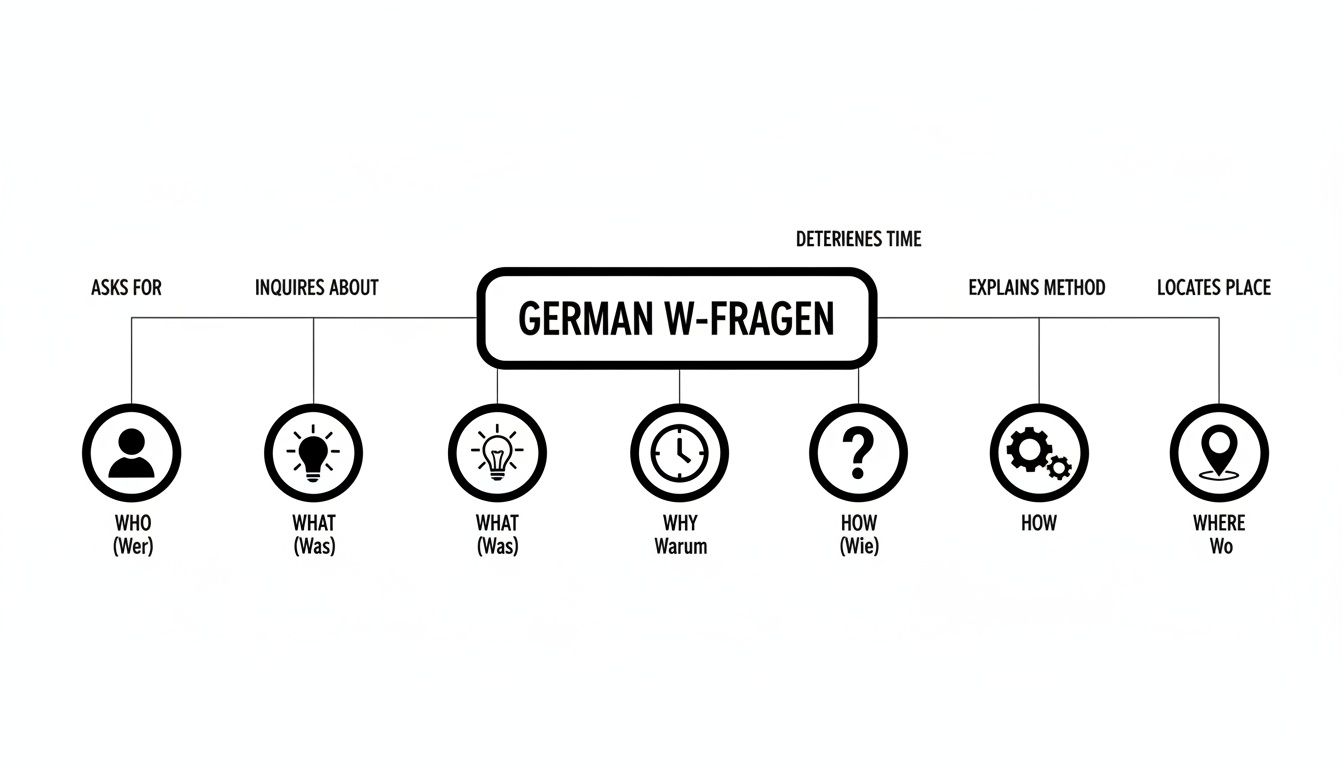
It’s a great visual reminder: the W-word leads, the verb follows right behind, and the subject is next in line.
Before and After Examples
It's amazing how just shuffling a few words can completely transform a sentence from a statement into a question.
Here are a couple of quick transformations. Notice how the verb flips with the subject as soon as the question word appears at the front.
-
Statement: Du gehst zur Schule. (You are going to school.)
-
Question: Wann gehst du zur Schule? (When are you going to school?)
-
Statement: Er liest ein Buch. (He is reading a book.)
-
Question: Was liest er? (What is he reading?)
This side-by-side shows just how reliable the V2 rule is. It’s your key to making questions that sound natural to a native speaker.
Practice Tips and Common Mistakes
One of the most common mistakes beginners make is keeping the statement word order. For example:
- Wrong: *Wo du wohnst?
- Right: Wo wohnst du?
Remember, the verb has to jump into that second slot!
A great way to drill this is to take simple statements and flip them into questions yourself. Try this five-step exercise:
- Start with a simple statement, like Ich lerne Deutsch. (I am learning German.)
- Decide what you want to ask. Let’s ask “Why?”
- Put the question word first: Warum...
- Apply the V2 rule: Add the verb next, followed by the subject. Warum lernst du...
- Finish the sentence: Warum lernst du Deutsch?
Doing these quick drills over and over will build muscle memory. Soon, you won’t even have to think about it.
Troubleshooting Complex Cases
So, what happens when a sentence gets more complicated? Don't panic. The V2 rule is your anchor. No matter how many other pieces you add, the question word and verb hold their positions.
- What if I have two question words? You generally can't start a sentence with two W-Fragen like wer and was. You have to pick one to focus on or break it into two separate questions.
- What about long sentences? The rule still works. Just count the slots: position one is for the question word, and position two is for the verb. Everything else comes after.
Keep practicing this every day. The blueprint is simple: Question word first, verb second, subject third. Master that, and you've mastered the art of the German question.
Expanding Your Questioning with Advanced Words
So you've got the basic W-Fragen down. What's next? It's time to add some precision to your questions. Once you're comfortable with the fundamentals, you can start weaving in more specific and nuanced German question words. Think of it like graduating from a basic toolkit to a specialized set of instruments.
These words let you move beyond simple inquiries and start asking with much greater detail. They help you specify choices, pinpoint direction, and ask about the tools or topics of conversation. Getting these right is a huge step toward making your German sound less like a textbook and more like a real conversation.
Welcher, Welche, Welches — The Word for “Which”
Meet welcher (which), the chameleon of German question words. It’s your go-to when you want someone to pick from a specific, limited set of options. But here's the catch: it has to change its ending to match the gender and case of the noun it’s describing.
This is what separates it from a general question like was (what). You use was for wide-open questions, but you pull out welcher when you’re basically pointing to a selection and asking, "this one or that one?"
Here’s how it works in action:
- Welchen Film möchtest du sehen? (Which movie do you want to see?) — Film is masculine and in the accusative case here, so we use welchen.
- Welche Tasche ist deine? (Which bag is yours?) — Tasche is feminine nominative, so it gets the simple -e ending: welche.
- Welches Buch liest du? (Which book are you reading?) — Buch is neuter accusative, calling for welches.
Nailing these endings definitely takes some practice. It's one of those grammar points that can feel tricky at first, but it makes a world of difference in sounding fluent. Using a smart study technique like spaced repetition for language learning can really help drill these variations into your long-term memory.
Wo, Wohin, Woher — Mastering Location and Direction
In English, we get by with "where." German, however, is a bit more precise. While wo asks about a fixed, static location (where something is), the language uses two other words to handle movement: wohin (where to) and woher (where from).
Using the right one adds a layer of clarity that English often bundles into one word.
Think of it this way:
- Wo is all about the destination itself: Wo ist der Bahnhof? (Where is the train station?)
- Wohin is about the journey to a place: Wohin gehst du? (Where are you going to?)
- Woher is about the journey's origin, or coming from a place: Woher kommst du? (Where do you come from?)
Getting the hang of these three is a true sign of an intermediate speaker. It shows you’re not just thinking about location, but also about the dynamics of movement, direction, and origin.
Womit and Worüber — Creating Compound Question Words
German is famous for its love of building long, descriptive words by snapping smaller ones together. This applies to question words, too. By combining wo- with a preposition, you can create super-efficient new question words that pop up constantly in daily conversation.
Two of the most common ones you'll run into are womit and worüber.
- Womit (With what?): This is a mashup of wo- + mit (with).
- Womit schreibst du? (What are you writing with?)
- Worüber (About what?): This one comes from wo- + über (about).
- Worüber sprecht ihr? (What are you talking about?)
These wo- compounds are your tool for asking about things and concepts. Just remember, if you were asking about a person, you’d flip the structure and use the preposition with wen or wem. For instance: Mit wem sprichst du? (Who are you talking with?).
Putting Your German Question Skills into Practice
Knowing the rules is one thing, but getting these question words to roll off your tongue in a real conversation is a whole different ball game. The real magic happens when you move these words from the textbook page into your active vocabulary. That's where theory meets practice.
You can start building that muscle memory right now, no fancy tools needed. Just look around whatever room you're in and start asking questions about what you see.
- Spot a book on your table: Was ist das? Welches Buch ist das? (What is that? Which book is that?)
- See someone walking outside your window: Wer ist das? Wohin geht er? (Who is that? Where is he going?)
- Glance at the clock: Wie spät ist es? Wann gibt es Abendessen? (What time is it? When is dinner?)
Turning your immediate environment into a German quiz show is a simple but powerful habit. It builds the mental pathways you need to recall these words without freezing up mid-sentence.
Speed Things Up with Modern Tools
While talking to yourself is a fantastic start, modern language apps can seriously accelerate your progress. Interactive tools turn what could be a chore into something genuinely fun, giving you instant feedback and throwing you into all sorts of realistic situations.
Take PolyChat, for example. Its gamified approach is designed to drill the spelling, meaning, and usage of each question word until it becomes second nature. Timed vocabulary challenges and interactive conversation games put you on the spot, forcing you to ask and answer questions correctly to move forward.
The fastest way to learn is by doing. Simulating real-life conversations forces your brain to retrieve and use German question words on the fly—the single most important skill for building true speaking confidence.
From Drills to Real Dialogue
Ultimately, the goal is to use these words when talking to another human. All this practice builds a solid foundation, making it way easier to ask questions naturally without that awkward hesitation. For more strategies on this, our guide on how to improve speaking skills is packed with tips for turning passive knowledge into active conversation.
Here’s a quick practice routine you can try today:
- The News Headline Challenge: Find a German news headline online. Your mission? Turn that single statement into as many W-Fragen as you possibly can. If the headline is "Der Kanzler fliegt nach Paris" (The Chancellor flies to Paris), you could ask:
- Wer fliegt nach Paris? (Who is flying to Paris?)
- Wohin fliegt der Kanzler? (Where is the Chancellor flying to?)
- Warum fliegt er nach Paris? (Why is he flying to Paris?)
- Daily Journaling—with a Twist: Before you go to bed, write down three questions in German about your day. Think things like, Was habe ich heute gelernt? (What did I learn today?).
By weaving these little habits and powerful tools into your daily routine, you’ll find yourself getting comfortable and confident with German question words much faster than you thought possible.
Common Questions About German Question Words
As you start using German question words more, you’ll probably run into a few tricky spots. These are the usual suspects—the classic mix-ups that trip up almost every learner. Let’s clear these hurdles right now so you can ask questions with total confidence.
Nailing these little details is what separates someone who just memorizes phrases from someone who actually gets how German flows. It's about feeling the language, not just reciting it.
What Is the Difference Between Wo, Wohin, and Woher?
This one is, without a doubt, the most common point of confusion. In English, we get lazy and just use "where" for everything. German, however, needs you to be more precise about location and movement.
- Wo is for a static, unmoving location. Think of it as asking "at where?"
- Example: Wo ist die Bibliothek? (Where is the library?)
- Wohin is for movement towards a destination. This is your "where to?"
- Example: Wohin gehst du heute Abend? (Where are you going tonight?)
- Woher is for an origin—where something is coming from. It's the classic "where from?"
- Example: Woher kommt dieser Käse? (Where does this cheese come from?)
Here's a simple mental shortcut: link them to prepositions. Wo = at, Wohin = to, and Woher = from. This tiny shift in thinking can solve 90% of the confusion instantly and make your questions sound way more natural.
How Do I Choose Between Was and Welcher?
Another classic challenge. Both can mean "what" or "which," but they aren't interchangeable. The real difference is all about whether you're asking a wide-open question or one with a limited set of options.
You use was (what) for general, open-ended questions where the sky's the limit on possible answers.
- Example: Was ist dein Hobby? (What is your hobby?)
You use welcher/welche/welches (which) when you're asking someone to pick from a specific, limited group. Imagine you're pointing at a few items and asking, "which one of these?" Just remember, its ending has to change to match the gender and case of the noun it’s connected to.
- Example: Welches T-Shirt soll ich kaufen, das rote oder das blaue? (Which T-shirt should I buy, the red one or the blue one?)
Why Does the Verb Always Come Second?
This isn’t just a friendly suggestion—it’s one of the bedrock rules of German grammar, known as V2 (verb-second) word order. In a normal statement and in any W-Frage, the conjugated verb is locked firmly into the second position.
Think of it this way: the question word itself (Warum, Wann, etc.) takes up the first slot in the sentence. That means the verb has no choice but to slide right into the second slot. Getting this rhythm down is absolutely essential for sounding like you actually speak German.
Can I Ask a Question with Just One Word?
You bet! In casual, spoken German, this happens all the time, just like in English. It's all about context.
If your friend is telling a story and suddenly stops, a simple "Warum?" (Why?) is completely natural. If someone hands you a bizarre-looking object, you can just ask, "Was?" (What?). These are conversational shortcuts.
Of course, for grammatically complete sentences in writing or more formal situations, you'll need the full structure with a verb and subject.
Ready to turn all this theory into actual fluency? With PolyChat, you can master German question words through fun, interactive games that make practice feel more like play. Stop just memorizing rules and start having real conversations. Download PolyChat today and discover a smarter way to learn at https://www.polychatapp.com.

Jean-Baptiste Bolh
Co-Founder
Applied AI