A Practical Guide to the German Past Tense
If you’ve ever tried to tell a story in German, you know that moment of panic. Which past tense do I use? It’s a classic stumbling block, but it’s simpler than it looks. The secret isn’t just about what happened, but how you’re talking about it—whether you're chatting with a friend or reading a novel.
Your Roadmap to the German Past Tense
Welcome to your guide for getting the German past tense right. If terms like Perfekt or Präteritum make your head spin, you’re not alone. In fact, a whopping 78% of German learners say past tenses are one of the trickiest parts of the language.
Why? Because unlike in English, the tense you choose often depends on whether you're speaking or writing.
But here’s the good news: this distinction actually makes your life easier once you get the hang of it. In spoken German, the Perfekt is king, used in about 90-95% of everyday conversations. It's your go-to for telling stories, sharing news, and just about any chat. On the flip side, the Präteritum (simple past) dominates the written word, showing up in roughly 70% of literary texts like novels and news articles.
The Three Tenses at a Glance
To get started, let's take a quick look at the main players. Think of them as different tools for different storytelling jobs.
| Tense | What It Looks Like | Primary Use |
|---|---|---|
| Perfekt | haben/sein + past participle (e.g., ich habe gemacht) | Spoken conversation, informal writing (emails, texts). |
| Präteritum | Simple verb form (e.g., ich machte) | Written narratives (books, news), formal speech. |
| Plusquamperfekt | hatten/waren + past participle (e.g., ich hatte gemacht) | "Past before the past." Describing an action that happened before another past event. |
This table gives you a bird's-eye view, but we're about to dive into the details of each one. Here’s a quick overview of what we'll cover:
- The Perfekt Tense: We’ll break down why this is the most important past tense for daily conversation and how to build its two-part structure.
- The Präteritum Tense: You’ll learn when to use this "storytelling" tense, which is essential for reading and formal writing.
- The Plusquamperfekt Tense: We’ll demystify this advanced tense, showing you how to talk about an event that happened before another past event.
Nailing these tenses is a huge step in your language journey. For more strategies to build a solid foundation, check out our guide on how to learn the German language fast. By focusing on real-world usage and consistent practice with tools like PolyChat, you’ll turn this grammar hurdle into a skill you can use with total confidence.
Let's get started.
Using The Perfekt Tense To Speak Naturally

If you only have time to learn one German past tense for conversation, make it the Perfekt. Seriously. This is the tense you’ll hear and use constantly—when you’re chatting with friends, ordering a coffee, or just talking about what you did over the weekend. While other past tenses exist, the Perfekt is the absolute lifeblood of everyday spoken German.
Think of it as a simple two-part formula: you grab a helper verb (either haben or sein) and pair it with the main verb in its past participle form. It might feel a little strange at first, but this structure quickly becomes second nature.
For instance, to say "I have learned" or "I learned," you combine Ich habe (I have) with gelernt (learned).
Ich habe gelernt. (I have learned / I learned.)
See how that works? The helper verb, haben, slots into the second position where verbs usually go in a simple German sentence. The real action, the past participle gelernt, gets booted all the way to the very end. This "verb-at-the-end" thing is a classic feature of the Perfekt tense, and you'll get used to it fast.
Choosing Between Haben and Sein
Okay, here's the first big question every learner runs into: when do I use haben (to have) and when do I use sein (to be)? Thankfully, the logic here is pretty straightforward.
You'll use haben for the vast majority of verbs. It's your default, your go-to.
You only switch to sein in a few specific situations. Most of the time, it’s for verbs that show movement from one place to another or a change in condition.
- Verbs showing a change of location: Think of verbs like gehen (to go), fahren (to drive), fliegen (to fly), and kommen (to come). If you're going from Point A to Point B, you'll probably need sein.
- Verbs showing a change of state: This includes verbs like aufwachen (to wake up), einschlafen (to fall asleep), and sterben (to die). The subject is in one state, and then it's in another.
A few key verbs—sein (to be), werden (to become), and bleiben (to stay)—also use sein as their helper. Just memorize those three.
To make it even clearer, here’s a quick-glance table to help you decide.
Haben vs Sein: Choosing Your Auxiliary Verb
| Use 'sein' when the verb shows... | Example Verb (infinitive) | Example Sentence (Perfekt) |
|---|---|---|
| A change in location | gehen (to go) | Ich **bin** ins Kino **gegangen**. (I went to the cinema.) |
| A change in state | aufwachen (to wake up) | Er **ist** um 7 Uhr **aufgewacht**. (He woke up at 7 o'clock.) |
| Specific key verbs | bleiben (to stay) | Wir **sind** zu Hause **geblieben**. (We stayed at home.) |
For pretty much everything else, from kaufen (to buy) to lesen (to read), haben is your best friend. Nailing this distinction is a massive step toward making your spoken German sound natural.
Forming The Past Participle
The second piece of the Perfekt puzzle is the past participle. For regular verbs (often called "weak" verbs), there's a beautifully reliable pattern:
- Take the verb stem (the infinitive minus -en).
- Stick ge- on the front.
- Add a -t to the end.
Let’s try it with machen (to make/do):
- Stem: mach-
- Add prefix: ge-mach
- Add suffix: ge-mach-t -> gemacht
Easy, right? The catch is that many of the most common verbs in German are irregular (or "strong"), and they play by their own rules. Verbs like sehen (to see) becomes gesehen, and trinken (to drink) becomes getrunken. There's no magic formula for these—you just have to learn them through practice and exposure.
Key Takeaway: The Perfekt tense is your #1 tool for speaking German. Master the
haben/sein + past participlestructure, and you'll be able to tell stories and share your experiences without thinking twice.
The fastest way to get these forms to stick is just to use them. Over and over. Linguistic studies confirm just how important this is—analysis of native conversations shows the Perfekt is used in 80-90% of all spoken stories about the past. This means focusing your energy here gives you a huge return on your learning investment.
Interactive tools are a great help here. An app like PolyChat offers hundreds of conjugation lessons that turn grammar drills into a game, which has been shown to boost retention for tricky rules by up to 40%. You can dive deeper into this by reading the full research on past tense frequency in speech.
Ultimately, learning grammar isn't just about rules; it's about building the confidence to speak. For more tips on that front, check out our guide on how to improve your speaking skills.
Mastering the Präteritum for Formal Writing
While the Perfekt is perfect for chatting about your weekend, the Präteritum (also known as the simple past) is your ticket to a more formal, literary side of German. Think of it this way: if the Perfekt is how you’d tell a story to a friend over coffee, the Präteritum is how a historian would write it down in a book.
You’ll see this German past tense absolutely everywhere in written form—from news articles and official reports to classic fairy tales and novels. It’s the tense of narration, giving events a more detached, formal tone. If you want to read German proficiently or write with a professional touch, getting a handle on the Präteritum is a must.
How to Form the Regular Präteritum
The good news is that for regular verbs (often called "weak" verbs), the Präteritum follows a wonderfully simple pattern. Once you learn the rule, you can apply it to countless verbs. The formula is all about adding a -te ending to the verb's stem, followed by the familiar personal ending.
Let’s walk through it with the verb machen (to make/do):
- Find the verb stem: Take the infinitive (machen) and chop off the -en ending. You’re left with mach-.
- Add the Präteritum marker: Stick -te onto the stem. Now you have the past stem: machte-.
- Add the personal ending: Finally, tack on the correct ending for the pronoun you're using.
Helpfully, these endings look almost exactly like the ones for modal verbs in the present tense, which is a nice shortcut for your brain.
| Pronoun | Präteritum Ending | Example with machen |
|---|---|---|
ich (I) | -te | ich machte (I made) |
du (you) | -test | du machtest (you made) |
er/sie/es | -te | er machte (he made) |
wir (we) | -ten | wir machten (we made) |
ihr (you all) | -tet | ihr machtet (you all made) |
sie/Sie | -ten | sie machten (they made) |
Did you spot it? The ich and er/sie/es forms are identical, making things even easier. This straightforward system is your key to unlocking a huge chunk of German verbs.
The Irregular Verbs You Cannot Ignore
Of course, just like in English, some of the most common verbs in German are rebels. These irregular (or "strong") verbs don't play by the neat -te rule. Instead, they change their stem vowel entirely in the Präteritum, and there's no magic trick to figuring them out—they simply have to be memorized.
But here’s the crucial part: a small handful of these irregular verbs are so common that their Präteritum forms are used all the time, even in everyday speech. Mastering these isn't just a good idea; it's non-negotiable for sounding natural.
Key Insight: While the Präteritum is mostly for writing, essential verbs like sein (to be), haben (to have), and the modal verbs (können, müssen, etc.) are almost always used in their Präteritum forms, even when speaking. Trying to use the Perfekt for these just sounds clunky and unnatural to a native ear.
These are the absolute must-knows:
- Sein (to be):
- ich war (I was)
- du warst (you were)
- er war (he was)
- wir waren (we were)
- Haben (to have):
- ich hatte (I had)
- du hattest (you had)
- er hatte (he had)
- wir hatten (we had)
- Werden (to become):
- ich wurde (I became)
- du wurdest (you became)
- er wurde (he became)
- wir wurden (we became)
Because you'll use these words constantly, they are the big exception to the "written tense" rule. For instance, a German speaker would say "Ich war krank" (I was sick) nine times out of ten, not the technically correct but very awkward "Ich bin krank gewesen."
Why This Matters for Learners
This split between the spoken Perfekt and written Präteritum is a major stumbling block for learners. With 15.4 million people learning German worldwide, understanding this difference is key to real communication, especially as business with Germany’s €4 trillion economy continues to grow. In fact, research shows that 78% of learners find past tenses the hardest part of German, mainly because the Perfekt is used in 95% of casual speech while the Präteritum dominates 70% of formal texts. You can read more in these German language learning statistics.
This is where smart practice tools like PolyChat make a massive difference. The app’s conjugation drills let you zero in on those core irregular Präteritum forms—the ones that pop up in both writing and speaking. By focusing your practice, you build the muscle memory to use them automatically, helping you confidently clear one of the trickiest hurdles in German grammar.
Diving Deeper: The Plusquamperfekt (The "Past Before the Past")
Alright, let's get into a tense that really adds some sophistication to your German storytelling: the Plusquamperfekt, or the past perfect. If the Perfekt and Präteritum are for talking about what happened, the Plusquamperfekt is for talking about what had already happened before that.
Think of it as the German tense for flashbacks. It's the secret sauce for clarifying the order of events when you’re already telling a story in the past. It shows that one action was completely finished before another past action even started.
While it might sound complicated, you've already learned all the parts you need. It’s built just like the Perfekt tense, using a helper verb and a past participle. The only twist? The helper verbs—haben and sein—get knocked back into their own past tense forms: hatten and waren. That one simple change is what pushes the action further back in time.
The Main Idea: The Plusquamperfekt describes an action that happened before another past action. The formula is simply
hatten/waren + past participle.
How to Build the Plusquamperfekt
Building this tense is actually pretty intuitive. You’re just taking the Perfekt tense you already know and making the helper verb past tense, too. That’s it.
The rules for choosing between haben and sein don't change one bit. You still use waren (the past of sein) for verbs involving movement or a change of state, and hatten (the past of haben) for pretty much everything else.
Let's walk through a real-world example. Say you want to express: "The train had already left when I arrived at the station."
You have two past events here:
- Action #1 (happened first): The train left. (In Perfekt: Der Zug ist abgefahren.)
- Action #2 (happened second): I arrived. (In Präteritum: Ich kam am Bahnhof an.)
To make it clear that the train leaving happened before you got there, you pop that first action into the Plusquamperfekt:
- Putting it together: Der Zug war schon abgefahren, als ich am Bahnhof ankam.
See what happened? The ist from the Perfekt form simply became war.
Visualizing the Timeline
The whole point of the Plusquamperfekt is to create a clear timeline for your listener when you're recounting past events.
Let's try another one: "He had already eaten before the movie started."
- First Past Event (Plusquamperfekt): He ate. (Er hatte schon gegessen...)
- Second Past Event (Präteritum): The movie started. (...bevor der Film anfing.)
Using hatte gegessen immediately signals that the meal was finished and done with before the film ever began. Without the Plusquamperfekt, the sequence could get a bit muddled.
This isn't just a stuffy grammar rule; it's a vital tool for moving beyond stating simple facts and into the realm of telling compelling stories. Mastering it gives your German a much more polished, natural, and advanced feel.
Choosing Between Perfekt and Präteritum
Figuring out the German past tense can feel like a puzzle at first, and the biggest piece is deciding between Perfekt and Präteritum. You’ve probably heard the simple rule: "Perfekt for speaking, Präteritum for writing." That's a fantastic starting point, but the reality has a few more layers. Getting these nuances right is what will make your German sound genuinely natural.
Think of it like getting dressed. The Perfekt is your everyday outfit—it's what you wear to chat with friends, tell a story, or send a text. It’s comfortable and common. The Präteritum, on the other hand, is like a formal suit. You'll find it in novels, news articles, and official documents. Using the wrong one isn't a grammar catastrophe, but it can feel a bit awkward, like showing up to a backyard barbecue in a tuxedo.
This little decision tree gives you the basic lay of the land.
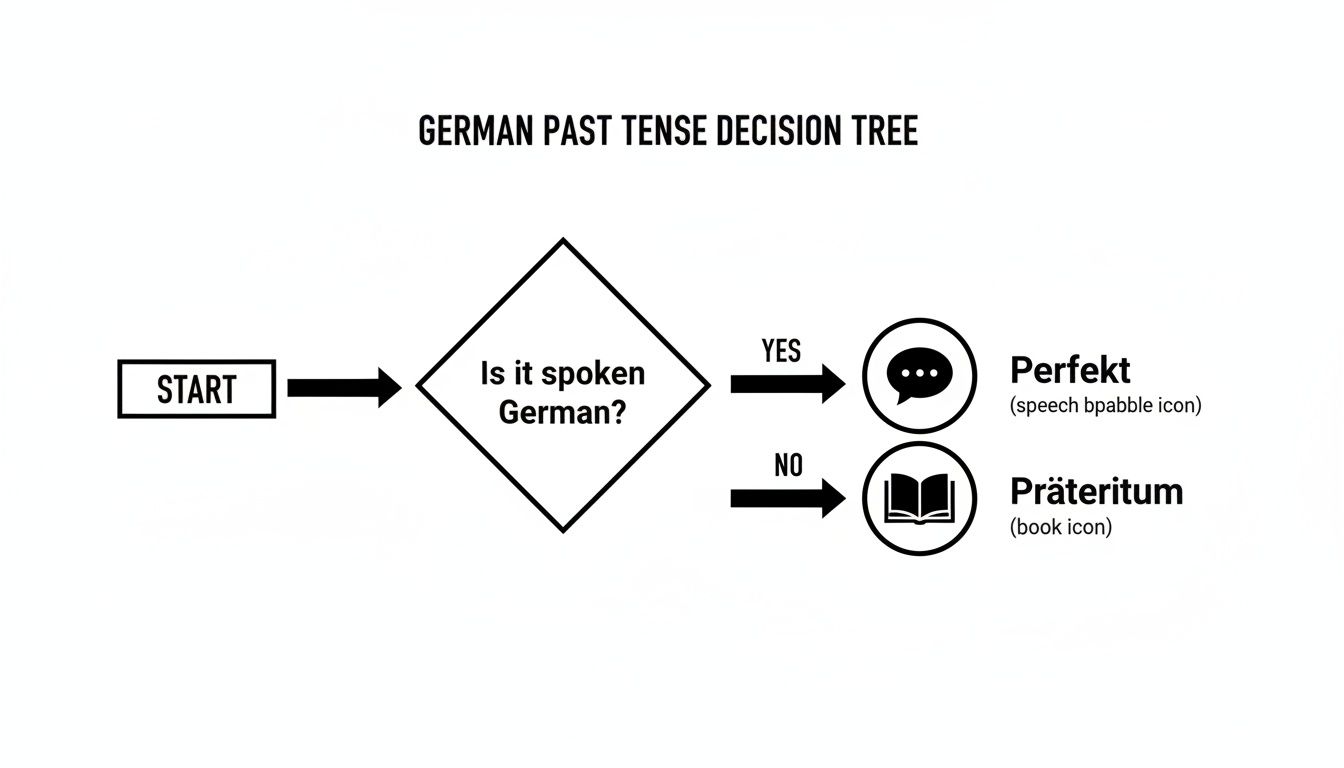
As you can see, the context—spoken or written—is your main guide. But let's dig into the exceptions that make the language so interesting.
The Big Exceptions You Must Know
There's a small but powerful group of verbs that almost always break the "spoken vs. written" rule. They are so common that their Präteritum forms are the default, even in the most casual chats. Using their Perfekt forms, while technically correct, just sounds clunky and unnatural to a native speaker.
You absolutely have to know the Präteritum for these:
- Sein (to be): Always go with ich war (I was), du warst (you were), and so on. The Perfekt ich bin gewesen is pretty rare in conversation.
- Haben (to have): Stick to ich hatte (I had), du hattest (you had), etc. You'll almost never hear someone say ich habe gehabt.
- Modal Verbs: Verbs like können (can), müssen (must), wollen (want), sollen (should), dürfen (may), and mögen (to like) are almost always used in the Präteritum when speaking.
Here’s how that sounds in a real conversation: A German speaker would naturally say, "Ich war im Supermarkt und ich wollte Milch kaufen, aber ich hatte kein Geld." (I was at the supermarket and I wanted to buy milk, but I had no money.) Trying to use the Perfekt for those verbs would sound very strange.
Regional and Stylistic Differences
Where you are in the German-speaking world can also change the game. This is one of those little details that can make you sound more like a local and less like someone who learned straight from a textbook.
In Southern Germany, Austria, and Switzerland, the Perfekt is king. It completely dominates conversations, and you’ll hear it used for almost everything, sometimes even for sein and haben. Head up to Northern Germany, though, and you’ll hear the Präteritum pop up a bit more in daily speech, although the Perfekt still reigns supreme for most verbs.
Style matters, too. When telling a story, even out loud, a speaker might switch to the Präteritum to give it a more formal, narrative feel. Imagine a grandparent telling a fairy tale. They might use the Präteritum to signal that it’s "story time," giving the whole thing a classic, literary vibe.
Developing Your Intuition
So, how do you get a gut feeling for all this? It really comes down to two things: exposure and practice. You need to listen to how native speakers actually talk and read all sorts of German texts. This is where interactive tools can give you a huge leg up.
An app like PolyChat creates a safe space to practice without the pressure of a live conversation. With its conjugation drills and gamified exercises, you can drill those essential Präteritum forms until they become automatic. When you build that muscle memory, you stop trying to remember the rules and start feeling which German past tense is the right one for the moment.
Your Path to Past Tense Mastery
Alright, let's talk about turning all these rules into real, confident conversation. It’s one thing to know the difference between the Perfekt and Präteritum on paper; it’s a whole different ball game to use them instinctively without thinking. This is where we bridge that gap.
The journey from memorizing grammar to actually using it starts with focused practice. Think of it like building muscle memory. Your brain needs to forge new pathways to make these tense patterns automatic, and the only way to do that is by actively using them yourself, over and over, until it just feels right. This is where the right tools can make a huge difference.
Key Strategy: Don't just learn the rules—drill the exceptions. The verbs that constantly switch between Perfekt and Präteritum in spoken German (like sein, haben, and the modals) are your highest priority. Mastering them is the fastest way to sound more like a native speaker.
Building Your Skills with Smart Practice
Consistent, targeted exercises are your best friend for locking in the German past tenses. Let's do a quick check to see where you stand. For a normal, spoken conversation, which past tense form feels most natural?
Quick Practice Round
- Ich ___ gestern krank. (I was sick yesterday.)
- (a) bin gewesen
- (b) war
- Wir ___ den Film schon gesehen. (We have already seen the movie.)
- (a) haben
- (b) hatten
- Er ___ nicht zur Party kommen. (He couldn't come to the party.)
- (a) hat gekonnt
- (b) konnte
(Answers: 1-b, 2-a, 3-b)
How'd you do? If you hesitated on any of those, that’s a perfect signpost showing you exactly where to focus your energy. This is precisely where an app like PolyChat becomes your secret weapon. Its unlimited conjugation practice lets you drill these tricky verbs until the correct forms become second nature.
Your Action Plan for Fluency
Ready to put it all together? Here’s a simple roadmap to get you mastering the German past tense with confidence.
- Drill the Core Verbs: Jump into PolyChat’s conjugation tool and specifically target sein, haben, and all the modal verbs in the Präteritum. Just 5-10 minutes of this each day works wonders.
- Embrace Timed Challenges: Turn learning past participles into a game with timed challenges. This builds speed and recall, helping you grab the right word faster when you're actually talking to someone.
- Build Your Personal Hit List: As you practice, add any verbs that trip you up to your personal dictionary in the app. Reviewing your own list of tricky words is way more effective than studying a generic one.
- Listen Like a Spy: Pay close attention to how native speakers use past tenses in podcasts, TV shows, and movies. You'll start to notice the natural rhythm—when they use Präteritum for storytelling and Perfekt for everyday chat.
This active approach transforms grammar from a chore into an engaging challenge. You can also turbocharge your progress by connecting with one of the best online German teachers for personalized feedback.
To keep moving forward and explore further language learning resources, always be on the lookout for new ways to practice. By combining smart tools with consistent effort, you’ll stop worrying about the rules and start telling your own stories in German. And that's the whole point, isn't it?
Got Questions? We've Got Answers.
Even with the rules laid out, a few tricky questions always pop up when you're trying to master German past tenses. Let's clear up some of the most common sticking points that learners run into.
Which German Past Tense Should I Learn First?
If you want to have a conversation, the Perfekt is your absolute top priority. Hands down. It's used in over 90% of spoken German, from chatting with friends to telling a story about your weekend. For speaking and listening, the Perfekt is king.
But if you want to read a book or a newspaper, you can't ignore the Präteritum. It's the standard for written narratives and formal communication, so you’ll be completely lost without it.
Why Do "Sein" and "Haben" Break the Rules in Conversation?
This is one of those classic "exceptions" that makes you sound like a pro when you get it right. Core verbs like sein (to be), haben (to have), and all the modal verbs (können, müssen, etc.) are just so common that their shorter Präteritum forms (war, hatte, konnte) have become the go-to even in spoken German.
Sure, you could say "ich bin gewesen" (I have been), and it would be grammatically correct. But it would also sound stuffy and unnatural. Sticking with "ich war" for these essential verbs is a simple trick that will instantly make your German sound more authentic.
When Do I Actually Need to Use the Plusquamperfekt?
Think of the Plusquamperfekt as your timeline tool. You need it when you’re telling a story and want to make it crystal clear that one thing happened before another past event. It’s all about showing the sequence.
For instance, saying, "Ich hatte schon gegessen, als sie anriefen" (I had already eaten when they called) leaves no room for confusion. You’re not using it in every sentence, but when you need to layer past events, it’s the only tool for the job. Mastering it is a huge step toward more sophisticated storytelling in German.
Ready to turn these rules into reflexes? PolyChat offers unlimited, gamified conjugation drills and interactive exercises to make mastering the German past tense fast and fun. Stop memorizing and start speaking with confidence by downloading the app.

Jean-Baptiste Bolh
Co-Founder
Applied AI