Can You Learn a Language While Sleeping?

So, can you actually learn a language in your sleep?
The short answer is yes—but not in the way you see in sci-fi movies. You can't just put on headphones and wake up fluent in Japanese. What you can do is use sleep as a powerful tool to reinforce what you’ve already studied while you were awake.
Ready to Learn a Language?
Try PolyChat's engaging language lessons, interactive learning games and put your new vocabulary to the test!
Games & Tools
Tools that every language learner needs at all stages of their learning journey.
AI Chat Tutor
Practice real conversations with an AI tutor that helps you speak with confidence.
Interactive Games
A variety of games to help you learn and remember new words and phrases.


The Reality of Learning a Language While Sleeping
Let's get one thing straight right away. The dream of effortlessly absorbing a new language while you're passed out is, sadly, just a dream. Real language learning takes conscious effort—you have to show up, do the lessons, practice vocabulary, and make a ton of mistakes. Your brain simply can't build the complex new connections required for a new language from scratch while you're unconscious.
But that doesn't mean those eight hours are a waste.
Think of your brain like a librarian working the night shift. During the day, every time you study—say, by completing a few lessons in PolyChat or drilling flashcards—you’re dropping off a huge stack of new books at the front desk.
Sleep isn’t about learning new material from scratch. It’s about cementing what you’ve already been exposed to. It takes those fragile, short-term memories and files them away into your brain's more durable, long-term archives.
This filing process is a real neurological function called memory consolidation, and it’s where the magic truly happens. When you replay familiar words and phrases softly while you sleep, you're essentially sticking a bright "IMPORTANT" note on those specific books. This tells your brain's librarian to prioritize filing them away securely, strengthening the neural pathways you built during the day.
The result? The next morning, that vocabulary is easier to recall and feels more natural. Decades of research back this up, shifting our understanding from sleep learning to sleep reinforcement. For a deeper dive, BrainFacts.org has a great summary of the neuroscience behind it.
Sleep Learning: What Science Supports vs. What Is a Myth
To make sure we're all on the same page, it's really important to separate what this technique can do from what it can't. This table breaks it down clearly.
| Activity | What Science Says | Practical Takeaway |
|---|---|---|
| Learning New Words from Scratch | Myth. The brain can't form brand-new, complex memories for unknown words while unconscious. | Don't play a list of words you've never seen before. It won't work. |
| Reinforcing Recently Studied Words | Supported. Replaying audio of words you studied just before sleep can significantly boost recall. | Review your vocabulary for 15-20 minutes right before bed, then play the audio of those same words. |
| Mastering Complex Grammar Rules | Myth. Abstract concepts like grammar require active, conscious thought and cannot be absorbed passively. | Sleep won't teach you the subjunctive. Focus on reinforcing concrete vocabulary. |
| Improving Pronunciation & Accent | Partially Supported. Hearing native audio can help solidify phonetic patterns you've already practiced. | Replaying audio of words you've practiced saying can help your brain internalize the sounds. |
This distinction is everything. The goal isn't to replace your active study time but to make every minute of it count for more. You're giving your brain a superpower to lock in the hard work you’ve already done.
How Your Brain Organizes Language While You Rest
Think of your brain as a diligent librarian working the night shift. All day, as you're learning new words, grammar rules, and phrases, you’re essentially dropping off stacks of new books at the front desk. It's only when you go to sleep that the real work begins—this is when your librarian starts sorting through everything you’ve learned.
This isn’t just a cute analogy; it's a pretty accurate picture of a neurological process called memory consolidation. Sleep isn't just downtime for your body. It's an intensely active period where your brain strengthens important new connections (like that new vocabulary list) and clears out the clutter.
The infographic below cuts through the sci-fi fantasies and lays out the reality of what sleep can—and can't—do for your language skills.
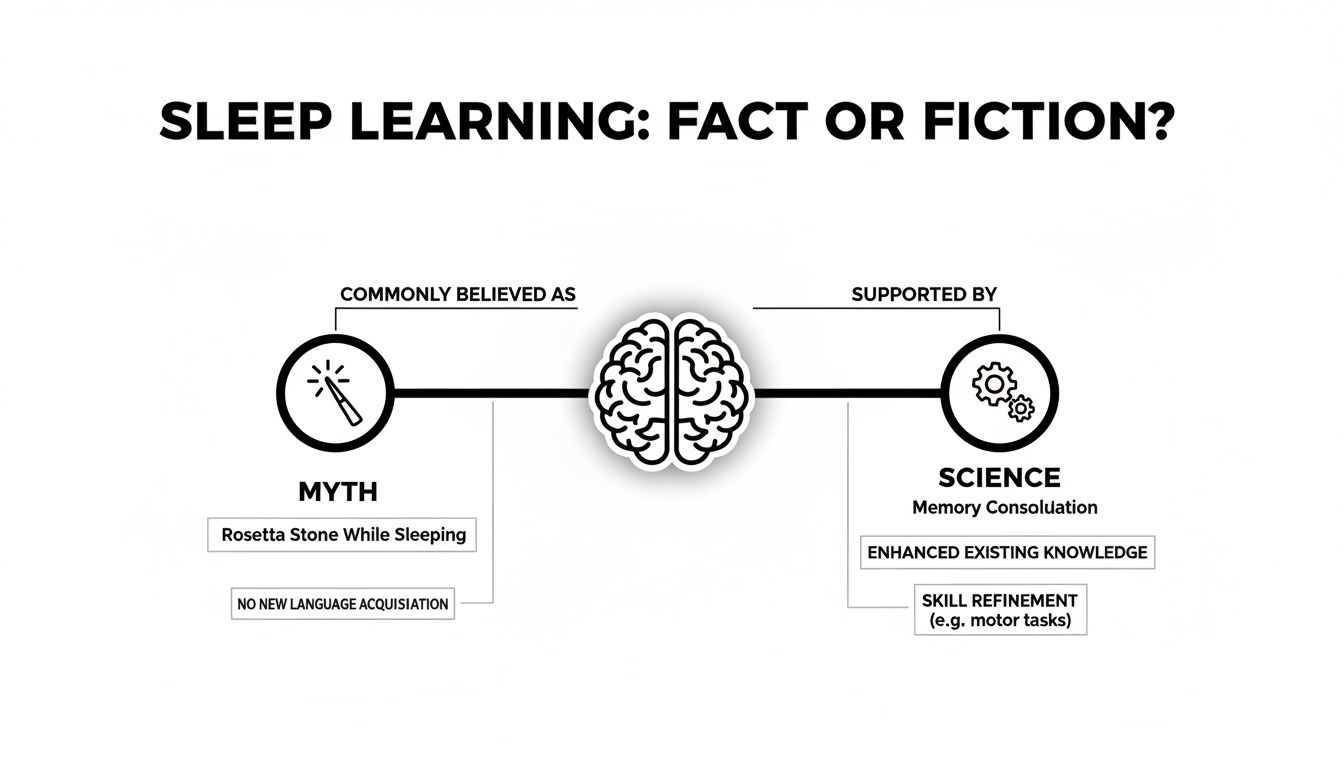
The big takeaway here is that you can’t learn something brand new in your sleep. But you can absolutely use sleep to lock in what you've already studied, making it stick far better.
The Role of Different Sleep Stages
Your sleep isn’t one long, uniform state. It’s a cycle of different stages, and each one has a specific job to do. For language learners, the most important parts of the night are NREM (Non-Rapid Eye Movement) sleep—especially the deep, slow-wave parts—and REM (Rapid Eye Movement) sleep.
During deep NREM sleep, your brain is busy replaying and strengthening the neural pathways you created while studying earlier. It’s like the librarian taking your new vocabulary words from a temporary cart (your short-term memory) and carefully filing them onto the permanent shelves (your long-term memory).
Later, during REM sleep (the part of the night famous for dreaming), your brain starts connecting these new memories to everything you already know. This is where it integrates a new word like perro with your existing concepts of "dog," "animal," and maybe even "loyal." For a deeper dive into this fascinating process, it’s worth understanding the REM sleep cycle and its role in memory.
From Short-Term to Long-Term Storage
The journey a new word takes to become a permanent part of your vocabulary is a real, physical process inside your brain. It involves moving a memory from the hippocampus—the brain's inbox for new information—to the cortex for stable, long-term storage.
And here's the kicker: this transfer happens most effectively while you're asleep. Study after study shows that a good night's rest after a learning session leads to much better retention than pulling an all-nighter.
One fascinating study had people learn a miniature artificial language. The group that studied in the evening and then slept performed significantly better on tests than the group that studied in the morning and went about their day. The researchers could actually see the difference in brainwave patterns during NREM sleep that were responsible for locking in the new language skills.
At the end of the day, sleep is the final, essential step that secures all your hard work. It's the reason why a solid study session followed by a night of quality rest will always beat frantic, last-minute cramming. This is the whole principle behind smart study techniques, like those we cover in our guide on the best way to memorize vocabulary, which are designed to work with your brain's natural learning cycle, not against it.
Reinforcing Knowledge, Not Acquiring It Anew
That classic sci-fi image of learning a whole language from sleep tapes? It gets one crucial thing wrong. The science is pretty clear on this: your brain is a brilliant editor overnight, not a first-draft writer. You can absolutely reinforce what you already know, but you can’t learn brand-new concepts from scratch while you’re unconscious.
Think of it this way. Studying your vocabulary before bed is like drawing up the blueprints for a house. When you play audio of those same words as you sleep, you’re basically delivering the lumber and nails to the construction site. Your sleeping brain knows exactly what to do—it can get to work building the structure because the plans are already there.
But if you just play audio of words you've never seen before? That’s like dumping a pile of lumber on an empty lot. Without blueprints, no house gets built. Your brain can reactivate and strengthen neural pathways you’ve already started to form, but it can’t forge brand-new ones without you being awake and paying attention.
The Power of Cued Memory Reactivation
So what’s actually happening when you play those familiar words? It’s a process called cued memory reactivation. Your brain recognizes the sounds it was recently exposed to and gives those specific memories the VIP treatment, strengthening them so you can recall them better later.
One landmark study really drove this home. Researchers had German-speaking participants memorize a list of Dutch-German word pairs right before going to sleep. While they were in a deep sleep, the researchers quietly played back some of the Dutch words.
The results were impressive. After waking up, the participants had significantly better recall for the words that were played back—or "cued"—during their sleep. The study suggests that during deep, slow-wave sleep, the brain actively strengthens the traces of these existing memories, all without you even knowing it.
The key takeaway is that audio reinforcement works on memories that are already present. You are tagging specific information as "high priority" for consolidation, not introducing new data.
From Reinforcement to Fluency
This shifts the question from "can you learn a language while sleeping?" to "how can sleep accelerate my learning?" The answer is to use it as a highly targeted review tool. It’s a powerful supplement, not a magic replacement for active study.
By focusing your waking hours on conscious learning and then using sleep to lock in that day's work, you create an incredibly effective cycle. Your daytime efforts provide the raw material, and your brain refines it overnight. This combined approach is far more potent than either activity on its own and is a cornerstone for anyone figuring out how to learn a language on your own.
Your Guide to Sleep Enhanced Language Learning
You don't need complicated gadgets or strange sleep rituals to make this work. It's all about building a simple, repeatable routine that plugs directly into your brain's natural memory-filing process.
This four-step protocol is designed to be easy enough to start tonight. It takes the cool concept of sleep reinforcement and turns it into a concrete action plan to help you remember more of what you study.
Step 1: The Pre-Sleep Review
This is the most critical step, and it happens right before you turn out the lights.
Set aside 15-20 minutes to actively review the specific words or phrases you want to lock in. This isn't the time for learning new material—it’s a lightning-fast refresher of what you’ve recently studied.
Think of this pre-sleep session as "priming" your brain. You're essentially sticking a bright neon tag on these words, telling your brain, "Hey, these are important. Pay special attention to them while you're cleaning up tonight."
For example, you could use this time to:
- Whip through a set of digital flashcards.
- Skim a recent lesson you finished.
- Practice vocabulary from a conversation you stumbled through earlier.
Many of the best language learning apps for adults are perfect for this quick, focused review.
Step 2: Timed Audio Reinforcement
Once you’re in bed and ready to drift off, it’s time for the audio.
Create a short, looping playlist of the exact same words you just reviewed. Play this audio very, very quietly as you fall asleep.
The key here is subtlety. The audio should be barely audible, almost a whisper. If it's loud enough to wake you or pull you out of a deep sleep, it'll backfire and do more harm than good. Set it on a timer to play for the first 60-90 minutes of sleep, which is your prime-time window for the deep, slow-wave sleep cycles we talked about.
And, of course, this entire process hinges on actually getting good rest. If you struggle with that, exploring things like essential oils for improving sleep quality can help set the stage for a productive night.
Step 3: The Morning Recall Test
The moment you wake up—before you check your phone, before your feet hit the floor—try to recall the words from your playlist.
This immediate recall test does two things beautifully. First, it strengthens the neural connections your brain just spent the night reinforcing. Second, it gives you instant, unfiltered feedback on what stuck and what didn't. You get to see the results right away.
Step 4: Integrate with Spaced Repetition
Finally, don’t treat this as a standalone magic trick. Sleep reinforcement is a booster rocket, not the whole spaceship. It works best when it complements a smart, consistent study strategy like a Spaced Repetition System (SRS).
Your morning recall test is pure gold for your SRS. It tells you exactly which words need more work and which ones have been successfully cemented in your memory. Feed this info back into your study schedule.
By combining active daily practice with nightly reinforcement and strategic review, you create a powerful learning loop where every minute—awake or asleep—counts for more.
To make it even easier, here's a simple checklist you can follow each night.
Your Evening Language Learning Protocol
| Step | Action | Time Allotment | Why It Works |
|---|---|---|---|
| 1. Prime the Brain | Actively review 10-15 target words or phrases using flashcards or your learning app. | 15-20 minutes | "Tags" the information as important for your brain to process during sleep. |
| 2. Set the Audio | Create a short, looping audio file of those same words. Play it quietly on a timer as you fall asleep. | 60-90 minutes | Reactivates the memory traces associated with the reviewed words during deep sleep. |
| 3. Test Recall | Immediately upon waking, try to write down or say the target words from memory. | 5 minutes | Strengthens the newly consolidated memories and provides immediate feedback. |
| 4. Update & Repeat | Update your Spaced Repetition System based on what you recalled. Add any missed words back into rotation. | 5 minutes | Integrates the passive, sleep-based learning with your active study for maximum effect. |
Following these steps transforms your sleep from dead time into a productive part of your language learning journey.
Common Mistakes to Avoid for Effective Sleep Learning
The biggest mistake by far is trying to learn brand-new material from scratch while you sleep. We’ve covered how your brain acts as an editor, not a writer, during sleep. Playing a list of words you’ve never seen before won’t just be useless; it can actually create confusing "noise" that messes with the memory consolidation process.
Another classic error is cranking the volume up too high. The goal here is subtle reinforcement, not a middle-of-the-night classroom lecture.
Your audio should be barely audible, almost like a whisper in the background. If it’s loud enough to jolt you out of a deep sleep, you’re actively preventing your brain from hitting those slow-wave stages that are essential for locking in memories.
This defeats the whole purpose of the exercise and just leaves you feeling tired and annoyed the next day.
Protecting Your Sleep and Your Progress
Beyond the technical setup, a few mindset traps can also completely derail your efforts. It’s tempting to think that sacrificing an hour of sleep for an extra hour of study is a good trade-off, but this is a perfect example of diminishing returns.
Here are a few key pitfalls to sidestep on your journey:
- Skimping on Sleep: Robbing yourself of rest to cram more information is like hiring a construction crew but never actually letting them on the job site. Sleep is the non-negotiable phase where the real work of building and securing memories happens.
- Ignoring Active Learning: Don't ever treat sleep learning as a replacement for conscious study. Think of it as a powerful supplement, but it can’t build a foundation on its own. Your daytime efforts with tools like PolyChat are what provide the raw materials for your brain to work with overnight.
- Inconsistent Routines: Trying this for one night and then skipping a week won't get you anywhere. Consistency is what trains your brain to expect and efficiently process those nightly review cues.
By steering clear of these simple mistakes, you ensure you’re working with your brain’s natural rhythms, not fighting against them. This is how you make your downtime count and get more mileage out of every moment you spend studying.
Got Questions About Sleep Learning?
Diving into the world of sleep-enhanced learning usually sparks a few practical questions. Let's clear things up so you can get started tonight with the right expectations.
How Loud Should the Audio Actually Be?
Think whisper-quiet, not classroom lecture. The whole point is subtle reinforcement that your brain can process without waking you up.
If you can consciously hear and understand every single word, it’s definitely too loud. A great rule of thumb is to set the volume so it’s barely perceptible when you’re getting ready for bed. It should be background noise, quiet enough that it never interferes with you falling asleep or, more importantly, pulls you out of those precious deep sleep cycles. Wrecking your sleep quality completely defeats the purpose.
Does This Work for Learning Grammar Rules?
Stick to vocabulary. This technique is fantastic for strengthening the memory of concrete information like individual words and simple phrases. Your sleeping brain is great at reinforcing existing, straightforward memories when it gets an auditory nudge.
It falls flat, however, when it comes to complex or abstract ideas like grammar rules. Grasping how a sentence is built requires conscious, active thought—you need to understand the logic and context. You can't just passively absorb that kind of information. For the best results, focus on reinforcing the vocabulary you've already studied.
Can I Just Do This During a Nap?
While any sleep is good for your memory, a quick nap just doesn't pack the same punch as a full night for this specific method. The magic of memory consolidation happens most intensely during slow-wave sleep (SWS), the deepest phase of our sleep cycle.
You get much longer, more consolidated blocks of SWS during a full night of rest. A nap might offer a bit of a memory refresh, but it's usually too short to provide a big enough window of deep sleep for the audio cues to really work their wonders. If you want to see real results, prioritize a full, uninterrupted night.
Ready to build a vocabulary that’s perfect for both active study and sleep reinforcement? PolyChat gives you fun, gamified lessons that make your pre-sleep review sessions a breeze. Start learning faster today.

Jean-Baptiste Bolh
Co-Founder
Applied AI