How to Learn German Language Fast for Real-World Fluency

So, you want to learn German, and you want to do it fast. The real secret isn't some magic app or grammar hack; it's nailing down the powerful reasons that will keep you going when things get tough.
We're talking about career breakthroughs in Europe's economic powerhouse, connecting with a deep cultural history, and opening doors to some of the world's best universities. Understanding your why is the fuel that powers your how.
Ready to Learn German?
Try PolyChat's engaging language lessons, interactive learning games and put your German vocabulary to the test!
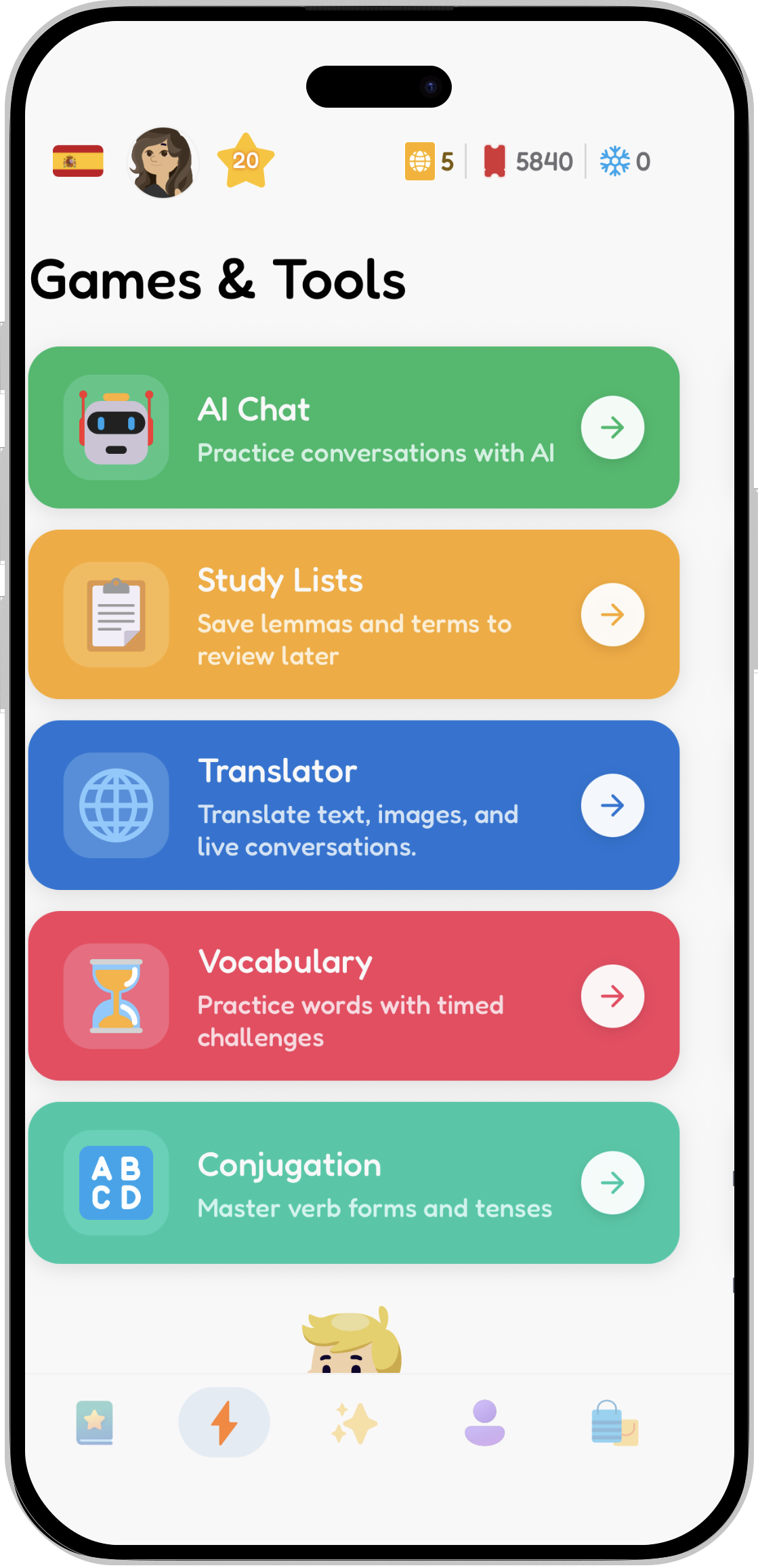
Games & Tools
Tools that every language learner needs at all stages of their learning journey.
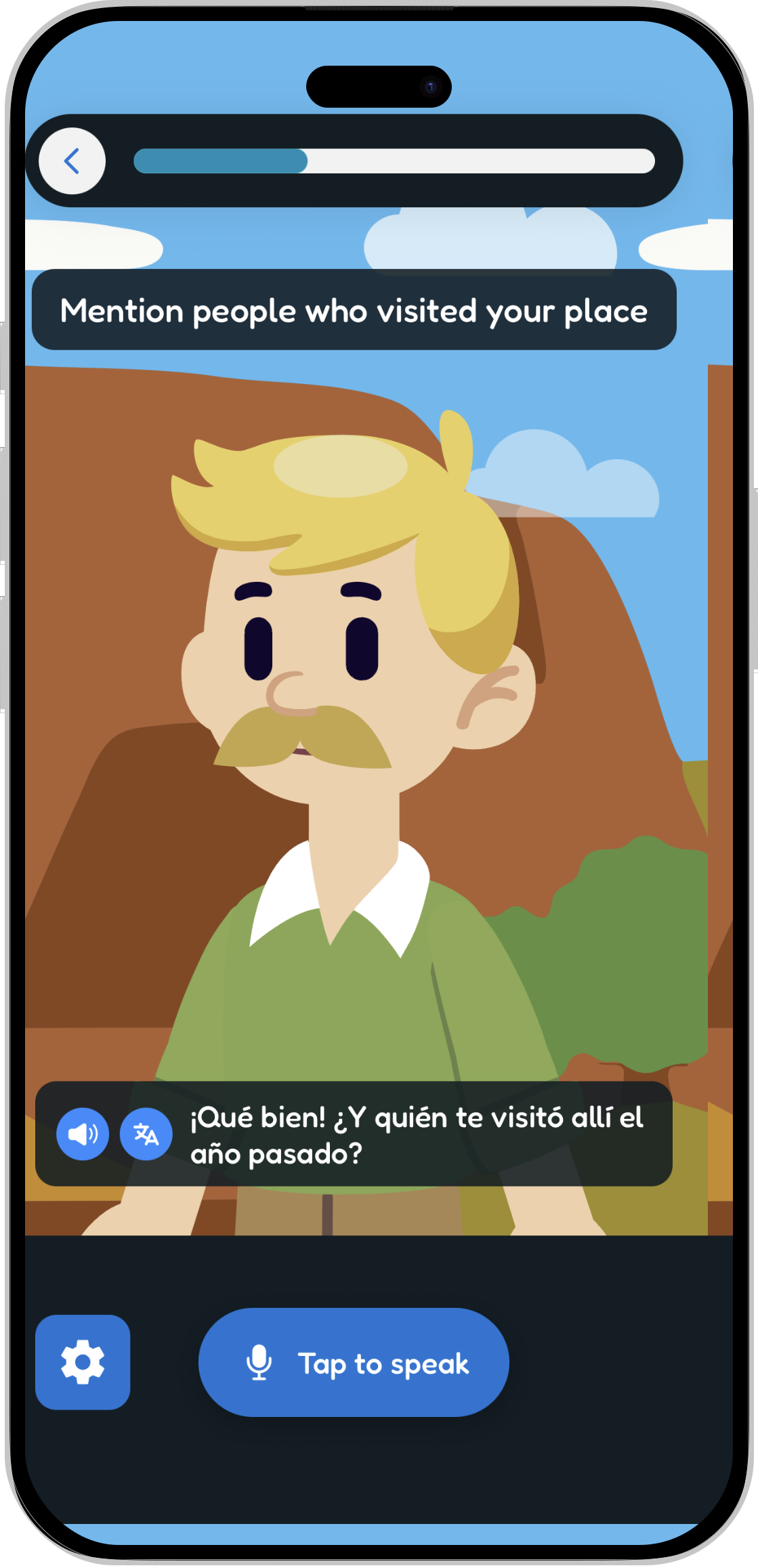
AI Chat Tutor
Practice real conversations with an AI tutor that helps you speak with confidence.
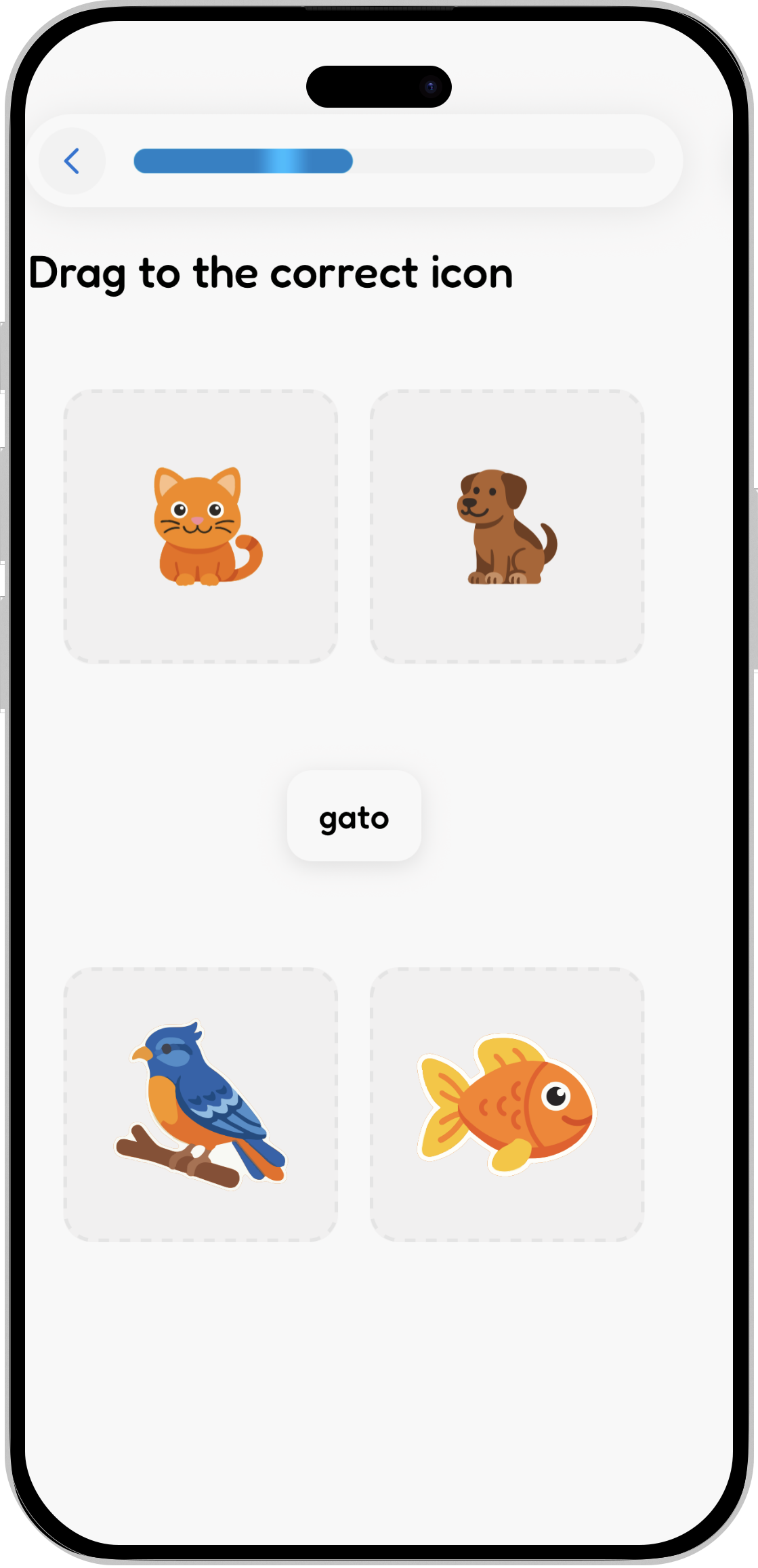
Interactive Games
A variety of games to help you learn and remember new words and phrases.


Unlock Your Future by Learning German

Before you even think about a study schedule, let's get your motivation locked in. Learning a language is a serious commitment, and if you want to speed up the process, you need a compelling reason to push through the plateaus.
Luckily, the incentives for learning German are huge, and they go way beyond just ordering a pretzel in Berlin.
Fuel Your Career Growth
Let's be blunt: Germany is an economic giant. It’s a global leader in engineering, automotive, and green energy. If you work in these fields, speaking German isn't just a nice resume-builder—it's a career-defining advantage.
The demand for German speakers inside the country is massive. One analysis of online job ads in Germany found that only 2.7% of them explicitly said German wasn't required. That tells you everything you need to know. The vast majority of employers expect it.
Knowing German can transform your professional profile. You go from just another qualified candidate to the one who can actually lead a German-speaking team, build relationships with clients in their own language, and truly integrate. That's a serious competitive edge.
Immerse Yourself in Culture and Education
Beyond the boardroom, German opens up a whole new world of culture. Imagine reading Goethe or Kafka in the original German, catching the subtle humor in a Wim Wenders film without subtitles, or truly appreciating the power of a Wagner opera. It's a connection that translations just can't replicate.
Germany also has a world-class, often tuition-free, university system that pulls in students from all over the globe. But here's the catch: most undergraduate courses are taught in German. Proficiency isn't just helpful; it's your ticket in.
Thinking about the big picture helps keep you on track. Here's a quick look at the major drivers for learning German fast.
Top Reasons to Learn German Quickly
| Category | Benefit for Fast Learners |
|---|---|
| Economic & Career | Quickly access jobs in Germany's high-demand sectors like engineering and tech. |
| Education | Meet language requirements for tuition-free German universities sooner. |
| Culture | Dive deep into German literature, film, and philosophy in its original language. |
| Travel & Relocation | Navigate daily life with confidence, from apartment hunting to making local friends. |
| Cognitive Benefits | Enhance problem-solving skills and mental flexibility through language acquisition. |
These aren't just abstract ideas; they're tangible goals that you can achieve much faster with a focused plan.
Structured Pathways to Success
The good news is you don't have to figure this all out on your own. A massive support system is already in place for learners.
Institutions like the Goethe-Institut have been perfecting rapid learning programs for decades, helping hundreds of thousands of students every year.
When you combine these proven, structured methods with modern tools, the path to fluency becomes clearer and faster than ever. As you build your learning strategy, think about how AI in language learning can accelerate your progress by offering instant feedback and lessons that adapt to your level.
When your "why" is crystal clear, finding the "how" gets a whole lot easier.
Building a Mindset for Rapid Progress
If you want to learn German fast, you need more than a stack of books or the latest app. The real secret, the thing that separates the sprinters from the joggers, isn't a technique at all. It’s the mindset you build before you even learn your first word.
It all starts by ditching vague, useless goals like "become fluent." What does that even mean? Instead, you need to define success in a way you can actually measure. The pros use the Common European Framework of Reference for Languages (CEFR).
So, a weak goal becomes a powerful one: "I will achieve a conversational A2 level in 90 days." Suddenly, you have a specific, measurable target. You have a finish line to sprint towards.
Embrace Imperfection and Stay Consistent
The fastest learners I’ve ever seen all have one thing in common: they treat mistakes as data, not failures. Every single time you mess up a grammar rule or mispronounce a word, you’re just getting feedback. It’s a signpost pointing to what you need to work on next. Perfectionism is the enemy of speed.
This shift in thinking is what fuels consistency, and consistency is everything. Learning a language is just like building muscle. You wouldn't hit the gym for seven hours straight on a Sunday and expect to see results, right? The same goes for German.
Sporadic, marathon study sessions just don't work. A focused 60 minutes every single day will always crush cramming for hours once a week. You’re trying to build a sustainable habit, something that feels as natural as making coffee in the morning, not a chore you dread.
Your brain learns through repetition and routine. Committing to a small, manageable chunk of practice every day creates a powerful compounding effect that will blow you away over time.
Find Your Personal Learning Style
Finally, getting good fast means working with your brain's natural tendencies, not fighting against them. We all absorb information differently, and figuring out your dominant learning style helps you pick the methods that will feel the most intuitive and give you the best bang for your buck.
Think about what feels most natural to you:
- Visual: Do you learn best by seeing things? Lean into flashcards with images, watch German movies with subtitles, and physically draw out mind maps for confusing grammar rules.
- Auditory: Are you someone who learns by hearing? Your commute is now German podcast time. Fill your house with German music and get really good at shadowing techniques where you mimic native speakers.
- Kinesthetic: Do you need to do something for it to stick? Then get active. Try role-playing exercises, stick labels on everything in your house with the German words, or even act out verbs as you learn them.
This isn’t about boxing yourself in. It's about prioritizing the activities that give you the biggest return on your time investment. When learning feels enjoyable and effective, you stick with it. And that’s how you make rapid progress.
Your Daily 60-Minute German Power Routine
Consistency is everything. Forget those grueling, multi-hour study sessions that just lead to burnout. Real, rapid progress in German comes from a smart, focused daily habit. Think of it less as "studying" and more as a daily workout for your brain.
This 60-minute routine is designed for maximum impact. It's a balanced mix of intense drills and creative practice, hitting every core language skill without taking over your life. This isn't about passively absorbing information; it's about actively wrestling with German every single day.
The data backs this up. Learners who put in a focused 30–60 minutes per day improve way faster—we're talking up to five times the weekly progress compared to people who only study now and then. A daily habit like this can get you to a basic conversational level in as little as 90–120 hours. Sporadic learners? They often need over 200 hours to hit that same milestone.
The First 20 Minutes: Vocabulary and Retention
Let's start by getting new words to stick. This is where Spaced Repetition Systems (SRS) become your secret weapon. Instead of mindlessly flipping through a giant, random list of words, SRS apps use an algorithm to show you flashcards right before they're about to slip from your memory.
To get the most out of this, you need to master the spaced repetition technique. It turns vocabulary building from a frustrating chore into a ridiculously efficient, science-backed process.
Here’s how to structure your 20 minutes:
- Minutes 1-10: Fire up your SRS app (Anki and Memrise are popular choices) and clear out your review queue. The app does the heavy lifting, telling you what to review and when.
- Minutes 11-20: Add 10-15 new words. Pull them from a high-frequency list or, even better, from words you came across yesterday in a podcast or article.
Here's a pro tip: Don't just make flashcards for single words. That's a rookie mistake. Instead, create cards with full sentences. So, instead of a card for just "der Tisch" (the table), make one that says "Das Buch liegt auf dem Tisch" (The book is on the table). You learn grammar and context for free.
The Next 20 Minutes: Active Listening
Time to switch gears from memorizing to understanding. Active listening isn't just having a German podcast on in the background while you do dishes. It’s a focused exercise where your only job is to decode meaning, rhythm, and pronunciation.
You need audio that stretches you a bit but doesn't completely overwhelm you. Good places to start are:
- Slow News: Deutsche Welle's Langsam gesprochene Nachrichten is perfect for this.
- Beginner Podcasts: Hunt down podcasts made specifically for German learners.
- Children's Stories: The simple grammar and super-clear narration are a godsend.
This part of the routine trains your ear to pick up the natural flow of spoken German, which is a massive step toward fluency.
This whole process works best when you have the right mindset.
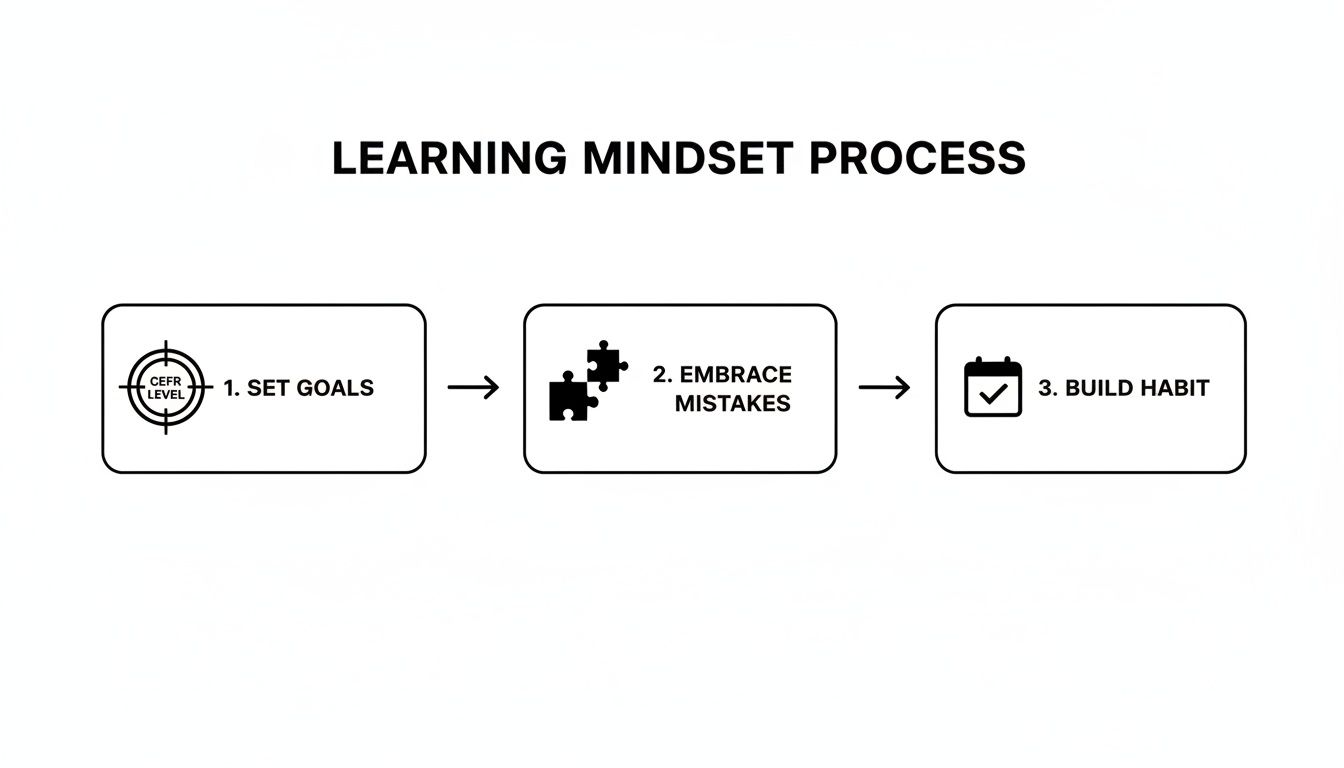
It really is that simple. Setting a goal, being okay with making mistakes, and building the habit—that’s the foundation for moving fast.
The Final 20 Minutes: Active Production
The last block is all about output. You have to actually use the German you've been learning. This is non-negotiable.
One of the best techniques for this is shadowing. Just take a short audio clip from your listening practice, play a sentence, pause it, and immediately repeat it out loud. Try to mimic the speaker's intonation and rhythm as closely as you can. It feels weird at first, but it works wonders.
Another great option is to spend this time journaling. Write a few simple sentences in German about your day or your plans. Don't stress about getting it perfect. The goal is to force your brain to recall words and build sentences from scratch. If you combine this routine with some of the best language learning apps, you'll have even more tools to put your German into practice.
Mastering German Grammar That Actually Matters
German grammar has a reputation for being a beast. Let's be honest, it can be. But here’s a secret the fastest learners know: you don’t need to master all of it to speak well. Not even close.
The key is applying the 80/20 rule. We're going to focus on the 20% of grammar that you'll use 80% of the time in real-world conversations. Forget trying to memorize every obscure declension table from day one. That’s a one-way ticket to burnout. Instead, let's zero in on the high-impact concepts that form the backbone of everyday German.
Core Grammar for Fast Progress
Start with the single most important rule in German sentence structure: the verb-second rule. In most standard sentences, the conjugated verb always sits in the second position. Master this, and your sentences will instantly sound more natural. It's a simple change that makes a huge difference.
Next up, the infamous noun genders. Every German noun is either masculine (der), feminine (die), or neuter (das). While some patterns exist, the best approach is to learn the article with every new noun. Don't just learn Tisch—learn der Tisch (the table). Make this a non-negotiable habit. It will save you countless headaches down the road.
Trying to learn German without learning the gender of each noun is like trying to build a house without a foundation. Everything else—cases, adjectives, pronouns—builds on this. Make it a core part of your vocabulary practice from the very beginning.
Your First 4 Weeks German Grammar Focus
To avoid overwhelm, it helps to have a structured plan. Instead of trying to learn everything at once, focus on one or two key concepts each week for your first month. This will build a solid, practical foundation you can actually use.
Here's a simple schedule to get you started:
| Week | Primary Focus | Practice Exercise |
|---|---|---|
| 1 | Verb-Second Rule & Pronouns | Write 10 simple sentences daily about your routine. (e.g., Ich lerne Deutsch.) |
| 2 | Nominative & Accusative Cases | Describe what you see, identifying subjects and direct objects. (e.g., Ich sehe den Tisch.) |
| 3 | Present Tense Verb Conjugations | Take 5 common verbs and conjugate them with every pronoun. Say them out loud. |
| 4 | Articles (der, die, das) | When using flashcards, always say the article with the noun. Test yourself. |
This approach ensures you're building a strong base layer by layer, rather than just getting a shallow overview of too many topics. It's about depth, not just breadth, in these early stages.
The Only Two Cases You Need at First
German has four grammatical cases, which is where many learners get scared off. But here’s the good news: you only need to really understand two to get started.
- Nominative: This is just the subject of the sentence—the one doing the action. It's the default case you learn with new nouns. Der Mann liest. (The man reads.)
- Accusative: This is the direct object—the thing receiving the action. It answers the question "what?" or "whom?". Ich sehe den Mann. (I see the man.)
By focusing only on Nominative and Accusative, you can build a massive variety of correct, useful sentences without getting bogged down. You can worry about the Dative and Genitive cases much, much later, once you have a solid conversational base.
Building Your Core Vocabulary
Just like with grammar, a small number of words do most of the heavy lifting. Your initial goal should be to learn the 1,000 most frequently used German words. That number might sound big, but with consistent daily practice using a tool like Anki or a smart app like PolyChat, it’s entirely manageable.
This core vocabulary covers the essentials for greetings, asking for directions, ordering food, and talking about your day. By targeting these high-frequency words first, you ensure every minute of your study time directly contributes to your ability to actually communicate. This is the cornerstone of learning German fast—building functional skills from day one.
Put Your German to Work From Day One
Here's a hard truth: you can't learn to speak German just by reading about it. The fastest way to get fluent is to start speaking the moment you begin learning, even when your vocabulary is tiny and your sentences are a mess.
The goal isn't perfection; it's practice. Making this mental shift from passively consuming German to actively producing it is what separates the fast learners from everyone else. You’ve got to get the language out of your head and into the real world.
Luckily, we're living in the best possible time to do this. A global boom in German language learning means there’s a massive network of people to connect with. While 73% of learners are in Europe, demand is skyrocketing elsewhere—the number of learners in Africa, for instance, has jumped by nearly 50% since 2015.
This global community has spawned countless online platforms, giving you direct access to native speakers from anywhere in the world.
Find Your Speaking Partners
First things first: you need someone to talk to. This doesn't have to be intimidating or expensive.
- Language Exchange Apps: Services like Tandem and HelloTalk are absolute goldmines. You can find native German speakers who are eager to learn your language, creating a free and natural way to practice.
- Affordable Tutoring: On platforms like iTalki, you can find tutors for just a few dollars a session. This is perfect for structured, one-on-one practice where you can ask specific questions and get instant, personalized feedback.
Finding the right instructor makes a world of difference, especially when you're just starting. Our guide on the best online teachers for German can help you find a tutor who fits your style and makes those first conversations feel productive, not scary.
Build Your Own German Immersion Bubble
You don't need to move to Berlin to immerse yourself in German. You can build a surprisingly effective immersion environment right where you are, just by tweaking your digital life. This constant, low-level exposure keeps the language buzzing in the back of your mind.
Start with these simple changes:
- Your Smartphone: Switch your phone’s system language to German. You already know the layout, so you'll naturally learn words like Einstellungen (Settings) and Nachrichten (Messages) just by using your phone.
- Your Social Media: Follow German news outlets, celebrities, and even meme accounts. This fills your downtime with authentic, bite-sized German content.
- Your Entertainment: Change your Netflix or Disney+ profile language to German. Try watching shows you've already seen, but this time with German audio and subtitles. It’s a great way to connect spoken words with their written form.
One of the most powerful tools for building confidence is also the simplest: talk to yourself. Narrate your daily actions in simple German. "Ich mache Kaffee." (I'm making coffee.) "Ich öffne die Tür." (I'm opening the door.) This no-pressure practice builds the crucial habit of thinking directly in German.
Remember, when you start speaking, it's not just about the words. It's about the rhythm, the intonation, the music of the language. Understanding the importance of prosody in speech will help you sound more natural and be understood more easily, even from your very first conversations. This one-two punch of active practice and passive immersion is the engine that will drive you toward fluency, fast.
Answering Your Biggest Questions About Learning German Fast
Even the most perfect plan runs into real-world questions. When you’re trying to move quickly, a few common roadblocks and nagging doubts always seem to pop up.
Let's cut through the noise and tackle the questions I hear most often. Getting these answers straight will keep you on track when you hit those inevitable bumps in the road.
Seriously, How Long Does "Fast" Actually Take?
Let's get real for a second. "Fast" doesn't mean you'll be debating philosophy in Berlin next month. For a motivated learner, "fast" means hitting a solid conversational level—think A2 or B1—in about three to six months. This is absolutely doable with 45-90 minutes of focused work every single day.
At that point, you can handle daily chats, get around Germany without just pointing at things, and share your ideas with confidence. For context, the U.S. Foreign Service Institute says it takes about 750 hours to reach professional fluency. But our accelerated approach gets you to a functional, real-world level way sooner by ditching exhaustive grammar drills for what actually works.
If You Had to Pick One Thing, What's the Best Technique for Quick Progress?
If I had to bet on one single thing, it’s active output. That means speaking and writing every single day, even if it’s just for 15 minutes. It’s non-negotiable.
Listening and reading are great, but actively producing the language is what burns it into your brain. It forces you to actually retrieve words and grammar instead of just passively recognizing them. That's the whole game.
- Daily Speaking: Hop on a language exchange app like Tandem, chat with an AI tutor like PolyChat, or just talk to yourself in German while you make coffee. Seriously. Narrate your life.
- Daily Writing: Keep a dead-simple journal. Before bed, jot down three sentences about your day. That’s it.
This daily habit is the engine that will drive your progress faster than anything else.
Can I Just Use an App to Get Fluent Quickly?
Look, language apps are brilliant tools, but they are not the whole toolbox. Think of them as your daily workout supplement, not your entire training program. They’re fantastic for building vocabulary and getting in your daily reps.
An app can teach you the words, but only real interaction can teach you the conversation. Use apps for your daily drills, then immediately use that knowledge in the real world.
Use your app to warm up, then immediately apply what you just drilled. Talk to a tutor, watch a German YouTuber, or write a few sentences. Connect the dots.
Help! I've Hit a Wall. How Do I Break Through a Plateau?
First off, relax. A learning plateau isn't a sign you're failing—it's a sign your brain is working hard to sort through everything you've thrown at it. It's a completely normal part of the process. The trick isn't to push harder, but to push differently.
When you feel stuck, shake things up:
- Sick of grammar charts? Ditch them for a week and learn the lyrics to a song by Rammstein or AnnenMayKantereit.
- Flashcards making your eyes glaze over? Watch a German movie with German subtitles and write down five new phrases you actually think you'd use.
- Feeling totally unmotivated? Go back to your notes from week one. You'll be shocked at how far you've come.
Sometimes, the best thing you can do is reconnect with your original "why." Remember that job opportunity in Berlin or that trip you’re planning to the Black Forest? That's the real fuel. Use it to push through to the next level.
Ready to accelerate your learning with a tool that combines powerful lessons, vocabulary drills, and unlimited practice? PolyChat offers a fun, gamified path to fluency without frustrating limits. Start your German journey today on PolyChat.

Jean-Baptiste Bolh
Co-Founder
Applied AI