The 8 Essential Basic Italian Phrases for Tourists in 2026
 Free interactive quizEnglish to Italian Vocab Quiz10 questions · 10 seconds each · no signupPlay now
Imagine navigating Venice's canals, ordering gelato in Rome, or discovering a hidden trattoria in Florence—all with a newfound confidence. While English is common in tourist hubs, making an effort to speak Italian transforms your trip from a simple visit into a genuine cultural immersion. Learning a few basic Italian phrases for tourists isn't just about politeness; it's about connecting with people, showing respect for their culture, and unlocking authentic experiences that most tourists miss.
This guide isn't just a list; it's a practical toolkit of the most crucial phrases you'll need. Each entry includes phonetic pronunciation, real-world usage scenarios, cultural notes, and even short practice prompts perfect for a powerful tool like the PolyChat app. By mastering these 8 foundational phrases, you'll be equipped to handle everything from greetings and dining to shopping and emergencies, turning potential language barriers into opportunities for connection.
While mastering these phrases is crucial for your adventure, ensuring you have reliable mobile connectivity is another key consideration. You'll want to look up directions, post photos, and maybe even use a translation app on the go, so it's wise to sort out eSIM options for your trip to Italy before you depart. Now, let's dive into the essential phrases that will enrich your Italian journey.
1. Ciao / Hello, Goodbye
Of all the basic Italian phrases for tourists, Ciao is arguably the most famous and versatile. Pronounced CHOW, this single word serves as an informal way to say both "hello" and "goodbye," making it incredibly efficient for everyday interactions. Its origins are surprisingly humble, evolving from the Venetian phrase s'ciavo vostro, meaning "(I am) your slave," which was a polite way to offer services. Over time, it shortened to the friendly, universally understood greeting we use today.

When and How to Use 'Ciao'
Because Ciao is informal, it's best used with peers, younger people, or in casual settings like cafés, pizzerias, and local markets. It immediately creates a warm and approachable atmosphere.
- Upon Meeting: When greeting a shopkeeper in a small boutique or meeting a new friend at a bar, a simple "Ciao!" with a smile is perfect.
- When Leaving: As you exit a restaurant or part ways with someone, "Ciao, grazie!" (Goodbye, thank you!) is a polite and common closing.
- On the Phone: It's also frequently used to answer the phone among friends: "Ciao, chi parla?" (Hello, who's speaking?).
The Politeness Scale: 'Ciao' vs. Formal Greetings
While Ciao is essential, knowing when not to use it is just as important. In more formal situations or when addressing older individuals, authority figures, or hotel staff you've just met, it's better to use more formal greetings.
Key Insight: Using the right greeting shows cultural respect. While Italians are generally forgiving with tourists, opting for a formal "Buongiorno" or "Buonasera" with an elder or in an upscale shop demonstrates courtesy and awareness.
Switch to these alternatives for a touch of formality:
- Buongiorno: Good morning (used until early afternoon)
- Buonasera: Good evening (used from late afternoon onwards)
- Arrivederci: Goodbye (a more formal and universally safe option)
Mastering the nuances between these greetings is a great step forward. For those looking to dive deeper into practical conversation skills, you can learn more about the PolyChat app for Italian and its interactive learning games.
2. Parla inglese? / Do you speak English?
While the goal is to immerse yourself in Italian, this is one of the most practical basic Italian phrases for tourists. Pronounced PAR-lah een-GLAY-zay, this polite question is your go-to lifeline when you're truly stuck. It respectfully acknowledges the local language before you switch to English, showing courtesy rather than simply assuming everyone will understand you. Knowing this phrase provides a crucial safety net for complex situations or emergencies.

When and How to Use 'Parla inglese?'
Use this phrase as a bridge, not a default. It's perfect for situations where specific details are critical and your current Italian skills might not be sufficient. Always start with a polite "Mi scusi..." (Excuse me...).
- Complex Transactions: When buying train tickets with multiple changes, you might say, "Mi scusi, parla inglese?" to ensure you understand the details.
- Navigating Menus: If a menu in a small trattoria is unclear, asking your waiter "Parla inglese?" can help you avoid ordering the wrong dish.
- In an Emergency: This phrase is vital if you need help. A clear "Parla inglese? Ho bisogno di aiuto!" (Do you speak English? I need help!) can quickly get you the assistance you need.
Possible Responses and What to Do Next
The answer to your question will guide your next steps. Being prepared for the response is just as important as asking the question itself.
Key Insight: Asking "Parla inglese?" first is a sign of respect. It shows you're not entitled to English being spoken and that you appreciate any help you can get, whether in Italian or English.
Here’s how to handle the common responses:
- Sì, un po': "Yes, a little." This is your cue to speak slowly and use simple English.
- No, mi dispiace: "No, I'm sorry." Don't panic. You can try to use gestures, a translation app, or attempt your basic Italian again. This is where practicing in a safe environment helps.
- Certo!: "Of course!" You've found an English speaker and can proceed with your question.
Learning how to navigate these conversations is a core skill. For building confidence in real-time scenarios, PolyChat offers interactive conversation games that simulate these exact situations, helping you practice your delivery and understand responses.
3. Mi scusi / Excuse me, I'm sorry
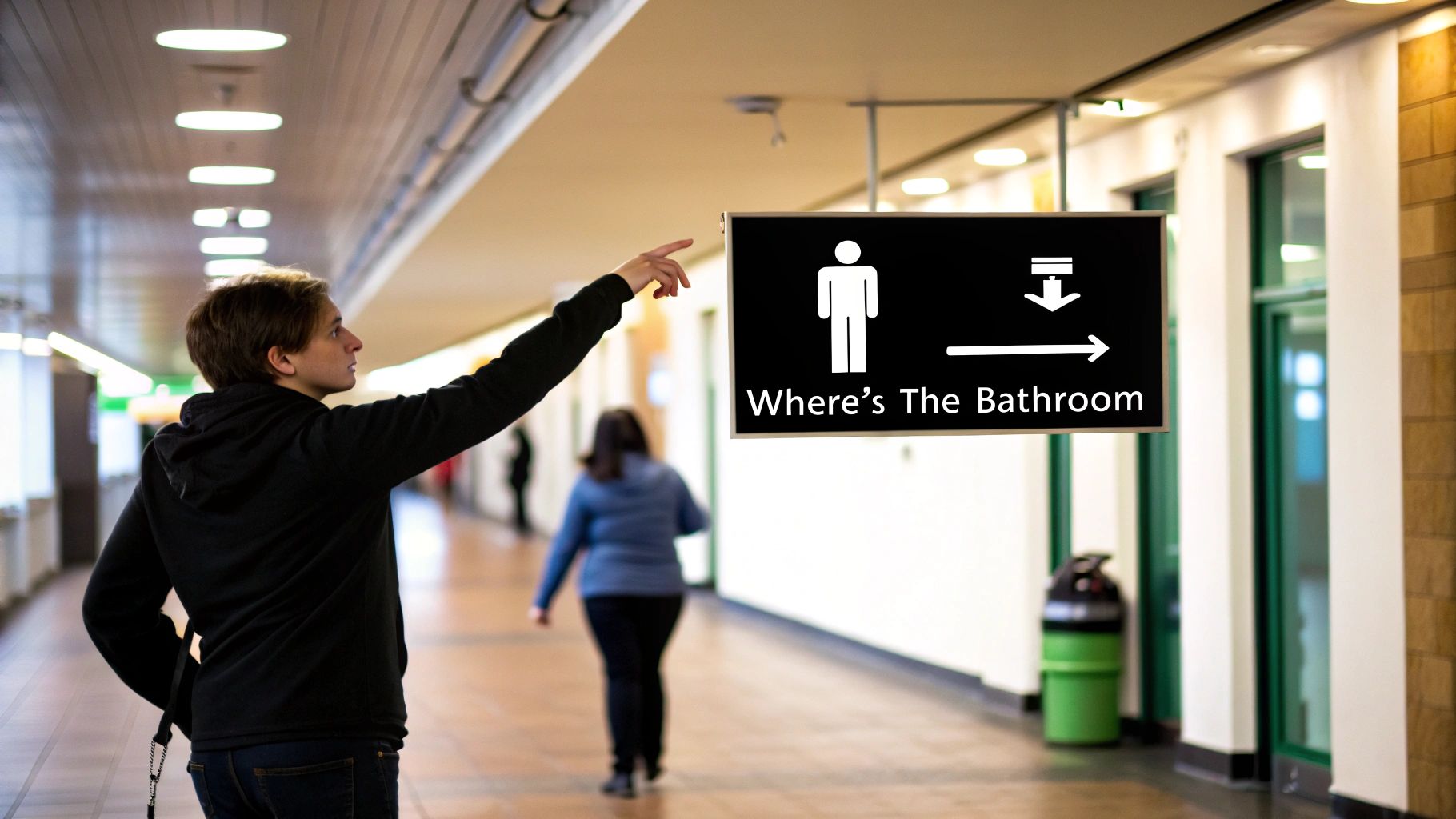
Navigating crowded streets, busy shops, and public transport in Italy requires a dose of politeness, and Mi scusi is your golden ticket. Pronounced mee SKOO-zee, this versatile phrase is one of the most important basic Italian phrases for tourists, serving both to get someone's attention ("Excuse me") and to apologize ("I'm sorry"). Its power lies in its ability to smooth over social interactions, showing respect and awareness of local customs, which are highly valued in Italian culture.
When and How to Use 'Mi scusi'
Mi scusi is your go-to phrase for any situation that requires a polite interruption or a sincere apology. It's the key to turning a potentially awkward moment into a positive exchange.
- Getting Attention: Before asking a stranger for directions or flagging down a waiter, start with a gentle "Mi scusi." Example: "Mi scusi, dov'è la stazione?" (Excuse me, where is the station?).
- Navigating Crowds: When you need to pass someone in a tight space, like on a bus or train, say "Mi scusi" to ask them to let you by.
- Apologizing: If you accidentally bump into someone or make a small mistake, a quick "Mi scusi!" is the perfect way to express regret.
The Politeness Scale: 'Mi scusi' vs. 'Scusa'
Just like with greetings, there's a formal and informal version of this phrase. Understanding the difference is crucial for showing the proper respect.
Key Insight: Mi scusi is the formal form, used when addressing strangers, elders, or anyone you would use "Lei" (the formal "you") with. It’s your safest and most respectful option as a tourist. The informal version, scusa, is reserved for friends, family, and children.
Here’s when to use each:
- Mi scusi: Use with shopkeepers, police officers, hotel staff, and anyone you don't know.
- Scusa: Use with a friend if you're late or need to interrupt them.
- Permesso?: A great alternative when physically passing someone. It translates to "permission?" or "may I pass?" and is very common.
Mastering Mi scusi is fundamental for polite travel. For those looking to practice this and other essential phrases in realistic scenarios, the PolyChat app for Italian offers interactive dialogues to help you build conversational muscle memory.
4. Grazie / Thank you
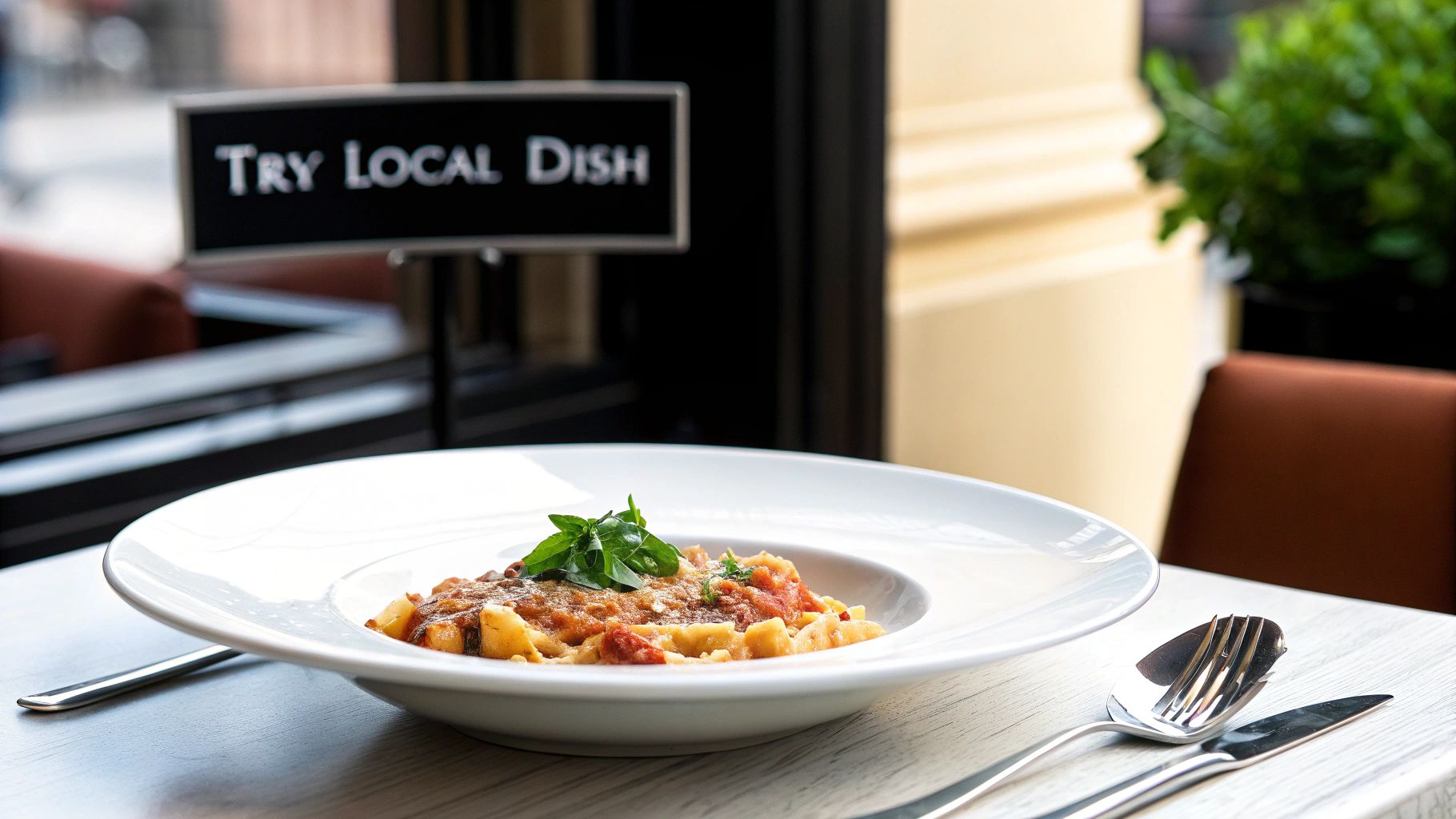
Among the most essential basic Italian phrases for tourists, Grazie is a word whose power and importance cannot be overstated. Pronounced GRAHT-see-eh, it’s the universal expression of gratitude. In Italian culture, where politeness and social connection are highly valued, a simple and sincere "thank you" can transform an ordinary interaction into a warm, positive exchange. It acknowledges the effort of others and shows respect, a gesture that is always appreciated.
When and How to Use 'Grazie'
Grazie is appropriate in nearly every situation, from the most casual to the most formal. Its versatility makes it one of the first words any traveler should master. Always pair it with a genuine smile and eye contact for maximum effect.
- In Restaurants: When a server brings your food or clears your plates, a simple "Grazie" is customary.
- While Shopping: Thank the cashier after paying or a shop assistant who helps you find an item.
- For Small Gestures: Use it when someone holds a door open for you or a taxi driver drops you off at your destination.
- Responding to Compliments: If someone compliments your Italian, you can respond with "Grazie!"
Adding Emphasis: Beyond a Simple 'Thank You'
While Grazie is always sufficient, adding an extra word can convey deeper appreciation, which is perfect for when someone has been especially helpful.
Key Insight: The common response to Grazie is Prego (You're welcome). Listening for this exchange is a great way to immerse yourself in the natural rhythm of Italian conversation and politeness.
Here are a few ways to amplify your gratitude:
- Grazie mille: "A thousand thanks," or thank you very much. Use this when a hotel concierge goes out of their way to book a tour for you.
- Grazie tante: Thanks a lot. This is a slightly more informal but equally warm alternative.
- Molto gentile: "Very kind." You can say this after Grazie to compliment the person's kindness (e.g., "Grazie, molto gentile").
Mastering these polite expressions opens the door to more authentic interactions. For those interested in the more casual side of communication, you might enjoy exploring some common Italian slang words.
5. Quanto costa? / How much does it cost?
Among the most practical basic Italian phrases for tourists, Quanto costa? is your key to navigating markets, shops, and restaurants without financial surprises. Pronounced KWAHN-toh KOH-stah, this question directly translates to "How much does it cost?" and is indispensable for everything from buying a leather souvenir in Florence to ordering an espresso at a local café. Using it shows you're an engaged and savvy traveler, ready to participate in the local economy confidently.
When and How to Use 'Quanto costa?'
This phrase is universal for any transaction. Its directness is not considered rude; it's simply a necessary part of making a purchase. You can use it as a standalone question or make it more specific by pointing to an item.
- In a Market: While pointing at a specific item, you can ask, "Quanto costa questo?" (How much does this cost?).
- In a Restaurant: If a menu isn't available or unclear, you might ask, "Quanto costa il piatto di pasta?" (How much is the pasta dish?).
- Booking Accommodation: At a hotel reception, you could inquire, "Quanto costa una camera per due notti?" (How much is a room for two nights?).
The Politeness Scale: Adding Specificity
While "Quanto costa?" is perfectly acceptable on its own, adding a polite introductory phrase can make the interaction smoother, especially in more formal settings. Understanding the response is just as crucial, so practicing your numbers in Italian beforehand is highly recommended.
Key Insight: Asking the price upfront is a common practice in Italy, especially in smaller shops or markets where prices aren't always displayed. It prevents misunderstandings and is a normal part of the shopping culture, not an awkward or confrontational question.
Here are a few ways to enhance your inquiry:
- Scusi, quanto costa? Excuse me, how much does it cost? (A universally polite opener)
- Vorrei sapere quanto costa. I would like to know how much it costs. (Slightly more formal)
- È troppo caro. It's too expensive. (Useful if you plan to negotiate gently in a market setting)
Mastering this simple question empowers you to manage your budget effectively. For more immersive practice, you can explore the PolyChat app for Italian, which features real-world conversation scenarios that simulate shopping and ordering food, helping you prepare for these exact situations.
6. Dov'è il bagno? / Where is the bathroom?
Of all the practical, basic Italian phrases for tourists, this one addresses a universal and often urgent need. Pronounced doh-VEH eel BAHN-yoh, this question is your key to finding relief and avoiding stressful situations. In Italy, public restrooms aren't as common as in many other countries, so knowing how to confidently ask for the bathroom in cafés, museums, or train stations is an invaluable skill for any traveler.
When and How to Use 'Dov'è il bagno?'
This phrase is a straightforward question, but adding a touch of politeness goes a long way. It's universally appropriate in almost any setting, from a rustic trattoria to a high-end fashion boutique. A simple "per favore" (please) elevates the request.
- In a Restaurant: After a meal, you can ask your waiter, "Scusi, dov'è il bagno, per favore?" (Excuse me, where is the bathroom, please?).
- At a Museum or Attraction: Approach an employee and ask, "Dov'è il bagno più vicino?" (Where is the nearest bathroom?).
- In an Emergency: If you're in a hurry, a simple and direct "Bagno?" while looking inquisitive will usually get the point across immediately.
The Politeness Scale: 'Il Bagno' vs. 'La Toilette'
While il bagno is the most common and widely understood term for a restroom, you might also hear or see the word la toilette, which is a direct borrowing from French. Both are perfectly acceptable, but il bagno is more authentically Italian and used more frequently in everyday conversation.
Key Insight: In Italy, it's common practice to buy a small item, like a coffee (un caffè) or a bottle of water (un'acqua minerale), at a bar or café to be able to use their restroom. Don't be surprised if you see a sign indicating the facilities are for customers only (solo per clienti).
Here are a few related terms to keep in mind:
- Signori: Gentlemen (for the men's room)
- Signore: Ladies (for the women's room)
- Occupato: Occupied
- Libero: Free
Memorizing this essential question is a non-negotiable for a comfortable trip. You can practice this and other real-world scenarios with the PolyChat app for Italian to ensure you can ask for directions to the bagno with confidence when you need it most.
7. Qual è il piatto tipico qui? / What is the typical dish here?
One of the greatest joys of visiting Italy is the food, and this phrase is your key to unlocking the most authentic culinary experiences. Pronounced kwahl EH eel pee-AH-toh TEE-pee-koh kwee, this question shows genuine interest in local culture and almost always leads to a more memorable meal than simply choosing a familiar dish from the menu. Italy's cuisine is fiercely regional, and locals take immense pride in their specific culinary traditions, from risotto in the north to fresh seafood in the south.
When and How to Use 'Qual è il piatto tipico qui?'
This phrase is perfect for any dining situation where you want a local recommendation, from a family-run osteria to a bustling market stall. It immediately signals that you are an adventurous and respectful traveler, eager to experience the true taste of the region.
- In a Trattoria: When the waiter arrives, ask "Qual è il piatto tipico qui?" to discover what the restaurant is famous for. In Bologna, they might suggest tagliatelle al ragù.
- At a Coastal Restaurant: In Sicily or along the Amalfi Coast, this question could lead you to the freshest catch of the day, prepared in a traditional local style.
- At a Market: Approaching a food vendor and asking this can open up a wonderful conversation about regional products, like a specific cheese or cured meat.
The Politeness Scale: Adding a Touch of Finesse
While the phrase is perfectly fine on its own, you can make it sound even more natural and polite by slightly altering the wording. This small adjustment can make your interaction feel less like a direct question and more like a friendly request for a suggestion.
Key Insight: Asking for a recommendation is a sign of trust and respect. It empowers the chef or server to share their expertise and pride, often resulting in them bringing you the best dish they have to offer.
Consider these slightly more nuanced alternatives:
- Mi consiglia il piatto tipico? (Can you recommend the typical dish?)
- Cosa mi consiglia di tipico? (What typical [dish] do you recommend for me?)
- C'è una specialità della casa? (Is there a house specialty?)
Beyond just knowing the words, understanding the culture around food can enhance your experience; explore more about the rich history and variety of Italian cuisine. Mastering this simple phrase is one of the most rewarding basic Italian phrases for tourists, transforming you from a passive diner into an active cultural explorer.
8. Aiuto! / Help! & Non capisco / I don't understand
While you hope you'll never need them, knowing how to ask for help or express confusion are crucial safety nets. Aiuto! (pronounced ah-YOO-toh) is your urgent call for assistance, while Non capisco (pronounced nohn kah-PEES-koh) is the essential phrase for navigating communication breakdowns. These are two of the most important basic Italian phrases for tourists, providing a way out of difficult situations, from genuine emergencies to simple misunderstandings.
When and How to Use These Phrases
Aiuto! is reserved for serious situations where you need immediate attention, such as a medical issue or if you feel you are in danger. Non capisco is a much more common, low-stress phrase used to signal a language barrier and request clarification. It's a polite way to slow down a conversation and prevent frustration on both sides.
- Genuine Emergency: Shout "Aiuto! Ho bisogno di un medico!" (Help! I need a doctor!) or "Aiuto! Sono in pericolo!" (Help! I'm in danger!).
- Lost in Conversation: A simple "Mi scusi, non capisco" (Excuse me, I don't understand) is perfect. Follow up by asking, "Puoi parlare più lentamente, per favore?" (Can you speak more slowly, please?).
- Confused by Directions: If gestures aren't enough, say "Non capisco. Puoi mostrare sulla mappa?" (I don't understand. Can you show me on the map?).
Bridging the Communication Gap
The power of Non capisco lies in what you say next. It's not just about stating a problem; it's about proposing a solution. Following it with a request to speak slowly, repeat, or write something down shows you are actively trying to understand.
Key Insight: Using Non capisco isn't admitting failure. It’s an active tool to manage the conversation's pace and clarity. It invites the other person to help you, turning a potential moment of frustration into a collaborative effort to communicate.
Here are some phrases to pair with Non capisco:
- Puoi ripetere? (Can you repeat?) - A slightly softer alternative.
- Puoi parlare più lentamente? (Can you speak more slowly?)
- Puoi scriverlo? (Can you write it down?) - Extremely useful for names, addresses, or numbers.
For moments when verbal communication is completely stuck, having a reliable digital tool is invaluable. With the PolyChat app’s built-in translator, you can have a backup ready after these initial phrases have been tried.
8 Essential Italian Phrases for Tourists — Comparison
| Phrase | 🔄 Complexity | ⚡ Resource requirements | ⭐ Expected effectiveness | 📊 Expected outcomes / impact | 💡 Ideal use cases & key advantages |
|---|---|---|---|---|---|
| Ciao / Hello, Goodbye | Low — informal nuance | Minimal — pronunciation practice | ⭐⭐⭐ | Immediate friendly rapport; easy conversation starter | Informal settings; universal recognition; great for beginners |
| Parla inglese? / Do you speak English? | Low | Low — polite phrasing; translator backup useful | ⭐⭐⭐ | Opens access to English help; reduces misunderstandings | Tourist hubs, ticket counters, hotels; respectful language bridge |
| Mi scusi / Excuse me, I'm sorry | Low — formal vs. casual use | Minimal — polite formula | ⭐⭐⭐ | Smooths interactions; prevents offense; gets attention | Crowds, apologies, formal/semi‑formal situations |
| Grazie / Thank you | Very low | Minimal — just use sincerely | ⭐⭐⭐⭐ | Builds goodwill; often improves service and recommendations | All contexts; universal politeness that yields positive responses |
| Quanto costa? / How much does it cost? | Low–Medium — numbers useful | Moderate — number vocabulary & bargaining phrases | ⭐⭐⭐ | Prevents overspending; enables negotiation in markets | Shopping, markets, restaurants; budget‑minded travelers |
| Dov'è il bagno? / Where is the bathroom? | Very low | Minimal — memorize for urgency | ⭐⭐⭐⭐ | Resolves urgent practical need quickly; reduces stress | All travelers, long trips, public buildings; immediate utility |
| Qual è il piatto tipico qui? / What is the typical dish here? | Medium — regional terms | Moderate — cultural knowledge & translation help | ⭐⭐⭐⭐ | Unlocks authentic culinary experiences; deeper local interaction | Food enthusiasts, cultural explorers, regional dining |
| Aiuto! / Help! — Non capisco / I don't understand | Low — emergency vs. comprehension | Minimal — memorize; know emergency number | ⭐⭐⭐⭐ | Safety alerting & conversation recovery; prevents escalation | Emergencies, comprehension breakdowns; essential safety phrases |
Turn Your Knowledge into Conversation
You've just equipped yourself with a foundational toolkit of basic Italian phrases for tourists, moving beyond simple translations to understand the cultural nuances, situational context, and polite alternatives that truly enrich communication. From the simple versatility of Ciao and the essential politeness of Grazie and Mi scusi, to the practical necessities of asking Quanto costa? or Dov'è il bagno?, you're now prepared for key interactions. Mastering these phrases is your first and most important step toward transforming a standard vacation into a genuinely immersive cultural experience.
Remember, the goal isn't flawless, native-level pronunciation on day one. The real value lies in the effort and the connection it builds. When you attempt to speak Italian, you are showing respect for the local culture and opening doors that might otherwise remain closed. A simple Parla inglese? shows humility, while asking Qual è il piatto tipico qui? demonstrates a genuine interest in local traditions, often leading to unforgettable culinary discoveries and warm interactions.
From Memorization to Mastery
The journey from learning a phrase to using it confidently in a real-world scenario requires active practice. Passive reading is a good start, but active recall and application are what build true fluency and confidence. The difference is like reading a recipe versus actually cooking the meal. To truly make these phrases your own, you must speak them, hear them, and use them.
Here are your actionable next steps to bridge that gap:
- Review and Rehearse: Don't just read the list once. Revisit these phrases daily in the lead-up to your trip. Practice saying them out loud, focusing on the phonetic pronunciations provided. Record yourself and compare it to online audio examples to fine-tune your accent.
- Visualize Scenarios: Actively imagine yourself using these phrases. Picture yourself in a bustling market in Rome asking Quanto costa? for a souvenir, or in a charming Florentine trattoria asking Dov'è il bagno?. This mental rehearsal prepares your brain for the real moment, reducing anxiety and hesitation.
- Embrace Imperfection: Your accent won't be perfect, and you might stumble over words. That's not just okay; it's a critical part of the learning process. Most Italians will appreciate your effort immensely and will gladly help you. The most important thing is to try. A smile and a genuine attempt to speak the language will always be better received than defaulting immediately to English.
By committing these basic Italian phrases for tourists to active memory, you are investing in a more authentic and rewarding travel experience. You're preparing not just to see Italy, but to engage with it, connect with its people, and create memories that go far beyond the surface.
Ready to turn your new vocabulary into confident conversation? Move beyond static lists and start practicing with PolyChat. Our app uses AI-powered, gamified lessons and real-world conversation simulations to help you master these essential phrases and more. Visit PolyChat to begin your journey toward speaking Italian with confidence before you even pack your bags.
Practice Italian Slang with Quickshot
Test your knowledge of Italian slang words with this interactive game!
Embed this game on your siteFree for teachers, schools and bloggersGet code
Paste this where you want the game. It includes a credit link back to this article.
<iframe src="https://www.polychatapp.com/widget/quickshot-game?data=N4IgLiBcIKIHYHMA2BLAzgCwARgPZYEkwBDVYuLANVwGNiAjLARQFcUAvEAGhACcoA2qADuUEAHUApkiRcsaXHLAZJcbiFyCQAIVwZ1AEWIp1AQRm5exdQDEUCFlbAmAujxpjzSS9YC+XETECLAATXDgAcjAsAGs4XFEeTUgBEABhFSwAM3tiEgBCdV19HgBZYgRiXhMeAgp6WjosUiwkFgAHTTcQD2hikH9A6AAJBKwaXFwkQqStDMksdtIkSRn0zJzKgsNjW3tHPNd3MXns3O3BkFFocQw85sXjODXk1KMa9YWlmVW9hFwAPTWWr1RrEZpIVodLrHaCnb4rQqXa7pXAAWwW4SwAKww0cvAAnlgOupXiA7A4nB93upypVqrTVPg0aRJCBur0QDTkWIDOEolhhJZCc0GixoihojiAJq4FgRXgLYTSCYY7FYADyWXGct4aDZsxSIC8Pj+B2cf0BwJAAFUKGhiDQJqEjj0xBTzSYeXDJkhSVo6lgGk7wS02p1LUDaRUqh9SkysCyVuzYeT7FaBgErmIAOKTEJQmgxF5afplGMMkFBsEQqERng0jlBUEh2vhzTekDBYToDD5dUEbXhJAE-1G+PxROs6P0j4AZSWIcVRUkeXwYDZTegdNjmaGIAAKnc4DEsP9cCE4JI0Gh1QAZFhFlAjsepE1WRmTpMGkALx10ZceAPDgUEBYD2BQawtxACdmWnXwXF8IA" title="Language game" style="width: 440px; height: 520px; border: none; display: block;"></iframe>
<p style="font-size: 12px; margin: 4px 0 0;">Free language games by <a href="https://www.polychatapp.com/blog/basic-italian-phrases-for-tourists">PolyChat</a></p>

Jean-Baptiste Bolh
Co-Founder
Applied AI