The Best Way to Learn Conversational Spanish for Real-Life Chats
The best way to learn conversational Spanish is surprisingly simple: speak it, every single day. Forget trying to memorize the entire dictionary. The real secret is combining consistent daily speaking practice with smart immersion tactics and a laser focus on the words you'll actually use.
It’s an approach that values active communication over passive knowledge, helping you connect with real people, not just conjugate verbs in your head.
Ready to Learn Spanish?
Try PolyChat's engaging language lessons, interactive learning games and put your Spanish vocabulary to the test!
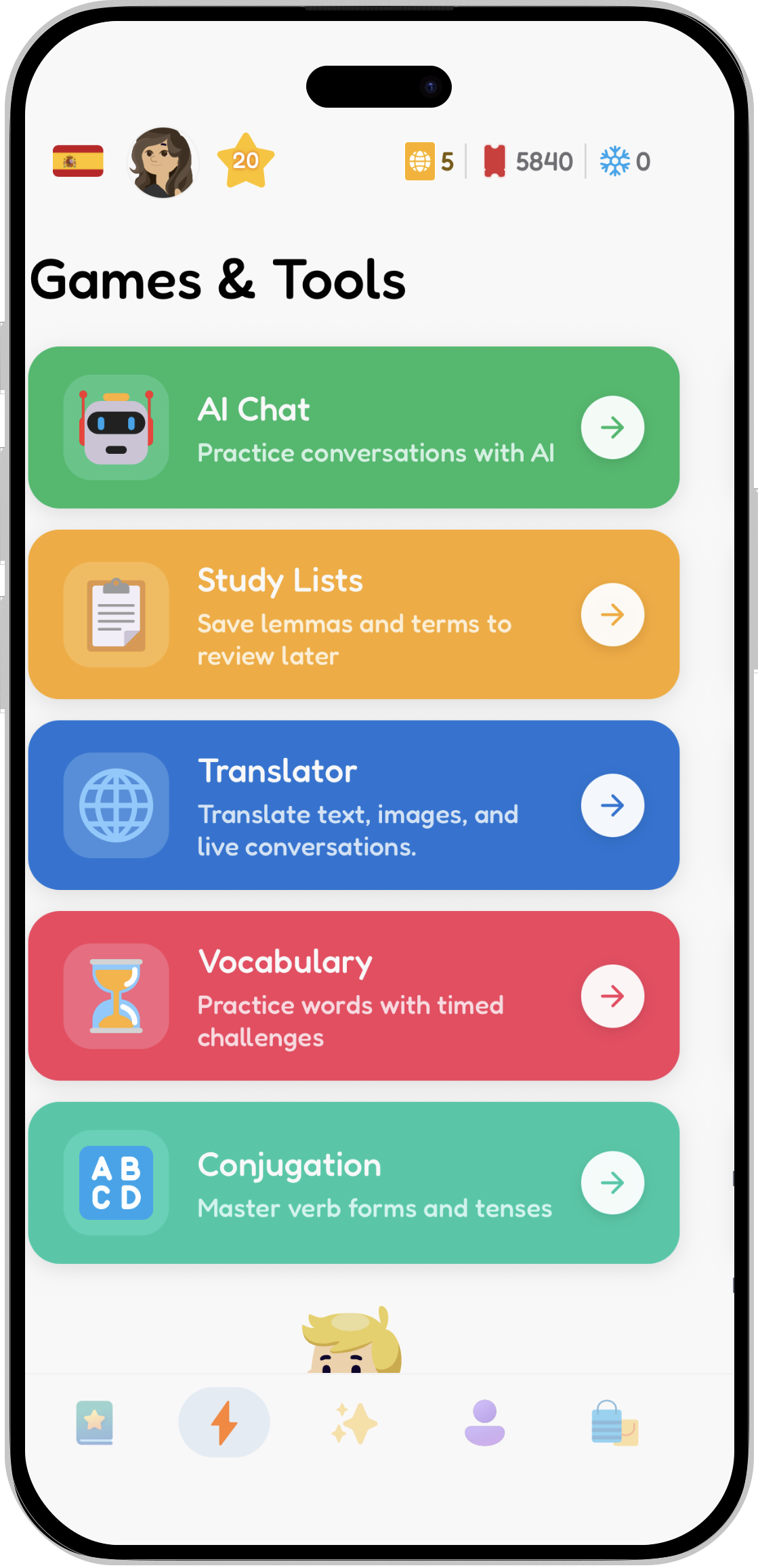
Games & Tools
Tools that every language learner needs at all stages of their learning journey.
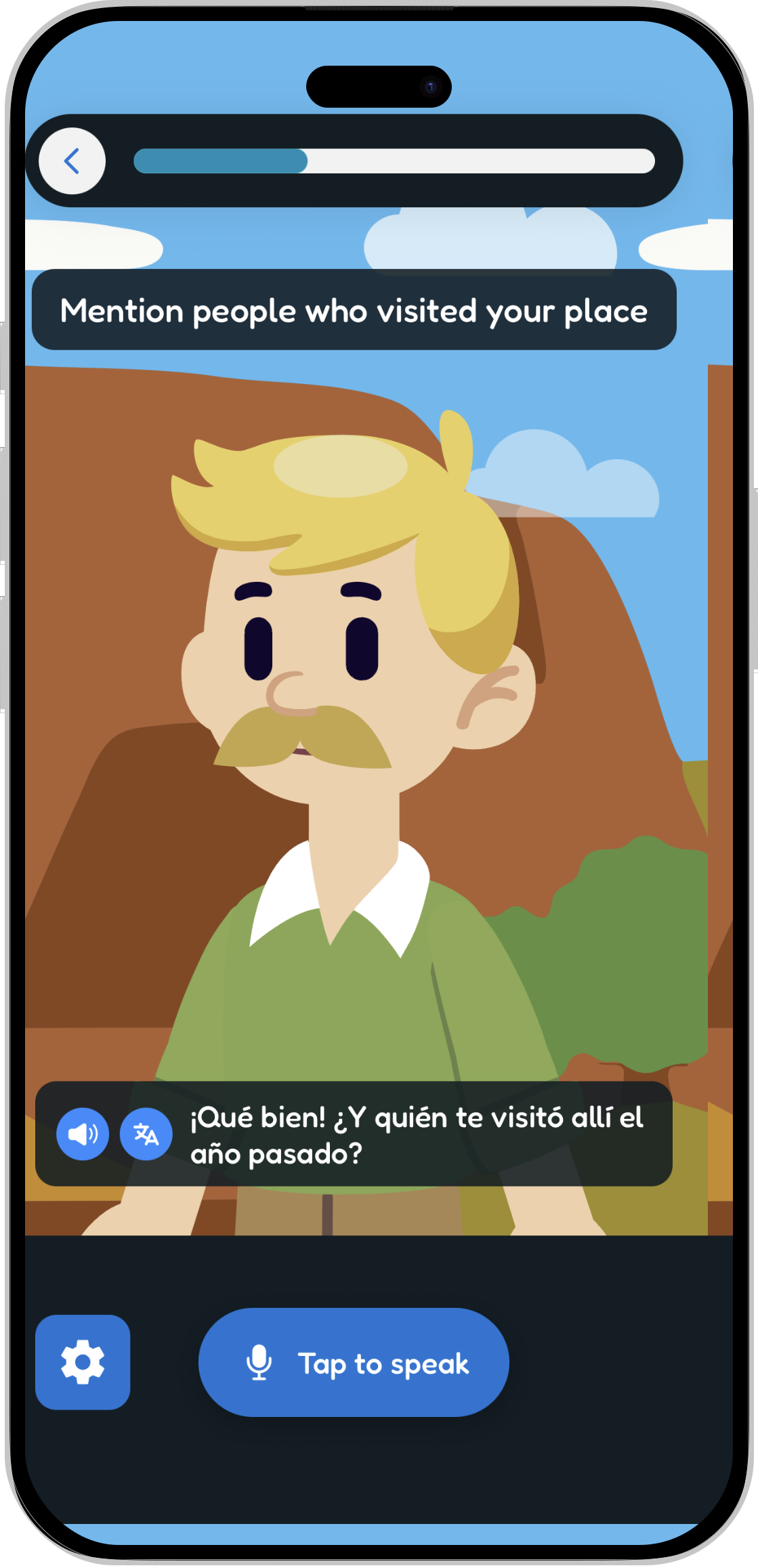
AI Chat Tutor
Practice real conversations with an AI tutor that helps you speak with confidence.
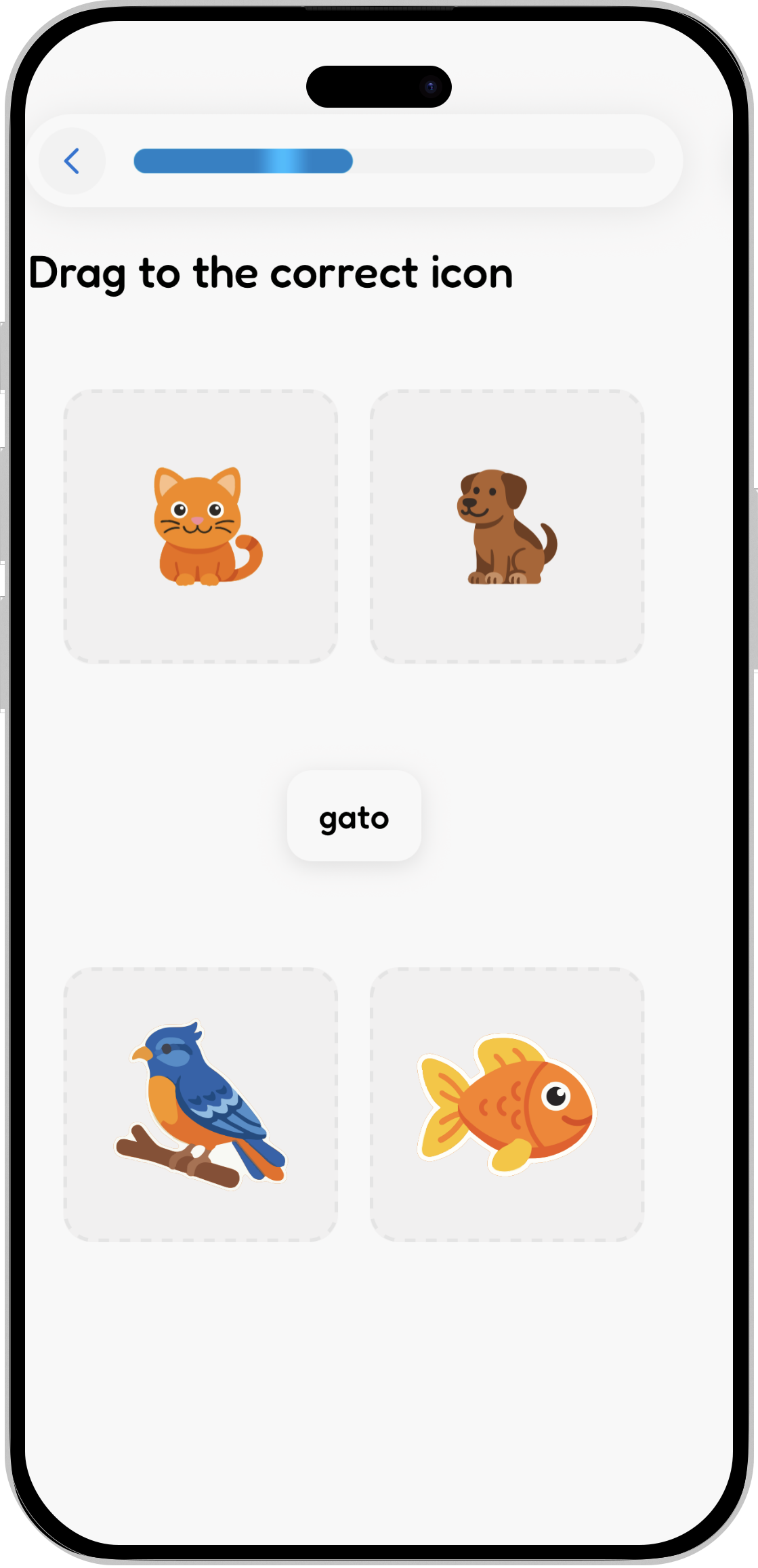
Interactive Games
A variety of games to help you learn and remember new words and phrases.


Your Practical Path to Spanish Fluency
Ready to leave textbook phrases behind and start having real conversations? Good. Let's bust a myth right now: there's no single "secret" to fluency. The real magic is in having a realistic, practical roadmap that gets you speaking from day one. It's about building a system that works for you—one that prioritizes connection over perfection.
This guide is your no-fluff framework for getting there. We'll help you build a solid foundation using the most common words and grammar you'll need to start talking, right now.
What Does "Conversational" Actually Mean?
Before you start, it’s critical to define the target. "Conversational" doesn't mean you know every word or have flawless grammar. Not even close.
It’s really about being able to:
- Get your thoughts and ideas across on everyday topics.
- Understand the main point of what someone is saying, even if you miss a few words.
- Ask for clarification to keep the conversation moving.
- Handle common situations like ordering coffee or asking for directions.
Think of it as a journey with three core pillars that feed into each other.
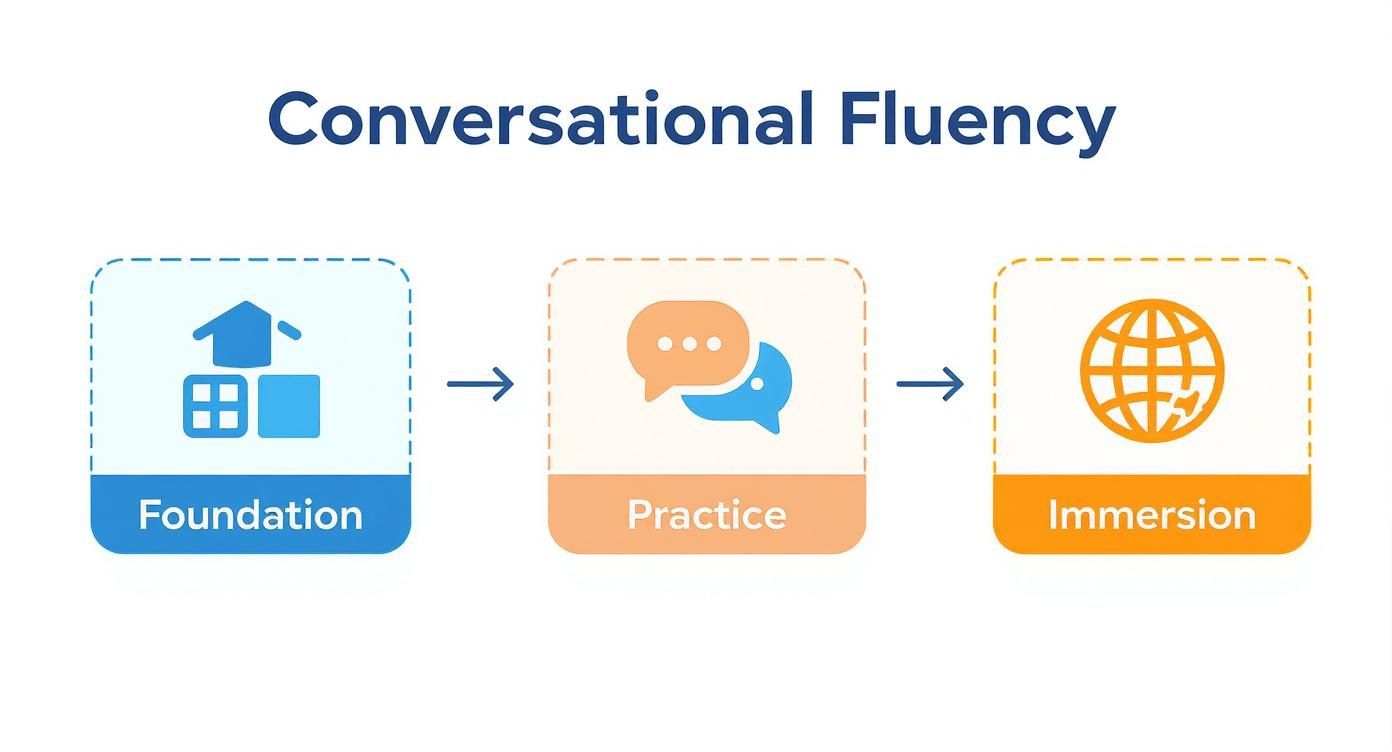
As you can see, a solid foundation enables you to practice, and immersing yourself in the language reinforces both. It's a powerful learning cycle.
Start by Building Your Foundation
Every great speaker started with the basics. Research consistently shows that a strong initial vocabulary is one of the best predictors of future conversational skill. You have to build that core knowledge first.
The real value in learning a language lies in being able to connect with people from different cultures. It's about the experience, not just the skill.
So, where do you start? Forget trying to swallow the dictionary. Your first goal should be learning the 800-1,000 most frequent words in Spanish. This might sound like a lot, but these words make up roughly 80% of all daily conversations.
Combine that vocabulary with a handful of essential verbs in the present tense (like ser, estar, tener, querer), and you suddenly have the tools to build real sentences.
To help you get organized, here is a quick look at the essential components you need to gather.
Your Conversational Spanish Starter Kit
This table summarizes the core components needed to kickstart your conversational Spanish journey. Think of it as your initial toolkit.
| Component | Why It's Essential | Your First Action Step |
|---|---|---|
| High-Frequency Vocabulary | Covers ~80% of daily speech, giving you maximum impact for minimum effort. | Find a list of the top 1,000 Spanish words and start learning 10 per day. |
| Core Verb Conjugations | Verbs are the engines of sentences. Mastering the present tense is non-negotiable. | Learn to conjugate ser, estar, tener, and querer in the present tense. |
| A Speaking Partner | Puts your knowledge into active practice, which is the fastest way to build fluency. | Find a language exchange partner or start using an AI tutor like PolyChat. |
| Daily Immersion Habit | Surrounds you with the sounds of the language, training your ear to understand natives. | Switch your phone's language to Spanish or listen to a 15-minute Spanish podcast. |
This foundation isn't about achieving perfection. It's about giving you a functional toolkit so you can get out there and start talking. Exploring some of the top resources for speaking any language fluently can give you a major boost here.
The whole point is to get you speaking, making mistakes, and learning from them as quickly as possible. That’s how passive knowledge becomes an active, confident skill.
Building a Daily Spanish Speaking Habit
What’s the biggest difference between someone who knows a lot of Spanish and someone who actually speaks it? A daily speaking habit. That's it.
Consistency is the engine that drives you to fluency. The fastest way to learn conversational Spanish isn’t cramming for hours on a Saturday. It’s weaving short, focused speaking sessions into your life, every single day.
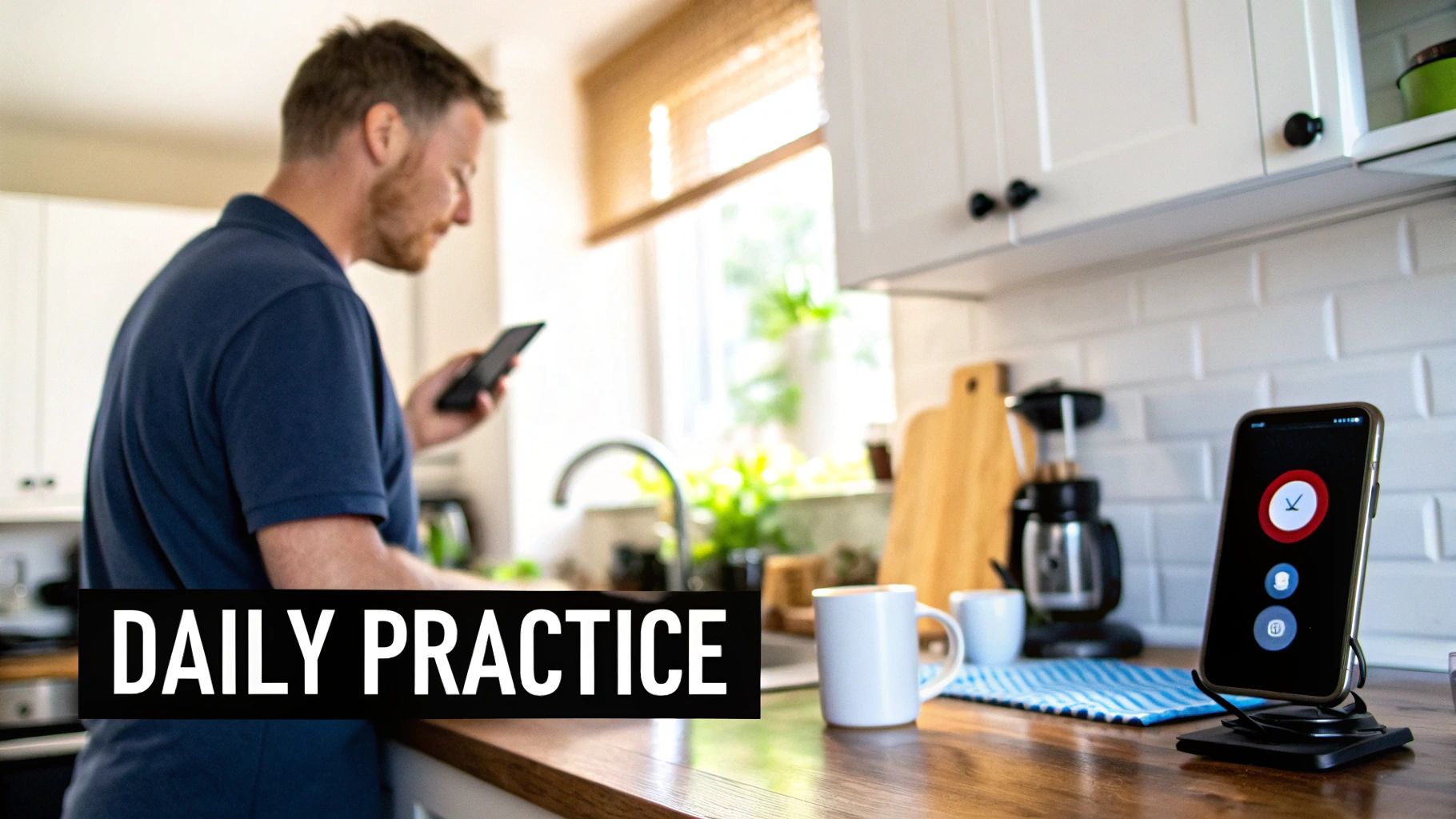
You don’t need to find a spare hour. Honestly, that’s a recipe for burnout. Starting with a realistic goal of just 20 to 30 minutes a day is far more powerful. This simple shift turns practice from a chore into something as automatic as brewing your morning coffee.
Embrace the Power of Micro-Conversations
The secret to a daily habit that sticks is what I call ‘micro-conversations.’ These are quick, focused bursts of speaking practice you can do anytime, anywhere. They completely lower the stakes and make speaking a normal part of your day, not a special event.
The real goal here is to get your brain and mouth comfortable producing Spanish sounds and stringing sentences together without overthinking. You're building the muscle memory you need for real, spontaneous conversations.
Here are a few dead-simple micro-conversations you can try today:
- Narrate Your Morning Routine: As you make your coffee, just say what you're doing out loud. "Estoy haciendo café. Ahora, pongo el café en la taza. Necesito un poco de leche." It feels weird for about two days, then it becomes an incredibly effective way to drill high-frequency verbs.
- Describe Your Commute: Driving, walking, on the train? Describe what you see. "Veo un coche rojo. Ese hombre camina muy rápido. Los árboles son enormes." This forces you to pull your core vocabulary out of your brain and use it in new ways.
- Use an AI Language Tutor: A quick, 5-minute chat with an AI partner like PolyChat is a game-changer. You can run through a specific scenario, like ordering from a menu or asking for directions, with zero fear of judgment.
These tiny actions compound like crazy over time. They keep Spanish front-and-center in your mind and start turning speaking into a reflex, not a slow, painful calculation.
Structure Your Practice for Maximum Impact
Just randomly saying words won't get you very far. Your practice needs a little structure to be truly effective. The key is to focus on high-frequency verbs and sentence patterns—the stuff that gives you the most conversational bang for your buck.
Instead of trying to learn every single word, concentrate on the grammatical building blocks.
For example, you could spend one week just mastering sentences with "querer" (to want). You’d practice saying things like "Quiero un café," "¿Quieres ir al cine?" and "No quiero trabajar hoy." The next week? Move on to "tener" (to have). This targeted approach makes every minute you spend practicing count.
The people who get fluent aren't the ones who study the most. They're the ones who find clever ways to bake the language into their actual lives. It’s all about frequency and consistency, not just duration.
This isn’t just a hunch; it's backed by solid research on language acquisition. Studies show that immersive methods—actively using the language multiple times a week—crush infrequent lessons. Engaging with Spanish for 30-40 minutes, 3-5 days per week, gives your brain the consistent exposure it needs to start thinking in the language. You can dive deeper into the research on how consistent immersion leads to superior language outcomes at Harvard.
From Chore to Habit: The Five-Minute Kickstart
Let's be real: the hardest part of any new habit is just starting. That's where the "five-minute rule" comes in.
Commit to speaking Spanish for just five minutes. That's it. Set a timer.
Literally, anyone can find five minutes. The magic is that once you start, you’ll almost always find it easy to keep going for 15, 20, or even 30 minutes. It’s a simple psychological trick that demolishes the mental barrier and makes the habit feel tiny and achievable.
Over time, that small daily commitment builds a rock-solid speaking routine, putting you on the fastest path to real conversational confidence.
Mastering Real-World Immersion from Home
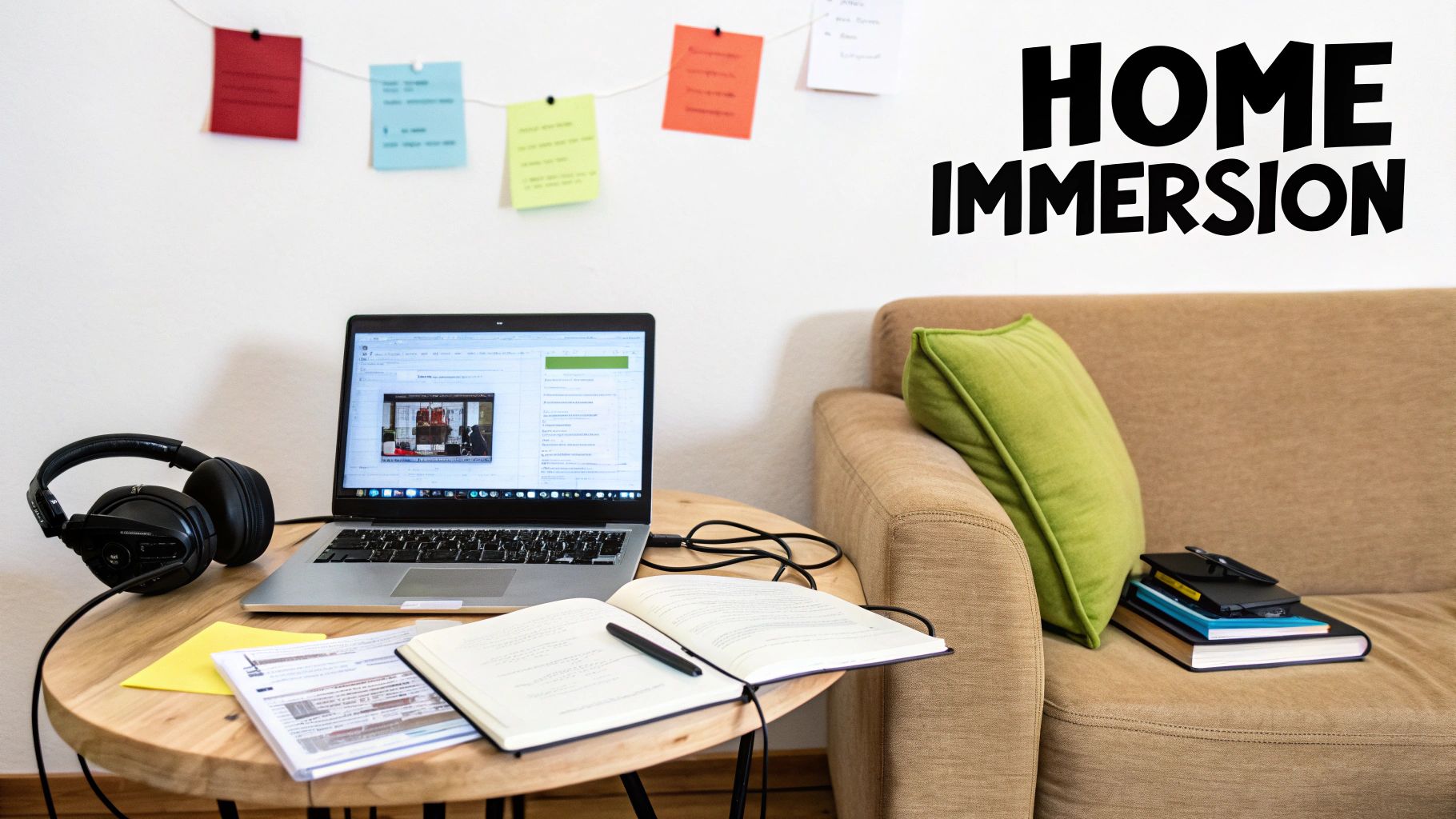
You don't need a plane ticket to Madrid or Mexico City to surround yourself with Spanish. The secret is creating a rich, immersive environment right where you are. This is all about turning your home into a personal language lab—a place where Spanish isn't just a subject you study, but a living part of your day.
The whole idea is to crank up your passive and active exposure to the language. When you constantly see, hear, and interact with Spanish, your brain starts to process it more naturally. This trains your listening skills (a non-negotiable for real conversation) and helps you absorb the rhythm and flow of native speech.
This goes way beyond just watching a movie with subtitles. It’s a strategic, layered approach that should match where you're at in your journey.
Create Your Beginner Immersion Bubble
If you're just starting out, the goal is to make Spanish unavoidable in small, manageable doses. You're building a foundation of familiarity. The trick is to swap out some of your daily English consumption with Spanish equivalents, creating a gentle but consistent stream of input.
Here are a few simple but powerful ways to get started:
- Change Your Device Language: Switch your phone, computer, or tablet to Spanish. This is a low-effort, high-impact move. You already know where everything is, so you’ll learn words like Ajustes (Settings), Mensajes (Messages), and Llamar (Call) through pure context.
- Curate a Spanish Soundtrack: Create a playlist of Spanish-language music you actually enjoy. Look up the lyrics (letras) and sing along. Music is fantastic for learning natural contractions and rhythm.
- Follow Spanish-Speaking Creators: Your social media feeds are a goldmine. Follow creators who post about your hobbies—whether it's cooking, gaming, or fitness—but in Spanish. This makes the content immediately engaging and relevant.
These little changes might feel small at first, but they add up fast. You’re creating dozens of daily touchpoints with the language, which is exactly what your brain needs to start making connections.
Level Up to Intermediate Immersion Tactics
Once you've got some basic vocabulary and can follow simple sentences, it's time to go deeper. The focus now shifts from just listening to actively engaging. You need to put yourself in situations where you have to understand and process Spanish to keep up.
This is where the real acceleration happens. You’re no longer just observing the language; you’re starting to live in it.
The real value in learning a language lies in being able to connect with people from different cultures. It's not about the skill itself, but about the new experiences and relationships that skill unlocks.
To make this leap, find content and communities designed for native speakers.
- Find a Language Exchange Partner: Platforms like Tandem or HelloTalk connect you with native Spanish speakers who want to learn English. Schedule a 30-minute call once a week: 15 minutes in English, 15 in Spanish. This is your training ground for real, unscripted conversation.
- Join a Spanish-Speaking Online Community: Love hiking? Find a Spanish-language Facebook group or subreddit about senderismo. Big fan of a particular video game? Join its Spanish-language Discord server. Discussing your passions forces you to learn specialized, interesting vocabulary.
- Listen to Learner-Focused Podcasts: Podcasts like Notes in Spanish or Coffee Break Spanish are perfect for intermediate learners. They speak clearly and often explain complex phrases or cultural nuances, bridging the gap between textbook Spanish and the fast-paced speech you'll hear in the wild.
By diving into these resources, you’ll not only improve your listening but also pick up on the subtleties of everyday language. To really sound natural, you need to know how people actually talk. A great starting point is exploring some common Spanish slang words and phrases. This is the kind of authentic vocabulary that makes you sound less like a textbook and more like a real person.
The goal here is to create a constant loop of hearing, processing, and understanding. By weaving Spanish into the fabric of your daily life, you transform it from a foreign subject into a familiar tool for communication and connection.
Using Technology to Accelerate Your Speaking Skills
Modern technology has completely changed the game for language learners. Gone are the days of relying solely on dusty textbooks and expensive tutors. Today, the smartest way to learn conversational Spanish is to strategically use the powerful tools right at your fingertips.
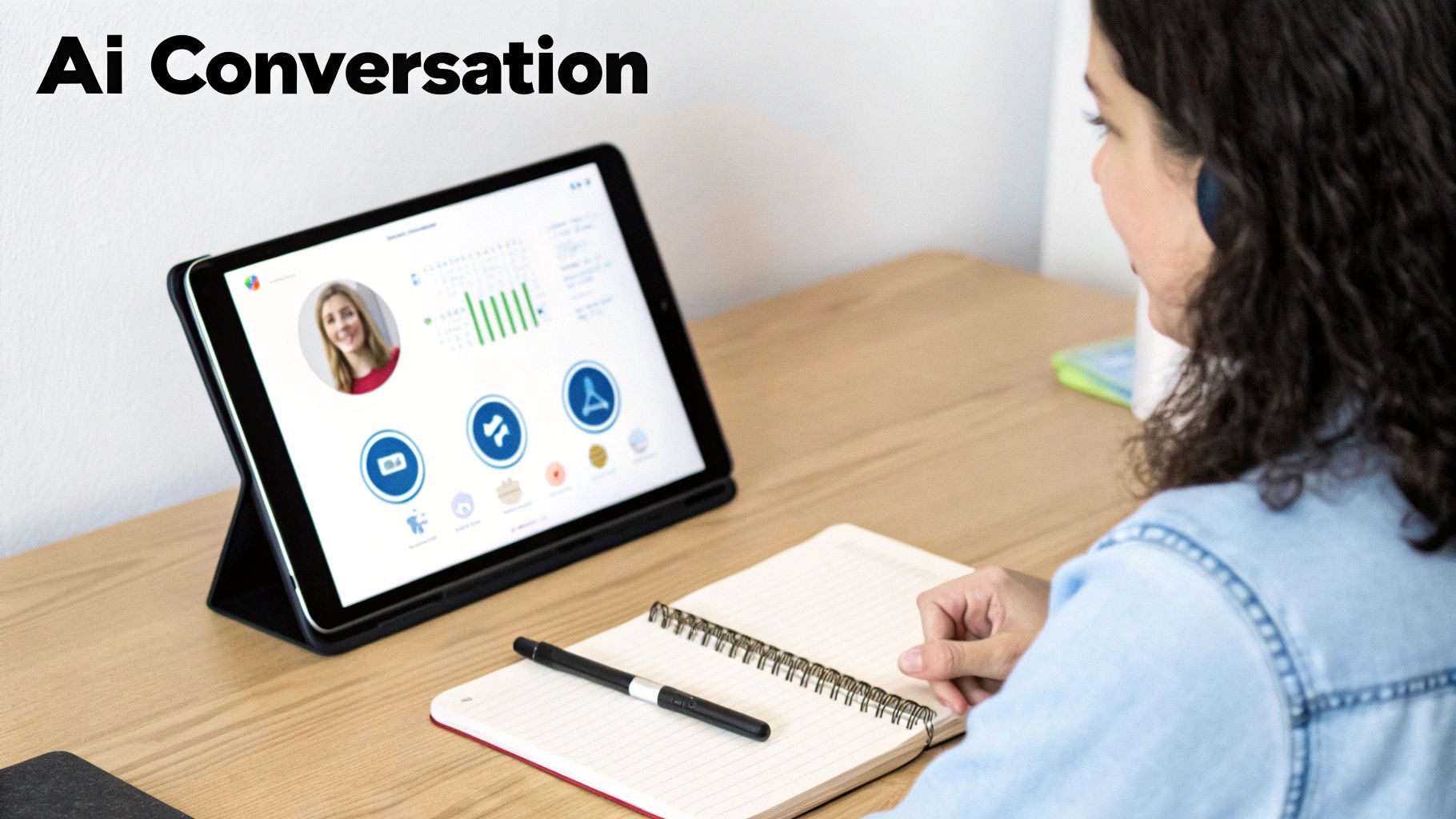
This isn't just about downloading an app and hoping for the best. It's about building a personal "tech stack" that bridges that frustrating gap between knowing words and actually using them in a real conversation.
Think of technology less as a teacher and more as a flight simulator. It’s a way to get hundreds of practice reps in a low-stakes environment before you ever have to order that coffee under pressure.
The Rise of AI Conversation Partners
The single biggest leap forward for language learners has been the arrival of AI conversation partners. Tools like PolyChat solve the classic problem of not having someone to talk to, offering a judgment-free space for unlimited speaking practice.
Imagine you're getting ready for a trip to Colombia and you’re nervous about ordering food. Instead of just memorizing phrases from a book, you can run through the entire scenario with an AI tutor until it feels completely natural.
Real-World Scenario: Ordering Coffee
- You: “Hola, buenos días. Quiero un café, por favor.” (Hello, good morning. I want a coffee, please.)
- AI Tutor: “¡Claro! ¿Le gustaría con leche o azúcar?” (Of course! Would you like it with milk or sugar?)
- You: “Con un poco de leche. Y… uh… una empanada.” (With a little milk. And… uh… an empanada.)
- AI Tutor: “¡Excelente elección! ¿Algo más?” (Excellent choice! Anything else?)
This simple back-and-forth is where the magic happens. The AI can offer instant feedback on your pronunciation or suggest a more natural phrase, letting you practice the same interaction over and over until it becomes second nature. You get to make all your mistakes and build real confidence without any of the social pressure.
Choosing the Right Tools for the Job
While AI tutors are fantastic for interactive practice, a truly effective strategy uses different tools for different goals. No single app is a silver bullet; it’s about understanding what each one does best. For a deeper dive, check out our guide on the best language learning apps to see how various platforms stack up.
The key is to build a digital toolkit that covers all your bases. Some tools are great for building your vocabulary foundation, while others are designed purely to get you speaking.
Language Learning Tool Comparison
Here's a quick look at the main types of tools and where they fit into your learning plan.
| Tool Type | Best For | Limitations for Conversation |
|---|---|---|
| Flashcard Apps (Anki, Quizlet) | Rapidly building a large, active vocabulary with spaced repetition. | Passive learning; doesn't teach you how to use words in sentences. |
| Comprehensive Platforms (Babbel) | Structured lessons that build grammar and vocabulary systematically. | Can be less focused on spontaneous, unscripted speaking practice. |
| AI Tutors (PolyChat) | Practicing real-world conversations and getting instant pronunciation feedback. | Best used alongside a tool for foundational vocabulary and grammar. |
| Speech-to-Text Tools | Getting immediate, objective feedback on your pronunciation and clarity. | Does not correct grammar or provide conversational context. |
By combining these, you create a powerful system that builds both your foundational knowledge (words and rules) and your active skills (speaking and listening) at the same time.
Integrating Tech Into Your Daily Routine
The learners who make the fastest progress are the ones who weave these tools into their daily habits. This could look like a 10-minute Anki session on your morning commute and a 15-minute AI conversation on your lunch break.
The data backs this up. One 2020 study showed that after just 12 weeks of using Babbel for 10 minutes a day, nearly 60% of users improved their oral proficiency. While apps are incredibly effective, combining them with interactive speaking is what truly puts you on the fast track to fluency.
The goal of using technology isn't to replace human interaction, but to prepare you for it. Every AI conversation you have makes the next real one easier.
To really zero in on your spoken Spanish, dedicated Spanish Speech To Text tools can be a game-changer. They give you an unbiased look at how clearly you're speaking, helping you catch and fix those tricky pronunciation habits. By layering structured lessons, AI role-playing, and pronunciation analysis, you build a powerful, tech-driven system for becoming conversational.
Getting Comfortable With Mistakes and Seeing Real Growth
Let's be blunt: the biggest wall you'll hit on your way to speaking Spanish isn't verb conjugation—it's fear. The fear of making a mistake, of sounding ridiculous, or just completely freezing up is what stops most people in their tracks.
But I want you to reframe this. Errors aren't failures. They're data points. Every time you grab the wrong word or mess up the grammar, you’re getting a crucial piece of information about where to focus next. Once you adopt this mindset, speaking practice shifts from a high-stakes performance to a low-stakes experiment. The goal is connection, not perfection.
Actionable Strategies to Lower Speaking Anxiety
Knowing you shouldn't be afraid is one thing. Actually feeling confident enough to speak is something else entirely. The trick is to give yourself some practical tools that lower the pressure and make those first conversations feel less terrifying.
Here are a couple of my favorite warm-up exercises:
- Prepare 'Conversation Starters': You don't need a full script, just a few go-to phrases. Knowing how to introduce yourself, ask about someone’s day (“¿Qué tal tu día?”), or mention a hobby gives you a reliable launchpad when you're feeling nervous.
- Practice Short Monologues: This is a powerful, zero-pressure exercise. Just talk to yourself in Spanish for two minutes about something simple—your favorite movie, what you ate for lunch, your weekend plans. It builds the mental muscle of forming thoughts in Spanish without any audience.
These tactics aren't about avoiding spontaneous conversation. They’re about building a small, comfortable base so you have something solid to stand on when a real chat begins. That little bit of control can make all the difference.
How to Handle Corrections and Feedback
Getting feedback is a vital part of the learning loop, but the way you get it matters. Whether it's from a human tutor or an AI tool, you need feedback that’s specific and constructive, not demoralizing.
When practicing with a language partner, ask them to let you finish your thought before they jump in. Constant interruptions kill your confidence and conversational flow. A better approach is to have them jot down 2-3 major errors to discuss afterward.
This is where AI tools like PolyChat really shine. They provide instant, non-judgmental feedback on your pronunciation or grammar right after you speak, letting you learn and adapt in the moment. For many learners, fixing common Spanish pronunciation mistakes early on provides a massive confidence boost.
The real measure of language progress isn't the number of words you know. It’s your resilience when you don't know. It’s about your willingness to try, stumble, and try again.
Meaningful Ways to Track Your Fluency
Stop counting vocabulary words. That's a passive metric that doesn't mean much in the real world. True progress is active and functional. To see how far you’ve really come, you need to track your ability to actually communicate.
Here are a few progress indicators that actually tell you something useful:
- Conversation Stamina: Can you talk for 5 minutes on one topic without getting completely stuck? Time it. Next week, aim for 6 minutes. This shows your ability to sustain a conversation is growing.
- English Reversion Rate: In a 15-minute chat, how many times did you have to fall back on an English word? Keep a tally. Your goal is to see that number shrink over time.
- Phrase Journaling: Keep a simple list of new phrases you successfully used in a real conversation this week. It’s a tangible record of your growing confidence and capability.
By focusing on these practical measures, you shift your goal from "knowing Spanish" to "using Spanish." That mental shift keeps you motivated and highlights the real-world communication skills you're building every single day.
Common Questions About Learning Conversational Spanish
When you first dive into learning Spanish, a few big questions always seem to pop up. Getting clear, practical answers to these from the start can save you a ton of frustration and keep you on the right track.
So, let's cut through the noise and tackle the most common hurdles. Understanding these points will help you set realistic goals and focus your energy on what actually works for getting you speaking.
How Long Does It Take to Become Conversational in Spanish?
This is the million-dollar question, isn't it? The honest answer is that it really hinges on your consistency. But we can definitely set a reliable benchmark.
If you put in about an hour of consistent daily practice, most learners can reach a solid basic conversational level (think A2/B1 on the CEFR scale) in 6 to 12 months. At this point, you'll be able to handle everyday chats, ask for what you need, and get by in common travel situations without much trouble.
To get to that next level—a more confident B2 fluency where you can tackle complex topics and keep up with native speakers—you're typically looking at 1 to 2 years of dedicated effort. The single biggest factor is your commitment to active speaking and immersion, not just passively studying flashcards. The Foreign Service Institute's estimate of 600-750 study hours to reach professional proficiency lines up perfectly with this timeline for a daily learner.
Should I Focus on Grammar or Just Start Speaking?
For getting conversational, the answer is simple: lean heavily into speaking from day one. This is probably the most important mental shift you can make.
Don't fall into the trap of waiting to master every single grammar rule before you try to have a conversation. The whole point is communication, not academic perfection. Learn a foundational concept, like present tense verb endings, and immediately start using it in real sentences.
Think of grammar as the seasoning, not the main dish. A little bit adds flavor and structure to your conversation, but too much upfront will overwhelm you and ruin the meal. The real substance comes from actually using the words you know.
You'll find that grammar rules stick way better when you learn them from context—by using what you know, making mistakes, and getting corrected. It's how we all learned our first language, after all. You'll start noticing patterns naturally through listening and talking.
What Is the Most Effective Daily Practice Routine?
The best routines are all about active production. Just listening to a podcast or flipping through an app is fine, but it won't build your speaking muscles. You have to actually produce the language yourself.
A powerful daily routine blends a few key activities to hit all the different skills you need for a real conversation.
Here’s a simple, effective mix:
- Talk to Yourself (5-10 mins): Seriously. Spend a few minutes just narrating your life in Spanish. Describe what you're doing, what you see out the window, or what your plans are. This builds the crucial habit of forming thoughts directly in Spanish instead of translating from English.
- Practice with an AI Partner (10-15 mins): This is where you can do targeted, low-pressure practice. Use a tool like PolyChat to run through specific role-playing scenarios. Practice ordering coffee, asking for directions, or making small talk.
- Active Listening (15 mins): Put on a podcast or a YouTube video made for Spanish learners. Don't just have it on in the background—actively listen. Try to pick out specific words and phrases you recognize.
This balanced approach gives you a mix of solo practice, targeted training, and listening work. It's a sustainable habit that directly builds the skills you need for spontaneous, real-world conversations.
Ready to put these strategies into practice? With PolyChat, you can start having unlimited, judgment-free conversations with an AI tutor today. Practice real-world scenarios, get instant feedback, and build the speaking confidence you need to chat with anyone, anytime. Download PolyChat now and start speaking Spanish from your very first lesson.

Jean-Baptiste Bolh
Co-Founder
Applied AI