10 Language App with No Hearts Options

You're ready to keep studying, the lesson is going well, and then the app stops you with a hearts or energy limit. The interruption feels especially frustrating when you're correcting mistakes, repeating a difficult conjugation, or preparing for a trip. A language app with no hearts removes that particular barrier, but the phrase covers several different experiences.
Some apps provide unlimited gamified practice. Others avoid hearts because they're built around audio repetition, reading and listening immersion, sentence drills, or structured lessons without lives. Those models can support very different skills, so unlimited access alone shouldn't decide your choice.
This list compares each option through the no-hearts lens, including free and paid access, language coverage, study method, practical limitations, and the learner each app suits best. Polychat is the reference point for unlimited daily play, while the other tools take different routes to unrestricted practice. If you're preparing for travel or trying to communicate across cultures, practical study can also support overcoming language barriers abroad.
Ready to Learn a Language?
Try PolyChat's engaging language lessons, interactive learning games and put your new vocabulary to the test!
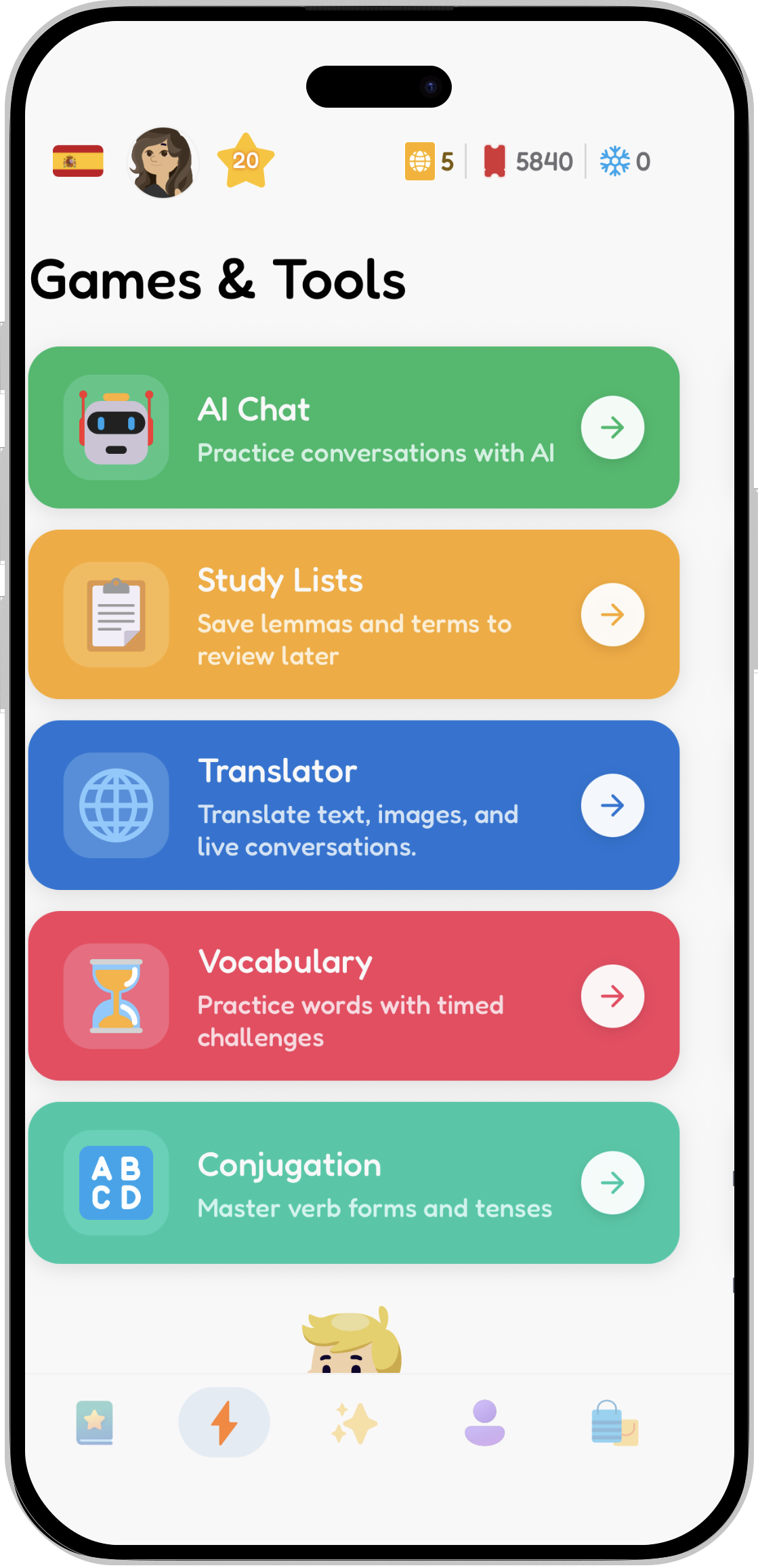
Games & Tools
Tools that every language learner needs at all stages of their learning journey.
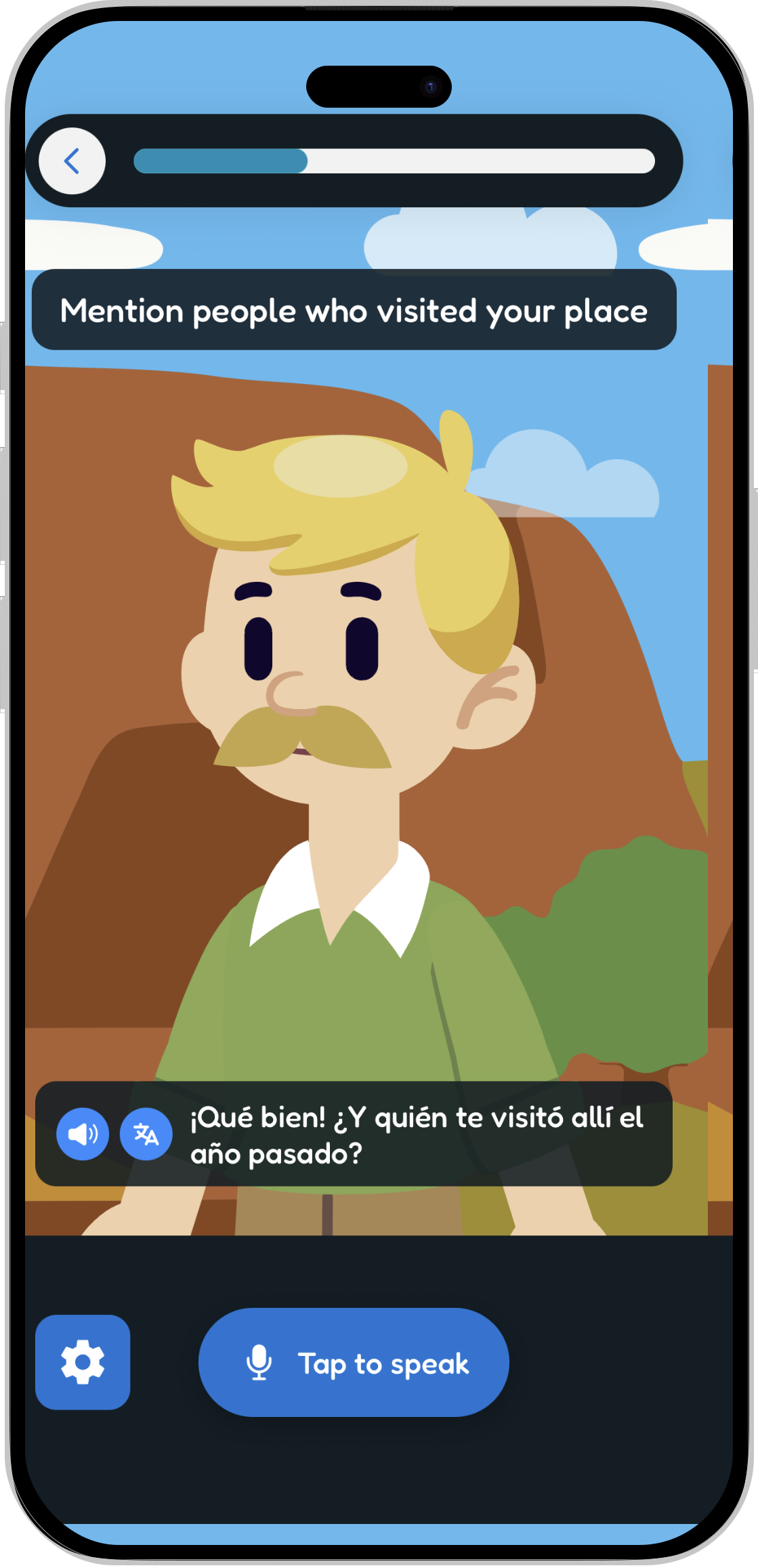
AI Chat Tutor
Practice real conversations with an AI tutor that helps you speak with confidence.
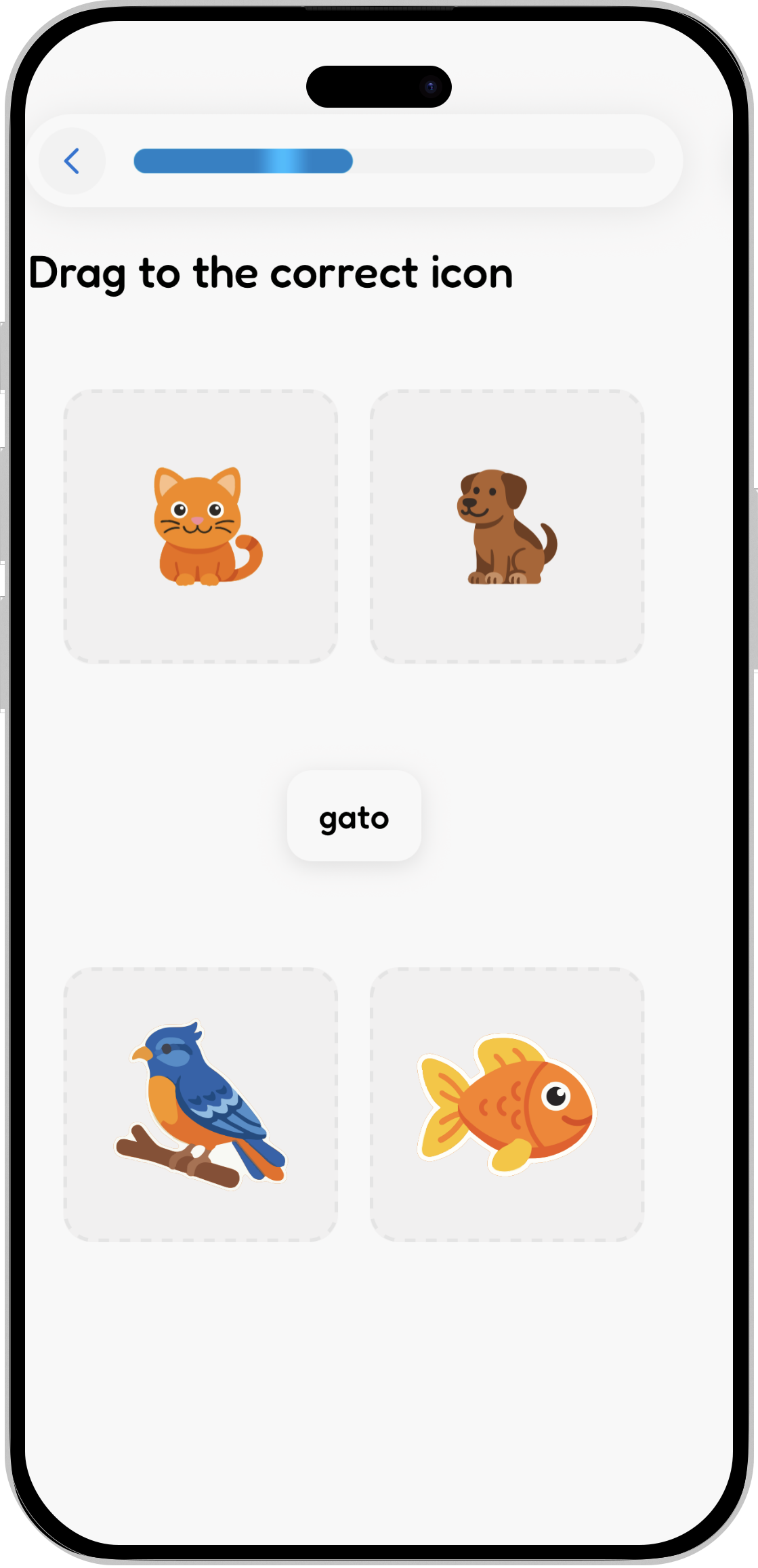
Interactive Games
A variety of games to help you learn and remember new words and phrases.


1. Polychat
A learner with fifteen minutes between meetings can finish one activity, make mistakes in another, and continue without waiting for hearts to refill. Polychat is built for that pattern. Unlimited daily practice is central to the product, rather than a side effect of an audio, reading, or lesson-based format.
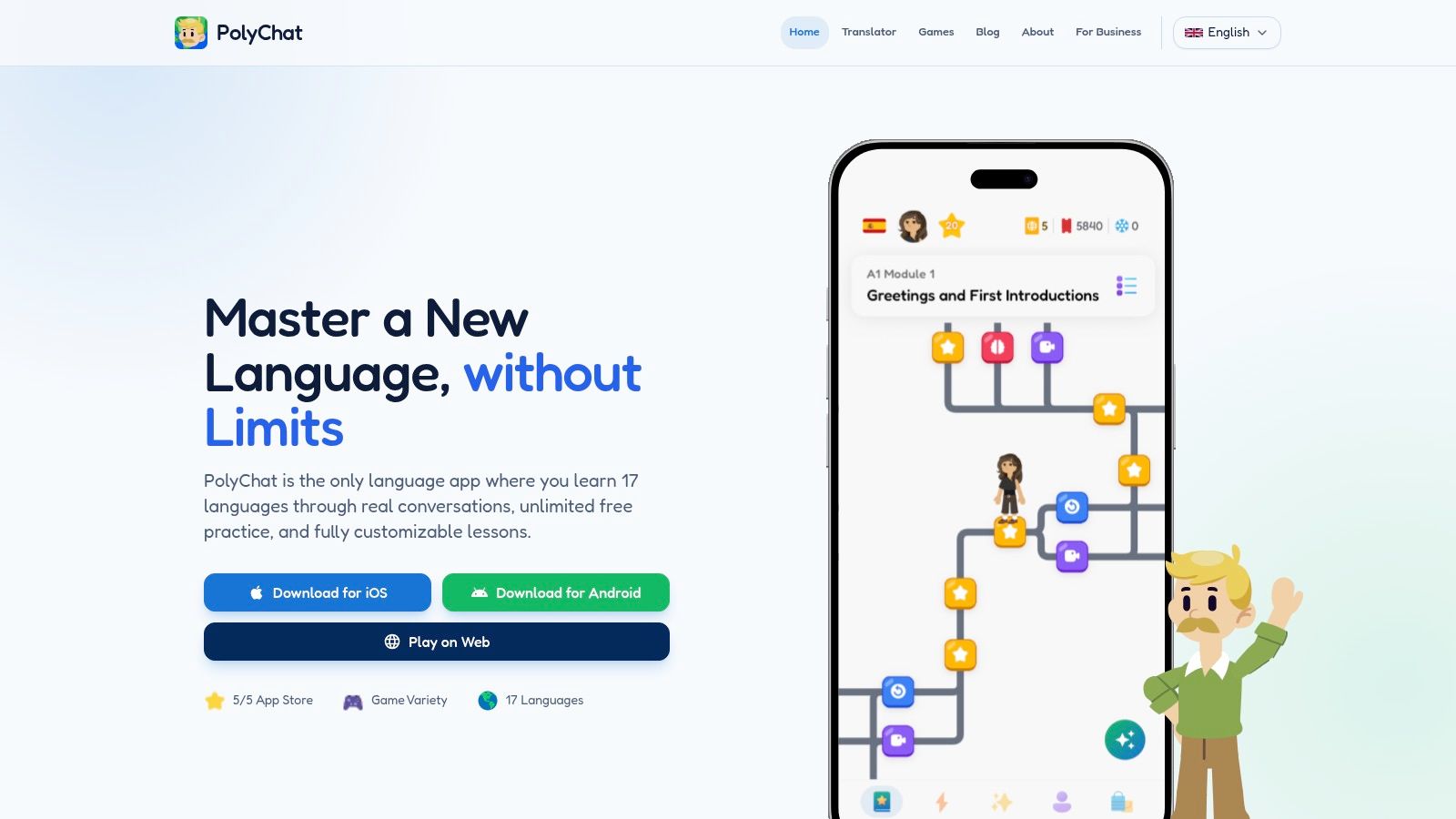
The app combines structured progression with game-based reinforcement. Its product information lists 17 languages, A1 to C2 mastery paths, and 5,000+ structured lessons per language. Language laddering also lets learners study one foreign language through another, instead of always using English as the starting point.
Why unlimited practice matters here
Unlimited attempts matter most when practice changes format. Polychat includes an AI Chat Tutor for spoken conversation, a custom lesson creator for topic-specific exercises and dialogues, and a conjugation tool for focused grammar work. A personal dictionary grows through completed activities, while timed vocabulary challenges, conversation games, leaderboards, streaks, and a built-in translator add variety.
Practical rule: Unlimited attempts help when you can apply the same language in several ways, not only repeat one quiz.
Public product pages emphasize unlimited free practice, but the free-versus-paid boundary is not clearly explained. They also do not provide clear details about paid tiers, offline access, enterprise packages, formal accreditation, or certification. Polychat therefore suits practical skill-building more directly than credential-focused study. For a comparison with another Duolingo alternative without energy or hearts, examine whether unlimited use is the main learning model or a result of the app's format.
Best fit: Travelers, students, professionals, polyglots, and frustrated mainstream-app users who want structured progression, gamification, AI conversation, conjugation practice, and unrestricted daily study. Check current access on Polychat's official website.
2. Memrise
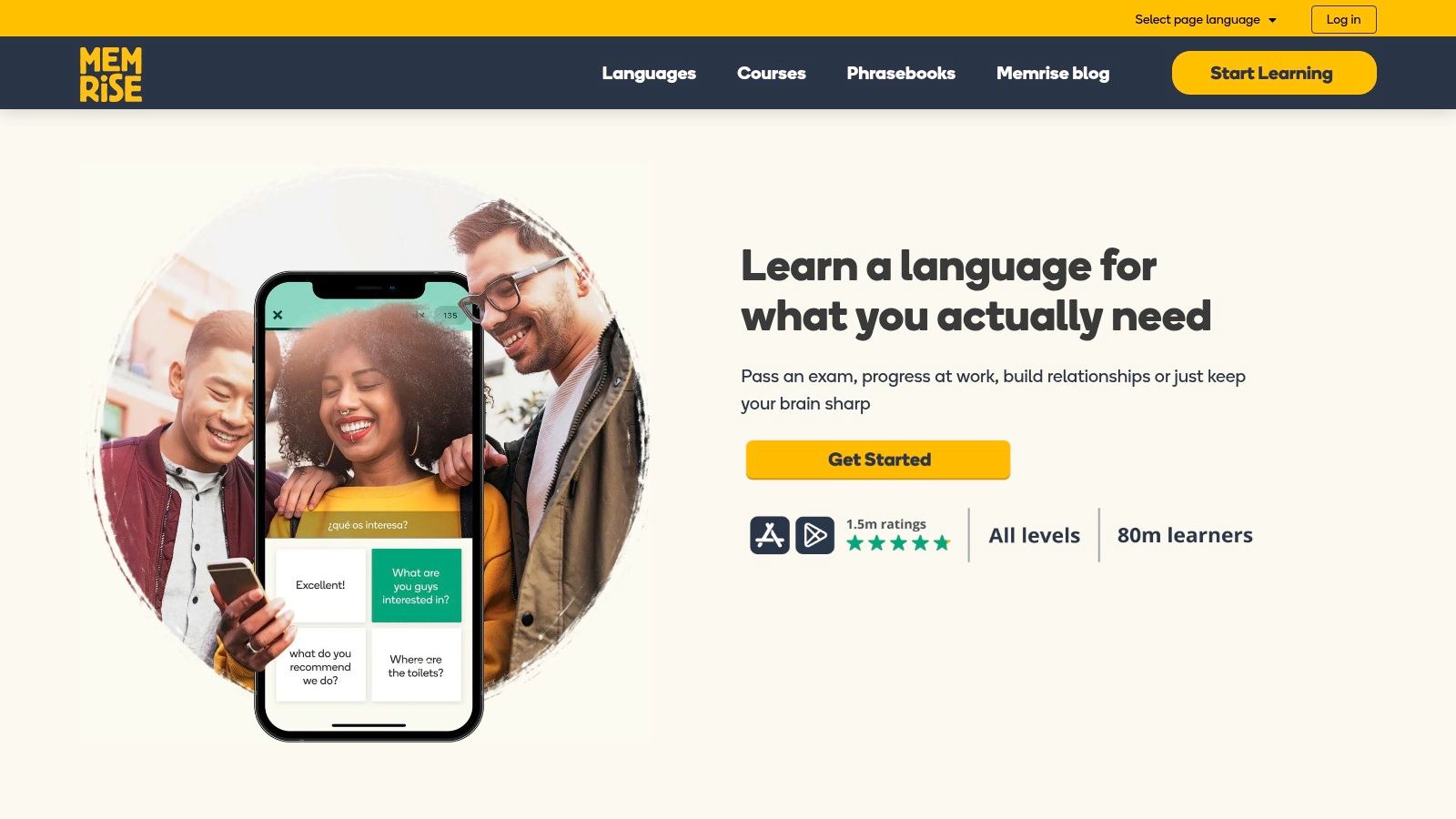
Memrise takes a different route to the language app with no hearts idea. Its value comes less from unlimited game attempts and more from moving learners from curated phrases into real-world listening. The platform uses short native-speaker videos matched to the learner's level and interests, making it useful when textbook sentences feel too detached from everyday speech.
The app includes official courses across major languages, speech recognition, and AI conversation practice. Its video-first design is particularly practical for travel preparation because you can hear how expressions sound in natural contexts rather than studying vocabulary in isolation.
The no-hearts trade-off
Memrise doesn't need hearts to create momentum. Short clips, phrase review, and AI speaking activities let you continue without the same failure-limit frustration found in lives-based systems. The trade-off is that the experience may feel less like a single linear course and more like a blend of guided learning and media discovery.
Community-course access and course structure have changed over time, so check what's available for your target language before committing. Grammar explanations also vary by language, which means Memrise may need support from a grammar reference or a more structured course.
For vocabulary development, its strength is contextual exposure. The move from official phrase work to native media can help you notice register, speed, pronunciation, and expressions that a tightly scripted lesson may not provide. More practice ideas are collected in this guide to vocabulary-building apps.
Free versus paid: Access depends on the course and feature. The paid experience adds deeper access to the platform's learning and conversation features.
Best fit: Learners who want useful phrases, native-speaker video, conversational listening, and a motivating bridge from beginner study to real media. Explore Memrise for current language and plan details.
3. Babbel
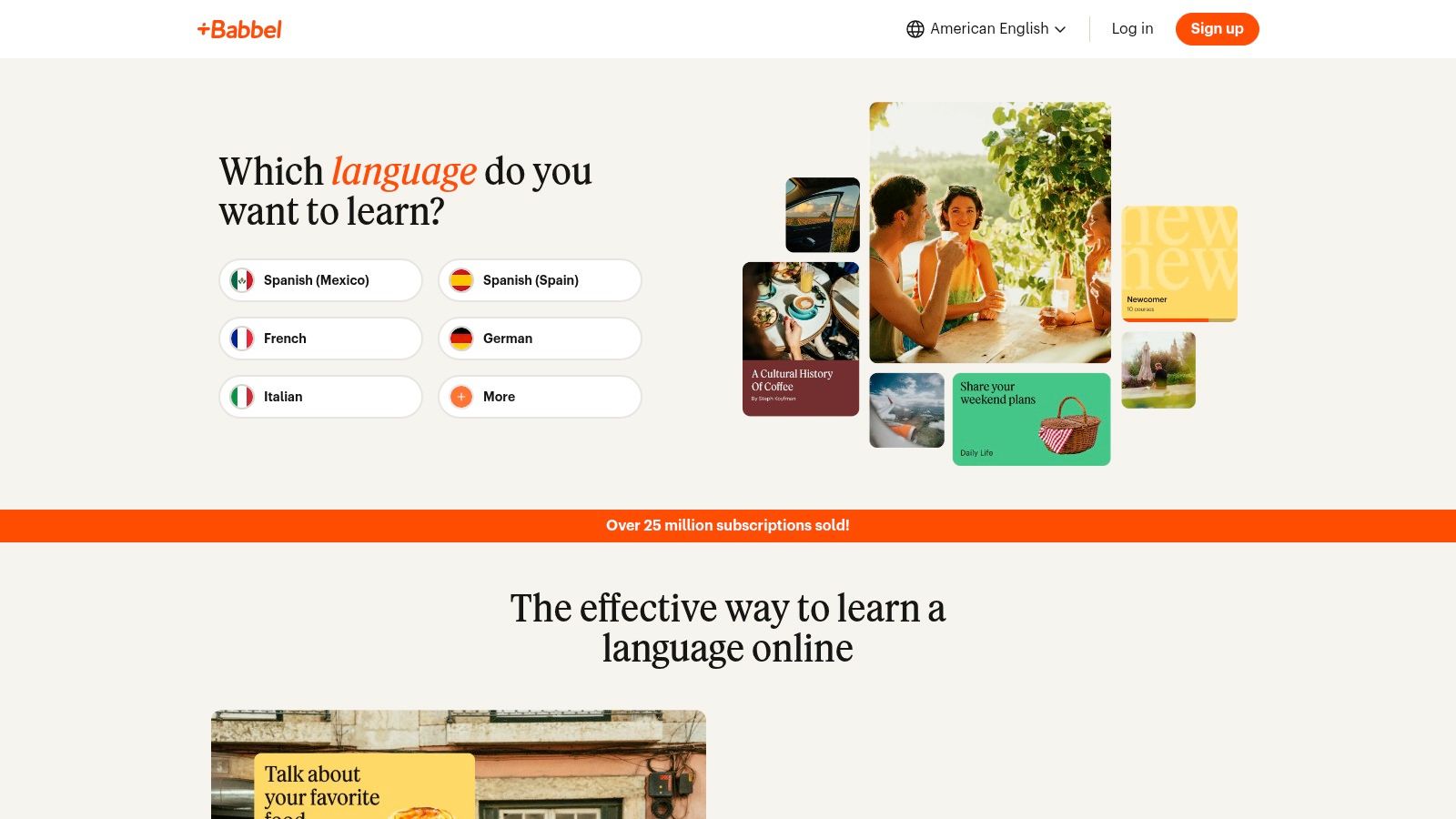
Babbel is a structured alternative for learners who don't need game lives in the first place. Its courses focus on practical communication across speaking, listening, reading, and review activities, with lessons organized into a clear progression. Rather than asking whether you can keep playing after mistakes, Babbel asks whether the next lesson gives you the right practice for your level and situation.
The platform uses CEFR-aligned course organization and speech recognition for pronunciation work. Lessons are built around real-life scenarios, so beginners can study language for introductions, travel, daily tasks, and workplace communication in a sequence that feels deliberate.
Where Babbel fits
Babbel's linear design suits learners who want a dependable daily routine without a leaderboard-driven experience. It's a good choice if you tend to lose momentum when an app gives you too many disconnected activities, or if you prefer explicit instruction over constant game pressure.
The limitation is coverage. Babbel offers fewer languages than some broad-catalog competitors, so verify that your target language is supported before comparing subscriptions. Babbel Live is also a separate offering, which matters if you expect teacher-led lessons rather than app-only study.
Babbel provides certificates after completing levels, but that shouldn't be confused with formal accreditation unless the specific credential is accepted by the institution or employer you're dealing with. Its main value remains guided practical learning.
Free versus paid: The free experience provides limited access, while a subscription provides the broader course path. Live classes require a separate offering.
Best fit: Beginners and returning learners who want a clear path, pronunciation practice, and scenario-based lessons without an energy mechanic. See Babbel, or compare its approach with Duolingo versus Babbel.
4. Busuu
Busuu is a strong choice when feedback from other people matters more than unlimited game attempts. Its courses combine guided study plans, progress tracking, review tools, and a global community where learners can submit writing and speaking exercises for correction by fluent speakers.
That community layer changes the meaning of “no hearts.” You're not getting permission to repeat drills indefinitely. You're getting a practice environment that can move from recognition into production, where another person can point out what sounds unnatural or unclear.
A social model without lives
Busuu's pathway covers A1 to B2 content for major languages, based on the product description provided. Goal-setting tools help establish a routine, while community corrections add accountability that automated marking can't fully replicate. This is especially useful once you're writing messages or recording speech rather than selecting answers.
The free tier gives you an entry point, while Premium and Premium Plus subscriptions provide additional features. Exact pricing can vary by device, region, and promotion, so check the offer shown in your account rather than relying on a generic price comparison.
Advanced depth varies by language. A course may feel substantial for one target language and more limited for another, so inspect the actual pathway before paying.
Best fit: Learners who want structured progression plus human feedback on writing and speaking. Start with the Busuu platform and test whether its community workflow matches your study habits.
5. LingoDeer
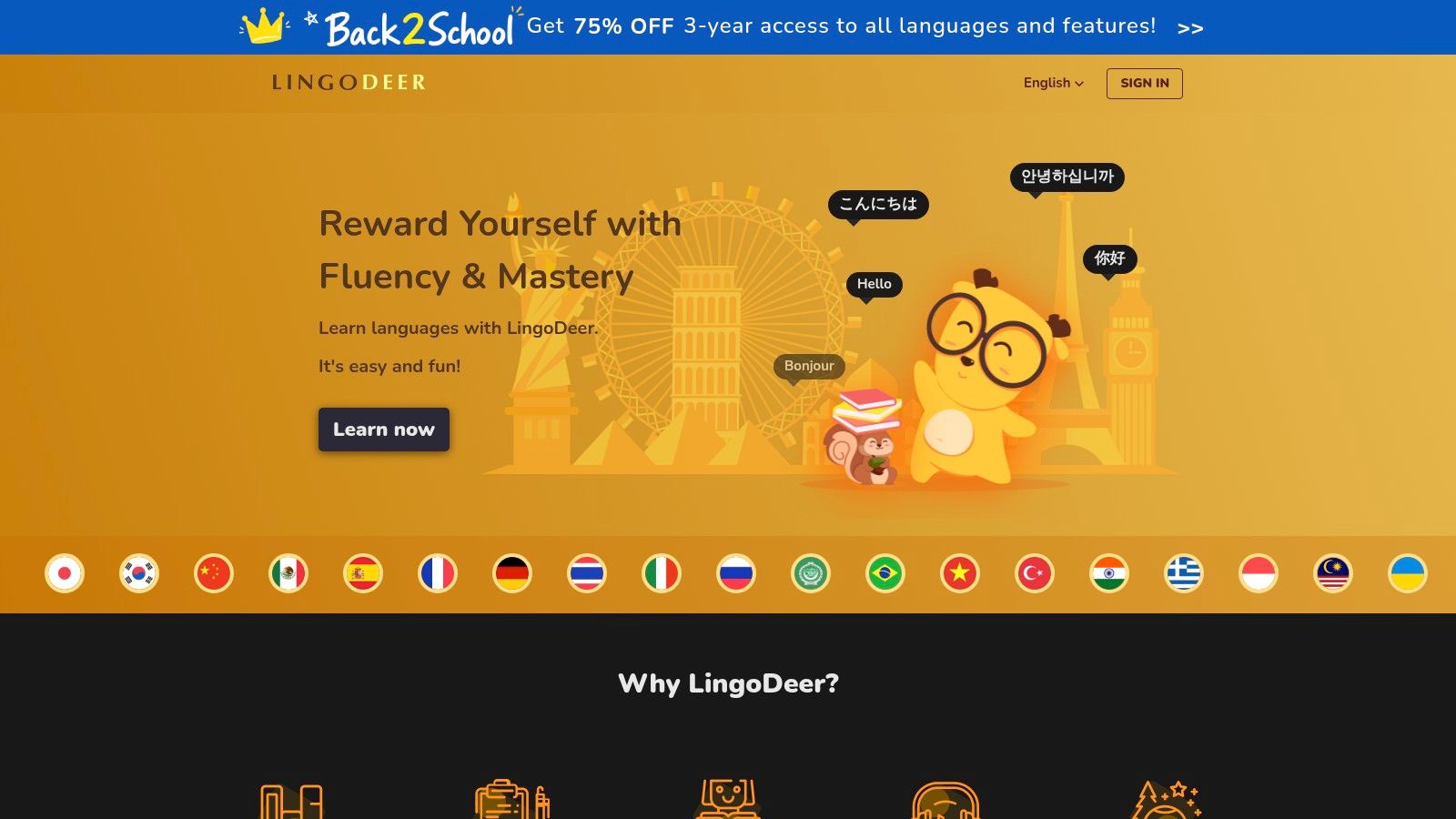
LingoDeer is built for learners who want explanation and structure, especially in Korean, Japanese, and Mandarin. It doesn't rely on a daily lives-gating system, so you can continue through available lessons and practice activities without treating mistakes as a reason to stop.
The app's grammar notes are a major part of its appeal. Exercises are designed around the language being taught, rather than presenting every language as a variation of the same vocabulary game. That matters for word order, particles, sentence structure, and other features that beginners often need explained directly.
Unlimited access without a gamified identity
LingoDeer's no-hearts advantage is quiet. The app isn't primarily selling endless competitive play. It gives you room to revisit grammar-aware exercises, switch between skills, and study multiple languages under one account where the relevant courses are available.
The catalog is smaller than some rivals, and upper-intermediate or advanced depth can vary by course. That makes it a better foundation for clear early and intermediate study than a complete answer for every learner's advanced immersion needs.
Free versus paid: Some introductory material is available without payment, while full course access generally requires a subscription. Review the target-language curriculum before buying.
Best fit: Learners studying East Asian languages, or anyone who prefers grammar explanations and varied exercises over a hearts-based game loop. See LingoDeer for current course availability.
6. LingQ
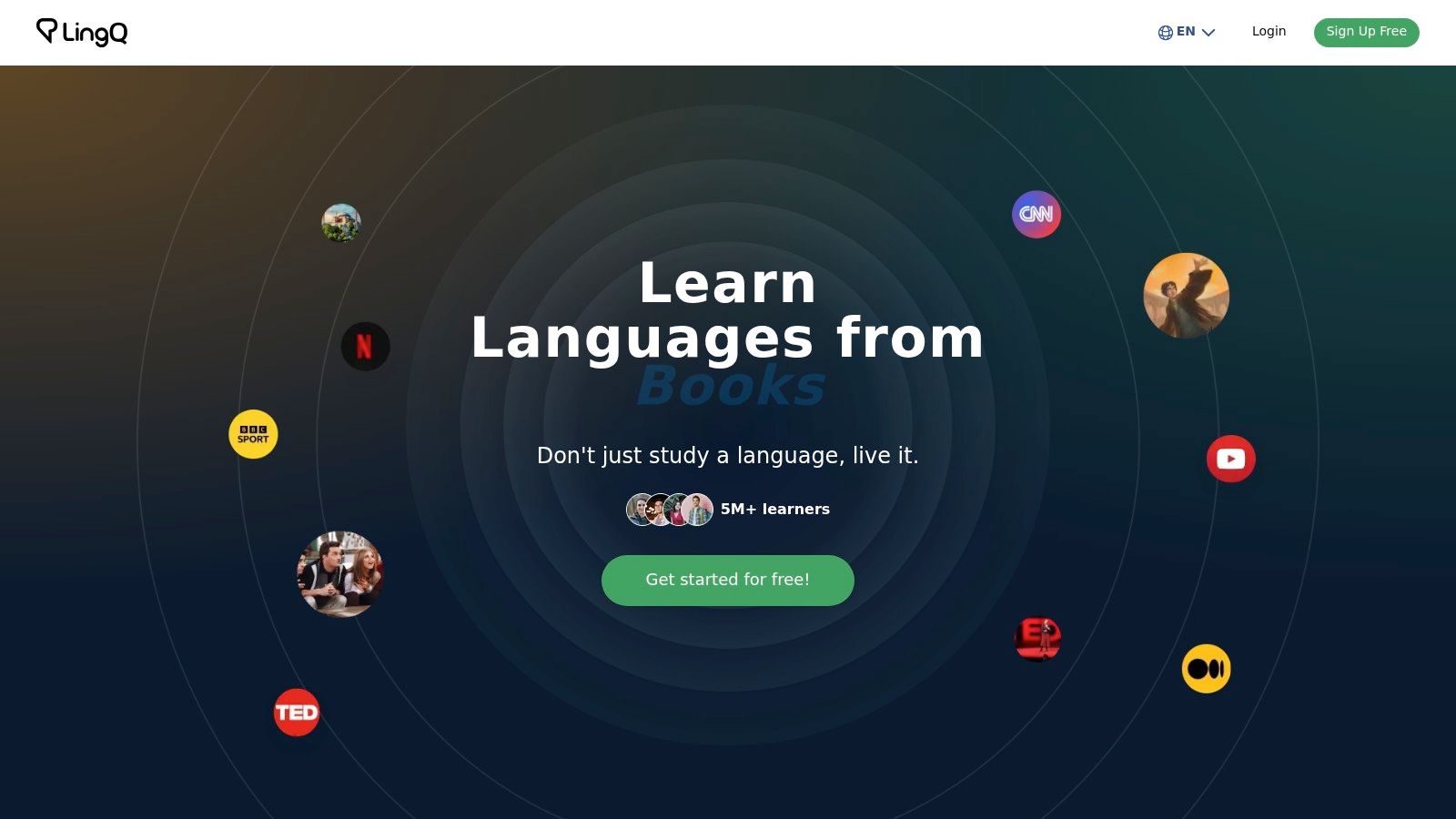
LingQ treats unlimited practice as an input problem. Instead of limiting lives, it gives you a large library of articles, podcasts, videos, and other material to read and hear. You click unknown words or phrases, save them as LingQs, and build a personal review system around the content you want to consume.
That model becomes more valuable as your level rises. A beginner who needs step-by-step explanations may find the library overwhelming, but an intermediate learner can choose news, interviews, stories, or subject-specific material and keep extending the range of language they understand.
The cost of freedom
LingQ offers content importing from the web, YouTube, and ebooks, alongside click-to-translate definitions and spaced-repetition review. Progress syncs between mobile and web, so it works well for a learner who reads on one device and listens on another.
The same openness creates its main limitation. You need to choose suitable content, decide what to save, and maintain a review routine. Speaking practice and explicit grammar instruction are lighter than in course-centric apps, so many learners pair LingQ with classes, a grammar resource, or targeted conversation practice.
Unlimited input only helps when you can select material that's understandable enough to keep you reading and listening.
Free versus paid: The free version offers a way to explore the system, while paid access expands features and usage.
Best fit: Self-directed intermediate and advanced learners who want real content, personal imports, and a scalable reading-and-listening library. Try LingQ if you're ready to manage your own input.
7. Clozemaster
Clozemaster is a sentence-drill game rather than a complete course. You fill in missing words inside contextual sentences, making it useful for vocabulary exposure, recall, and maintenance across a broad set of languages and language pairs.
The no-hearts experience is central because the platform is designed for repeated practice. You can move quickly through sentence sets without the stop-start frustration of a limited-energy model. That makes it particularly effective for learners who already understand basic grammar and want more contact with common patterns.
A drill companion, not a course replacement
Clozemaster supports 50+ languages, according to the product description provided, and offers thousands of cloze sentences per language. It also supports many language pairs, which is useful for polyglots and people studying through a language they already know well.
The free core mode is enough to test the method. Clozemaster Pro adds advanced statistics and customization, which matter more if you want detailed tracking or control over your practice.
There's little explicit grammar teaching, and the interface prioritizes speed over hand-holding. Use it after a structured course, alongside reading, or as a maintenance tool rather than expecting it to teach every foundation from scratch.
Best fit: Intermediate learners, polyglots, and vocabulary-focused students who want fast contextual sentence practice. Explore Clozemaster before deciding whether its drill-heavy format suits you.
8. Glossika
Glossika makes unlimited practice a core part of an audio-driven sentence system. The method centers on listening, recalling, and repeating natural sentences through structured repetition. You're not spending hearts to access a finite collection of mini-games. You're building a speaking and listening routine around repeated patterns.
This makes Glossika useful for learners who need more automaticity. A sentence such as a request, description, or response becomes practice for rhythm, pronunciation, word order, and recall at the same time.
Repetition without visual rewards
Glossika supports cross-language learning, so you can learn one language from another. Its web and mobile access also lets you customize study routines around listening and speaking rather than screen-heavy quiz sessions.
The method's limitation is equally clear. Glossika gives little explicit grammar explanation, and the repetitive format won't suit learners who need frequent novelty or visual interaction. Pair it with a grammar reference and reading practice if you want stronger explanations and written-language development.
Free versus paid: The main program is subscription-based, with access shaped by the current plan and trial offer.
Best fit: High-beginner through advanced learners who want pronunciation, listening comprehension, sentence patterns, and a repeatable audio routine. Check Glossika for current language and access details.
9. Pimsleur
Pimsleur avoids hearts because it's an audio course. Lessons ask you to respond out loud, recall words after intervals, and follow graduated dialogues that build speaking ability from the beginning. The app is designed for commuters, walkers, drivers, and anyone who can practice without staring at a screen.
The core lesson experience is structured rather than game-like. That distinction matters if your frustration with hearts comes from interruptions, but you don't necessarily want leaderboards, streaks, or rapid-fire tapping.
Strong speaking practice, lighter written coverage
Pimsleur's app adds reading, quizzes, speed rounds, and offline downloads through its premium experience. The broad language catalog makes it relevant to travelers who need practical phrases and speaking confidence rather than a long grammar syllabus.
Writing and explicit grammar explanations are lighter. If you want to read comfortably or understand why a sentence is formed a certain way, add a reading resource or grammar guide. Pimsleur works best as the audio and speaking component of a wider routine.
Free versus paid: The full course experience is paid, with access depending on the current subscription or purchase option.
Best fit: Busy learners, travelers, and beginners who can commit to spoken recall but have limited screen time. Visit Pimsleur to compare the current app options.
10. Mango Languages
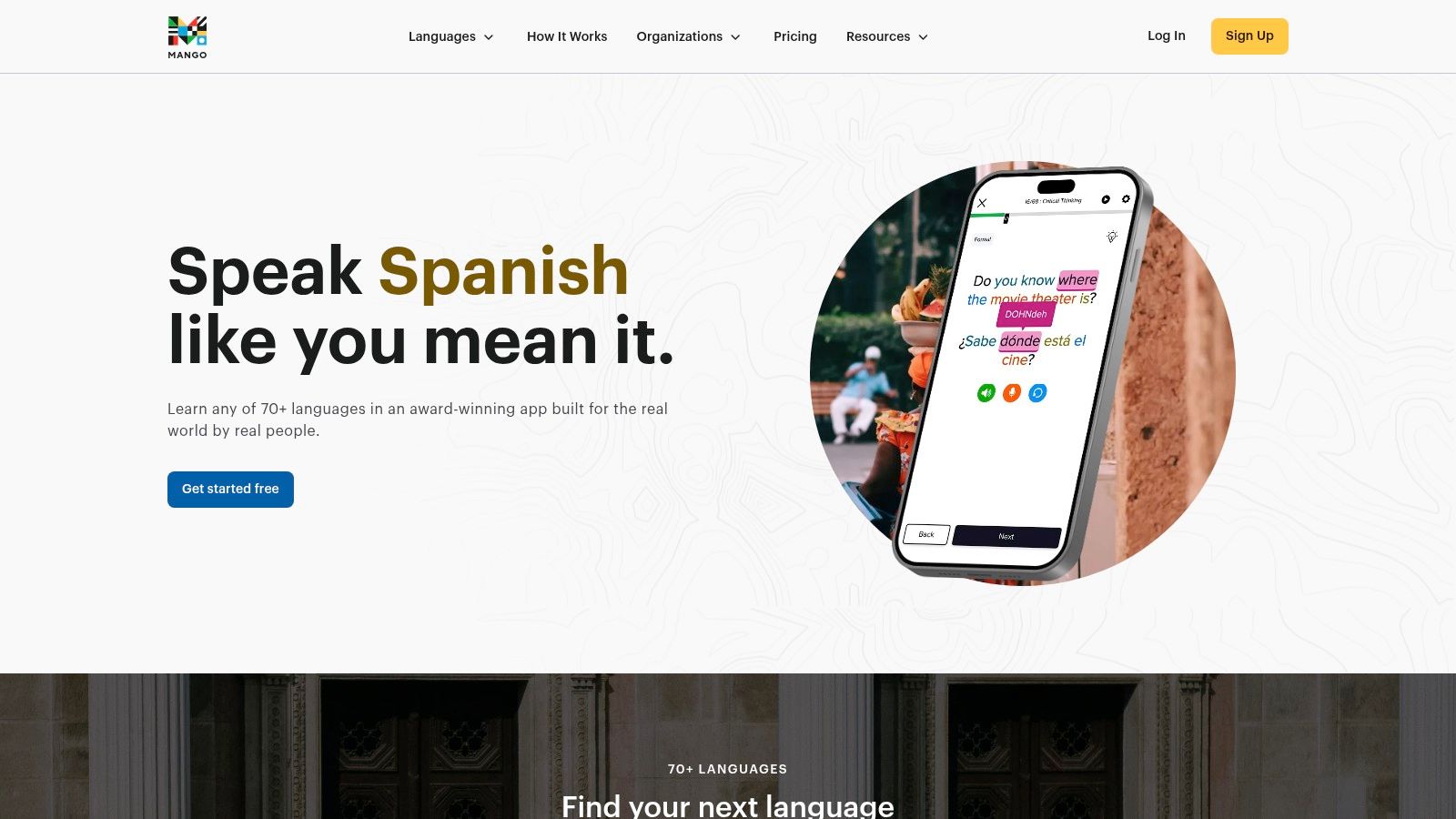
Mango Languages offers conversation-led courses across 70+ languages, including less-common, heritage, and Indigenous options, based on the product information provided. The platform focuses on practical dialogues, pronunciation, culture notes, and guided repetition rather than a hearts-based game system.
Its strongest no-hearts advantage is access to substantial conversation practice without forcing learners into a competitive loop. In the United States, many public libraries provide full access with a library card when the library participates, which can make Mango especially attractive for eligible users.
Check access before you subscribe
Every direct subscription includes access to all languages offered, according to the product description. If you don't have participating library access, an individual plan applies, so confirm the current offer before choosing Mango on price alone.
The pedagogy is conversation-led and practical, but explicit grammar depth is limited. Learners who want detailed explanations, extended reading, or advanced writing will likely need another resource alongside it.
Best fit: Travelers, heritage learners, and students whose target language isn't well served by mainstream apps. Check Mango Languages and ask your local library whether it provides access.
Top 10 Language Apps, No Hearts
| App | Core Features | UX & Quality | Value & Price | Target Audience | Unique Selling Point |
|---|---|---|---|---|---|
| Polychat 🏆 | AI Chat Tutor, 5k+ lessons, top conjugation tool, built-in translator, no daily limits ✨ | ★★★★★ Gamified, measurable progress | 💰 Unlimited daily practice (free core; paid tiers not publicly detailed) | 👥 Travelers, students, professionals, polyglots | ✨ Unlimited play + AI-driven conversation & language laddering |
| Memrise | Video-first native clips, AI convo, speech recognition | ★★★★ Engaging, contextual listening | 💰 Freemium → paid to unlock full courses | 👥 Casual learners & travelers | ✨ Thousands of short native-speaker clips |
| Babbel | CEFR-aligned courses, speech recog, certificates, live classes | ★★★★ Clear, linear learning path | 💰 Subscription; live classes extra | 👥 Beginners & daily learners | ✨ Structured CEFR paths + certificates |
| Busuu | Guided study plans, community corrections, progress tracking | ★★★★ Social feedback improves retention | 💰 Freemium + Premium/Premium Plus | 👥 Learners who want peer feedback & goals | ✨ Community corrections from native speakers |
| LingoDeer | Grammar notes, grammar-aware practice, strong East-Asian courses | ★★★★ Excellent grammar clarity for Asian languages | 💰 Paid (one account, full access options) | 👥 Learners of Korean/Japanese/Chinese | ✨ Detailed grammar explanations & exercises |
| LingQ | Import native content, click-to-translate, SRS review | ★★★ Self-directed, scalable for higher levels | 💰 Subscription; pay for advanced features | 👥 Intermediate→advanced, content-focused learners | ✨ Massive native-content library & import tools |
| Clozemaster | Thousands of cloze sentences, many language pairs | ★★★★ Fast, high-exposure drills | 💰 Free core; Clozemaster Pro for advanced stats | 👥 Polyglots & vocabulary maintainers | ✨ Rapid contextual vocab growth via sentences |
| Glossika | Spaced sentence repetition, audio-driven speaking practice | ★★★☆ Effective for rhythm & fluency | 💰 Subscription; audio-focused plans | 👥 Pronunciation & speaking fluency seekers | ✨ Pattern acquisition through mass sentence reps |
| Pimsleur | Audio-first graduated-interval recall, speaking-focused lessons | ★★★★ Hands-free, strong speaking practice | 💰 Paid (often higher price); offline downloads | 👥 Busy commuters & speaking-first learners | ✨ Guided spoken-response audio method |
| Mango Languages | Conversation units, culture notes, wide language catalog | ★★★ Practical, conversation-led UX | 💰 Library access often free; subscriptions otherwise | 👥 Library users, learners of rare/heritage languages | ✨ 70+ languages incl. less-common & heritage options |
Choose the App That Matches Your Practice Style
A no-hearts design solves one problem, but it doesn't automatically solve language learning. Unlimited attempts can help you get more repetitions, correct errors immediately, and keep studying when motivation is high. They can also become empty activity if the app rewards taps, minutes, or streak preservation without moving you toward retrieval, listening, speaking, reading, and useful communication.
Independent research helps explain why gamified apps remain popular. A meta-analysis reported significant positive effects for gamification in cognitive learning outcomes, motivational outcomes, and behavioral learning outcomes, with effect sizes of g = 0.49, g = 0.36, and g = 0.25, respectively, across the analyzed outcomes (ERIC research summary). Game mechanics can support practice, but they work best when they reinforce meaningful learning rather than replace it.
The wider market also shows why this product category continues to attract serious investment. Business of Apps reported that language learning apps generated $1.54 billion in revenue in 2025, rose 18.8% year over year, and reached 327 million downloads that year. The same report placed Duolingo's 2025 revenue at $1.03 billion (Business of Apps market data). Those figures describe market scale, not proof that any individual app will make you fluent, but they show that learners are using these products as recurring study tools rather than occasional novelties.
Choose Polychat if your priority is unlimited gamified practice, AI conversation, structured lessons, conjugation work, and language laddering. Choose Memrise for native-speaker video and contextual listening. Babbel or LingoDeer make more sense when you want structured instruction and clear explanations. LingQ suits self-directed learners who want real input, while Clozemaster is better for sentence drills and vocabulary maintenance. Glossika and Pimsleur serve audio repetition and spoken recall, Busuu adds community feedback, and Mango Languages provides broad conversation coverage, particularly when library access is available.
Before installing, check four things:
- Confirm the access boundary: Find out which lessons, languages, AI tools, downloads, and review features are free, and which require payment.
- Verify the language direction: Make sure the app supports your target language from the language you understand, especially if you're using language laddering.
- Match the method to the skill: Pick audio for commuting, input for reading and listening growth, community correction for production, or structured lessons for guided progression.
- Build a sustainable routine: Unlimited practice is useful only when you can repeat it consistently without exhausting yourself or chasing empty points.
One user experience study of mobile language-learning apps found that satisfaction depends on usability, usefulness, and affection, with affection showing the strongest effect in one Duolingo review. Another mixed-methods study reported engagement, retention, usability, and acceptance scores clustered between 2.78 and 2.93 on a 5-point scale (PJMR research). The practical lesson is simple. An app can be acceptable and still fail to hold your attention, so choose the format you'll willingly open when the novelty fades.
Use unrestricted practice to support a sound spaced repetition study method, retrieval, correction, and real input. If a hearts-free app lets you do more of those things, it's a learning advantage. If it only lets you click longer, the missing hearts have solved the smaller problem.
Polychat gives learners unlimited daily lessons and games without hearts or energy caps, alongside AI conversation, structured paths, conjugation practice, translation tools, and language laddering across 17 languages. If you want a language app with no hearts that combines unrestricted practice with a practical gamified learning path, visit Polychat and start exploring.

Jean-Baptiste Bolh
Co-Founder
Applied AI