10 Duolingo Competitors for Adults (2026 Guide)

You’ve kept the streak alive. You can recognize a fair amount of vocabulary. You’ve probably translated enough harmless sentences to last a lifetime. But when you need the language for work, travel, dating, family, or daily life, Duolingo starts to feel small.
That’s the wall a lot of adult learners hit. The grammar support is often too thin when you need to understand why a sentence changes. The speaking work can feel shallow. And if the hearts system makes you slow down right when you finally have motivation, it stops feeling like a learning tool and starts feeling like a throttle.
Adults usually aren’t learning for XP. They’re learning because they need results. You want to handle a meeting, ask follow-up questions at a hotel, text naturally, understand verb forms, or stop freezing when someone answers you at full speed. That requires a different kind of app. Usually one with clearer explanations, more realistic practice, or fewer artificial limits.
The market is crowded, but adult-focused alternatives are clearly getting attention. In February 2026, Babbel drew 3.17 million monthly website visits and Busuu drew 3.16 million, while Rosetta Stone reached 1.42 million and Pimsleur reached 619.84K, according to Semrush competitor traffic data for Duolingo. That matters because it shows adult learners aren’t all looking for the same replacement. Some want structure. Some want speaking. Some want serious grammar. Some just want to practice without being cut off.
If your main frustration is freezing when someone asks you a real question, the contrast between passive recognition and active production is the gap most of these tools are built to close. The list below covers structured courses first; later sections call out pronunciation coaches, language exchange, and live tutoring when you need more than app prompts.
Below are the duolingo competitors for adults that are worth considering, with the trade-offs spelled out plainly.
Ready to Learn a Language?
Try PolyChat's engaging language lessons, interactive learning games and put your new vocabulary to the test!
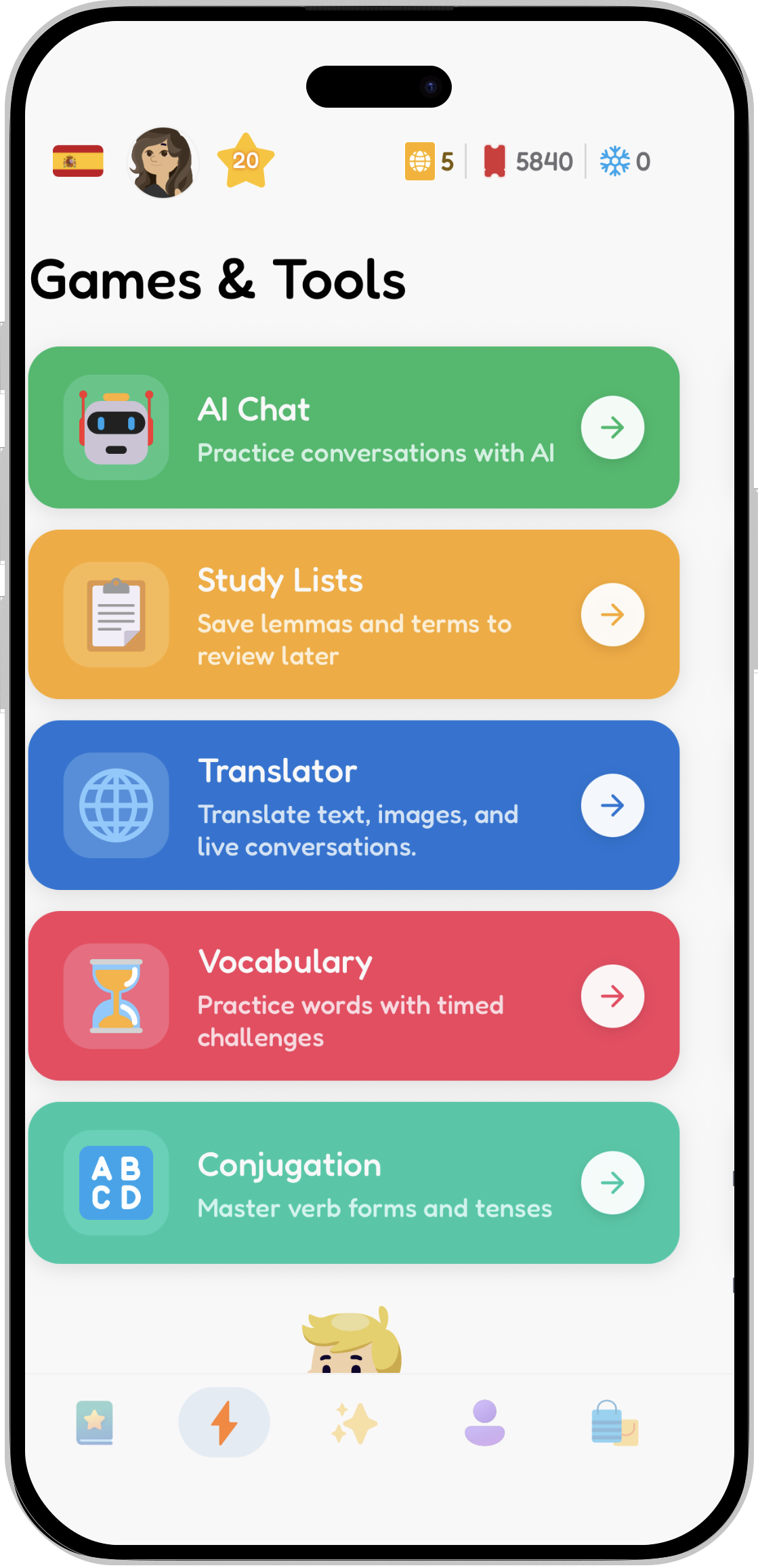
Games & Tools
Tools that every language learner needs at all stages of their learning journey.
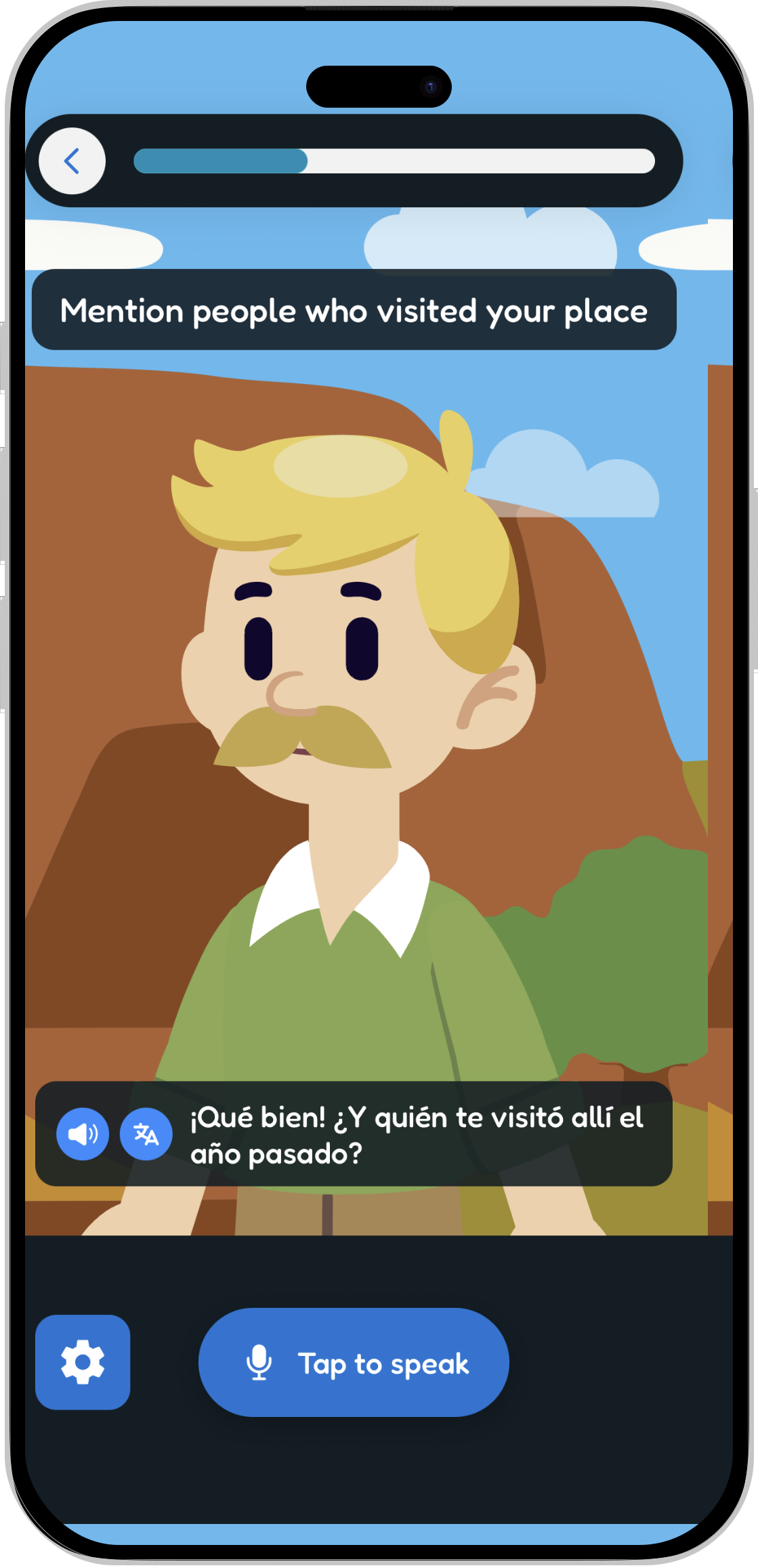
AI Chat Tutor
Practice real conversations with an AI tutor that helps you speak with confidence.
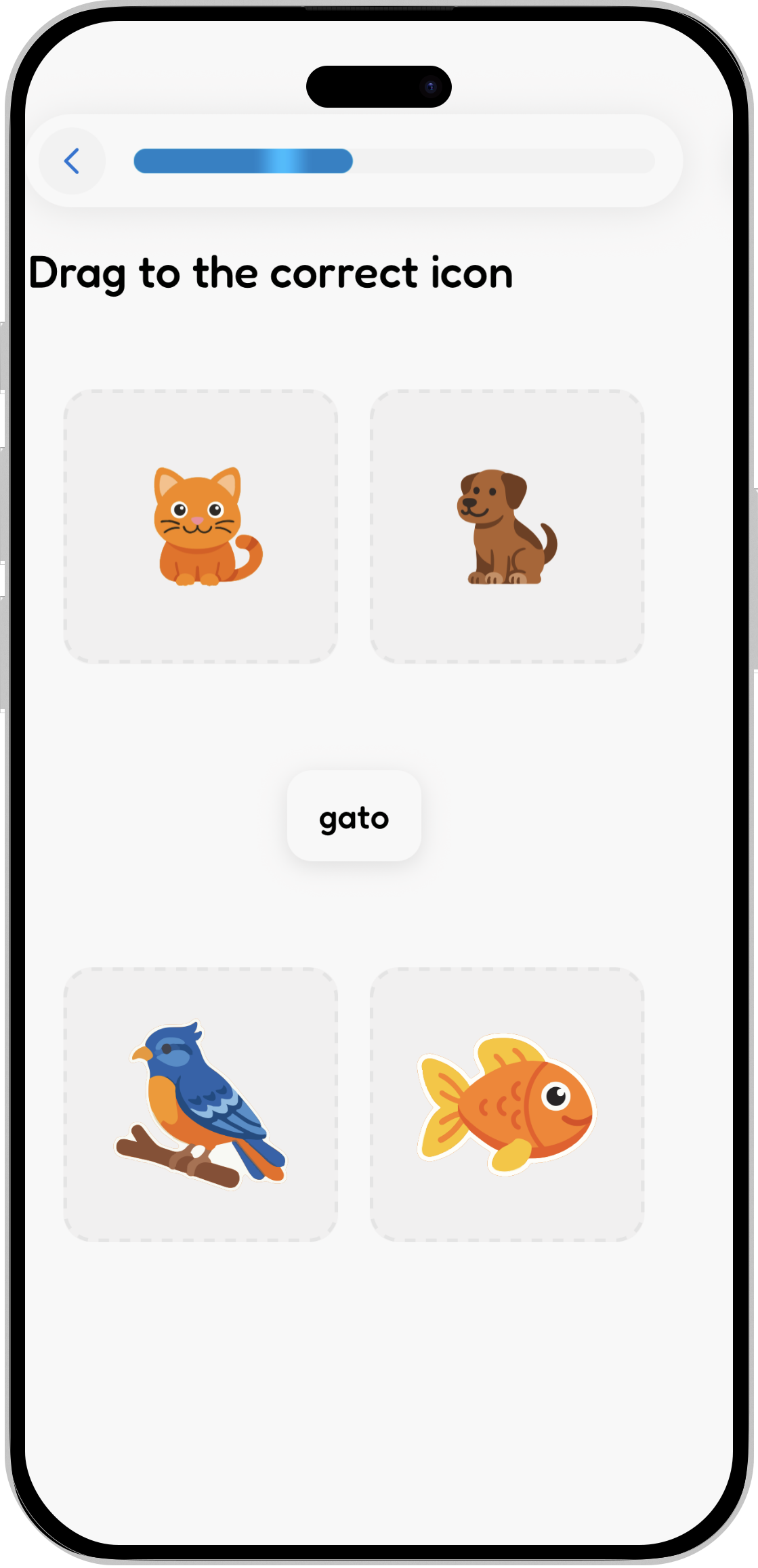
Interactive Games
A variety of games to help you learn and remember new words and phrases.


1. PolyChat

You sit down to study after work, finally have momentum, make a few mistakes, and the app tells you to wait. That is a bad fit for adult learning. PolyChat stands out because it removes that interruption and lets you keep practicing while your attention is still there.
That matters more for adults than it does for casual learners. Adult study time is uneven. It happens on commutes, between meetings, late at night, or in one longer weekend block. If Duolingo frustrates you because the hearts system turns practice into rationed screen time, PolyChat fixes that specific problem fast.
Why it works better for adults
PolyChat is strongest for adults who need repetition with a purpose. The app centers on active recall through timed vocabulary drills, conversation and translation games, a personal dictionary, and a conjugation tool that helps when verb systems get dense. That combination is more useful than simple streak maintenance if your goal is to speak, write, or understand with less hesitation.
The core advantage is fit. Adults usually are not looking for one vague promise of "fluency." They want to prepare for a trip without freezing at check-in, review grammar before a class, build work vocabulary, or stay sharp in a heritage language. A quick look at PolyChat’s language practice games shows the approach clearly. Short rounds, fast feedback, and enough repetition to fix weak spots instead of just exposing them.
PolyChat also gives multilingual adults more flexibility than many mainstream apps. You can study from different supported base languages, which is useful for expats, polyglots, and learners who do not want every explanation filtered through English.
Practical rule: If Duolingo helped you build the habit but did not help you handle real communication, switch to a tool that lets you repeat problem areas until the response feels automatic.
Where PolyChat fits best
PolyChat makes the most sense for adults who want frequent practice without artificial friction. It is a good match for travel prep, relocation, school support, and job-related study because those goals usually require both recall speed and grammar control. Duolingo often covers the first part lightly and the second part inconsistently.
It also deserves credit for language coverage. Adult learners looking beyond the usual Spanish and French options often have fewer good choices, especially if they want drilling instead of passive exposure. That gap matters in practice. If you are comparing cost-conscious alternatives too, it helps to weigh this against the price structure in a Babbel monthly subscription, since many adults are deciding between tighter course structure and more open-ended daily practice.
Speaking workflow
If speaking is your bottleneck, use PolyChat in a loop instead of treating lessons as one-off tasks:
- Start with one guided lesson: Get the phrases and patterns for a specific topic.
- Switch into an AI conversation game: Use those phrases before they fade.
- Drill the verb forms that slowed you down: Hesitation mid-sentence is usually tense control, not vocabulary alone.
- Run a timed vocabulary challenge: Train recall speed, not just recognition.
- Save misses to your personal dictionary: Review what blocked your speech before the next session.
That mix handles the stacked problems speaking apps often split apart: output volume, verb control, and fast recall under pressure.
Trade-offs
PolyChat is not the right pick for every adult learner.
- Pricing clarity: Premium pricing is not especially clear on the website, so verify the current details in the app stores before paying.
- Formal exam prep: If your priority is certification, standardized test prep, or a platform your employer already recognizes, a more traditional course app may be easier to justify.
- Live human feedback: PolyChat is stronger for high-volume practice than for tutor-style correction; pair it with Busuu, Speechling, or italki if outside feedback keeps you accountable.
Still, PolyChat is one of the more practical Duolingo competitors for adults who want control over pace, more serious drilling, and fewer interruptions while they study.
2. Babbel

Babbel is for adults who want less game, more course. If Duolingo leaves you feeling like you’ve done a lot of exercises without building a clear mental model of the language, Babbel usually feels more grown up.
Its lessons are short —typically 10 to 15 minutes— but the structure is tighter. Dialogues are practical. Grammar appears when it’s needed. Courses are aligned with CEFR levels from beginner (A1) through upper-intermediate (B2), and supplemental podcasts and review sessions reinforce what you study in the core path. The overall feeling is closer to guided self-study than app-based entertainment.
Why adults often prefer it
Babbel works well when your goal is usable communication, not just exposure. It’s especially good for learners who like being shown a pattern, practicing it, and then seeing it again in a slightly different context. That’s a better match for many adult brains than pure gamification.
There’s also a real market signal here. In July 2024, Babbel generated over $5.4 million in in-app purchase revenue, while Duolingo generated $33 million, according to Electro IQ’s language learning app statistics roundup. The gap says something important. Babbel isn’t trying to win on free volume. It’s targeting adults willing to pay for a more structured path.
If your problem with Duolingo is that it feels broad but shallow, Babbel is one of the most sensible replacements. It offers 14 languages, and longer plans have commonly been listed around $15.99 per month.
Speaking workflow
- Start with one dialogue lesson: Say every line out loud before tapping ahead.
- Repeat speaking checks until delivery sounds clean: Do not accept a technical pass if rhythm or pronunciation still feels off.
- Review the grammar note right after the dialogue: Tie the rule to the sentence you just said.
- Rebuild the dialogue from memory: Swap in your own names, places, times, and verbs.
- Add one unscripted follow-up question: Go one step past the lesson script.
Practical rule: Treat each Babbel lesson as a speaking template you can bend, not a script you memorize.
Trade-offs that matter
Babbel’s strength is also its limit. It does controlled practice well. It’s less convincing when you want spontaneous speaking or lots of flexible drilling on one specific weakness.
- Best for: Adult beginners to intermediates who want practical dialogues and grammar support.
- Less ideal for: Learners who want open-ended conversation practice or heavy customization.
- Watch for: Regional pricing differences and varying promotions, including offers like a Babbel monthly subscription breakdown.
Babbel is what I recommend when someone says, “I need the app to explain the language, not just quiz me on it.”
3. Busuu

Busuu fits a common adult problem. You finish a lesson, get the answer right, and still have no idea whether you could say the same thing to a colleague, a client, or a hotel receptionist without sounding off. Busuu does a better job than Duolingo of closing that gap because it mixes a guided course with feedback from actual speakers.
That matters more for adults than app marketing usually admits. Adult learners often have a specific use case. They need to write a short message that sounds natural, speak without awkward phrasing, or build enough accuracy to avoid repeating bad habits for months.
Why adults pick Busuu over Duolingo
Busuu gives you more visible structure. Its courses are organized around CEFR-style levels in its main languages, so progress feels tied to a real standard rather than a streak. Personalized study plans can help if you need a fixed weekly path instead of opening the app and guessing what to do next. For adults who want to know where they are and what “intermediate” signifies, that is a practical advantage.
The other reason is correction. You can submit writing and speaking exercises for comments from native speakers. Duolingo is fine for quick exposure and repetition. Busuu is better when your frustration is, “I can answer app prompts, but I still don’t know if I sound natural.”
That human layer changes the kind of learning you get.
The trade-off in real life
Busuu works well for adults who want a middle ground between solo study and paid tutoring. You follow a course, get grammar support, and occasionally put your own language into the world for correction. That is useful if your goal is better professional communication, clearer travel basics, or fewer fossilized mistakes.
It is slower than instant feedback systems. Sometimes you submit an exercise and wait. Sometimes the correction is helpful. Sometimes it is brief. That trade-off is worth it if you care about natural phrasing more than speed.
- Best for: Adults who want structured study plus occasional human correction
- Especially useful for: Learners focused on writing, speaking, and sounding more natural
- Less ideal for: People who want constant live conversation or immediate speaking reps every session
Busuu also avoids one of Duolingo’s more irritating limits for adults. Practice feels less throttled and more course-driven, which makes it easier to study with intent instead of just protecting a streak.
Speaking workflow
- Finish one lesson and pull out the target phrases: Do not move on until you can say them aloud without reading.
- Record the speaking task once at normal pace: Use your real voice, not a rehearsed performance.
- Submit it for correction: Watch for repeated notes on verb choice, pronunciation, or sentence order.
- Re-record the same task after feedback: Fix the exact mistakes you were called out on.
- Add one extra sentence the lesson did not ask for: That is where speaking practice starts to become conversation practice.
Practical rule: Treat community corrections as revision rounds, not as a one-time score.
4. Rosetta Stone

You open a lesson, see a photo, hear the target language, and have to figure it out without an English shortcut. For some adults, that feels refreshingly close to real language exposure. For others, it feels like being asked to guess what the app wants.
Rosetta Stone works best for adults who want to build direct associations instead of translating everything back into English first. That matters if your Duolingo frustration is less about motivation and more about interference. You recognize plenty of words, but your brain still pauses to convert them before you can respond.
Why adults still choose it
Rosetta Stone covers roughly 25 languages and is built around immersion and repetition. You match audio, images, and spoken response until common patterns start to feel familiar. Its TruAccent speech recognition gives it a clear role for adults who want more pronunciation practice than Duolingo usually provides, and supplemental stories and travel phrasebooks extend the core lessons. Plans often start around $11 to $15 per month; note that Rosetta Stone has announced it will stop selling new lifetime subscriptions after February 14, 2026.
That makes it a better fit for accent work, listening discrimination, and basic speaking comfort than for grammar-heavy study. If your main goal is sounding clearer and reacting faster, it has a real use case. Recent progress in multilingual speech-to-text models also shows why pronunciation tools keep improving, even though Rosetta Stone still uses a more closed, course-based system than newer speaking apps.
Speaking workflow
- Answer aloud before tapping anything: Force recall first, recognition second.
- Repeat pronunciation checks until delivery is consistent: One lucky pass is not enough.
- Shadow short phrases back-to-back: Match rhythm and stress, not just individual words.
- Redo the same lesson later at a faster pace: Push for quicker reactions.
- Finish with two self-made sentences using the same pattern: Test whether the lesson transferred into usable speech.
If you need a broader framework for output beyond the app, pair this with how to improve speaking skills.
The trade-off for serious learners
Rosetta Stone asks for patience. It often prefers exposure over explanation, which means you may understand a pattern only after several examples instead of getting a quick rule upfront. Some adults like that because it reduces dependence on translation. Others find it inefficient, especially if they are studying after work and want to know exactly why a sentence is structured a certain way.
This is the key adult question. Are you trying to train instinct, or are you trying to understand structure? Rosetta Stone is stronger on instinct than structure.
- Best for: Adults who want pronunciation practice, listening repetition, and less English-dependent learning
- Especially useful for: Travel learners and beginners who freeze because they mentally translate before speaking
- Less ideal for: Adults who want explicit grammar, faster clarification, or language study tied to professional writing and precise usage
Live coaching is available, but it is an add-on rather than the core experience.
If you want clear grammar notes, business-ready phrasing, or a faster path to understanding sentence mechanics, other apps in this list will usually serve you better. If you want to train your ear and reduce the habit of translating every line in your head, Rosetta Stone still earns its place.
5. Pimsleur
Pimsleur is the one to pick when your problem isn’t vocabulary recognition. It’s output. You know more than you can say, and you freeze when someone expects an answer fast.
Pimsleur’s audio-first format attacks that problem directly. Daily 30-minute lessons use graduated interval recall —prompting you to speak just before you are likely to forget a word— so vocabulary moves toward long-term memory. You hear a prompt, you respond, and the lesson keeps moving. It works especially well for adults who can study while driving, walking, cooking, or commuting. A single-language Premium plan is often around $20.95 per month; the All-Access plan covering 50+ languages is only slightly more at about $21.95 per month.
Why Pimsleur is different
This isn’t a pretty app-first experience. It’s a speaking habit machine. The method leans heavily on listening, recall, and repeated oral response. That makes it one of the best duolingo competitors for adults who need practical speaking confidence more than flashy interaction.
If speaking is your top priority, this category deserves extra attention. The contrast between passive recognition and active production is exactly why many learners move beyond Duolingo.
Speaking workflow
- Do one full audio lesson without multitasking at first: Answer every prompt out loud, even when you are unsure.
- Replay the hardest sections immediately: Fix hesitation on the spot instead of hoping it disappears tomorrow.
- Shadow key lines after the lesson: Match pacing, stress, and rhythm, not just the words.
- Reuse the lesson in real life: Turn 5 to 10 core phrases into your own examples and say them from memory later that day.
The adult trade-off
Pimsleur fits busy adults very well because it doesn’t demand full visual attention. But it is narrow. You won’t get rich grammar explanation, broad writing practice, or the kind of drill variety some learners want.
- Best for: Speaking confidence, pronunciation habits, listening under pressure.
- Weaker for: Writing, explicit grammar, and open-ended conversation.
- Good use case: Commuters and anyone who struggles to carve out full-screen study time.
Pimsleur is a better replacement than a supplement only if your goal is mostly spoken basics. For balanced study, many adults pair it with something more visual or grammar-heavy.
6. Memrise

You finish a Duolingo lesson, then hear native speakers order food, joke, or speak casually on the street and realize you still can’t track the rhythm. That gap is exactly where Memrise helps. It gives adults more contact with everyday phrasing, faster speech, and accent variation than Duolingo usually does.
That matters if your goal is travel, dating, social conversation, or sounding less rehearsed. Adults often leave Duolingo because they can recognize the “study version” of a language but struggle with its authentic application. Memrise addresses that problem better than apps built mainly around tidy sentence drills.
Where it helps most
Memrise is strongest as a listening and phrase-building tool. The native-speaker clips push you toward the language people use, not just the language apps can grade easily. Its AI chat partner, MemBot, adds private speaking practice between video clips. Premium subscribers can also download lessons for offline study. Be aware that some legacy user-created courses have moved to a separate platform, so check the main app for official curated content. For adults preparing for a trip or trying to get comfortable with informal conversation, that practical exposure is often more useful than another streak-based review session.
It also suits learners who want short study blocks that still stick. If you want the retention side to make more sense, this explanation of how spaced repetition supports language learning is a useful companion.
Where it falls short
Memrise is weaker if you need a clear grammar ladder, structured writing practice, or a path toward professional communication. It can help you catch phrases and understand spoken language faster, but it will not do much of the heavy lifting if your goal is email writing, case endings, verb systems, or formal speaking.
That trade-off is why I usually see Memrise work best as either a supplement or a targeted replacement. It fits adults who already have another source for grammar and want to make their listening less fragile.
- Strong at: Natural phrases, accent exposure, everyday listening.
- Weak at: Deep grammar instruction, formal language, full curriculum structure.
- Best for: Adults who want more realistic input than Duolingo gives, especially for travel and casual conversation.
7. Lingvist
Lingvist is for adults who want efficiency more than charm. It feels less like a game and more like a focused vocabulary engine.
That’s a good thing if Duolingo made you feel busy without making your reading and listening improve fast enough. Lingvist emphasizes high-frequency vocabulary and adaptive repetition, which tends to appeal to learners who like measurable progress.
Why adults click with it
Some learners don’t need another mascot. They need volume on the right words. Lingvist delivers that well. It’s especially useful for adults who are also using podcasts, graded readers, subtitles, work materials, or imported text and want their core vocabulary to catch up.
Custom deck features also make it practical. If your actual goal is meetings, travel phrases, or reading industry-specific content, you can steer your study more directly than you can in heavily scripted apps.
Trade-offs
What Lingvist gives you in efficiency, it takes back in breadth. It’s not where I’d send a total beginner who wants hand-holding, conversation practice, and grammar explanation in one place.
- Choose Lingvist if: You want fast vocabulary growth and data-driven review.
- Skip it if: You need a full guided path with lots of dialogue support.
- Best role: Primary tool for disciplined vocabulary learners, or companion app for content-heavy study.
For adults with limited time, that focus can be a relief.
8. LingQ

LingQ is what you move to when you’re done pretending that toy sentences are enough. It’s built around real content. Articles, podcasts, transcripts, imported material. That makes it one of the best options for adults aiming past beginner survival mode.
If your goal is reading fluency, listening volume, and long-term growth through interesting input, LingQ is hard to ignore.
Why it suits serious adult learners
Adults usually learn better when the material matters to them. LingQ lets you study through content you would choose. That can mean business podcasts, interviews, travel videos, news, or niche topics. For many people, that’s more sustainable than endless generic lessons.
It also scales well. Unlike many apps that feel cramped past lower-intermediate level, LingQ gets more useful as your comprehension grows.
The moment you can tolerate ambiguity and learn from context, LingQ becomes much more powerful than a beginner app.
The obvious limit
LingQ is not beginner-friendly in the same way Babbel or Busuu is. The freedom is the point, but freedom can be overwhelming when you still need guided basics.
- Best for: Low-intermediate to advanced adults who want input-rich study.
- Not ideal for: Absolute beginners who need a structured course.
- Big benefit: You can build your study around subjects you care about.
For adults who’ve outgrown game loops and want something closer to real language life, LingQ is often the next serious step.
9. Mango Languages
Mango Languages is one of the most practical choices for adults who want useful phrases, cultural notes, and a wider language catalog without unnecessary complexity.
It rarely gets the same hype as flashier apps, but it solves a real problem. Some adults aren’t looking for a streak game or a hardcore immersion platform. They want straightforward conversational study that works and covers more than the usual major languages.
Why it deserves more attention
Mango is especially strong for travelers, families, library users, and learners exploring less common languages. Its catalog spans 70+ languages, including less common and Indigenous options such as Cherokee, Hawaiian, and Potawatomi. Its conversational lessons are clear, and the cultural and etiquette notes are useful. Individual plans often start around $7.99 per month for one language or $17.99 for all languages; family plans can cover up to five profiles on one subscription. That matters if your goal is not just grammatical accuracy, but sounding appropriate in real situations.
For adults frustrated by the market’s bias toward the same handful of languages, Mango is one of the better-known alternatives with broader coverage. That’s relevant because one of the biggest gaps in this space is still niche-language comparison for adults, a problem highlighted in the earlier discussion of underserved language options.
Practical fit
Mango is more utilitarian than Duolingo. Some people will love that. Others will find it less motivating because it isn’t trying as hard to feel like a game.
- Best for: Travel prep, practical conversation, broad language availability.
- Less ideal for: Learners who want deep grammar progression or heavy gamification.
- Extra advantage: Access is often available through libraries, schools, and employers.
For adults who want sensible, low-drama study, Mango is a strong option.
10. Mondly

Mondly fits adults who like visual interfaces, short topical lessons, and light conversational practice. It’s one of the easier apps to stick with if you want frequent, low-friction sessions.
Its chatbot and optional AR or VR features make it feel modern, though whether that matters depends on how you learn. For some adults, visual novelty helps. For others, it’s extra packaging around fairly standard phrase practice.
Where Mondly makes sense
Mondly covers 40+ languages and structures study around daily lessons, weekly quizzes, and monthly challenges —a cadence that helps if you need recurring goals to stay consistent. It’s often better for confidence-building than for deep mastery, and family packs are available outside standard app-store sharing.
That’s a key distinction. If your Duolingo frustration is “I need more serious grammar and clearer progression,” Mondly probably won’t be the final answer. If your frustration is “I want practical micro-lessons that feel less childish,” it can work.
The trade-off in plain terms
Mondly is engaging, but not especially deep. That can be enough for travel prep or habit-building. It’s less convincing for adults aiming at precise professional communication.
- Use Mondly for: Quick study, confidence-building, visual and topical practice.
- Don’t use it alone for: Deep grammar control or advanced communication.
- Good audience: Adults who like short sessions and broad language availability.
11. Clozemaster
Clozemaster is not a full course replacement, but it is one of the better vocabulary supplements for adults who already have grammar basics elsewhere. Instead of isolated flashcards, it drills thousands of fill-in-the-blank sentences so you learn words in context —a method that helps with nuance and natural word order, not just recognition.
The retro, game-like interface is utilitarian rather than polished, which suits learners who want high-repetition exposure without another mascot-driven streak system. The free tier is substantial; Clozemaster Pro adds custom review settings, richer stats, and offline mode for roughly $8 per month or $60 per year.
- Best for: Intermediate to advanced adults who want massive contextual vocabulary practice.
- Weak at: Teaching grammar from zero or guiding absolute beginners.
- Best role: Pair with Babbel, Busuu, or PolyChat when your bottleneck is vocabulary in real sentences.
Speaking-first alternatives
The ten apps above cover most adult study goals. If conversation is still the bottleneck after structured practice, these five options attack speaking from different angles: pronunciation precision, human correction, real partners, paid tutors, and scheduled classes.
ELSA Speak

ELSA Speak is a pronunciation tool first, not a full course. It is English-only, which is a limitation, but it is more useful than Duolingo when people often ask you to repeat yourself. Duolingo can tell you to read a sentence; ELSA judges how you said it and pushes you to fix weak sounds.
- Best for: English learners targeting accent reduction and clearer connected speech.
- Workflow: Run a short diagnostic, drill one sound at a time, then use role-play scenarios to move from isolated sounds to natural speech.
- Pair with: Conversation practice such as how to improve speaking skills or PolyChat for broader output between drills.
Speechling

Speechling is for learners who need real correction, not another cartoon lesson. You record yourself, compare your delivery, and get feedback from human coaches. That is a step up from Duolingo’s light speaking checks when rhythm, stress, and natural phrasing are the weak points.
- Best for: Lower-intermediate and up learners polishing delivery on phrases they already know.
- Workflow: Pick one function (introductions, directions), mimic pace and melody, record and submit without over-rehearsing, then re-record after coach notes.
- Limit: Strong on feedback volume, weaker as a full grammar curriculum.
Tandem

Tandem puts you in contact with real people, which Duolingo cannot replicate. Voice notes and calls expose hesitation, filler words, and listening gaps fast. The catch is initiative: you need good partners, consistent topics, and patience with uneven matches.
- Best for: Learners past the point where app drills feel too safe.
- Workflow: Send short voice notes first, keep one recurring topic, ask partners to correct one thing only, then move to a call after several exchanges.
- Limit: A practice arena, not a curriculum. Pair it with structured drilling between exchanges.
HelloTalk
HelloTalk works like a social network for language exchange rather than a course app. You connect with native speakers through text, voice notes, and calls, and you can post public “Moments” for community corrections. Long-press any message to fix grammar or phrasing —useful when you want feedback on writing that feels more spontaneous than a lesson prompt.
- Best for: Intermediate learners who want cultural exchange and correction outside scripted drills.
- Workflow: Start with short text chats, move to voice notes, then schedule calls once you have a reliable partner.
- Limit: Partner quality varies; VIP perks such as unlimited translations start around $12.99 per month.
italki

italki is the clearest upgrade when Duolingo never forces real output. You book a tutor and spend the session speaking under live pressure. Tutors catch hesitation, weak structure, and the habit of giving short, safe answers in a way automated scoring usually misses.
- Best for: Targeted conversation help when you can afford pay-per-lesson practice.
- Workflow: Book one tutor for consistency, bring one topic and one grammar target, ask for live correction, end with a two-minute free monologue using the fixes.
- Limit: High-quality speaking time, not unlimited reps between sessions. For more on this category, see apps better than Duolingo for conversation.
Lingoda

Lingoda offers live teacher-led lessons when self-study is not enough. The structure adds social pressure to speak on schedule, which helps adults who procrastinate when practice is optional.
- Best for: Learners who do better with fixed classes and teacher correction than open-ended exchange.
- Workflow: Take one live class on a practical topic, speak early in the session, write down recurring corrections, then drill those points the same day in a second app.
- Limit: Higher cost and fixed scheduling than marketplace tutoring.
Top 10 Duolingo Alternatives for Adults, Feature Comparison
| Product | Core features | UX & Quality ★ | Value & Pricing 💰 | Target audience 👥 | Unique selling points ✨ |
|---|---|---|---|---|---|
| PolyChat 🏆 | Gamified lessons, timed vocab, conjugation tool, built-in translator | ★★★★★, fast, playful, measurable | 💰 Free app; in‑app plans (check stores) | 👥 Beginners → Advanced; polyglots & learners wanting unlimited practice | ✨ Unlimited daily practice, learn any language from any other, personal dictionary, market’s best conjugation practice |
| Babbel | Structured dialogue courses, grammar explanations, offline mode | ★★★★, clear, textbook-like | 💰 Subscription (regional pricing; term-based) | 👥 Adult beginners → intermediate focused on practical convo | ✨ Linguist-designed lessons with guided speech practice |
| Busuu | CEFR-aligned courses, review tools, community corrections | ★★★★, structured, progress-driven | 💰 Freemium + premium; dynamic regional pricing | 👥 Learners wanting guided path + native feedback | ✨ CEFR targets + peer/native corrections |
| Rosetta Stone | Immersion-style lessons, TruAccent speech recognition | ★★★★, polished pronunciation focus | 💰 Subscription or one-off packages; guarantees on web | 👥 Adults preferring immersion & pronunciation work | ✨ Strong speech-recognition + cross-device syncing |
| Pimsleur | Audio-first 30-min lessons, spaced recall, car integrations | ★★★★, excellent for speaking/listening | 💰 Subscription / per-course; trials & discounts | 👥 Busy adults commuting or hands-free learners | ✨ Hands-free audio drills, CarPlay/Android Auto support |
| Memrise | Short videos of native speakers, AI chat practice | ★★★, authentic input & accent variety | 💰 Freemium + premium; regional promos | 👥 Learners wanting colloquial phrases & listening exposure | ✨ Real native-speaker videos and scenario drills |
| Lingvist | Adaptive SRS, frequency-based word decks, custom decks | ★★★★, fast vocabulary gains, data-driven | 💰 Free trial + paid plans; seasonal offers | 👥 Adults focused on rapid vocab acquisition | ✨ Frequency-based decks & custom material import |
| LingQ | Import real content, assisted reading, spaced review (LingQs) | ★★★★, input-rich for advanced growth | 💰 Freemium + Premium/Premium+ tiers | 👥 Low‑intermediate → advanced who prefer content-driven study | ✨ Learn from authentic articles/podcasts + advanced AI tools |
| Mango Languages | Conversation-driven lessons, 70+ languages, family plans | ★★★, practical convo + cultural notes | 💰 Subscription; often free via libraries/institutions | 👥 Families, travelers, library users | ✨ Wide language catalog incl. niche/Indigenous languages & library access |
| Mondly | Phrase-driven lessons, chatbots, optional AR/VR features | ★★★, visual, gamified micro-lessons | 💰 Freemium + Premium; platform-dependent billing | 👥 Visual learners & those wanting AR/VR speaking practice | ✨ AR/VR companion apps and chatbot conversation practice |
| Clozemaster | Thousands of cloze sentences; gamified points and leaderboards | ★★★, utilitarian UI, strong contextual exposure | 💰 Free core; Pro ~$8/mo or ~$60/yr | 👥 Intermediate → advanced vocab builders | ✨ Massive sentence banks for contextual word learning |
| HelloTalk | Text, voice, video, Moments feed; in-app corrections | ★★★, authentic exchange, partner quality varies | 💰 Freemium; VIP from ~$12.99/mo | 👥 Conversation seekers wanting cultural exchange | ✨ Social-network model with built-in grammar correction tools |
Beyond the App Your Next Steps to Fluency
Choosing among duolingo competitors for adults matters, but no app will carry the whole load for you. The best one removes the bottleneck that’s currently slowing you down. If Duolingo’s problem was shallow speaking, pick a speaking-first tool. If it was weak grammar explanation, pick a structured course. If it was practice limits, move to something that lets you work as long as your attention holds.
Before you switch, ask four quick questions:
- What is your primary motivation? Travel, work, school, or personal enrichment point you toward different content mixes.
- How do you learn best? Visual immersion, audio drills, structured courses, and exchange apps suit different brains.
- What is your biggest weakness? Vocabulary in context (Clozemaster or Lingvist), speaking pressure (Pimsleur, italki), or natural phrasing (Busuu, HelloTalk, Tandem).
- What is your real budget and time? Use free trials where they exist; match the app to whether you have five focused minutes or a daily 30-minute block.
True fluency usually comes from mixing tools. Babbel or Busuu for structure, Clozemaster or Lingvist for vocabulary density, and HelloTalk or Tandem for unscripted output is a common adult stack.
Outside dedicated apps, small habits reinforce what you study. Many adults use voice notes for language learning to practice pronunciation and sentence construction without the pressure of a live call —and to track speaking progress over time.
Adult learners usually make faster progress when they stop expecting one app to do everything. A better approach is to match the tool to the job. Babbel works well for guided structure. Pimsleur is strong for spoken recall. Busuu adds human correction. LingQ scales reading and listening. PolyChat is especially useful when you want repeated active practice without getting cut off.
The easiest mistake is staying inside the app too long. Recognition feels productive because it’s smooth. Real communication feels messy because it exposes what you can’t yet do. That mess is where progress happens.
Here’s the practical way to use any of these tools well.
- Turn lessons into output: After every session, say or write five original sentences using what you just studied.
- Reuse vocabulary immediately: Label items around your home, write a short note to yourself, or narrate a routine in the target language.
- Build a weekly speaking habit: Even if you study alone, answer prompts out loud. Don’t just read internally.
- Use content outside the app: Watch short videos, listen to simple podcasts, or read easy articles so the language stops feeling trapped inside exercises.
If your goal is work, your practice should look like work. Learn the phrases you need for introductions, scheduling, clarification, disagreement, and follow-up. If your goal is travel, drill questions, directions, restaurant language, and repair phrases like “Could you say that again?” If your goal is deeper fluency, start reading and listening sooner than feels comfortable.
Adults improve faster when they study for the situation they’ll actually face, not for the lesson they happen to be assigned.
Another point that matters. Motivation changes. A streak might get you started, but it usually won’t be enough to carry you through plateaus. Systems matter more than motivation. Pick one tool you’ll use daily, one kind of output you’ll do consistently, and one source of real input you enjoy.
That could look like this:
- Structured learner: Babbel or Busuu, plus one weekly conversation session.
- Speaking-first learner: Pimsleur or PolyChat, plus daily out-loud response practice.
- Pronunciation-focused learner: Rosetta Stone or ELSA (for English), plus recorded self-checks outside the app.
- Human-feedback learner: Speechling or Busuu corrections, plus high-volume reps in PolyChat between submissions.
- Live-conversation learner: italki or Lingoda for scheduled pressure, Tandem for informal exchange, PolyChat for daily volume between sessions.
- Input-heavy learner: LingQ or Memrise, plus vocabulary review and occasional grammar checks.
- Travel-focused learner: Mango or Mondly, plus phrase rehearsal before real trips.
If you only have five minutes today, say ten sentences out loud and repeat them until they come out cleanly. Recognition feels productive because it is smooth. Real communication feels messy because it exposes what you cannot yet do. That mess is where progress happens.
The app is not the point. Communication is the point. The right app just makes it easier to practice the right things often enough.
If Duolingo helped you build the habit, that’s useful. But if it’s now slowing you down, take that seriously. Adults usually know when a tool has stopped matching their goal. Once you’ve reached that point, the best move is simple. Switch to the platform that fits the kind of fluency you want, then use it hard enough to make the difference show up in real life.
If you’re done with hearts, artificial limits, and surface-level practice, PolyChat is the most practical next step. It gives you unlimited daily lessons and games, strong conjugation practice, flexible language pairs, and a structure that fits real adult study goals like travel, work, and serious self-study.

Jean-Baptiste Bolh
Co-Founder
Applied AI