21 Apps Better Than Duolingo for Serious Language Learners in 2026

Duolingo has masterfully gamified language learning, making it accessible and fun for millions to begin their journey. Its colorful interface and bite-sized lessons have undoubtedly lowered the barrier to entry. However, for learners serious about moving beyond basic vocabulary and achieving genuine conversational fluency, its limitations often become frustrating roadblocks. The 'hearts' system, which penalizes natural mistakes, and a heavy focus on isolated, often nonsensical sentences can hinder real-world communication skills.
If you find yourself hitting a plateau or simply crave a more robust learning experience, you're in the right place. Duolingo still dominates the market. It was the most downloaded language learning app worldwide in 2025, with roughly 77 million global downloads between January and December, while second-place Lingutown reached only around 2 million in the same period. Popularity and effectiveness aren't the same thing. Serious learners often outgrow beginner-friendly gamification and start looking for tools that teach grammar more clearly, allow more intensive practice, and make room for real conversation.
This guide is your definitive resource for discovering powerful apps better than Duolingo, each engineered to tackle different facets of language acquisition. We're moving past the surface to give you a comprehensive breakdown of the best alternatives available today. If you're not sure what kind of learner you are, it's worth spending two minutes understanding different learning styles before you choose an app.
This isn't just a list; it's a detailed roadmap to help you find the perfect tool for your specific goals. For each app, we will explore:
- Who it’s best for: From absolute beginners to advanced polyglots.
- Standout features: What makes it a compelling alternative.
- Pricing and availability: So you know what to expect.
- Real-world use cases: How to apply it for travel, work, or study.
Our goal is to help you transition from a casual learner to a confident speaker. We use “better” to mean tools that build conversational confidence, teach grammar clearly, or remove artificial limits so you can practice at full volume—not just apps with a different mascot. Many entries below also offer strong free tiers (unlimited core practice, library access, or donation-supported courses), so you can upgrade only when a paid feature actually removes a bottleneck—not because the heart system ran out. If Mandarin is on your radar, a dedicated overview of Mandarin learning app options can also help you see how alternatives stack up beyond Duolingo.
While exploring these specific apps is essential, you might also want to dive into a wider array of language learning resources to find what truly suits your style. Let's find the app that will take your language skills to the next level.
1. PolyChat
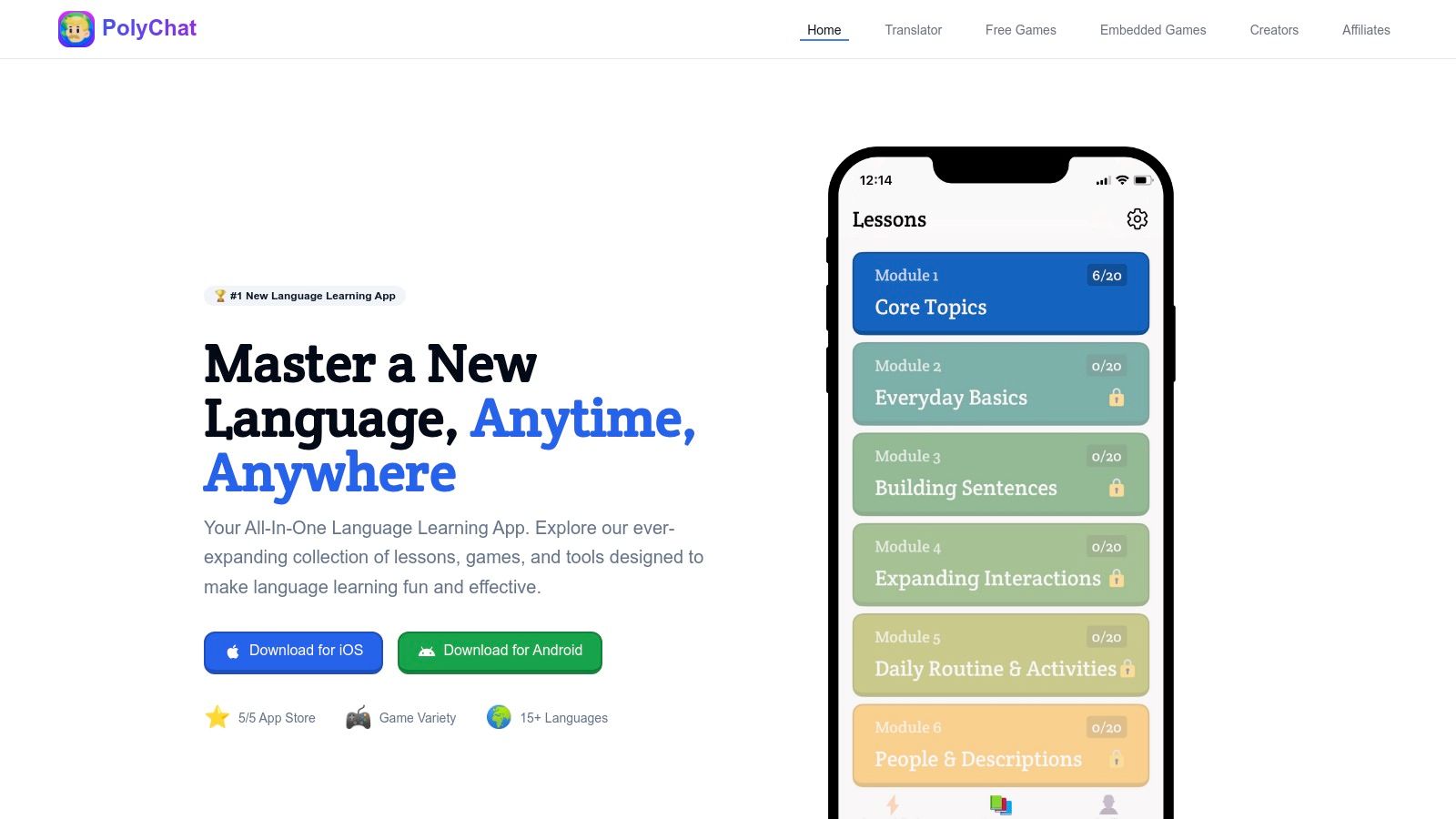
PolyChat earns its top spot as a powerful, all-in-one alternative for learners who feel constrained by Duolingo’s limitations. It combines structured, bite-sized lessons with advanced AI and gamification but crucially removes the "hearts" or energy systems that cap daily practice. This single change makes it one of the best apps better than duolingo for serious learners who want to practice intensively without being forced to stop or pay.
The app's design philosophy centers on high-volume, effective practice. Its unlimited lesson model is ideal for building consistent habits, whether you have five minutes or an hour. PolyChat is particularly strong in foundational skills, offering market-leading conjugation drills and timed vocabulary challenges that genuinely accelerate retention.
Key Features & Standout Advantages
PolyChat’s feature set is built for comprehensive, on-the-go learning. It moves beyond simple flashcards to provide a suite of integrated tools that support a learner from beginner to advanced stages.
- Unlimited Practice: The most significant advantage over Duolingo. You can engage in as many lessons, games, and drills as you want each day, which is perfect for binge-learning or fitting in extra practice whenever you have time.
- Flexible Language Pairs: Unlike apps that force you to learn from English, PolyChat allows learning from any supported language to any other (e.g., learning German from French). This is a game-changer for polyglots and multilingual learners who want to build on their existing language skills.
- Superior Grammar Drills: The conjugation and vocabulary tools are a core strength. These are not simple multiple-choice questions but dynamic, timed challenges that train you to recall verb forms and words quickly, mimicking the pressure of real-world conversation.
- Integrated Utilities: It includes a personal dictionary that populates as you learn new words and a built-in free translator. This transforms it from just a learning app into a practical daily utility for communication and study.
- AI Conversation Mode: Practice speaking with an AI tutor that offers instant feedback, helping you build confidence before real-world interactions.
Beyond major languages like Spanish, French, German, Italian, and Portuguese, PolyChat also supports options that often get sidelined, such as Romanian, Polish, Czech, Croatian, Catalan, Albanian, and Vietnamese. The bidirectional language-pair design is especially valuable for polyglots, expats, and non-English-native learners who are tired of English-only course paths. As noted in Babbel's comparison of language learning apps, different apps solve different Duolingo weaknesses. PolyChat's answer is simple: remove the friction and give learners more chances to practice. Its approach to gamification in language learning also aligns with what works in practice: games help when they reinforce study, not when they throttle it.
Ideal User & Use Case
PolyChat is best suited for learners who are self-motivated and thrive on repetition and gamification. If your main frustration with Duolingo is the inability to practice as much as you'd like, PolyChat is the definitive solution. A student preparing for a Spanish exam could use the unlimited conjugation drills to master verb tenses, while a traveler could use the free translator and vocabulary games to quickly build practical knowledge before a trip.
| Feature | PolyChat | Duolingo |
|---|---|---|
| Daily Practice | Unlimited, no "heart" system | Limited by a "heart" system |
| Language Pairs | Any to any (e.g., French to German) | Primarily from English |
| Core Drills | Advanced conjugation and vocab | General sentence-based exercises |
| Built-in Tools | Free translator, personal dictionary | Basic dictionary features |
Pros & Cons
Pros:
- No daily limits on learning, encouraging high-volume practice.
- Exceptional tools for mastering verb conjugations and vocabulary.
- Unique flexibility for multilingual learners with any-to-any language pairs.
- Highly-rated user experience with strong testimonials and App Store recognition (often cited at 5/5 in store reviews).
Cons:
- Free to start, with PolyChat Pro typically around $59.99/year for full feature access.
- Lacks features for live, human-led practice like tutoring or detailed pronunciation feedback from native speakers.
- Android users should note it's currently distributed via APK from the official site, not the Google Play Store.
Practical rule: If Duolingo motivates you but its limits make you quit mid-session, PolyChat is the most direct upgrade. Vs. Duolingo, it feels less like a streak machine and more like a training app.
Website: https://www.polychatapp.com
For more on where PolyChat sits in the AI-assisted space, see this roundup of the best AI language learning apps.
2. Babbel
Babbel offers a curriculum-first approach that appeals to learners seeking structure over pure gamification. Its lessons are designed around real-life conversations, focusing on practical vocabulary you would actually use when ordering coffee or asking for directions. This makes it one of the better apps than Duolingo for learners who want to build conversational confidence quickly and efficiently.
The platform is built on short, 10 to 15-minute lessons that are easy to fit into a busy schedule. Babbel's methodology emphasizes retaining information through spaced repetition and review cycles, ensuring that you remember what you’ve learned. Its integrated speech recognition also provides valuable pronunciation feedback.

Key Information & Features
| Category | Details |
|---|---|
| Best For | Beginners and intermediate learners who want a structured, conversation-focused curriculum for practical communication. |
| Availability | iOS (App Store), Android (Google Play Store), Web. |
| Pricing | Subscription-based, with plans starting around $14.95/month. Discounts for longer commitments (e.g., ~$83/year). A lifetime subscription is sometimes offered. |
| Key Features | Conversation-Based Lessons: Focuses on practical dialogue. Spaced Repetition: Built-in review manager to help with long-term memory. Babbel Speak: Speech recognition for pronunciation feedback. Guided Conversations & Podcasts: Extra speaking and listening content in supported languages. |
Why It's a Strong Duolingo Alternative
Babbel's core strength is its professionally designed curriculum. Unlike Duolingo's more random sentence-building exercises, Babbel's lessons are logically sequenced to build upon each other, providing a clear path from A1 to B1 levels. This makes it an excellent choice for serious learners who prefer a more traditional, classroom-like structure. You can see how Babbel's features stack up in our language learning apps comparison.
The emphasis on practical, everyday conversations means you'll learn relevant phrases from your very first lesson. Babbel Live group classes were discontinued as of July 1, 2025; the core app remains focused on self-paced lessons, review, and podcasts. Pricing varies by region and promotion—a lifetime subscription for all languages is often advertised around $199 during sales. In U.S. consumer surveys from May 2023, Babbel reached 55% brand awareness compared with Duolingo's 40%, and in July 2024 it generated over $5.4 million in in-app purchases, according to language learning app market statistics compiled by Electro IQ. Download data also reflects this split: while Duolingo led global installs in 2024 with 16.2 million and Babbel had 1.16 million, Babbel is repeatedly favored by serious learners for structured, textbook-style progress rather than rote vocab drills.
For speaking, Babbel pairs well with extra practice outside the app. If that's your weak spot, this guide on how to improve speaking skills is a useful complement because no app, including Babbel, fully replaces live production.
Tip: Use Babbel’s spaced-repetition review daily—it pulls vocabulary and grammar from past lessons and is one of the fastest ways to move material into long-term memory.
Visit Babbel: www.babbel.com
3. Pimsleur
Pimsleur offers a scientifically-proven, audio-first method designed to get you speaking and understanding a new language from the very first lesson. Its core philosophy revolves around 30-minute daily audio sessions that you can complete while commuting, exercising, or doing chores. This focus on listening and speaking makes it one of the most effective apps better than Duolingo for building conversational confidence and a natural-sounding accent.
The method uses Graduated Interval Recall (spaced repetition with timed recalls) and asks you to construct phrases from memory, which is highly effective for long-term retention. Unlike apps that focus heavily on text and translation, Pimsleur immerses you in the sound of the language, training your ear to pick up on nuances and rhythm.

Key Information & Features
| Category | Details |
|---|---|
| Best For | Auditory learners, commuters, and anyone who wants to prioritize speaking and listening skills over reading and writing from day one. |
| Availability | iOS (App Store), Android (Google Play), Web, Amazon Alexa integration. |
| Pricing | Subscription-based. Pimsleur Premium starts at around $19.95/month for one language or $20.95/month for All Access (50+ languages). A 7-day free trial is available. |
| Key Features | Core Audio Lessons: 30-minute daily lessons based on the Pimsleur Method. Voice Coach: AI-powered tool for pronunciation feedback. Offline Mode: Download lessons for on-the-go learning without data. Driving Mode: Simplified, hands-free interface for safe use in the car. |
Why It's a Strong Duolingo Alternative
Pimsleur’s greatest strength is its ability to build an instinctive conversational ability. While Duolingo teaches you to translate isolated sentences, Pimsleur trains you to think and respond in the target language. The 30-minute daily commitment creates a consistent and manageable habit, perfect for busy adults who struggle to find dedicated screen time for lessons.
It works exceptionally well as a foundational tool for speaking and listening, which you can then supplement with other resources for grammar and reading. While it doesn't offer the same gamified experience as Duolingo, its focus on practical, real-world conversation skills provides a more direct path to actually speaking the language. For more dialogue-heavy complements, see apps better than Duolingo for conversation.
Tip: Answer prompts out loud—even with headphones in public. Pimsleur is built on vocal production, not silent review.
Visit Pimsleur: https://www.pimsleur.com/
4. Rosetta Stone
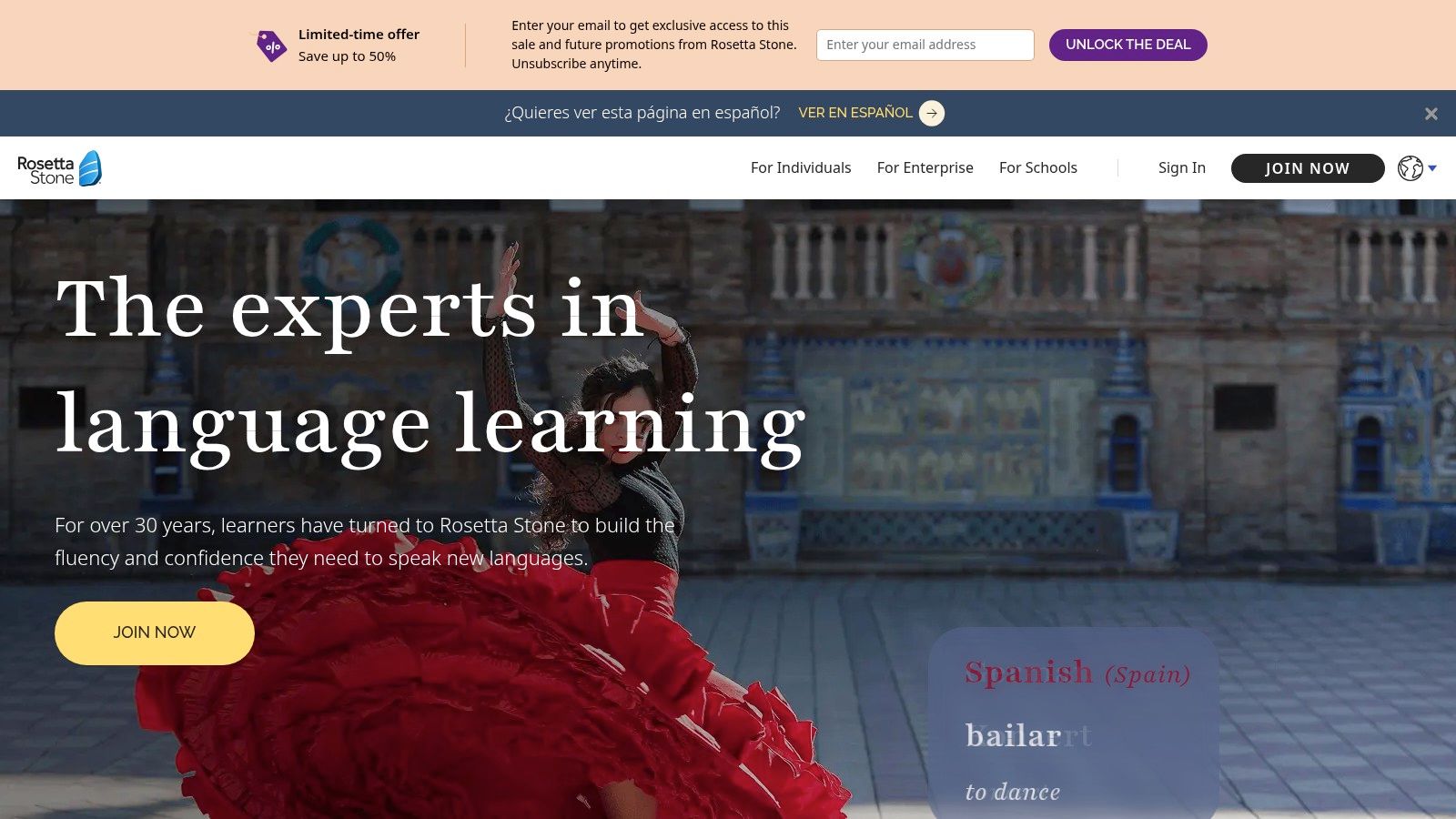
Rosetta Stone is a legacy player in the language-learning space that stands apart with its "Dynamic Immersion" method. This technique teaches you a new language the way you learned your first one: by associating words and phrases with images and context, completely avoiding translation. This makes it one of the most effective apps better than Duolingo for learners who want to develop an intuitive, instinctual understanding of a language from the very beginning.
The platform is designed to build a solid foundation through visual and auditory cues, forcing your brain to think in the target language. Its TruAccent speech-recognition engine provides detailed feedback on your pronunciation, helping you sound more like a native speaker.
Key Information & Features
| Category | Details |
|---|---|
| Best For | Visual learners who want to build a foundational, intuitive understanding of a language without relying on translation. |
| Availability | iOS, Android, Desktop (Web). |
| Pricing | Subscription-based (from $11.99/month). Rosetta Stone’s consumer lifetime all-languages bundle ended February 14, 2026—check the site for current plans. |
| Key Features | Dynamic Immersion: Learn through image and audio association without translation. TruAccent Technology: Advanced speech recognition for pronunciation feedback. Offline Access: Download lessons to study without an internet connection. Live Tutoring: Optional sessions with native speakers. |
Why It's a Strong Duolingo Alternative
Rosetta Stone's core strength is its translation-free methodology. Unlike Duolingo, which constantly prompts you to translate back and forth, Rosetta Stone forces you to start thinking in your new language immediately. This builds a deeper, more organic connection to the vocabulary and grammar rules.
While its structured, repetitive nature might feel slow for those who prefer fast-paced gamification, its trusted curriculum remains strong for pronunciation-first immersion. Rosetta Stone also ranks as a top overall Duolingo competitor by G2 in 2026, within a language-learning app market projected to reach 24.39 billion dollars by 2033.
Tip: If you use immersion mode, resist constantly flipping to translations—let images, audio, and repetition wire meaning directly in the target language.
Visit Rosetta Stone: https://www.rosettastone.com/
5. Busuu
Busuu offers a highly structured, curriculum-driven approach that sets it apart from more gamified apps. Its courses are aligned with the Common European Framework of Reference for Languages (CEFR), giving learners clear goals from A1 through B2—and C1 in some languages such as English. At the end of each CEFR level you can take an in-app certificate test; these mark progress inside Busuu but are not formal qualifications for school or work.
The platform's core strength is its unique blend of AI-powered review and human interaction. While you learn vocabulary and grammar through structured lessons, you can also submit writing and speaking exercises to Busuu’s community of native speakers for feedback. This peer-review system provides invaluable, real-world corrections that automated systems can't replicate.
Key Information & Features
| Category | Details |
|---|---|
| Best For | Learners seeking a CEFR-aligned curriculum, structured grammar lessons, and feedback from native speakers. |
| Availability | iOS (App Store), Android (Google Play), Web. |
| Pricing | Free basic access. Premium plans unlock more features, starting around $6-14/month depending on the plan and billing cycle. |
| Key Features | Community Feedback: Get corrections on your speaking and writing from native speakers. CEFR-Aligned Courses: Follow a structured path with clear proficiency goals. AI Conversations: Lower-stakes speaking practice before talking to real people. AI-Powered Review: Smart "Review" tab helps you remember vocabulary and grammar. Offline Mode: Download lessons for on-the-go learning with a Premium plan. |
Why It's a Strong Duolingo Alternative
Busuu’s main advantage is its community feedback loop. While Duolingo relies on AI for corrections, Busuu lets you practice with and get tips from real native speakers, which is crucial for mastering pronunciation and natural phrasing. Its AI Conversations feature also gives you a lower-pressure place to rehearse speaking before you use the language with actual people. The CEFR-aligned structure also provides a more tangible sense of progress compared to Duolingo's more abstract learning tree.
The free tier still includes a placement test, core vocabulary lessons, and participation in community corrections—enough to validate the method before paying. Advanced grammar units, AI-powered review, offline mode, and official certificates sit behind Premium, so serious long-term study usually needs a subscription—but the free path is more than a teaser. Busuu is also strong in business contexts because of native speaker interactions and structured grammar training, as noted in this competitor analysis of Duolingo alternatives.
Tip: Correct other learners’ exercises in your native language too—community goodwill often leads to faster, more detailed feedback on your own submissions.
Visit Busuu: www.busuu.com
6. LingoDeer
LingoDeer is one of the cleanest examples of an app built for learners who need more explanation, not less. That's why it's a common recommendation for Japanese, Korean, and Chinese. Duolingo's style can work for simple pattern exposure, but it struggles when learners need clear grammar notes, script support, and tighter sequencing—especially with sentence patterns, particles, and writing systems that differ sharply from English.
LingoDeer feels more like a proper beginner course. Units build carefully. Explanations are clearer. Practice reinforces a point instead of tossing another sentence at you and hoping you infer the rule.
Key Information & Features
| Category | Details |
|---|---|
| Best For | Beginners starting Asian languages, grammar-dependent learners, and anyone combining tools for explanation plus conversation practice. |
| Availability | iOS (App Store), Android (Google Play), Web. |
| Pricing | Freemium. Premium available monthly, annually, or as a lifetime purchase. |
| Key Features | Explicit Grammar Notes: Clear explanations for each unit. Structured Paths: Careful sequencing for Japanese, Korean, Chinese, and more. Review Games: Reinforcement without relying on guesswork alone. |
Why It's a Strong Duolingo Alternative
LingoDeer is less addictive and more instructive than Duolingo. For many learners studying Asian languages, that's exactly the upgrade. The trade-off is that it can feel more academic than conversational. You may finish a session feeling smart but not especially spontaneous, which is why it pairs well with speaking-focused tools.
Visit LingoDeer: https://www.lingodeer.com/
7. Lingvist
Lingvist is a hyper-focused tool engineered for one primary purpose: rapidly expanding your vocabulary using AI-driven spaced repetition. It moves away from the cartoonish, game-like interface of Duolingo to offer a sleek, scientific approach to memorization. By analyzing what you know and what you need to learn, it presents the most statistically relevant words first, making it one of the most efficient apps better than Duolingo for pure vocabulary acquisition.
The platform's core is its adaptive algorithm, which tailors flashcard-style reviews to your personal learning curve. This ensures you spend your time on words you're about to forget, not ones you've already mastered. The ability to create custom decks from your own articles, emails, or textbooks makes it an incredibly powerful tool for learners with specific goals, like passing an exam or mastering a professional lexicon.
Key Information & Features
| Category | Details |
|---|---|
| Best For | Intermediate learners wanting to quickly boost their vocabulary and professionals needing to learn subject-specific terminology. |
| Availability | iOS (App Store), Android (Google Play), Web. |
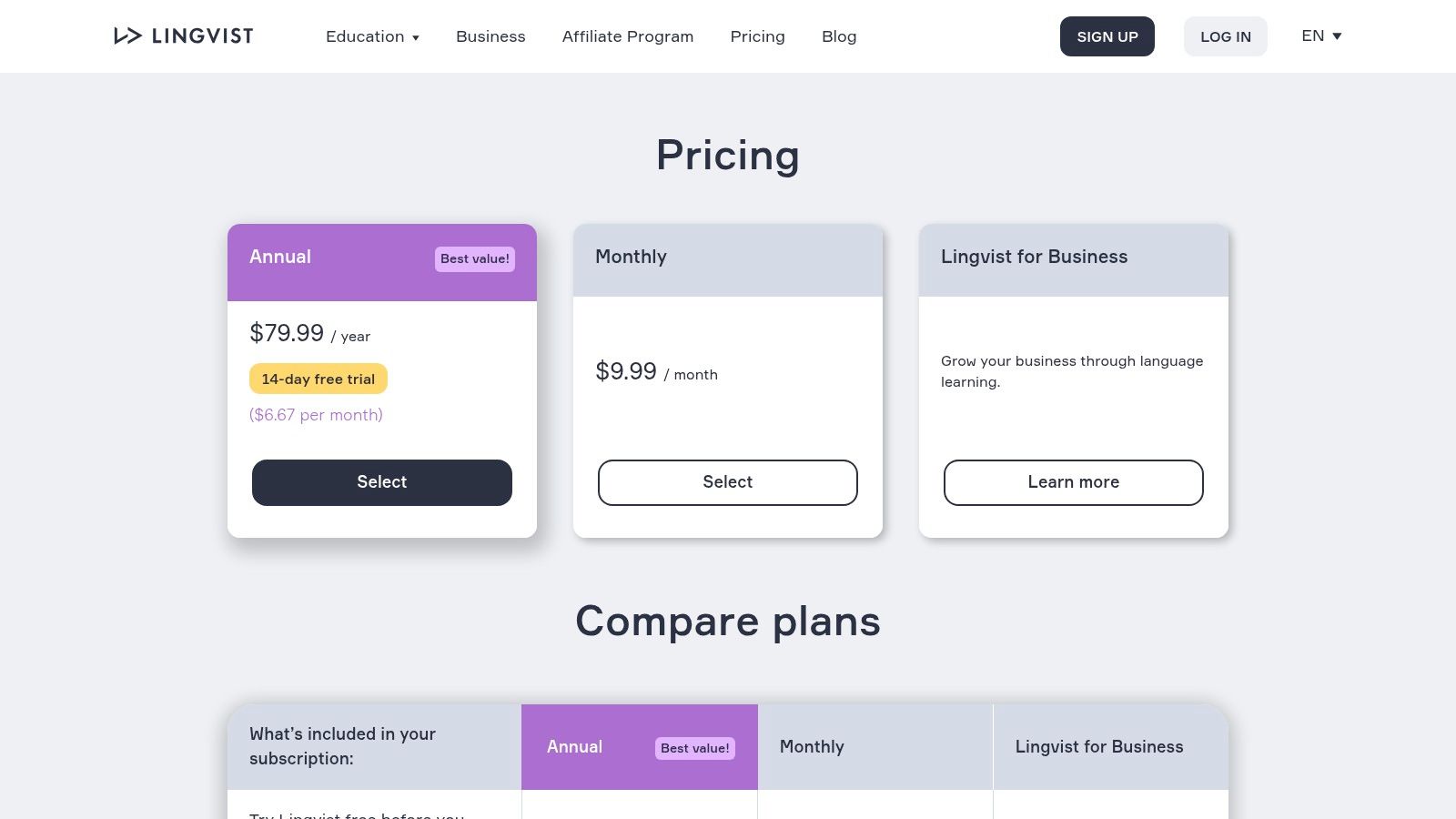
| Pricing | Free trial available. Premium subscription required for full access, typically around $79.99/year. |
| Key Features | AI-Powered Spaced Repetition: Intelligently schedules vocabulary reviews for maximum retention. Custom Decks: Create flashcard decks from any text or web page. Focused Learning: Strips away distractions to focus purely on vocabulary drills. |
Why It's a Strong Duolingo Alternative
Lingvist excels where Duolingo's broad approach can feel inefficient. Its singular focus on high-frequency vocabulary allows you to make measurable progress in your reading and listening comprehension much faster. The custom deck feature is a game-changer, allowing you to tailor your learning to your exact needs, a level of personalization Duolingo lacks.
While it is not a comprehensive language course and lacks grammar lessons or conversational practice, it is an unparalleled supplementary tool. For learners who feel their vocabulary is a bottleneck, Lingvist provides a surgical, data-driven solution to break through that plateau. It's the ideal tool for building the lexical foundation needed for fluency. Industry analysis of Duolingo competitors also highlights Lingvist's AI-driven adaptive flashcards for efficient vocabulary growth. If vocabulary is your weak point, pair it with this guide on the best way to learn vocabulary. For more on how adaptive tools are changing study habits, see this overview of AI language learning tools.
Tip: Run Lingvist for 15–20 minutes daily for vocab, then apply those words in a grammar-heavy course or with a tutor—the combo beats doubling down on drills alone.
Visit Lingvist: https://lingvist.com/
8. LingQ
LingQ champions comprehensible input: you learn largely through reading and listening to authentic material rather than rigid mini-games. Its library spans articles, podcasts, books, and imported content—plus a browser extension so you can pull in articles or videos you already care about.
The interactive reader lets you tap unknown words for translations and save them as LingQs, then review them with built-in spaced repetition. That turns almost any media into structured study. The free plan caps you at 20 active LingQs—enough to test imports and tap-to-save workflow, but long-term immersion usually needs Premium. It scales from cautious beginners to native-level material, though absolute beginners may feel lost without a parallel structured course.
Key Information & Features
| Category | Details |
|---|---|
| Best For | Intermediate learners, media-driven study, and self-directed learners who want input-heavy immersion. |
| Availability | Web, iOS (App Store), Android (Google Play). |
| Pricing | Limited free tier; Premium unlocks unlimited lookups and imports from about $12.99/month (annual discounts common). Pricing can vary by region at checkout. |
| Key Features | Authentic Content Library: Articles, podcasts, and books in your target language. Imports: Bring your own URLs and media (extension-supported). SRS Reviews: Saved words reviewed on a schedule. |
Why It's a Strong Duolingo Alternative
If Duolingo feels disconnected from how people actually write and speak, LingQ pushes you toward real texts and voices at volume. Pair it with grammar instruction elsewhere—it is intentionally lighter on explicit rules.
Tip: Don’t pause on every unknown word at first; aim for gist comprehension and let SRS reinforce vocabulary over time.
Visit LingQ: https://www.lingq.com/
9. Clozemaster
Clozemaster is not a beginner app, and that's why it works. Once you've outgrown absolute basics, the next bottleneck is usually vocabulary in context: real sentence exposure at volume, not isolated words or cartoonish examples. Clozemaster does that through fill-in-the-blank exercises sorted by frequency, so you keep seeing useful words in usable structures.
Key Information & Features
| Category | Details |
|---|---|
| Best For | Late beginners and intermediates (A2–B1+) who need scale, vocabulary-focused learners, and polyglots who want wide language-pair support. |
| Availability | iOS (App Store), Android (Google Play), Web. |
| Pricing | Strong free tier. Clozemaster Pro is about $8/month or $60/year; the lifetime Pro purchase option has been discontinued—plans are subscription-only now. |
| Key Features | Frequency-Based Cloze Sentences: High-volume contextual vocabulary practice with sentence audio on many items. Fast Track Collections: Curated sentence sets for efficient drilling. Cloze-Listening Mode: Fill blanks from audio alone for sharper real-world listening. Spaced Repetition: Reviews scheduled for retention. Wide Language Pairings: Strong option for learners studying multiple languages. |
Why It's a Strong Duolingo Alternative
If Duolingo taught you to recognize basic patterns, Clozemaster helps you stop living inside beginner content. The free tier includes massive sentence banks, multiple-choice and typing modes, spaced repetition, and leaderboards—Pro adds custom collections, richer stats, offline mode, and dedicated grammar challenges. It won't hold your hand through grammar foundations, so it works best as a supplement to a structured course. Vs. Duolingo, it is much better at pushing learners past the baby-steps phase.
Tip: Use Cloze-Listening in your target language when you want blanks filled from what you hear—it bridges the gap between reading cloze and messy real-world audio.
Visit Clozemaster: https://www.clozemaster.com/
10. Memrise
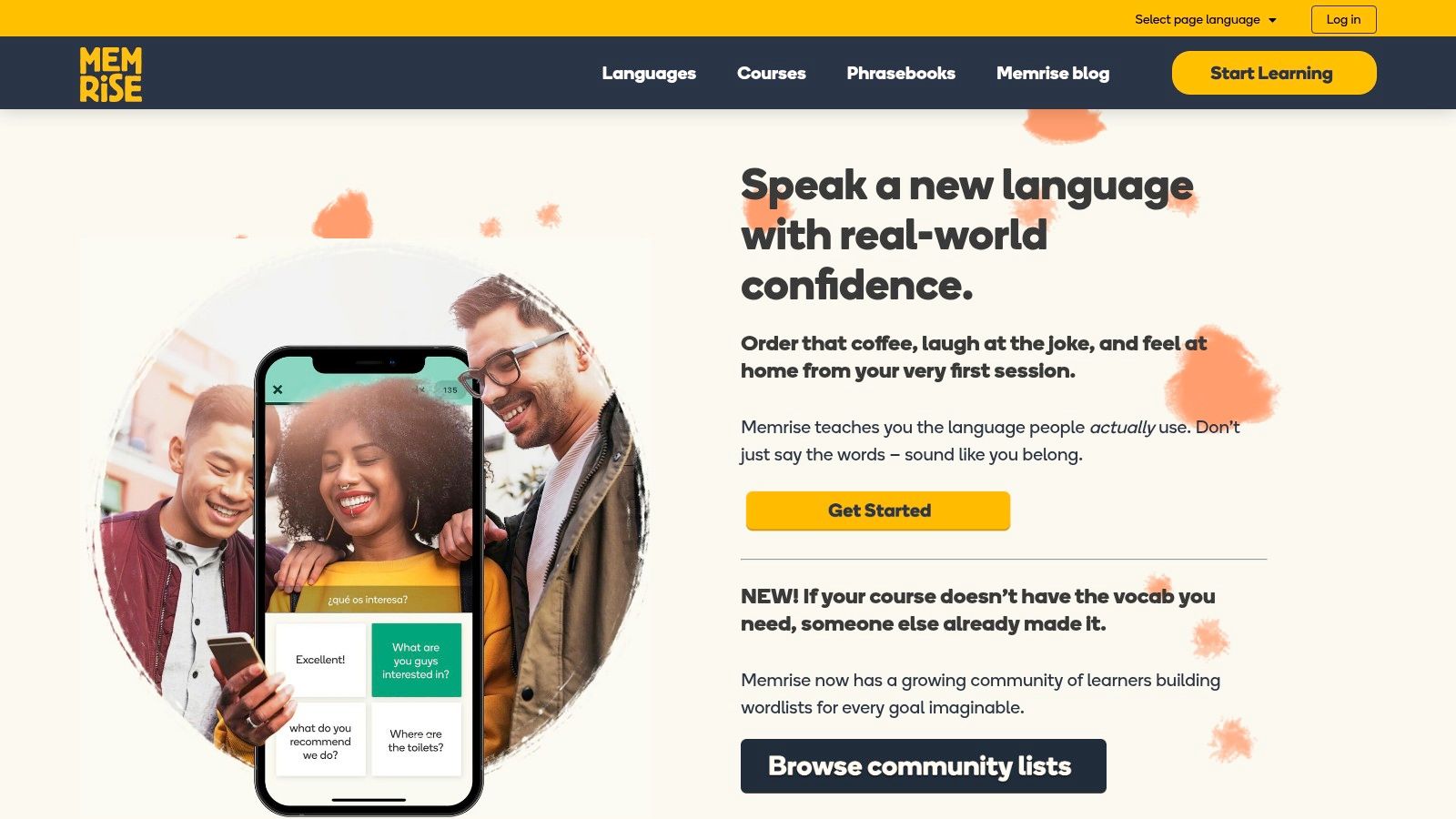
Memrise carves out its niche by focusing on practical, real-world language taught through video clips of native speakers. This approach moves beyond robotic text-to-speech audio, helping you connect words and phrases with authentic accents and natural intonation. It's built around spaced repetition, an effective memory technique that ensures new vocabulary sticks.
The platform blends these video-based lessons with an AI language partner, "MemBot," allowing you to practice what you've learned in simulated conversations. This combination of seeing, hearing, and using the language makes Memrise one of the apps better than Duolingo for learners who want to grasp conversational nuances and build recall for useful phrases they can use immediately. According to Android Police's review of why users are replacing Duolingo, Memrise stands out for native-speaker video lessons and spaced repetition over more gamified, profit-prioritized approaches.
Key Information & Features
| Category | Details |
|---|---|
| Best For | Visual and auditory learners who benefit from hearing native speakers and want to memorize practical, conversational phrases. |
| Availability | iOS (App Store), Android (Google Play), Web Browser. |
| Pricing | Free limited version. Premium subscription available monthly ( |
| Key Features | Learn with Locals: Short video clips of native speakers. Spaced Repetition: Intelligent algorithm for reviewing vocabulary. AI Language Partner: Practice conversation with MemBot. Community Courses: Access to user-created content via the web version. |
Why It's a Strong Duolingo Alternative
Memrise's greatest strength is its focus on authentic input. Hearing a phrase from multiple native speakers helps you internalize the sounds of a language far more effectively than Duolingo’s single computer-generated voice. This makes it an exceptional tool for building listening comprehension and confidence. It stands out as one of the best vocabulary building apps because it is designed for long-term memory retention.
On the free plan, you get full access to Memrise’s official starter courses across dozens of languages, plus spaced-repetition reviews—without paying to begin. MemBot AI chats, offline mode, and ad removal require Pro. Community-created decks have largely moved off the main app, so focus on official paths for a stable free experience. The availability of a lifetime subscription is also a major draw for learners who prefer a one-time investment over recurring payments. If you care about long-term retention, it is worth understanding how spaced repetition supports language learning.
Tip: Complete Memrise’s scheduled reviews faithfully—that algorithm is built on the same spaced-repetition logic that locks in words right before you forget them.
Visit Memrise: https://www.memrise.com/
11. Drops
Drops is a visual vocabulary builder built around minimalist illustrations and swipe-based micro-sessions—often about five minutes a day. It associates words with images instead of leaning on translation lists, which helps some learners create stronger mental hooks than Duolingo’s generic drills.
The free tier caps daily study time; premium removes the cap, unlocks 50+ languages, and adds offline access. Drops is deliberately narrow: almost no grammar or dialogue—think fast word pickup before a trip or as a warm-up before a heavier course.
Key Information & Features
| Category | Details |
|---|---|
| Best For | Visual learners, beginners, travelers rushing core vocabulary, and anyone who wants ultra-short daily sessions. |
| Availability | iOS (App Store), Android (Google Play). |
| Pricing | Free tier with a daily time limit; Premium monthly/yearly or lifetime purchase (often around $159.99 during promotions). |
| Key Features | Illustration-first vocabulary: Picture-linked words and swipe drills. Micro-sessions: Designed for consistent five-minute habits. Offline learning: Premium feature. |
Why It's a Strong Duolingo Alternative
When Duolingo feels slow on pure vocab acquisition, Drops front-loads words with low friction. Pair it with Babbel, LingoDeer, or a tutor so grammar and speaking keep pace.
Tip: Use Drops as a five-minute primer before grammar or conversation study—you’ll recognize those words faster when they appear in full sentences later.
Visit Drops: https://languagedrops.com
12. Mango Languages
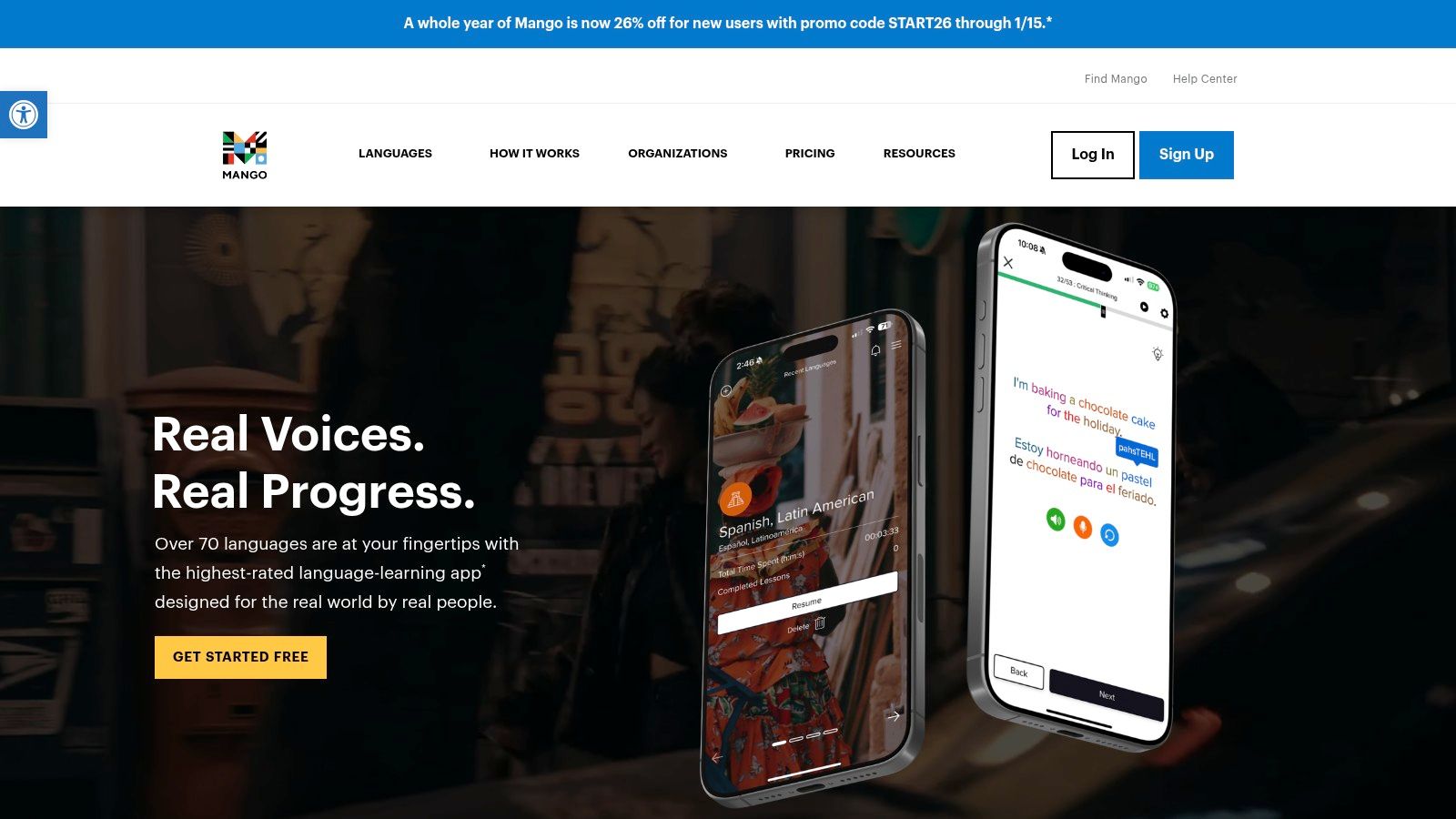
Mango Languages is a conversation-focused platform that prioritizes practical, real-world communication skills over gamified point-scoring. Its methodology revolves around breaking down conversations into manageable pieces, using color-coded grammar notes and phonetic spellings to build a deep, intuitive understanding. With 70+ languages, dialect support, and conversation-driven lessons, it is one of the better apps than Duolingo for learners who want to speak confidently from their very first lesson—especially when studying less-common languages that bigger apps treat as an afterthought.
The catalog spans major languages plus niche picks such as Cherokee, Dzongkha, and even Shakespearean English. Its voice comparison tool lets you record yourself and align your waveform with a native speaker’s—a concrete way to tighten pronunciation beyond yes/no speech checks.
The platform's most significant advantage is its widespread availability through public libraries in the US. Millions of users can access the full premium version for free with just a library card, making it an incredibly accessible and cost-effective tool.
Key Information & Features
| Category | Details |
|---|---|
| Best For | Travelers, library cardholders, and learners who want a practical, conversation-based curriculum without gamification. |
| Availability | iOS (App Store), Android (Google Play), Web Browser. |
| Pricing | Free with a participating library card. Individual subscriptions are $7.99/month for one language or $17.99/month for all languages. |
| Key Features | Intuitive Construction: Builds sentences by layering concepts and vocabulary. Voice Comparison: Record your voice and compare it directly to a native speaker's pronunciation. Cultural Notes: Provides context on customs and etiquette. Library Access: Free premium access through thousands of public libraries. |
Why It's a Strong Duolingo Alternative
Mango Languages excels where Duolingo's focus on isolated sentences can fall short: contextual conversation. Its lessons are built around dialogue relevant to travel and daily life, ensuring you learn phrases you will actually use. The voice comparison feature offers a more direct and effective way to practice pronunciation than Duolingo's simple speech recognition.
While it lacks the addictive game-like elements of its competitor, its clear, structured approach is perfect for learners who prefer a more academic and practical path. Before paying, check with your local library, as you may already have full, free access—Mango’s site lets you search by ZIP code or library name to confirm eligibility.
Tip: Always verify library access before subscribing retail; many learners get the full premium experience free with a card.
Visit Mango Languages: https://mangolanguages.com/
13. Rocket Languages
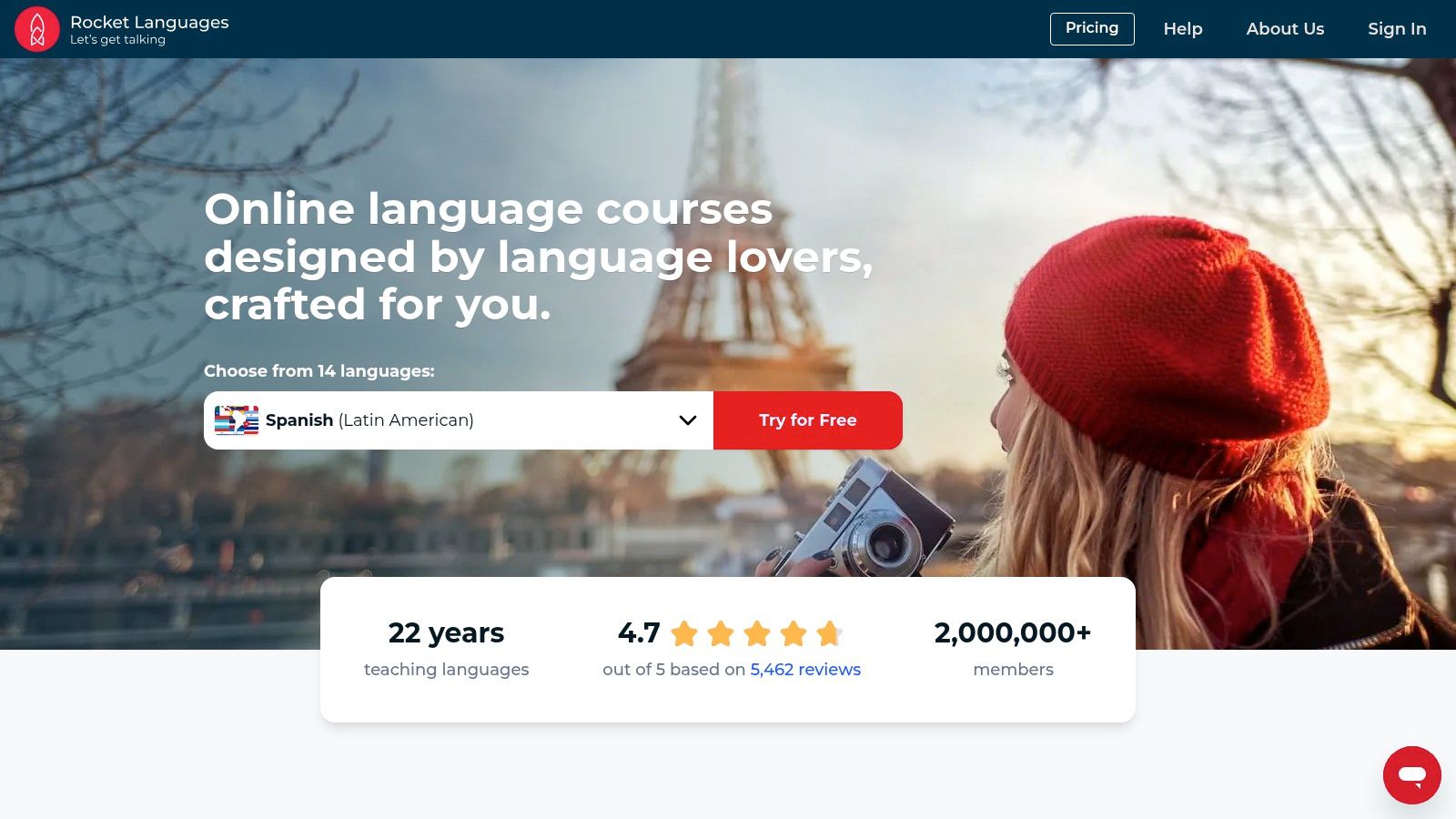
Rocket Languages offers a comprehensive, course-based approach that stands in stark contrast to the bite-sized, game-like lessons of Duolingo. It is built around a "buy once, own forever" model, making it ideal for learners who dislike subscriptions and want a complete curriculum they can access for life. This structure makes it one of the better apps than Duolingo for those committed to mastering a single language from beginner to advanced levels without recurring fees.
The platform's core strength is its blend of interactive audio lessons, which simulate real conversations, with robust reinforcement activities. Each lesson includes cultural notes and detailed explanations, providing context that is often missing in more gamified apps. The focus is less on quick wins and more on building a durable, practical understanding of the language.
Key Information & Features
| Category | Details |
|---|---|
| Best For | Serious learners who prefer a structured, one-time purchase course with lifetime access and a focus on conversational skills. |
| Availability | Web, iOS (App Store), Android (Google Play). |
| Pricing | One-time purchase per language level (e.g., Level 1, Levels 1-2, or Levels 1-3). Prices vary, often ranging from $99 to $259, with frequent discounts. Free trial lessons are available. Purchases typically include a 60-day money-back guarantee—confirm current terms at checkout. |
| Key Features | Interactive Audio Lessons: Focus on conversational practice from day one. Lifetime Access: Pay once for a course and receive all future updates. Voice Recognition: Advanced speech-to-text tools to perfect your pronunciation. Culture & Grammar Lessons: Integrated notes provide deep context. |
Why It's a Strong Duolingo Alternative
The primary advantage of Rocket Languages is its one-time purchase model with lifetime access. This eliminates the pressure of monthly subscriptions and provides incredible long-term value, directly appealing to learners frustrated with the freemium model. Its structured curriculum feels more like a complete course than a game, offering a clear path from beginner to fluency.
While the upfront cost is higher and the interface is less gamified, the depth of its content is far superior. The combination of audio lessons, pronunciation practice, and cultural insights provides a well-rounded education that prepares you for real-world conversations more effectively than Duolingo's repetitive sentence drills.
Tip: Treat Rocket’s audio prompts like a live class—repeat out loud whenever the narrator pauses instead of listening passively.
Visit Rocket Languages: https://www.rocketlanguages.com/
14. Mondly
Mondly, now part of the Pearson family, distinguishes itself with a broad language selection and a tech-forward approach that includes chatbot conversations and optional VR/AR features. Its daily lessons are designed to be short and engaging, focusing on practical vocabulary and real-world scenarios. This makes it one of the better apps than Duolingo for learners who need a quick, consistent study routine or want to learn a language from a non-English base.
The platform blends core vocabulary drills with innovative tools like its conversation chatbot, which uses speech recognition to help you practice pronunciation and phrasing. This combination is particularly effective for travelers who need to build conversational confidence quickly. Mondly's frequent promotions, especially its lifetime access deals, also offer exceptional long-term value compared to recurring monthly subscriptions.
Key Information & Features
| Category | Details |
|---|---|
| Best For | Casual learners, travelers, and polyglots who want access to many languages and prefer learning from a non-English native tongue. |
| Availability | iOS (App Store), Android (Google Play), Web. |
| Pricing | Free basic version. Premium subscriptions are around $9.99/month or $47.99/year. Look for frequent lifetime access deals for all 41 languages. |
| Key Features | Conversation Chatbot: Practice real-world dialogues with an AI partner. Extensive Language Support: Learn from over 40 languages. VR/AR Integration: Offers immersive virtual reality lessons (sold separately). Daily Lessons: Bite-sized, topic-based lessons. |
Why It's a Strong Duolingo Alternative
Mondly's biggest advantage is its flexibility in language pairing. Unlike Duolingo, where most courses are taught from English, Mondly allows you to learn from your native language, whatever it may be. This is a game-changer for non-English speakers. The AI chatbot also provides a more interactive and realistic speaking practice than Duolingo’s multiple-choice exercises.
While it may not offer the grammatical depth of more academic platforms, its focus on practical phrases and pronunciation makes it a superior choice for those preparing for travel or immediate conversation. For learners who collect languages, the value of its lifetime all-access deals is hard to beat.
Visit Mondly: https://www.mondly.com/
15. italki
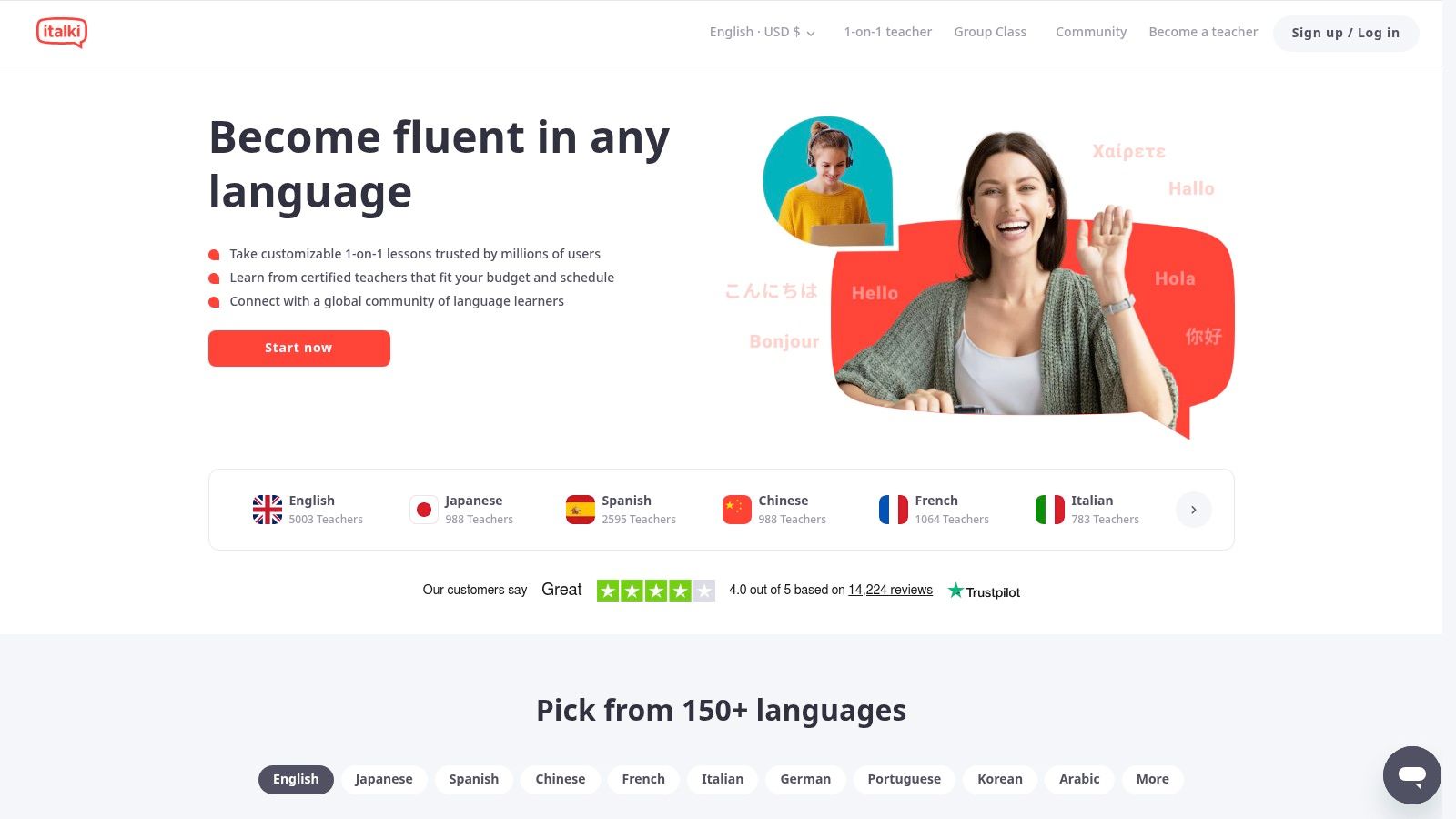
italki isn't an app in the traditional sense; it's a massive online marketplace connecting language learners directly with human tutors for 1-to-1 lessons. This approach moves beyond the algorithm-based drills of Duolingo to offer what many learners need most: real, dynamic conversation practice with a native speaker. It is one of the best platforms for those who find that app-based learning alone isn't improving their real-world speaking confidence.
The platform's core strength is its unparalleled flexibility and personalization. You can browse thousands of professional teachers and community tutors, filtering by price, availability, and specialty. This allows you to find an instructor who perfectly matches your learning style, goals, and budget, whether you're preparing for an exam or just want to practice casual conversation.
Key Information & Features
| Category | Details |
|---|---|
| Best For | Intermediate to advanced learners needing tailored speaking practice, exam preparation, and personalized feedback. |
| Availability | Web, iOS (App Store), Android (Google Play). |
| Pricing | Pay-per-lesson model. Prices vary widely by tutor, from ~$5/hr for community tutors to $30+/hr for professional teachers. Trial lessons are available at a discount. |
| Key Features | Vast Tutor Selection: Thousands of tutors for over 150 languages. Flexible Scheduling: Book lessons that fit your time zone and schedule. Pay-As-You-Go: No mandatory subscriptions; you only pay for the lessons you book. Specialized Coaching: Find experts in business language, test prep, and more. |
Why It's a Strong Duolingo Alternative
italki's primary advantage is its focus on human interaction and personalized feedback, an area where apps like Duolingo fall short. You get real-time corrections and can ask complex questions that an AI can't handle. It's the most effective way to address specific weaknesses and gain fluency. For those serious about mastering a language, learning how to improve speaking skills with real practice is non-negotiable.
While the quality can vary depending on the tutor and some users have noted UX changes, the ability to take low-cost trial lessons mitigates the risk. For learners who have hit a plateau with gamified apps, italki provides the crucial next step toward genuine conversational ability.
Visit italki: https://www.italki.com/
16. Tandem
Tandem centers on language exchange: you match with native speakers learning your language and practice via text, voice notes, or video. The free tier includes partner matching, in-app corrections, and Community Parties (group audio rooms on topics). Tandem Pro adds unlimited translations, advanced search filters, and ad removal—but the core exchange loop costs nothing.
Key Information & Features
| Category | Details |
|---|---|
| Best For | Intermediate learners ready for real conversation without tutor fees. |
| Pricing | Free messaging and calls; Pro ~$14/month for extras. |
| Key Features | Interest-based matching; multi-format chat; correction tools; group audio parties. |
Tip: Set a clear exchange rhythm in your first message (e.g., 10 minutes each language) so partners know you want structured practice, not casual chat only.
Visit Tandem: https://www.tandem.net
17. HelloTalk
HelloTalk turns learning into a global social network of language partners. The free version covers partner matching, built-in translation and correction in chats, public Moments posts, and live Voice Rooms for group listening practice. VIP removes ads, lifts translation caps, and adds profile boosts—but finding and chatting with natives remains free.
Key Information & Features
| Category | Details |
|---|---|
| Best For | Learners who want daily micro-conversations and community exposure beyond solo drills. |
| Pricing | Core exchange free; VIP for unlimited translations and extras. |
| Key Features | Text/voice/video chat; Moments feed; Voice Rooms; inline corrections. |
Tip: Post Moments in your target language and ask for corrections—it's a low-pressure way to get native feedback before one-on-one calls.
Visit HelloTalk: https://www.hellotalk.com
18. Language Transfer
Language Transfer is a 100% free, donation-supported audio course using the “Thinking Method”—guided lessons that teach you to build sentences from grammar logic instead of memorizing phrase lists. There are no ads, accounts, or paywalls; audio downloads work offline. It lacks interactive drills and spaced repetition, so pair it with vocabulary apps like PolyChat or Anki.
Key Information & Features
| Category | Details |
|---|---|
| Best For | Analytical beginners who want grammatical “aha” moments without subscription pressure. |
| Pricing | Free (donation-supported). |
| Key Features | Full audio courses; conceptual grammar teaching; offline downloads; no gamification clutter. |
Visit Language Transfer: https://www.languagetransfer.org
19. Beelinguapp
Beelinguapp teaches through parallel texts: stories shown in your target language beside your native language, with karaoke-style audio highlighting each sentence as a native speaker reads. The free tier rotates a library of fiction, news, and science stories—ideal for reading and listening together when grammar drills feel stale.
Key Information & Features
| Category | Details |
|---|---|
| Best For | Intermediate learners building reading speed and pronunciation cadence. |
| Pricing | Free rotating stories; Premium unlocks full catalog and offline downloads. |
| Key Features | Side-by-side texts; synced narration; tap glossary; genre variety. |
Visit Beelinguapp: https://beelinguapp.com
20. Anki (AnkiDroid / AnkiWeb)
Anki is the gold standard for customizable spaced repetition. Desktop and AnkiDroid are free; AnkiWeb syncs decks in the browser. You can create cards with audio and images or import community decks for nearly any language. The interface is technical, but retention efficiency is hard to beat for long-term vocabulary—especially when paired with a structured course.
Key Information & Features
| Category | Details |
|---|---|
| Best For | Dedicated learners who want full control over review scheduling and deck design. |
| Pricing | Free on desktop/Android; iOS app is a one-time purchase supporting development. |
| Key Features | Configurable SRS algorithm; shared deck library; rich media cards; offline study. |
Visit Anki: https://apps.ankiweb.net
21. Readlang
Readlang turns the open web into study material via a browser extension: click any word on an article for an instant translation and auto-generated SRS flashcard. The free plan includes unlimited single-word lookups and flashcard creation; phrase translations and text storage are capped—enough for habitual readers to build vocabulary from real news and blogs.
Key Information & Features
| Category | Details |
|---|---|
| Best For | Intermediate+ learners transitioning from textbooks to authentic online reading. |
| Pricing | Generous free tier; Premium for phrase translations, storage, and AI extras. |
| Key Features | Click-to-translate extension; auto flashcards; read anything online. |
Visit Readlang: https://readlang.com
21 Duolingo Alternatives — Quick Comparison
| Product | Core features | UX / Quality (★) | Price / Value (💰) | Target audience (👥) | Unique selling point (✨) |
|---|---|---|---|---|---|
| PolyChat 🏆 | Lessons, timed vocab games, conjugation drills, AI conversation, personal dictionary, built-in translator | ★★★★★ — highly engaging | 💰 Free (premium/in‑app details limited) | 👥 Multilingual learners, polyglots, high-volume practice | ✨ Unlimited daily practice; learn any→any language; market‑leading conjugation |
| Babbel | 10–15 min real-life lessons, Babbel Speak, review manager, podcasts | ★★★★ — curriculum-focused | 💰 Subscription; regional promos (~$199 lifetime sales common) | 👥 Learners wanting clear course progression | ✨ CEFR-aligned curriculum tuned to practical communication |
| Pimsleur | 30‑min audio lessons, graduated-interval recall, Voice Coach, offline/Car & Alexa modes | ★★★★ — excellent speaking habit | 💰 Subscription (All‑Access) + 7‑day trial | 👥 Commuters & speaking/listening focused learners | ✨ Audio-first method to build spoken confidence quickly |
| Rosetta Stone | Dynamic Immersion (visual+audio), TruAccent pronunciation, offline sync | ★★★★ — trusted, steady pace | 💰 Subscription (consumer lifetime bundle ended Feb 2026) | 👥 Visual learners preferring immersion | ✨ Translation-free immersion + robust pronunciation tech |
| Busuu | CEFR-aligned courses (through C1 in some langs), certs, AI conversations, community corrections | ★★★★ — balanced & structured | 💰 Freemium → Premium unlocks offline & extras | 👥 Learners seeking instruction + peer feedback | ✨ Community corrections + AI speaking practice |
| LingoDeer | Explicit grammar notes, structured unit paths, HD native audio, review games | ★★★★ — strong clarity for grammar learners | 💰 Freemium; Premium monthly/annual/lifetime | 👥 Beginners (esp. Japanese, Korean, Chinese) | ✨ Explicit grammar notes, strong Asian-language curriculum |
| Lingvist | AI-driven vocab scheduling, custom decks, progress analytics | ★★★★ — fast, efficient UX | 💰 Subscription (trial/annual offers) | 👥 Vocabulary-focused learners & targeted goals | ✨ Precision vocab growth with custom text decks |
| LingQ | Authentic reader, imports & extension, SRS LingQs | ★★★★ — ideal for input-heavy learners | 💰 Freemium → Premium (~$12.99/mo+) | 👥 Intermediate+ readers & podcast learners | ✨ Learn from real articles/media you choose |
| Clozemaster | Frequency cloze + sentence audio, Cloze-Listening, SRS | ★★★★ — fast contextual vocab growth | 💰 Free + Pro (~$8/mo or $60/yr; no lifetime Pro) | 👥 Intermediate learners (A2–B1+) | ✨ Frequency-ordered sentences + listening cloze |
| Memrise | Native-speaker videos, MemBot, spaced repetition | ★★★★ — engaging for phrases | 💰 Freemium; monthly/annual/lifetime options | 👥 Learners wanting real-world phrases & native clips | ✨ Native videos + AI rehearsal |
| Drops | Illustrated vocab, swipe micro-sessions (~5 min) | ★★★★ — ultra-low friction | 💰 Free tier timed; Premium unlocks 50+ langs | 👥 Beginners & travelers needing fast word pickup | ✨ Picture-linked vocab without grammar clutter |
| Mango Languages | Travel-ready lessons, waveform voice comparison, 70+ langs inc. niche | ★★★ — clear, travel-focused | 💰 Often free via US libraries; subscriptions for home | 👥 Library users, heritage/niche-language learners | ✨ Cherokee/Dzongkha/Shakespearean English–style breadth |
| Rocket Languages | Interactive audio lessons, grammar & culture, lifetime level packs | ★★★★ — thorough course design | 💰 One-time purchase per level + 60‑day refund typical | 👥 Self-paced learners avoiding subscriptions | ✨ Buy-once course depth + generous refund window |
| Mondly | Daily lessons, chatbot, speech recognition, VR add-on | ★★★ — quick & broad | 💰 Subscription; frequent lifetime sales | 👥 Casual learners & travelers | ✨ Wide language range + VR and non-English base support |
| italki | Marketplace of 1:1 teachers, trial lessons, pay‑per‑lesson scheduling | ★★★★ — highly personalized | 💰 Pay‑per‑lesson (wide price range) | 👥 Learners needing tailored speaking/coaching | ✨ Real tutors for bespoke feedback and exam/business prep |
| Tandem | Partner matching; text/voice/video; corrections; group Parties | ★★★★ — authentic exchange | 💰 Free core; Pro ~$14/mo | 👥 Conversation seekers on a budget | ✨ Free native practice without tutor fees |
| HelloTalk | Chat, Moments, Voice Rooms; inline corrections | ★★★ — social & global | 💰 Free usable; VIP for caps/ads | 👥 Social learners wanting daily micro-chat | ✨ Massive community + live audio rooms |
| Language Transfer | Donation audio courses; Thinking Method grammar | ★★★★ — clear explanations | 💰 100% free | 👥 Beginners needing grammar intuition | ✨ Zero paywall; offline audio |
| Beelinguapp | Parallel-text stories + synced karaoke audio | ★★★ — reading/listening blend | 💰 Free rotating library | 👥 Readers building cadence | ✨ Dual-language stories with narration |
| Anki | Custom SRS decks; shared libraries; media cards | ★★★★ — retention powerhouse | 💰 Desktop/Android free | 👥 Serious vocab builders | ✨ Maximum control over long-term memory |
| Readlang | Web click-to-translate; auto SRS flashcards | ★★★ — authentic reading | 💰 Generous free word lookups | 👥 Learners studying via real articles | ✨ Turn any webpage into a lesson |
Choosing the Right Tool for Your Language Journey
Navigating the landscape of language learning tools can feel overwhelming, but moving beyond a one-size-fits-all approach is the first step toward genuine progress. As we've explored, the world of language apps is rich with specialized platforms designed to cater to specific goals, learning styles, and commitment levels. The central takeaway is that there isn't a single "best" app, but there is a best app for you. The key lies in aligning a tool's strengths with your personal language-learning blueprint.
Your choice should be a deliberate one. Are you a beginner who needs a solid grammatical foundation and practical vocabulary for an upcoming trip? Babbel's structured, conversation-focused lessons offer an excellent, well-rounded curriculum. If you're an auditory learner who freezes up when it's time to speak, the audio-centric, spaced repetition method of Pimsleur is engineered to build your conversational confidence from the very first lesson. For those hitting a plateau, the personalized, human interaction provided by an italki tutor is an invaluable resource for breaking through to the next level of fluency.
How to Select Your Duolingo Alternative
The search for apps better than Duolingo is ultimately a search for a better fit for your individual needs. To make the right choice, you need to conduct a small self-assessment. Consider these factors before committing to a new platform:
- Primary Goal: Are you learning for travel, business, academic credit, or personal enrichment? A traveler might prioritize Mondly's AR features, while a student studying Japanese or Korean might need the grammar depth found in LingoDeer.
- Learning Style: Do you learn best by listening (Pimsleur), reading authentic media (LingQ), visual association (Rosetta Stone, Drops), or flashcard-style repetition (Memrise, Lingvist)?
- Time Commitment: How much time can you realistically dedicate each day? A tool with short, 5-minute lessons might be more sustainable than one requiring 30-minute sessions if your schedule is packed.
- Budget: Free trials are your best friend. Test several platforms before investing in a subscription to ensure the teaching method resonates with you. When you're evaluating different software, it can be helpful to look at various guides comparing top apps like the 'Top 12 Apps for Cheap International Calls in 2025' to understand different approaches to app reviews and feature comparisons.
Your Path Forward: From Choice to Consistency
Duolingo isn't useless. It's just limited. In Q1 2025, Duolingo reported 130.2 million monthly active users, 46.6 million daily active users, and $230.7 million in quarterly revenue. That scale shows Duolingo is great at getting people in the door. It is not proof that it is the best tool once your goals become more serious.
A lot of learners confuse consistency with progress because Duolingo makes consistency visible. You see the streak, the XP, the league movement. What you don't always see is whether you're getting better at recalling words under pressure, understanding natural speech, building sentences on your own, and holding a conversation when the script disappears.
The key is to stop looking for a single "best" app in the abstract and start choosing based on what is broken in your learning right now:
- If you quit because of limits: Use an app with unlimited daily practice, like PolyChat.
- If you don't understand grammar: Use one that teaches rules directly, like Babbel or LingoDeer.
- If you can read but can't speak: Use audio-first or feedback-based tools, like Pimsleur, Busuu, or Memrise.
- If you know the basics but still feel stuck: Add context-heavy vocabulary practice with Clozemaster or Lingvist.
- If you want immersion through real articles and podcasts: LingQ turns content you enjoy into structured study.
- If you want ultra-short visual vocab bursts: Drops fits five-minute gaps without pretending to teach full grammar.
- If real-world listening matters most: Memrise is hard to beat for native-speaker video and colloquial phrasing.
- If broader language access matters: Mango Languages earns its place when catalog breadth or library access beats gamified streaks.
- If you need free conversation practice: Tandem or HelloTalk replace hearts with real exchanges.
- If you want grammar intuition without paying: Language Transfer is fully free and donation-supported.
- If you learn by reading stories: Beelinguapp or Readlang turn authentic text into study.
- If retention is your bottleneck: Anki locks in words you meet elsewhere.
The global language learning apps market was valued at 6.34 billion dollars in 2024 and is projected to reach 24.39 billion dollars by 2033. More apps are competing for serious learners now, which is good news for anyone frustrated by shallow gamification.
If you are still unsure, test two or three apps for a week each. Do not judge them by how fun they are in the first five minutes. Judge them by what happens after a few sessions: are you learning something you can reuse, and does the app help you correct mistakes instead of just marking them? If English is your target language, it also helps to stack apps with broader resources for English language learners—reading and listening outside the app accelerates progress there too.
Ultimately, the most effective tool is the one you use consistently. PolyChat excels here by removing frustrating limitations like finite practice sessions or restrictive language pairings. Don't be afraid to experiment. Combine tools to create a personalized learning ecosystem: Babbel or Language Transfer for structure, PolyChat for unlimited drills, Memrise or Anki for retention, LingQ or Readlang for authentic reading, Beelinguapp for story-based listening, Clozemaster at the intermediate plateau, and Tandem, HelloTalk, or italki for speaking output. Your language journey is a marathon, not a sprint, and equipping yourself with the right tools makes all the difference.
Ready to break free from the limitations of mainstream apps and build a truly powerful learning habit? PolyChat was designed for serious learners who demand unlimited practice, superior learning tools, and the flexibility to learn any language, from any language. Stop hitting paywalls and start building fluency today by trying PolyChat.

Jean-Baptiste Bolh
Co-Founder
Applied AI