11 Best Free Language Learning Apps for 2026

You download a language app on Monday, feel productive for ten minutes, miss a day on Wednesday, hit a paywall or a practice limit by Friday, and start browsing for a different one on the weekend. That pattern is common, and it is usually not a motivation problem. It is a fit problem.
Free language learning apps work best when they match how you study. A commuter doing five-minute sessions needs something different from a learner preparing for a speaking exam. A beginner who wants clear lessons needs a different tool than someone who already knows the basics and just needs more reading, drilling, or conversation time.
That is the angle of this guide. It goes past feature lists and looks at which apps suit specific learner profiles, where the free version is genuinely useful, and where "free" really means "good for a short trial until the limits show up." That distinction shapes your routine more than most reviews admit.
Some apps are great at habit-building but weak for serious output. Some give better structure but restrict practice unless you pay. Some newer options, including PolyChat, are trying to compete on a pain point older apps still handle poorly: stopping learners mid-session with hearts, energy systems, or tight daily caps. If you are also comparing AI-heavy tools, PolyChat has a useful breakdown of AI language learning apps and how they differ in practice.
Practical rule: Choose the app that removes your main reason for quitting. If boredom kills your streak, use something more game-like. If shallow exercises frustrate you, use a more structured course. If usage caps break your study flow, favor apps that let you practice as long as you want.
The apps below cover different jobs well. Some are better for beginners, some for vocabulary volume, some for conversation, and some for learners who want one app to do more of the daily workload without constant switching. The comparison table later in the article makes those trade-offs easier to see side by side.
1. PolyChat

PolyChat stands out because it tries to solve a problem many learners hit early. They’re motivated, they want to practice more, and the app tells them to stop or wait. If that frustrates you, PolyChat is one of the more appealing free language learning apps because it’s built around unlimited daily practice rather than rationed access.
It’s available on PolyChat’s official site and supports 17 languages, including Spanish, French, German, Italian, Portuguese, Dutch, Swedish, Danish, Norwegian, Romanian, Polish, Czech, Croatian, Catalan, Albanian, English, and Vietnamese. It also lets learners start from any base language, which matters more than many reviews admit. If you already speak more than one language, learning one foreign language from another can feel much more natural than being forced back into English.
Why it works for serious daily practice
PolyChat combines several modes that usually get split across separate apps. You get timed vocabulary challenges, interactive conversation and translation games, AI-supported practice, conjugation work, a personal dictionary, and progress tracking inside one system. That all-in-one setup matters because less app switching usually means more consistency.
The biggest practical win is simple. No hearts. No energy cap. No artificial ceiling that cuts off a productive session.
That makes it a strong fit for learners who study in bursts. Students cramming before class, travelers prepping before a trip, professionals brushing up for meetings, and polyglots who like to overpractice all benefit from an app that doesn’t penalize momentum.
Where PolyChat beats more famous apps
The clearest difference is how it handles repetition. Many apps make repetition feel like punishment. PolyChat leans into reinforcement instead, especially with vocabulary, translation, and conjugation review. If you’ve ever thought, “I don’t need another mascot animation, I need another 20 reps on this verb,” this approach will probably click.
A good companion read is PolyChat’s breakdown of AI language learning apps, which gives more context on where AI practice helps and where it can still feel synthetic.
If your main complaint about language apps is “they keep interrupting me when I’m finally in the zone,” PolyChat is one of the strongest alternatives.
A few caveats matter. The available materials don’t specify current pricing or exactly which advanced features may sit behind a paid tier, so you’ll need to verify that in the app store or on the website. There’s also no mention in the provided materials of live tutoring, formal certification, or third-party curriculum alignment.
Still, for learners who want a structured path from beginner basics to advanced conjugations without artificial practice limits, PolyChat is one of the most practical options on this list.
2. Translator AI by Vidalingua
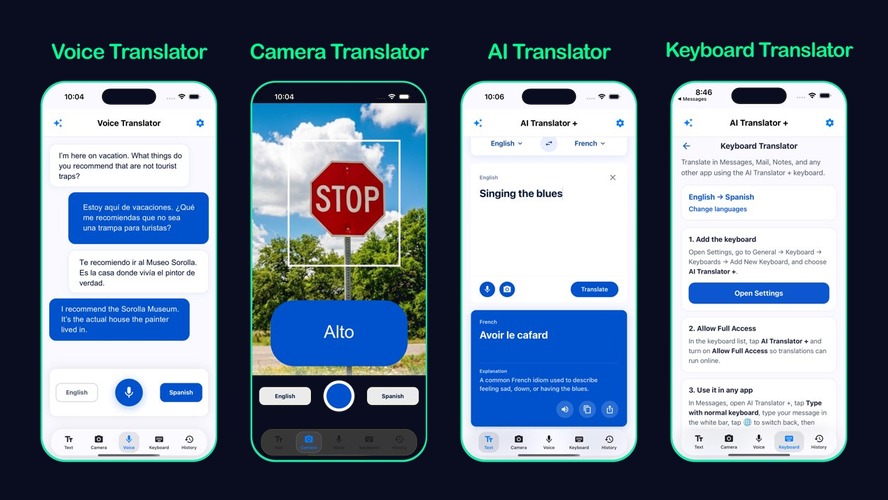
Translator AI is a newcomer in the translator space, but it comes from Vidalingua, one of the leading historical publishers of language apps. That pedigree matters. Instead of treating translation as a standalone utility, it uses artificial intelligence in new ways so the tool can sit beside the lesson apps you already use and fill gaps they leave open.
That complementary role is one reason it belongs high on this list. Duolingo, Busuu, LingoDeer, and similar apps build habits and teach patterns. They are weaker when you need a quick explanation of a weird sentence, a more natural phrasing for a message, or help reading a menu, sign, or chat in the wild. Translator AI is built for those moments. It is an AI-powered translator that can give additional guidance on top of lesson-based practice, without replacing your core course.
It is also the best choice on this list for tourists, travelers, and digital nomads who need to communicate in real time with locals. Voice and camera translation, a Travel tone, and offline packs matter more on the street, in a taxi, or at a coworking café than another streak reminder does.
Best as a companion to lesson apps — and for real-time travel
You can translate text in seconds by typing or pasting. The Voice Translator lets you speak naturally and hear the translation spoken back, which is useful for real-time conversations with hotel staff, drivers, shopkeepers, or new contacts abroad. Camera Translator points your phone at signs, menus, documents, or labels and translates what you see in real time. A custom keyboard works inside Messages, WhatsApp, email, and other apps so you can write in your language, translate, and send without switching screens.
Tone control is one of the clearer AI extensions. Casual and Formal are free; Premium unlocks options such as Flirty, Business, Travel, Modern Slang, and Academic so the output fits the situation instead of sounding like a dictionary dump. You can choose Gemini Light for fast everyday translations or Gemini Pro for deeper accuracy on complex text. Offline Translation downloads language models to the device for private use without a network — especially useful when roaming or Wi‑Fi is unreliable. Translation history saves past work for review, copy, or share later. The app supports over 47 languages and is free to download on iOS and Android, with text translation and explanations available free; Premium unlocks voice, camera, keyboard, advanced tones, Gemini Pro, and offline packs.
Lesson apps teach the path. Translator AI helps when you leave the path — in class review or face-to-face with locals — and need meaning, tone, or real-world text on demand.
- Best fit: Tourists, travelers, and digital nomads who need real-time communication with locals; learners pairing a course app with travel, messaging, or reading support; students who want explanations and tone control.
- Main weakness: It is a translator-first tool, not a full curriculum, so it works best alongside a lesson app rather than as your only study system.
- What to watch: Premium is required for several of the strongest features, including voice, camera, keyboard, advanced tones, and offline translation.
Choose Translator AI if you want the strongest free-list option for real-time local communication on the road, or an AI companion that extends lesson apps with smarter translation, tone, and multimodal help. Skip it as a sole learning path if you need structured courses, streaks, or graded drills from day one.
Download Translator AI for free from the App Store or Google Play.
3. Duolingo
Duolingo is the app almost everyone tries first, and that makes sense. The free tier is easy to start, the lessons are short, and the daily streak system does a good job of pulling casual learners back before a habit dies. If you want the lowest-friction entry point, Duolingo is still hard to ignore.
Its scale also explains why it keeps dominating conversations about free language learning apps. Duolingo reported 50.5 million daily active users in Q3 2025 and $1,037.6 million in FY 2025 revenue, which shows how large the freemium model has become in this category.
Best for beginners who need momentum
Duolingo works best when your biggest hurdle is showing up. The guided path removes a lot of decision fatigue. You don’t have to choose what to study next, and that’s useful for people who tend to overthink tools instead of studying.
The speaking and listening exercises help early learners hear common patterns, and many courses include Stories or similar reading-based features that break up the repetition. It’s polished, playful, and designed to get you moving quickly.
For readers weighing other options, this roundup of Duolingo alternatives is useful when the standard path starts feeling too restrictive.
- Best fit: Casual learners, total beginners, and anyone who benefits from reminders and streaks.
- Main weakness: The free plan’s hearts and ads can make long sessions feel choppy.
- What to watch: Depth varies a lot by language, so one course can feel far stronger than another.
The biggest criticism is familiar. Once you move beyond “I need a habit,” Duolingo can feel thin in grammar explanations or too stop-start if the free limitations interrupt your session. That doesn’t make it bad. It just means it’s often strongest as a launchpad rather than a complete long-term system.
4. Memrise

Memrise has always made the most sense for learners who care less about textbook sequencing and more about hearing useful phrases early. If your goal is to understand people in the wild, not just pass app exercises, Memrise is a strong pick.
Its style is practical rather than academic. Short native-speaker videos help you connect phrases to real pronunciation and rhythm. That can be more motivating than synthetic audio and isolated word lists.
Best for phrase-first learners
Memrise does a good job of making common expressions feel alive. That’s especially useful in the early stage, when many learners need fast exposure to listening before they build confidence. The app also includes AI speaking practice through MemBot, which gives you another way to rehearse output without immediately jumping into live conversation.
There’s also a strong memory angle here. If you like repeated exposure and quick recall drills, Memrise fits nicely alongside a broader spaced-repetition routine. PolyChat’s article on spaced repetition for language learning is a useful companion if you want to build a smarter review habit across apps.
Real listening input early on matters. An app that only teaches you to tap answers can leave you shocked when native speakers actually talk.
The trade-off is that Memrise can feel uneven if you expect one fully integrated system. Some advanced drills and parts of the catalog are paywalled, and pricing details on the web can be less transparent than they should be. Community-created lists are useful, but they can vary in quality and consistency.
Choose Memrise if your top priority is practical phrases, listening familiarity, and quick exposure to natural speech. Skip it as your only tool if you want a tightly structured course with deep grammar sequencing.
5. Busuu
Busuu is for the learner who wants a clearer syllabus and less game noise. If Duolingo feels too playful and scattered, Busuu often feels more grounded. The lessons are structured, the progression is easier to follow, and the CEFR-style framing gives many learners a stronger sense of direction.
That structure matters because lots of apps are good at getting users in the door but weaker at taking them from beginner confusion to organized progress. The freemium model dominates this market, capturing 67% of global market share in 2023, largely because free access lowers the barrier for hesitant first-time users. Busuu sits inside that same reality, but it presents itself more like a course than a game.
Best for learners who want a study plan
Busuu’s study plans, reminders, and lesson progression make it easier to build a routine around a goal. The native-speaker feedback feature is one of its best qualities because it nudges learners toward actual production, not just recognition. Writing and speaking correction from other users adds a human layer many solo apps miss.
- Strong point: Vocabulary, grammar, and production feel more balanced than in many highly gamified apps.
- Useful for: Learners who like course structure, milestone thinking, and feedback from people.
- Limitation: Some of the more valuable features, including richer grammar review and offline access, sit behind Premium.
Busuu isn’t the most exciting app on this list, and that’s part of the appeal. It’s steadier than flashy. If you want something that feels closer to a curriculum and less like a mobile game, it’s a smart choice.
6. LingoDeer

LingoDeer is one of the better options for learners who want clean explanations, manageable lesson chunks, and a stronger grammatical foundation from the start. It’s especially well known for Asian languages, where script learning and sentence structure can overwhelm beginners if the app moves too fast. You can explore it at LingoDeer’s website.
What I like about LingoDeer’s style is that it respects the fact that some learners want to understand why a sentence works, not just memorize the answer pattern. That makes it feel calmer and more methodical than some competitors.
Best for structured beginners
LingoDeer’s built-in reviews, test-outs, native audio, and script support make it useful when you’re learning a language that requires more scaffolding. The free alphabet content and starter material give you enough to test whether the teaching style suits you before committing further.
It isn’t the most social app, and that’s fine. This is more of a self-study tool than a community-first platform.
Some learners don’t need more motivation tricks. They need cleaner explanations and fewer distractions.
The catch is straightforward. Most course content requires Premium after the initial free units, so while it belongs in conversations about free language learning apps, it’s really best thought of as a generous sampler with a strong teaching style. If the starter lessons click for you, it may be worth keeping. If you need a larger free runway, other apps on this list will stretch farther.
7. Promova
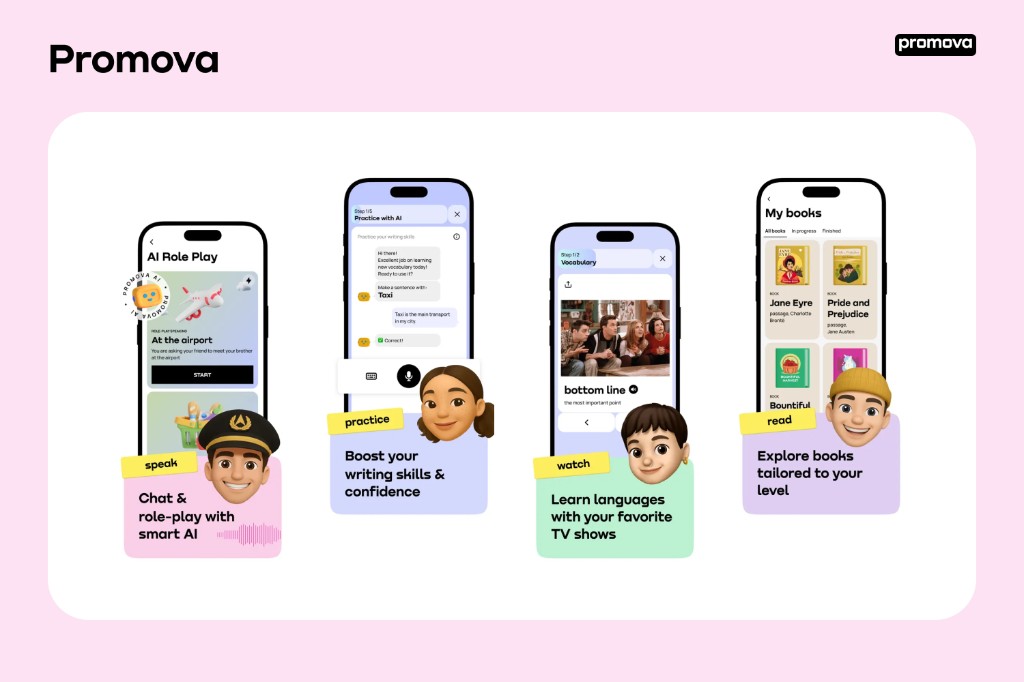
Promova is for the learner whose real problem is speaking — the one who understands far more than they can say and freezes the second a conversation starts. Instead of saving output for “later,” it’s built around one rule: you speak from your very first lesson. You can try it on Promova’s site or the iOS and Android apps.
Best for learners who want to actually talk early
Courses are written by linguists to cover vocabulary, grammar, reading, listening, and speaking, then paired with AI that removes the usual reasons people stall. A personalized daily plan decides what to study next, an AI Tutor gives text and voice feedback on your grammar and pronunciation, and AI role-play lets you rehearse real situations — a job interview, a doctor’s visit — before they happen for real. A CEFR-based speaking check shows where you actually stand.
It also covers a gap most roundups skip: accessibility. Promova was the first language platform to ship a Dyslexia mode (using a specialized typeface), later added a white-noise tool for learners with ADHD, and offers a free American Sign Language course. It runs 13 languages, including ones many apps ignore — Ukrainian, Arabic, Korean, Japanese, and Chinese.
If your streak keeps dying because tapping answers never turned into speaking, an app that makes you talk from lesson one is the more honest fix.
- Best fit: Learners who can read and understand but freeze when they have to speak.
- Main strength: AI role-play and pronunciation feedback that push real output early, plus the most inclusive setup on this list.
- Watch for: Full daily access needs Promova Premium, and the speaking features are strongest in the mobile app rather than on web.
On the free-versus-freemium split this list cares about: several courses and a set of web tools (a pronunciation checker, synonym finder, and more) are genuinely free and need no account, while full access sits behind Premium. But for learners who keep quitting because they can read yet can’t speak, it’s one of the most practical picks here.
8. Clozemaster

Clozemaster is not where I’d start as a complete beginner. It is where I’d go once the basics are in place and I need volume. You can use it through Clozemaster, and its core idea is simple: learn words in real sentence contexts through cloze exercises.
That makes it a good bridge between beginner app drills and actual reading. Instead of memorizing isolated vocabulary, you keep seeing words inside patterns, which is often where recall starts to stick.
Best as a companion, not a main course
Clozemaster shines when you already know enough to benefit from context. If you’re around late beginner or lower intermediate level, blasting through sentence-based review can improve reading speed and pattern recognition quickly. The spaced repetition options and custom review settings help, especially if you like tweaking how you study.
The downside is obvious as soon as you open it. The interface is functional rather than welcoming, and it doesn’t teach from zero in a hand-holding way. You won’t get the polished onboarding or game-like momentum of the biggest apps.
- Use it for: Context-rich vocabulary review after you know the basics.
- Don’t use it for: Your first exposure to grammar or sentence structure.
- Expect: A practical tool that values reps over polish.
Some listening features and more advanced review controls are part of the paid experience. Still, for learners who want more sentences and less fluff, Clozemaster remains one of the better supplements available.
9. LingQ

You finish a beginner lesson, then open a real article and still feel lost. LingQ is built for that stage. Instead of feeding you another closed set of scripted exercises, LingQ turns reading and listening materials into study material you can work through at your own pace.
That makes it a stronger fit for intermediate learners, or at least learners who already know the basics and want more exposure to real language. If your goal is to read more, listen more, and stop depending on hand-held lesson paths, LingQ has a clear use case.
Best for learners who want to build around real content
The core workflow is simple and useful. Read or listen to something interesting, save unfamiliar words or phrases, then review them later inside the same ecosystem. For learners who get bored with generic app content, that shift matters. It gives you more control over what you study, which usually makes it easier to stay consistent.
It also exposes one of the biggest free vs. freemium trade-offs in this category. LingQ gives enough access to understand the method, but many of the features that make the platform fully practical sit behind Premium, especially if you want higher import limits and a less restricted experience. That puts it in a different bucket from free apps built around daily caps, and it is one reason newer tools such as PolyChat are getting attention for pushing harder on practice access.
The drawback is obvious after a few sessions. LingQ asks you to choose content, manage your own difficulty, and tolerate a busier interface than simpler apps. Some learners find that freedom productive. Others open it, feel scattered, and go straight back to something more guided.
- Use it for: Reading and listening volume with vocabulary tracking built into the process.
- Don’t use it for: Your first steps in a language or a tightly structured grammar path.
- Expect: A flexible system that rewards self-direction, but feels limited on the free tier.
I recommend LingQ to learners who already know how they like to study and want an app that bends to that routine instead of dictating it. If you need structure, it can feel like work. If you want real input and control over your materials, it can be one of the more useful tools in the stack.
10. HelloTalk
You study for weeks, then open a chat with a native speaker and realize picking the right verb under pressure is very different from tapping the right answer in an app. HelloTalk is built for that moment. It puts you in contact with real people through text, voice notes, calls, public Moments posts, and live audio spaces.
That shift matters because HelloTalk trains a skill many apps avoid. Real-time communication is messy. People reply late, use slang, switch topics, and make your gaps obvious fast.
The app helps enough to make those early exchanges manageable. Built-in translation, pronunciation support, and correction tools lower the barrier, especially if you are still nervous about writing first. I have found voice notes to be the best starting point for learners who want speaking practice without the pressure of a live call.
Best for conversation exposure and cultural context
HelloTalk is strongest for learners who already have some base knowledge and need contact with how the language is used in practice. It is less about following a clean lesson path and more about getting used to unpredictable, human input. That makes it useful for travel prep, speaking confidence, informal writing, and picking up everyday phrasing that structured apps often miss.
The trade-off is quality control. Some conversations turn into consistent exchange. A lot do not. You will spend time filtering out dead-end chats, vague replies, and people who want social interaction more than language practice. That is normal on free exchange platforms, and it is one reason profile matching and practice limits matter so much when comparing free and freemium apps across this list.
HelloTalk also shows a different side of the free model. The free version is enough to test whether language exchange suits you, but some search, calling, and convenience features are tighter unless you pay. That puts it in a different category from guided apps, and it highlights why newer products like PolyChat are pushing on a separate pain point. Giving learners more consistent practice access without depending on partner availability.
Use HelloTalk if your main problem is hesitation with real people. Skip it as your only app if you still need grammar explanations, structured review, or a predictable study path.
11. Tandem
Tandem sits in the same broad category as HelloTalk, but it often feels more focused on one-to-one partner matching. Through Tandem, you can look for people based on goals and interests, then build ongoing chats and calls around that match.
That makes it better for learners who want continuity rather than lots of casual interaction. When you find the right partner, Tandem can become one of the most useful tools in your routine.
Best for sustained partner-based practice
The matching system is Tandem’s biggest advantage. If you want someone who cares about regular exchange instead of random social chatter, the app’s design supports that better than some alternatives. The interface is clean, and text, audio, and call features make it easier to build an ongoing rhythm.
Free language learning apps often over-optimize for quick engagement, not real conversation. Tandem is one of the better choices when your actual goal is to speak with another human regularly.
- Strong use case: Learners preparing for real conversations, interviews, travel, or relocation.
- Main frustration: You often need to message first, follow up, and filter for serious partners.
- Worth paying for if needed: Discovery filters can make partner search much more efficient.
The free version is useful, but some of the strongest search and translation tools are part of the Pro tier. As with all exchange apps, the app opens the door. You still have to walk through it.
Top 11 Free Language-Learning Apps Comparison
| Product | Core features ✨ | UX & Quality ★ | Price / Value 💰 | Ideal users 👥 | Standout / USP ✨ |
|---|---|---|---|---|---|
| 🏆 PolyChat | AI-enhanced practice, timed vocab, convo & translation games, market-leading conjugation tool, 17 languages, unlimited daily practice | ★★★★☆, gamified, progress tracking, bite-sized reinforcement | 💰 Freemium; subscription tiers (check app store) | 👥 Students, educators, polyglots, travelers, professionals | ✨ No energy limits; personal dictionary; AI reinforcement; best conjugation practice |
| Translator AI (Vidalingua) | Text, voice & camera translation, custom keyboard, tone control, Gemini Light/Pro, offline packs, 47+ languages | ★★★★☆, fast multimodal UI built for real-world use | 💰 Free text + explanations; Premium for voice, camera, keyboard, tones, offline | 👥 Tourists, travelers, digital nomads; learners pairing a course with on-the-go translation | ✨ Best for real-time local communication; strong companion to lesson apps |
| Duolingo | Guided path, bite-sized lessons, speaking/listening, Stories | ★★★★☆, extremely accessible, strong reminders & streaks | 💰 Free w/ ads & energy; Plus removes ads/limits | 👥 Casual beginners & daily practice users | ✨ Massive language catalog; low friction start |
| Memrise | Native-speaker video clips, AI speaking (MemBot), community decks | ★★★★☆, excellent early listening exposure | 💰 Freemium; some advanced features paywalled | 👥 Learners wanting real-life phrases & listening | ✨ 48k+ native clips; MemBot speaking tutor |
| Busuu | CEFR-aligned courses, goal study plans, native-speaker corrections | ★★★☆☆, structured, syllabus-driven | 💰 Freemium; Premium for grammar, offline & certificates | 👥 Goal-oriented learners & exam prep | ✨ Peer corrections and official-style certificates |
| LingoDeer | Curriculum-driven lessons, grammar explanations, script practice | ★★★★☆, clear scaffolding, neat UI | 💰 Freemium → Premium unlocks full courses | 👥 Structured beginners (esp. Asian languages) | ✨ Grammar-first lessons and script drills |
| Promova | AI Tutor, AI role-play, CEFR speaking check, daily plans, accessibility tools | ★★★★☆, speaking-first with structured courses | 💰 Freemium; Premium for full daily access | 👥 Learners who freeze when they have to speak | ✨ Speak from lesson one; Dyslexia mode & ASL course |
| Clozemaster | Cloze sentence drills, spaced repetition, audio practice | ★★★☆☆, utilitarian UI, focused practice | 💰 Free & Pro (advanced settings) | 👥 Intermediate+ learners needing sentence exposure | ✨ Massive corpus for contextual vocabulary |
| LingQ | Import real texts/audio, interactive reading, saved words (LingQs) | ★★★☆☆, content-first, highly customizable | 💰 Freemium; Premium for imports & higher limits | 👥 Intermediate learners consuming authentic content | ✨ Turn articles/podcasts/YouTube into lessons |
| HelloTalk | Text/voice exchange, in-chat translation & corrections, Voice Rooms | ★★★☆☆, social-first; partner quality varies | 💰 Free; VIP for extra features | 👥 Learners seeking real conversational practice | ✨ Real native chats with correction tools |
| Tandem | Partner matching, text/audio messaging, voice calls, Pro filters | ★★★☆☆, polished UI; match quality varies | 💰 Free; Pro for advanced filters/translations | 👥 Learners wanting targeted 1:1 practice | ✨ Goal-based partner matching for sustained practice |
Your Next Step to Fluency
It is easy to lose a week comparing apps, download three of them on a Sunday, then stop using all three by Wednesday. The problem usually is not motivation. It is a mismatch between the tool and the job.
Choose your next app based on the point where your routine breaks.
Learners who quit because lessons feel thin usually do better with Busuu or LingoDeer. Learners who need a quick win to keep showing up often stick longer with Duolingo or PolyChat. Learners who already know the basics and need more real language than beginner exercises can offer usually get more value from LingQ or Clozemaster. Learners who understand more than they can say often do better with Promova’s AI speaking practice before jumping to live partners. Learners who keep postponing speaking with real people need HelloTalk or Tandem. Learners who want smarter translation, tone control, or camera help alongside a course often pair any of those apps with Translator AI by Vidalingua. Tourists, travelers, and digital nomads who need to communicate in real time with locals will usually find Translator AI the best fit on this list.
The free versus freemium split matters here. Some apps give enough access for a real daily habit. Others let you sample the product, then slow you down with hearts, timers, lesson caps, or missing core features. That difference matters more than a polished app store page. A free app is only useful if it lets you practice often enough to improve.
That is also why comparison tables matter more than feature lists. Two apps can both claim speaking practice, vocabulary review, and daily lessons, while offering completely different amounts of useful time before limits kick in. Newer apps such as PolyChat stand out mainly on that practical point. Fewer usage caps means fewer interruptions, which can matter more than having one extra feature you rarely use.
For many learners, one app is not enough. Two is usually plenty.
Use one primary app to carry the routine, then add one support tool to cover a clear gap. A structured course plus a conversation app works well. A grammar-heavy app plus a faster vocabulary tool also works. If you’re pursuing A-Level German, a streak alone will not carry you very far. You need repeat exposure, explicit review, and practice that holds up under exam pressure.
A practical setup might look like this:
- Need structure first: Busuu or LingoDeer as the core, plus Promova when you want AI speaking practice on top.
- Need motivation first: Duolingo or PolyChat as the core, plus HelloTalk once you are ready to speak with other people.
- Need speaking confidence before live partners: Promova as the core, then HelloTalk or Tandem when you’re ready for real conversation.
- Need real-world input: LingQ or Clozemaster as the core, paired with any app that still covers weak spots in basics.
- Need more reps without getting blocked: PolyChat is a sensible option if usage limits are what usually break your streak.
- Need translation support beside lessons: Keep your main course app, then add Translator AI for text, voice, camera, tone, and on-the-go guidance.
- Need real-time talk with locals while traveling: Translator AI is the strongest choice here for tourists, travelers, and digital nomads.
Start smaller than you think. Test one main app for two weeks. Add a second tool only when you can name the exact problem it solves.
Judge the app on day fourteen, not day one. The right choice is the one you still open when your energy is low, your schedule is full, and the novelty is gone.
Fluency comes from repeatable practice. The app does not do the work for you, but the right one makes it easier to keep doing the work.
If you want a free app that keeps the fun parts of gamified learning without stopping practice early, try PolyChat. It offers structured lessons, AI-supported practice, translation and conversation games, conjugation drills, and unlimited daily practice without hearts or energy limits, which makes it a practical fit for learners trying to build a steady routine.

Jean-Baptiste Bolh
Co-Founder
Applied AI