Best Way to Learn a Language: An Evidence-Based Plan

Many individuals start with the wrong question. They ask for the best way to learn a language, as if one app, one course, or one method will grant fluency for everyone.
It doesn’t work like that.
A beginner who wants to survive a trip, a professional who needs meetings in German, and an expat building a life in Italy don’t need the same routine. They need a system that fits their time, their goals, and the stage they’re in. That matters more than chasing a miracle method. It also matters because the market is flooded with promises. The global language learning market was valued at $70.69 billion in 2022 and is projected to reach $187.69 billion by 2028, with 1.5 billion active learners worldwide, according to Kent State's overview of language learning trends and statistics. Demand is huge. Clear guidance is not.
The learners who last usually stop looking for magic and start building around a few reliable principles. They get a lot of understandable input. They review in a way that forces recall. They create immersion in small, repeatable ways. They use tools as parts of a routine, not as substitutes for one.
If you're learning for relocation, daily life matters as much as grammar. That’s why practical relocation-focused resources like Residaro's guide for Italian expats are useful. They connect language study to the situations you’ll face.
The strongest self-study setups also make room for guidance when motivation dips. A useful starting point is this breakdown of how to learn a language on your own, because solo learning works best when your routine is deliberate instead of improvised.
Ready to Learn a Language?
Try PolyChat's engaging language lessons, interactive learning games and put your new vocabulary to the test!
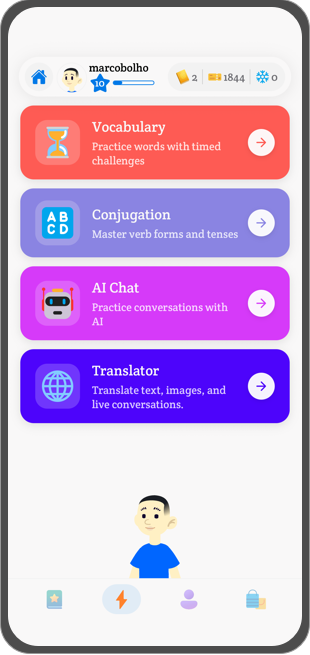
Games & Tools
Essential tools for every learner
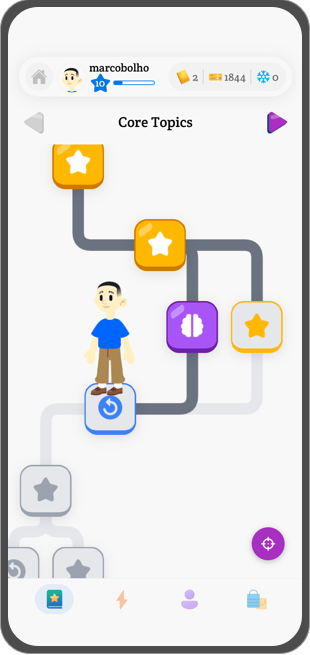
Thousands of Lessons
From beginner to fluent
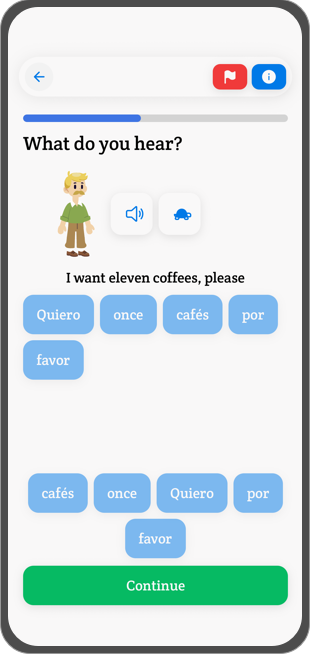
Interactive Exercises
Practice vocabulary & conjugation


Forget "The One Best Way" and Build a System That Works
The best way to learn a language is not a single technique. It’s a repeatable system built from methods that do different jobs well.
Some methods are good at helping you understand. Others are good at helping you remember. Others are good at forcing you to speak before you feel ready. If you rely on only one, you usually get a lopsided result. That’s why so many learners can read but freeze in conversation, or know grammar terms but can’t follow a podcast.
What a complete system needs
A practical system has three parts:
- Comprehensible input: You spend time with material you can mostly follow, so your brain keeps noticing how the language works in context.
- Active recall: You don’t just recognize words. You try to produce them from memory.
- Micro-immersion: You increase exposure outside formal study so the language stops feeling like a school subject.
That combination works because each piece solves a different problem. Input builds familiarity. Recall strengthens retrieval. Immersion increases total contact time without requiring a dramatic life change.
Practical rule: If your method only asks you to tap, match, and recognize, it’s incomplete.
What usually fails
Learners waste months on routines that feel productive but don’t transfer well.
A few common traps:
- Collecting resources: Downloading apps, bookmarking channels, and buying books feels like progress. It isn’t practice.
- Studying only rules: Grammar explanations can help, but they don’t replace contact with real sentences.
- Waiting to speak until you feel ready: Readiness usually comes after repeated low-stakes output, not before it.
- Doing too much on weekends: Long cram sessions are harder to sustain than daily contact.
The good news is that a better approach doesn’t have to be complicated. It has to be stable. A short, balanced daily routine beats a perfect plan you abandon after ten days.
Laying the Foundation Your First Month of Learning
The first month decides a lot. Not because you’ll become fluent in that time, but because you’ll either build momentum or prove to yourself that language learning feels chaotic.
Start smaller than your ego wants.
“Become fluent” is a weak first goal because it’s too vague and too distant. “Order lunch without switching to English,” “introduce myself clearly,” or “handle a three-minute conversation about work or travel” gives your study a direction. That kind of goal also tells you what vocabulary matters now.

Build around understandable language
The fastest start usually comes from comprehensible input. Research summarized in this explanation of comprehensible input and active immersion argues that progress comes from input that is just slightly above your current level, often described as i+1. The same source notes that the top 1,000 most frequent words cover about 75 to 80 percent of everyday communication.
That changes how you should study as a beginner.
You do not need rare vocabulary first. You need the words and patterns that show up constantly. Basic verbs. Common nouns. Daily questions. Connectors. Polite phrases. High-frequency language gives you return on effort because you’ll see it everywhere.
A simple first-month blueprint
Use your first month to do four things well:
-
Choose one concrete outcome Pick something visible and useful. Ordering food, checking into accommodation, introducing yourself, or handling simple messages all work.
-
Learn high-frequency words in context Don’t memorize isolated lists if you can avoid it. Learn words inside short phrases and example sentences.
-
Meet grammar through repeated exposure You don’t need to master every rule. You need to keep seeing the same structures often enough that they stop looking strange.
-
Protect daily continuity Missing a day won’t ruin you. Letting study become optional usually does.
What to focus on each week
A beginner month works better when each week has a job.
| Week | Main focus | What success looks like |
|---|---|---|
| Week 1 | Survival phrases and sound system | You can greet, thank, ask basic questions, and recognize common words |
| Week 2 | High-frequency vocabulary | You understand more repeated words in short dialogues |
| Week 3 | Core sentence patterns | You can build simple statements and questions |
| Week 4 | Controlled output | You can produce short, useful exchanges with less hesitation |
Don’t judge your progress by how “advanced” you feel. Judge it by whether basic tasks are getting easier.
The right attitude for month one
Beginners often make the same psychological mistake. They expect clarity before repetition has had time to work.
Language feels blurry at first because your brain is still sorting sounds, word boundaries, and common combinations. That’s normal. Keep the material understandable, keep it recurring, and keep your goal practical. The first month is not about proving talent. It’s about building a base you can stand on.
Crafting Your Daily Learning Routine A 60-Minute Power Hour
A good daily routine should do three things. It should expose you to new language, force you to recall old language, and make you produce something yourself.
That’s why a balanced hour works so well. It’s long enough to create momentum and short enough to repeat without turning your life into a study retreat.

The three-block structure
Split your hour into three blocks of 20 minutes each.
New input
This block feeds the system. Read a short lesson, listen to a beginner podcast, or work through a dialogue with audio. The material should be understandable enough that you can follow the gist, but not so easy that your attention switches off.
Use this block to notice recurring patterns:
- Repeated verbs: Watch which forms keep appearing.
- Common connectors: Words like “and,” “but,” “because,” and “then” carry more weight than learners think.
- Question structures: These become useful far earlier than many textbooks suggest.
If you’re using an app, structured lessons are beneficial. They can introduce vocabulary, sentence patterns, and listening in a controlled sequence rather than scattering your attention.
Reinforcement
This block is where memory gets sharpened.
Review yesterday’s phrases. Revisit words you half-know. Drill one grammar point that keeps showing up in your input. This is also the right place for conjugation work, because verb forms are easier to retain when you’ve recently seen them in actual sentences.
A short reinforcement block might include:
- Personal dictionary review: Go through saved words and phrases that came from real lessons.
- Conjugation drilling: Focus on one verb family or one tense at a time.
- Error correction: Rewrite sentences you got wrong yesterday.
Active output
This block turns knowledge into usable language.
Use speaking prompts, short writing tasks, or translation both ways. Don’t aim for elegance. Aim for retrieval. The struggle to produce a phrase is part of the learning.
Research summarized in this discussion of bidirectional translation argues that learners who practice Bidirectional Translation (BDT) for 20 minutes daily can build sentence-structuring confidence up to 4x faster than learners who rely only on grammar drills. That fits what many experienced learners notice in practice. Recognition feels good, but production changes your command of the language.
A daily hour with input, review, and output is more useful than a random three-hour binge once a week.
A sample 60-minute session
Here’s a practical version you can repeat:
| Time | Task | Why it matters |
|---|---|---|
| 20 min | Listen to or read level-appropriate material | Builds pattern recognition and comprehension |
| 20 min | Review vocabulary and drill one grammar feature | Strengthens retention and clears weak spots |
| 20 min | Speak, write, or do bidirectional translation | Converts passive knowledge into active use |
Where tools fit
Within this routine, app features become useful instead of distracting. A tool like PolyChat can fit inside this routine because it offers unlimited lessons, a conjugation tool, a translator, conversation practice, and a personal dictionary inside one workflow. Used well, that means you can do your input block with lessons, your reinforcement block with saved vocabulary and verb drills, and your output block with translation or conversation games without getting pulled into five separate apps.
The feature is not the method. The feature supports the method.
What to avoid in your power hour
A few habits reduce the value of the routine fast:
- Switching tasks every few minutes: Fragmented attention makes language feel harder than it is.
- Reviewing only what feels comfortable: Weak material needs more contact than familiar material.
- Treating speaking as optional: If output never enters your routine, understanding and speaking will drift apart.
- Chasing streaks over substance: Daily practice matters, but what you do in that time matters more.
If you only have one hour, make it balanced. That’s usually the best way to learn a language without burning out or fooling yourself.
From Passive Knowledge to Active Speaking
The most frustrating stage in language learning is not being a beginner. It’s understanding more than you can say.
You hear familiar words. You follow the general meaning. Then someone asks you a simple question and your mind goes blank. That gap is normal, but it does not close on its own. You have to train the jump from recognition to retrieval.
The advantage is bigger than many learners realize. The conversation-practice time paradox suggests that one hour of active conversation with corrections can be as effective as five hours in a classroom or ten hours of self-study, as discussed in Mark Manson's article on learning a foreign language. That doesn’t mean classes or self-study are useless. It means output has unusually high value once you’ve built some input.

Why passive knowledge stalls
Passive knowledge grows faster because recognition is easier than production. When you read or listen, the language comes to you. When you speak, you must search for vocabulary, choose a structure, inflect it correctly, pronounce it, and keep the conversation moving.
That’s a different skill stack.
Learners often misread this as failure. It isn’t failure. It’s a sign that your input has outpaced your output. The fix is not to stop consuming language. The fix is to add forms of output that are demanding enough to build recall but safe enough to repeat.
Three ways to activate what you already know
Shadowing
Shadowing is simple and demanding. You play native audio and repeat it in real time, trying to match rhythm, pronunciation, and phrasing.
This helps because it reduces hesitation. You’re not inventing language from scratch. You’re borrowing a ready-made sentence pattern and rehearsing the sound and timing of speech.
Use short clips. Repeat them several times. Focus on smoothness before perfection.
Structured conversation practice
Short speaking sessions beat occasional heroic efforts. A learner who does controlled speaking often will usually progress more steadily than one who waits for “real” conversation opportunities.
Good speaking practice has a few traits:
- Clear topic boundaries: Talk about food, work, travel, family, or routines.
- Correction built in: You need feedback, not just exposure.
- Low pressure: Anxiety blocks retrieval.
If you want a low-friction starting point, this guide to improving speaking skills offers useful ways to structure practice so you’re not just “trying to speak more” in a vague way.
Strategic translation
Translation gets a bad reputation when learners use it as a substitute for thinking in the language. Used carefully, it’s powerful.
The trick is to translate short, useful phrases, then reverse them later without looking. That forces you to notice missing words, unstable grammar, and the exact spots where your confidence breaks.
Speak before you feel fluent. Fluency grows from repeated retrieval under manageable pressure.
Use a translator without becoming dependent on it
A built-in translator can help during speaking practice if you use it with discipline.
Use it to look up one missing word or check one phrase so the conversation can continue. Don’t use it to generate full paragraphs you then read aloud. That turns practice into performance and hides the part your brain needs to train.
A good rule is simple. If the translator helps you keep momentum, it’s useful. If it replaces your own effort, it’s a crutch.
What active speaking should feel like
It should feel effortful, sometimes awkward, and often unfinished. That’s fine.
You are not trying to sound advanced during activation work. You are trying to make the language available faster. That’s why short bursts of repeated speaking work so well. They make common structures easier to retrieve under pressure, and that’s what real conversation demands.
Achieving Immersion Without Moving Abroad
“Just immerse yourself” is good advice in theory and lazy advice in practice.
Children in full immersion environments can reach near-native fluency, but most adults can’t recreate that setup. As Scott Young's discussion of immersion and adult time limits notes, a central problem is an immersion-intensity vs. time-availability mismatch. Adults need lots of exposure, but most only have small pockets of time. That’s why micro-immersion matters.

A commuter with twenty minutes on a train, a parent folding laundry, and a professional walking to lunch can all build immersion. Not dramatic immersion. Useful immersion.
What micro-immersion looks like in real life
A learner with a full-time job usually won’t disappear into the target language for hours at a stretch. But they can layer exposure into ordinary routines.
Try this mix:
- Phone language changes: Start with one device if a full switch feels annoying.
- Music rotation: Keep a playlist in the target language and learn choruses you enjoy.
- Commute listening: Use podcasts or short audio lessons even if you don’t catch everything.
- Familiar content: Rewatch a show you already know with target-language audio.
- Idle-time review: Use quick games or phrase review instead of mindless scrolling.
The power of this approach is cumulative. None of these moments feels decisive on its own. Together, they increase the number of times your brain meets the language in a normal day.
A practical weekly pattern
One way to think about immersion is by context, not by study session.
| Situation | Micro-immersion move |
|---|---|
| Morning routine | Listen to a short audio clip while getting ready |
| Commute or walk | Play target-language podcasts or music |
| Lunch break | Review saved phrases or one short lesson |
| Evening downtime | Watch familiar media in the target language |
| Waiting moments | Do quick vocabulary or translation practice |
This kind of exposure is especially useful because it lowers the emotional barrier. You’re not always “studying.” You’re letting the language become normal.
Here’s a useful video if you want another perspective on making daily exposure practical:
What immersion is not
Immersion is not background noise you ignore.
If audio is always playing and you never engage with it, the effect drops. Passive exposure still has value, but some attention has to be present. Even brief attention counts. Catching one recurring phrase, noticing one pronunciation feature, or recognizing one sentence pattern keeps the input alive.
The goal isn’t to recreate life abroad. The goal is to stop limiting your target language to a single study slot.
Why unlimited access matters
One practical obstacle in app-based learning is artificial restriction. When an app tells you to stop after a few mistakes or locks practice behind a limit, it fights the exact behavior immersion needs. Micro-immersion works best when you can dip in often, leave, and return without friction.
That matters more than many learners think. Immersion for adults is usually built from repetition in scraps of time, not from ideal conditions.
Tracking Progress and Breaking Through Plateaus
Language learning rarely feels linear. Early progress is obvious. Later progress gets quieter.
That’s when many learners make bad decisions. They assume they’ve stopped improving, switch methods too quickly, or keep repeating the same easy material because it feels safe. Plateaus aren’t always a sign that your system is broken. Often they’re a sign that your brain has adapted to the patterns you keep feeding it.
Research on statistical learning in language acquisition helps explain why. The brain learns language by tracking how often words and grammatical patterns appear together. When your input becomes too repetitive, progress can stall. New and varied material forces your brain to notice fresh patterns, which is why variety often helps break a slump.
Track what matters
A streak is not useless, but it’s weak as a primary metric. Streaks measure attendance. They don’t tell you what’s improving.
Better signals include:
- Personal dictionary growth: Are you saving useful words and phrases you can now recognize or use?
- Conjugation accuracy: Which verb forms still fail under pressure?
- Speaking friction: Which topics make you hesitate?
- Comprehension range: Can you handle only one type of content, or several?
- Error patterns: Do the same mistakes keep repeating?
If you like structured review, it helps to understand how memory spacing works in practice. This guide to spaced repetition in language learning is useful because it focuses on review as a system rather than a pile of flashcards.
Diagnose the plateau before changing everything
Different plateaus have different causes.
Plateau type one: everything feels too familiar
You understand your usual podcast or lesson style, but a new speaker or topic knocks you off balance.
That usually means your input is too narrow. Add novelty. Change topic, accent, format, or medium. Keep the level manageable, but widen the field.
Plateau type two: you understand but can’t produce
Your reading and listening are decent, but speech remains slow and fragile.
That points to an output shortage. Add more shadowing, short speaking sessions, and bidirectional translation. Don’t wait for spontaneous fluency to appear.
Plateau type three: grammar collapses in real use
You “know” the rule when studying, but lose it when writing or speaking.
That means the pattern hasn’t been stabilized through repetition in context. Pick one weak point for a focused week. One tense. One pronoun set. One question form. Use it repeatedly in sentences you care about.
A reset method that usually works
When progress feels flat, simplify and vary at the same time.
Try this for a week:
-
Keep one familiar daily habit Maintain your core lesson or listening routine so the system doesn’t collapse.
-
Add one new content stream New topic, new voice, new format.
-
Choose one weakness Don’t fix everything. Target one recurring problem.
-
Increase active use Speak, write, or translate daily, even briefly.
-
Review your own errors Your mistakes are more valuable than random exercises.
Plateaus usually break when you change the input, tighten the focus, or increase output. Usually you need at least one of the three.
The longer view
Advanced progress is harder to feel because gains get more subtle. You stop measuring by “Can I understand anything?” and start measuring by “How quickly can I follow, respond, and adapt?”
That’s still progress. It’s just less dramatic.
The best way to learn a language over the long term is to treat progress as something you can observe, not something you wait to feel. Track what you can do. Notice where retrieval breaks. Change the material when it gets stale. Then keep going.
If you want one place to run that kind of routine, PolyChat is built around the pieces that matter in daily practice: structured lessons, conversation and translation exercises, conjugation training, a personal dictionary, progress tracking, and unlimited use without hearts or energy limits. That makes it a practical option for learners who want one tool that supports input, review, and output inside the same habit.

Jean-Baptiste Bolh
Co-Founder
Applied AI