How to Improve Language Skills with Daily Steps
To really get anywhere with a new language, you have to start with a solid foundation. This means taking a moment to figure out where you are right now, deciding where you want to go, and—most importantly—understanding why you want to get there. Skipping this step is like trying to build a house without a blueprint; you might get a wall or two up, but it won't be long before things start to wobble.
Ready to Learn a Language?
Try PolyChat's engaging language lessons, interactive learning games and put your new vocabulary to the test!
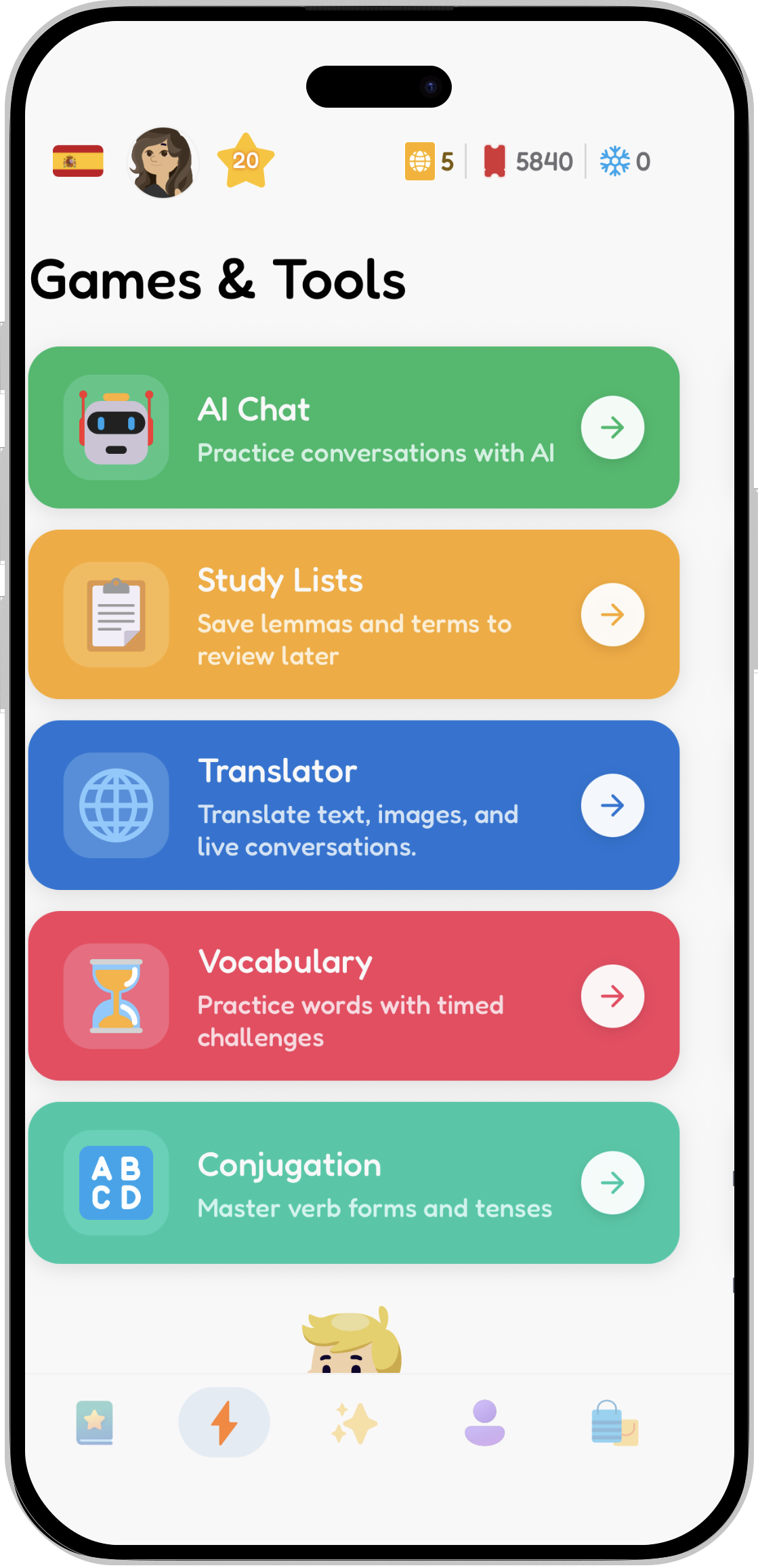
Games & Tools
Tools that every language learner needs at all stages of their learning journey.
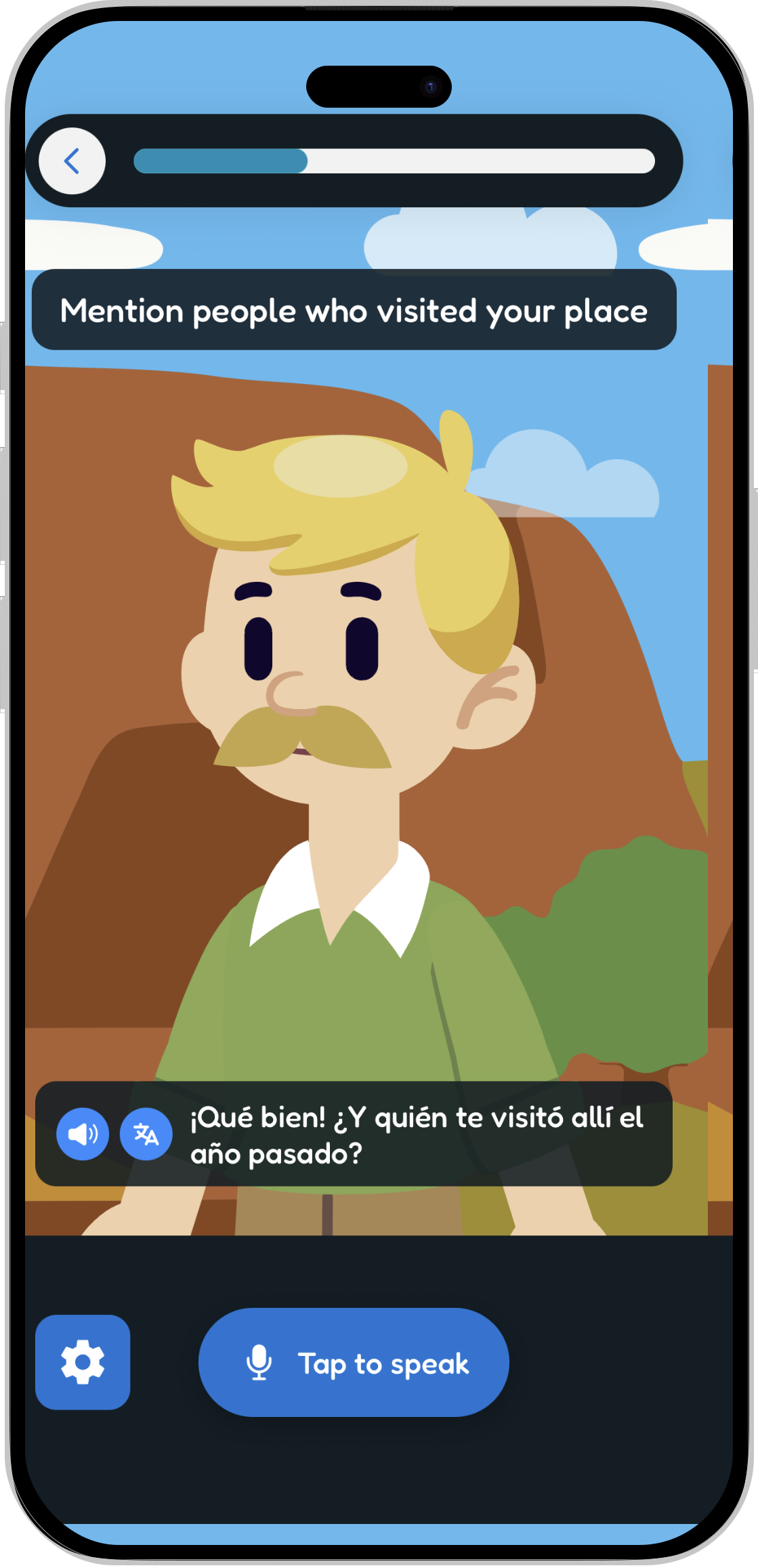
AI Chat Tutor
Practice real conversations with an AI tutor that helps you speak with confidence.
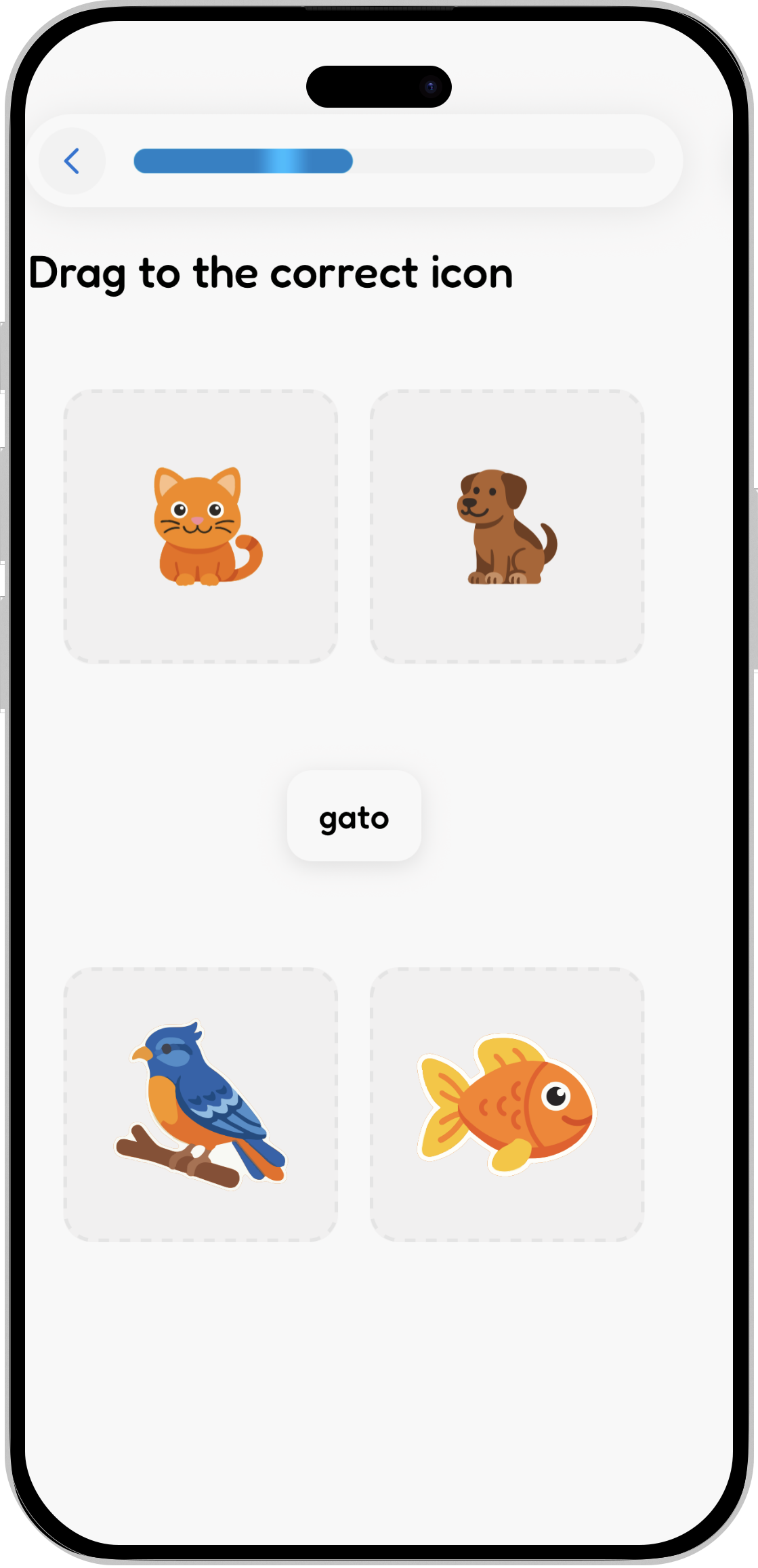
Interactive Games
A variety of games to help you learn and remember new words and phrases.


Laying Your Foundation for Language Mastery
Jumping into a new language is exciting. That initial burst of motivation is fantastic, but it won't last forever without a real plan. The secret to sticking with it long-term isn’t about plowing through lessons on day one; it's about building a smart, personal strategy from the ground up.
This means getting honest about your current abilities, defining what "fluent" actually looks like for you, and locking in the reason this goal matters so much. This process turns a vague wish like "I want to learn French" into a clear, actionable mission.
Assess Your Current Skill Level
Before you can chart a course, you need to know your starting point. It’s a classic mistake: learners either think they know more than they do and get overwhelmed, or they underestimate themselves and waste time on things they've already mastered. A quick, honest self-check helps you pick the right learning materials from the get-go.
Think about your skills across the four core areas:
- Listening: Can you pick out a few words in a song, or can you follow the plot of a TV show without subtitles?
- Speaking: Are you stringing together basic phrases, or can you talk about your day, even if you have to search for words?
- Reading: Can you understand a restaurant menu, or can you get the gist of a news article?
- Writing: Can you write a simple "thank you" email, or could you post a comment on social media without a translator?
This isn't a test—it's just a snapshot. It gives you a baseline so you can actually see and celebrate your progress down the line. To get a head start, you could even use an AI agent for creating personalized learning materials to generate some exercises that match your specific level.
Define Your "Why" and Set Meaningful Goals
Motivation is the engine of language learning. Vague goals like "get better at Spanish" are useless because they don't inspire action. You need to connect your learning to something that genuinely matters to you. Is it about chatting with your grandparents in their native tongue? Getting a promotion at work? Or just feeling confident enough to order coffee on your next trip?
Your "why" is your anchor. When you're struggling with a tricky grammar rule or just don't feel like practicing, remembering your core reason for starting is what will keep you in the game.
Once you know your "why," you can set SMART goals—that is, goals that are Specific, Measurable, Achievable, Relevant, and Time-bound.
- Instead of: "I want to learn German."
- Try: "In 3 months, I will be able to have a 5-minute conversation in German about my hobbies and family with a native speaker on a language exchange app."
See the difference? That second one gives you a clear target and a deadline. It's something you can actually work toward.
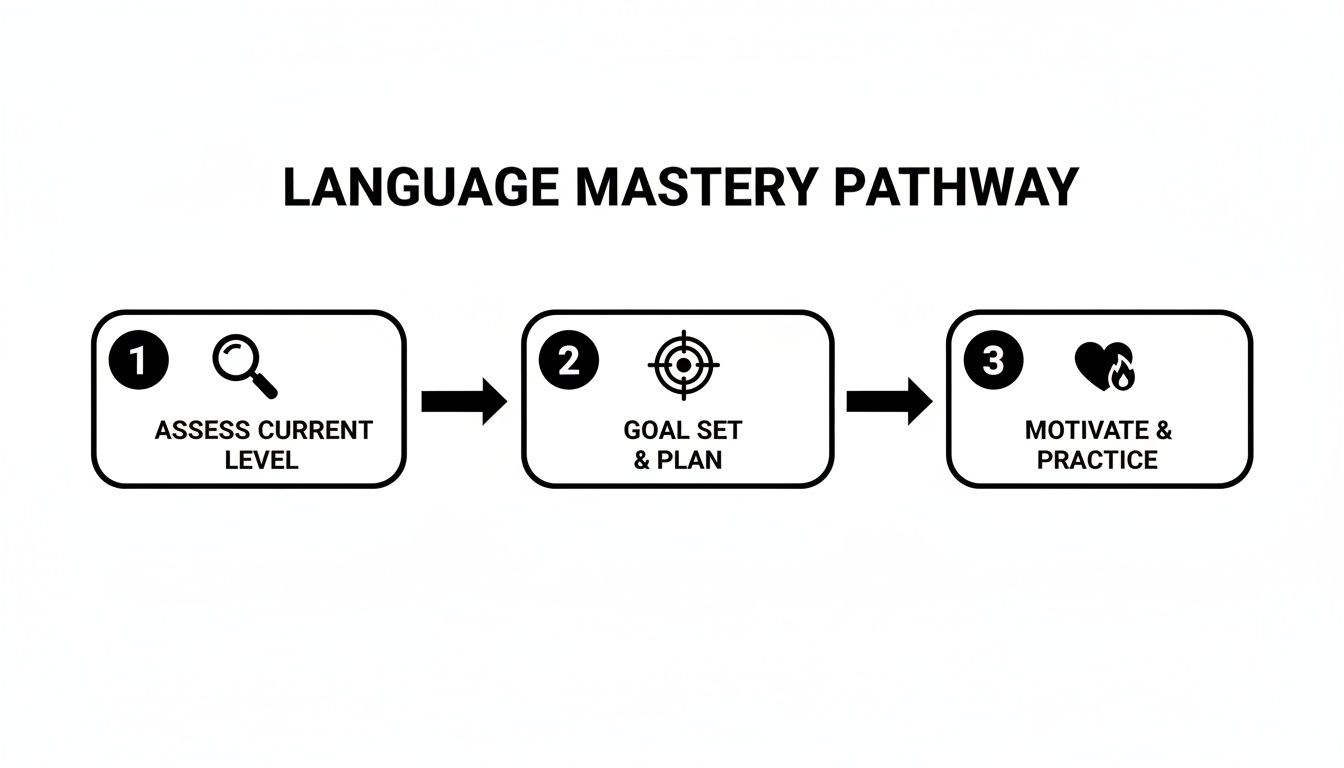
This simple pathway—assess, set goals, then practice—is incredibly powerful. It all starts with that initial self-awareness and a strong "why."
And this isn't just a feeling; the data backs it up. Studies show that learners with clear career or family-related goals log 30–50% more weekly study time than those just learning for fun. A powerful motivator leads directly to more consistent practice and, ultimately, faster results.
Your Personal Language Learning Framework
Ready to map out your own journey? Use this simple table to get your thoughts down on paper. It will help you move from vague ideas to a concrete plan for the next 3 to 6 months.
| Skill Area (Listening/Speaking/Reading/Writing) | Current Level (Beginner/Intermediate/Advanced) | 3-Month SMART Goal | 6-Month SMART Goal |
|---|---|---|---|
| Listening | e.g., Beginner | e.g., Understand the main points of a 5-minute podcast for learners. | e.g., Follow a 15-minute conversation between native speakers on a familiar topic. |
| Speaking | e.g., Beginner | e.g., Hold a basic 5-minute conversation about my daily routine. | e.g., Describe my job and hobbies in detail for several minutes without major pauses. |
| Reading | e.g., Intermediate | e.g., Read a short news article and summarize it in my own words. | e.g., Read a short story or a chapter of a young adult book with minimal dictionary use. |
| Writing | e.g., Beginner | e.g., Write a 50-word journal entry each day with correct basic grammar. | e.g., Write a 150-word email to a friend describing my weekend plans. |
Filling this out takes just a few minutes, but it provides the clarity you need to make every study session count. Don't skip it
Building a Daily Learning Habit That Actually Sticks
Knowing where you want to go is great, but the real journey is what you do every single day. The thought of "studying every day" often brings on a wave of dread. It sounds like another chore, another major time commitment you just don't have.
But here’s the secret: real, lasting progress doesn’t come from cramming for hours on a Sunday afternoon. It comes from tiny, consistent actions that slot so neatly into your life you barely notice them.
The key is to ditch the "all or nothing" mentality. You don't need a spare hour to make a difference. It’s all about finding those little pockets of "dead time" in your day and putting them to work. This is where micro-habits change the game.
A micro-habit is an action so small, so laughably easy, that it’s harder to skip it than to just do it. We're not talking about finding motivation; we're talking about making the first step too tiny to fail.
The Power of Micro-Habits and Habit Stacking
Think about your day so far. You've already performed dozens of actions on autopilot—making coffee, scrolling your phone while you wait, brushing your teeth. Habit stacking is simply attaching your new, tiny language habit to one of these existing routines.
This simple trick makes your new habit feel automatic. Instead of relying on willpower, which is always in short supply, you're letting your current schedule do all the heavy lifting.
Here's what this looks like in the real world:
- While your coffee brews: Don't just stand there. Fire up PolyChat and knock out one quick vocabulary game. That's a 3-minute burst of active learning before your day has even truly started.
- During your commute: Instead of mindlessly scrolling Instagram, pop in your headphones and listen to a 10-minute podcast in your target language.
- While you're waiting in line: That's a perfect 2-minute window to review a few digital flashcards or complete a single translation exercise.
- Right before you crash on the couch to watch TV: Grab a notebook and write just one sentence in your target language about your day. That’s it.
These actions feel insignificant in the moment, but their cumulative effect is huge. A consistent 10 minutes a day adds up to over 60 hours of focused practice in a year.
The secret to consistency isn't finding more time—it's hijacking the time you already have. Make starting so easy that skipping feels like more effort.
This approach shifts language learning from a scheduled, often-dreaded event into something that's just a part of your life, which is the only way to make it stick for the long haul.
Sample Schedules for Your Lifestyle
How you weave these micro-habits into your day depends entirely on your life. A student’s routine won't work for a corporate professional, and a stay-at-home parent has a completely different rhythm. The only goal is to create a plan that's so realistic you can't fail.
Here are a couple of starting points to get your ideas flowing:
For the 9-to-5 Professional
| Time of Day | Micro-Habit (15-20 mins total) | Example Action |
|---|---|---|
| Morning | 5 mins during your first coffee | Complete a timed vocabulary challenge on PolyChat. |
| Lunch | 10 mins while you eat | Read a short news article or blog post in your target language. |
| Evening | 5 mins right before you relax | Write one or two sentences in a journal summarizing your workday. |
For the University Student
| Time of Day | Micro-Habit (20-25 mins total) | Example Action |
|---|---|---|
| Morning | 10 mins on the bus to class | Listen to a language learning podcast or music. |
| Afternoon | 10 mins in that awkward gap between classes | Review a specific grammar rule or practice conjugations with an app. |
| Evening | 5 mins before you open your textbooks | Speak out loud, describing your study plans for the night. |
These are just templates. The best routine is the one you build for yourself. Try tracking your time for just one day to spot those empty moments—waiting for a meeting to start, standing in a queue, during commercial breaks. Those are your golden opportunities.
By consistently linking these tiny actions to your established routines, you build a powerful, automatic system for language improvement that works with your life, not against it.
Mastering Vocabulary and Grammar the Smart Way
Let's be honest. Trying to brute-force vocabulary by memorizing endless lists is a surefire way to get frustrated and quit. It’s just not how our brains are wired to learn.
The good news is that modern learning science points to a much smarter path, one that works with your brain's natural ability to remember things. It all boils down to two incredibly powerful techniques: spaced repetition and active recall.
Forget those painful, last-minute cram sessions. The real secret to locking information into your long-term memory is to review it at strategic, ever-increasing intervals. That’s the simple but brilliant idea behind spaced repetition.

Think of it as a perfectly timed interruption. Just as a new word or grammar rule is about to slip from your memory, you bring it back. This sends a powerful signal to your brain: "Hey, this is important!" Each time you do this, the neural pathway gets stronger, making the information much harder to forget in the future.
Why Spaced Repetition Crushes Cramming
Imagine you're building a brick wall. Cramming is like stacking all the bricks at once without letting the mortar dry between layers. The whole thing is unstable and will crumble in no time.
Spaced repetition is the professional approach. You lay one row of bricks, let the mortar set, and then add the next. The result is a solid, durable structure that stands the test of time.
This isn't just a neat analogy; the data backs it up. Study after study shows that spaced repetition and retrieval practice massively boost retention. Controlled experiments have found that spaced practice can double or triple long-term retention compared to cramming. Some studies even report retention jumping by 20–50 percentage points on delayed tests.
Thankfully, you don't need a complicated spreadsheet to manage this. Modern apps like PolyChat have this science baked right in. Their algorithms automatically schedule words for review at the perfect moment, focusing your effort where it's needed most.
From Knowing a Word to Using a Word
The second piece of this puzzle is active recall. This is the game-changer.
Active recall means pulling information out of your memory, not just passively looking at it. Reading a word and its definition is passive. Seeing a definition and having to produce the word yourself? That's active.
This mental effort is what forges strong memories. It’s the difference between recognizing someone's face in a photo and being able to recall their name when you bump into them on the street.
Active recall is the mental workout that builds memory muscle. It forces your brain to create and strengthen the connections needed to access information on demand—exactly what you need in a real conversation.
This is how you bridge that frustrating gap between understanding a word when you read it and being able to use it fluently when you speak. For more on this, check out our guide on how to learn vocabulary fast and effectively.
Practical Ways to Flex Your Recall Muscle
Weaving active recall into your daily routine is easier than you think. The goal is to constantly create low-stakes situations where you have to produce the language from scratch.
Here are a few of my favorite techniques:
- Hit the Quick-Fire Drills: Use an app's gamified challenges to put yourself on the spot. Timed vocabulary games, like those in PolyChat, force you to recall words under pressure, which is fantastic practice for thinking on your feet in a real conversation.
- Do It in Reverse: Try translating sentences from your native language into your target language. Don't let yourself peek at the answers! This forces you to actively search your mental database for both words and grammar rules.
- Narrate Your Life: This one is simple but so effective. As you go about your day—making coffee, walking the dog, cooking dinner—describe what you're doing out loud in your target language. It's a constant, powerful form of active recall.
By combining the smart timing of spaced repetition with the memory-building power of active recall, you create a learning system that's incredibly efficient. This is how you stop studying harder and start studying smarter.
Putting Your Language Skills Into Practice
Alright, let's talk about the big leap. You've been drilling grammar rules and memorizing vocabulary lists. That’s the foundation, but it's not the house. The real magic happens when you stop studying a language and start using it. This is where you transform all that passive knowledge into a dynamic, real-world skill that lets you actually communicate.
It’s completely normal to feel a bit shaky at first. The fear of sounding clumsy or making a mistake holds a lot of people back. But the goal isn’t perfection; it’s connection. Every single attempt to speak, listen, read, or write is a small win that moves you closer to fluency.
Here, we'll break down practical, enjoyable ways to practice the four core skills. Forget boring textbook exercises—this is about immersing yourself in the language and genuinely connecting with it.
Activate Your Speaking and Listening Skills
For most learners, speaking is the scariest part. That internal critic whispering, "You're going to say it wrong!" can be seriously loud. But here’s the thing: speaking and listening are two sides of the same coin. The more you listen, the more your brain absorbs the natural rhythms and sounds, making it infinitely easier to speak.
The first step is to create a judgment-free zone for yourself. This is where AI conversation partners, like the ones in apps like PolyChat, are absolute game-changers. You can practice pronunciation and test-drive new phrases without any of the pressure or self-consciousness that comes with talking to a real person. Think of it as your personal sandbox for building confidence.
Your goal is effective communication, not flawless perfection. Every mistake you make while speaking is just a signpost pointing you toward what to practice next. Embrace them.
Once you’ve built a little momentum, it’s time to start tuning your ear.
- Active Listening with Podcasts: Find a podcast for learners in your target language. Listen to a short segment once, just trying to get the gist. Then, listen again while reading the transcript to see what you missed. It’s a powerful way to connect the spoken sound to the written word.
- Watch TV Strategically: Fire up a movie or TV show you’ve already seen, but switch the audio to your target language. Since you already know the plot, your brain can relax and focus entirely on the dialogue.
- Imitate and Shadow: Don't just be a passive listener. When you hear a phrase you like, pause the audio and repeat it out loud. Try to mimic the speaker's intonation and rhythm. This technique, known as shadowing, is brilliant for building the muscle memory needed for speaking.
These simple habits train your brain to recognize patterns, making it easier to both understand what you hear and produce the language yourself. For an even deeper dive, check out our guide on practical ways to improve speaking skills for more specific tips.
Make Reading and Writing a Daily Habit
Reading and writing are your secret weapons for vocabulary growth and solidifying grammar. Unlike a fast-paced conversation, they let you slow down, look things up, and really observe how the language is put together.
The key to a consistent reading habit is finding stuff you actually want to read. If you're a foodie, find cooking blogs. If you're a sports fan, read sports news. When your practice feels like a reward instead of a chore, you'll absorb a massive amount of vocabulary without even trying.
Writing works the same way. It's not about composing a prize-winning essay. It's about producing a little bit of the language, consistently.
| Practice Method | Description | Daily Goal |
|---|---|---|
| Simple Journaling | Write about your day, your thoughts, or your plans. Don't worry about perfection; just get the words out. | Write just one new sentence a day. |
| Social Media Snippets | Find an influencer or page in your target language and write a short, simple comment on one of their posts. | Write one comment every other day. |
| Guided Writing | Use a prompt, like describing a picture or summarizing a short text you just read. This gives you a clear focus. | Complete one 5-minute prompt twice a week. |
Think of writing as speaking with an "undo" button. It gives you the space to think, check a dictionary, or double-check a grammar rule. This deliberate practice reinforces what you've learned and makes you much more prepared for those spontaneous, real-life conversations down the road.
Using AI and Gamification to Learn Faster
Let’s be honest: technology has completely changed the game for language learners. What used to be a chore filled with dusty textbooks and repetitive drills can now be an engaging, interactive, and genuinely fun experience. Modern tools are here to help you learn smarter, not just harder.
The days of one-size-fits-all lessons are pretty much over. Now, it's all about clever, data-driven platforms that adapt to you personally, keeping you hooked day after day.
How AI Creates a Learning Path Just for You
Artificial intelligence is the secret sauce behind today’s most effective language apps. These AI-powered platforms can watch how you're doing in real-time, pinpoint exactly where you’re struggling, and then serve up the perfect exercises to help you get better. This means the learning path becomes uniquely yours.
Instead of being stuck in a rigid curriculum, the app moves with you. If you’re tripping over a specific verb tense, the AI will keep giving you practice on that point until it clicks. On the other hand, if you're blazing through vocabulary, it’ll introduce new words faster to keep you on your toes.
To get the most out of these tools, it helps to understand a little bit about natural language processing. This is the core science that lets machines understand and talk back to us, powering everything from smart translators to the AI conversation partners you can practice with. We dive much deeper into this in our full guide on how AI is transforming language learning.
The Psychology Behind Gamification
Ever wonder why it's so easy to get sucked into a game for hours? That same addictive quality can be used to make learning a language feel less like work and more like play. That’s the magic of gamification.
Gamification simply means applying game-like elements—think points, leaderboards, and progress bars—to something that isn't a game. These features tap directly into our brain's reward system, giving us little hits of dopamine that make us feel accomplished and hungry for more.
This isn’t just about making learning "fun." It’s a proven method for boosting your engagement and helping you remember things long-term.
Timed challenges, achievement badges, and daily streaks create a powerful feedback loop. They give you instant, tangible proof of your progress, which is one of the strongest motivators to keep you coming back every single day.
Apps like PolyChat have evolved this idea by ditching frustrating limits like hearts or energy systems. This puts you in control, letting you practice as much as you want, whenever you want. You can turn that burst of motivation into real progress without ever hitting an artificial paywall.
This approach is exploding in popularity. The global language-learning market was valued at around USD 68.87 billion in 2024 and is expected to hit USD 188.70 billion by 2030. That massive growth is driving constant innovation, which is great news for learners looking for smarter, more flexible tools.
A Look at Modern vs Traditional Learning
With so many apps out there, you need to find tools that actually fit your goals and learning style. A great app should feel like a versatile workout partner, not a rigid drill sergeant. Here's a quick comparison of how new tech stacks up against old-school methods.
| Learning Aspect | Traditional Method | Modern Tool (e.g., PolyChat) |
|---|---|---|
| Feedback | Delayed correction from a teacher or textbook answer key. | Instant, personalized feedback on pronunciation and grammar. |
| Practice | Repetitive, one-size-fits-all drills from a workbook. | Adaptive, gamified challenges that focus on your specific weak points. |
| Speaking | High-pressure classroom practice or finding a language partner. | Judgment-free conversation practice with an AI tutor, available 24/7. |
| Motivation | Relies entirely on self-discipline and long-term goals. | Uses daily streaks, leaderboards, and progress bars for short-term motivation. |
The best way to make this work is to integrate these tools into the micro-habits we talked about earlier. Use a five-minute game to warm up your brain while your coffee brews. Chat with an AI tutor during your commute. By weaving these powerful apps into your daily routine, you can seriously accelerate your language skills.
Common Language Learning Questions Answered
As you get deeper into your language journey, you’re bound to hit a few roadblocks or wonder if you’re doing things right. That's totally normal. Getting clear on the common questions can save you a ton of time and keep you from getting discouraged.
Let's tackle some of the biggest questions learners ask. The answers here are all about giving you practical, no-nonsense advice to help you fine-tune your strategy and keep that motivation high.
So, How Long Does It Really Take to Get Fluent?
This is the big one, isn't it? The honest answer is that "fluency" is a moving target, not a finish line. It’s way more useful to think about hitting specific levels of skill.
The time it takes boils down to a few key things: the language itself, your study methods, and how much time you can realistically put in each day. For a frame of reference, the Foreign Service Institute (FSI) estimates it takes an English speaker around 600 classroom hours to get to a professional level in a language like Spanish or French.
But for a language that's structurally very different, like Japanese or Mandarin, that number skyrockets to over 2200 hours.
Forget chasing the fuzzy idea of "fluency." Your goal should be hitting tangible milestones, like reaching B1 (intermediate) or B2 (upper-intermediate) on the Common European Framework of Reference (CEFR) scale.
If you can manage a solid 30-60 minutes of daily practice using smart methods like spaced repetition and active conversation, you could realistically hit a conversational B1 level in a "Category I" language like Spanish in about 9-12 months.
What's the Single Best Way to Learn a Language?
Everyone is looking for that one magic trick, but the truth is, it doesn't exist. The most powerful approach is always a balanced mix of proven techniques.
But if I had to pick one single guiding principle, it would be consistent, active engagement. You have to do something with the language every single day, even if it's just for a few minutes. The key word here is active—you need to be producing language or trying to recall information, not just passively listening to a playlist.
A killer strategy combines these two things:
- Active Recall: Using tools like PolyChat’s gamified drills forces you to pull words and grammar rules from your memory, which is how you build strong recall.
- Real-World Use: Actually speaking with a tutor, writing a quick journal entry, or trying to order your coffee in the language.
Consistency will always crush cramming. Fifteen focused minutes every single day is infinitely more valuable than a two-hour panic session once a week.
How Do I Get Over My Fear of Speaking?
This is probably the biggest hurdle for most learners, but it's 100% beatable if you take it step-by-step. The trick is to start small in low-pressure situations to build up your confidence.
-
Talk to yourself. I know it sounds weird, but it's an incredible, zero-pressure technique. Just narrate what you're doing throughout the day—making breakfast, getting dressed, walking the dog—out loud in your target language.
-
Use an AI conversation partner. Apps like PolyChat provide a completely judgment-free zone to practice your pronunciation and string sentences together. An AI won't get impatient, and you can make all the mistakes you want without feeling embarrassed.
-
Find a patient human. Look for a language exchange partner or a tutor and tell them upfront that you're nervous. Ask them to be gentle with corrections. Remember, every mistake is just a signpost showing you exactly what you need to work on next.
Is It a Good Idea to Learn Two Languages at Once?
You absolutely can, but you need a smart plan to avoid getting your wires crossed and burning out. My strong recommendation for most beginners is to get to a solid intermediate level (B1) in one language before you even think about starting a second one. This gives you a strong foundation and helps prevent the grammar and vocabulary of the two languages from clashing in your brain.
If you’re determined to learn two at once, try picking languages that are very different from each other. For example, learning Spanish and Japanese at the same time is usually much easier than learning Spanish and Italian, where the similarities can actually cause more confusion.
Be sure to set aside specific days or times for each language to keep them mentally separate. Using an app like PolyChat, which lets you track multiple languages, is a massive help in staying organized.
Ready to put these ideas into practice and speed up your progress? PolyChat gives you a complete toolkit—from AI chat practice to fun vocabulary drills—all designed to make your daily learning stick.

Jean-Baptiste Bolh
Co-Founder
Applied AI